
Can Natural Astaxanthin Powder Improve Color and Oxidative Stability in Beverages?
2026-10-12 17:38:11
Beverage developers rarely struggle with what oxidative stability means in principle. The difficulty comes later, when the phrase must become a number on a specification, a line on a purchase order and a test in a trial plan. This article addresses that operational problem. Rather than surveying ingredient form, matrix behaviour and colour in clear versus cloudy bases, it focuses on measurement, specification and verification: how Natural Astaxanthin Powder is quantified, how a forced oxidation study is designed for a finished beverage, and how the resulting data is written into documents that QA and a retailer can both work from. Readers who need the broader survey should consult that material separately. For the ingredient's own physicochemical profile, see our Astaxanthin Powder product page.
What "Oxidative Stability" Actually Means Analytically
Oxidative stability is not a single property. In a beverage it is three separate measurements describing three different chemical events, and a specification that collapses them into one word cannot be audited.
Retention is a concentration measurement
Astaxanthin retention is the residual concentration of the carotenoid in the finished drink, expressed relative to its concentration at t = 0. It is obtained by extracting the pigment and quantifying it against a calibrated standard, usually by HPLC with UV or DAD detection. The main risk to this number is isomerisation: heat and ultraviolet irradiation drive conversion towards cis configurations, which weakens a single-wavelength assay if the method is not isomer-aware. A programme that measures only a total absorbance figure can report a reassuring retention value while the isomer profile has already shifted.
Colour retention is a colour-space measurement
Colour is perceived, but it must be specified instrumentally: a calibrated colorimeter or spectrophotometer reporting CIELAB coordinates (L*, a*, b*) against a defined illuminant and observer, with a fixed path length and background. Change between time points then becomes a total colour difference, ΔE*, or an independent shift in lightness and on the red–green axis. This is a stricter test than retention. Two samples can hold the same astaxanthin concentration yet differ in measured colour if the ingredient was dispersed at a different droplet size, if a carrier system has begun to cream, or if a co-pigment faded at a different rate. Where a drink combines carotenoid colour with a botanical colour source — hibiscus extract powder is common in red-toned beverages — the two systems must be tracked separately, because they fail by different mechanisms at different rates.
Where a lipid or emulsion phase exists, add an oxidation indicator
Astaxanthin is lipophilic, so many formats carry it in an emulsified oil phase: an oil-dispersible preparation emulsified into the base, or a spray-dried powder whose carrier includes a lipid fraction. There the oxidation of the oil is a separate event from the oxidation of the pigment, and it is quantified with lipid oxidation indicators — peroxide value for primary hydroperoxides, and a secondary indicator such as anisidine value or hexanal once hydroperoxides begin to decompose. Work on the oxidative stability of lard containing astaxanthin shows the point: the pigment degrades while the physicochemical profile of the lipid fraction also changes, so both must be followed.
The three indicators do not move together
This is the most common source of confusion in stability reports. Carotenoid loss is a chromophore event; colour difference is an optical event depending on concentration, dispersion state and chromophore environment; peroxide value is a lipid-chemistry event that can rise early, plateau or fall as hydroperoxides decompose. A beverage can lose a measurable share of its astaxanthin, show a ΔE* still inside visual tolerance, and record a peroxide value that has tripled in the same interval. Any one of those readings alone can be presented as stability, and each would mislead a reader not told which was measured.
| Indicator | What it actually measures | Typical method | Moves first when… | What it cannot tell you |
|---|---|---|---|---|
| Astaxanthin retention | Residual carotenoid concentration versus t = 0 | Extraction followed by HPLC-UV/DAD against a calibrated standard | Thermal and UV exposure drive isomerisation and loss | Whether the remaining pigment still reads as the intended colour |
| Colour retention | Instrumental colour of the finished drink in CIELAB terms | Calibrated colorimeter or spectrophotometer; report L*, a*, b*, ΔE* | Dispersion changes, creaming, or a second colourant fading | Which chemical species caused the shift |
| Peroxide value | Primary lipid hydroperoxides in the oil or emulsion phase | Titrimetric or instrumental determination on the extracted lipid phase | Oxygen ingress with a reactive lipid present; may peak and fall | Anything about headspace oxygen or about sensory off-notes still to come |
| Secondary oxidation markers | Decomposition products of hydroperoxides | Anisidine value, headspace volatiles such as hexanal | After the peroxide value has begun to decline | The absolute extent of prior oxidation |
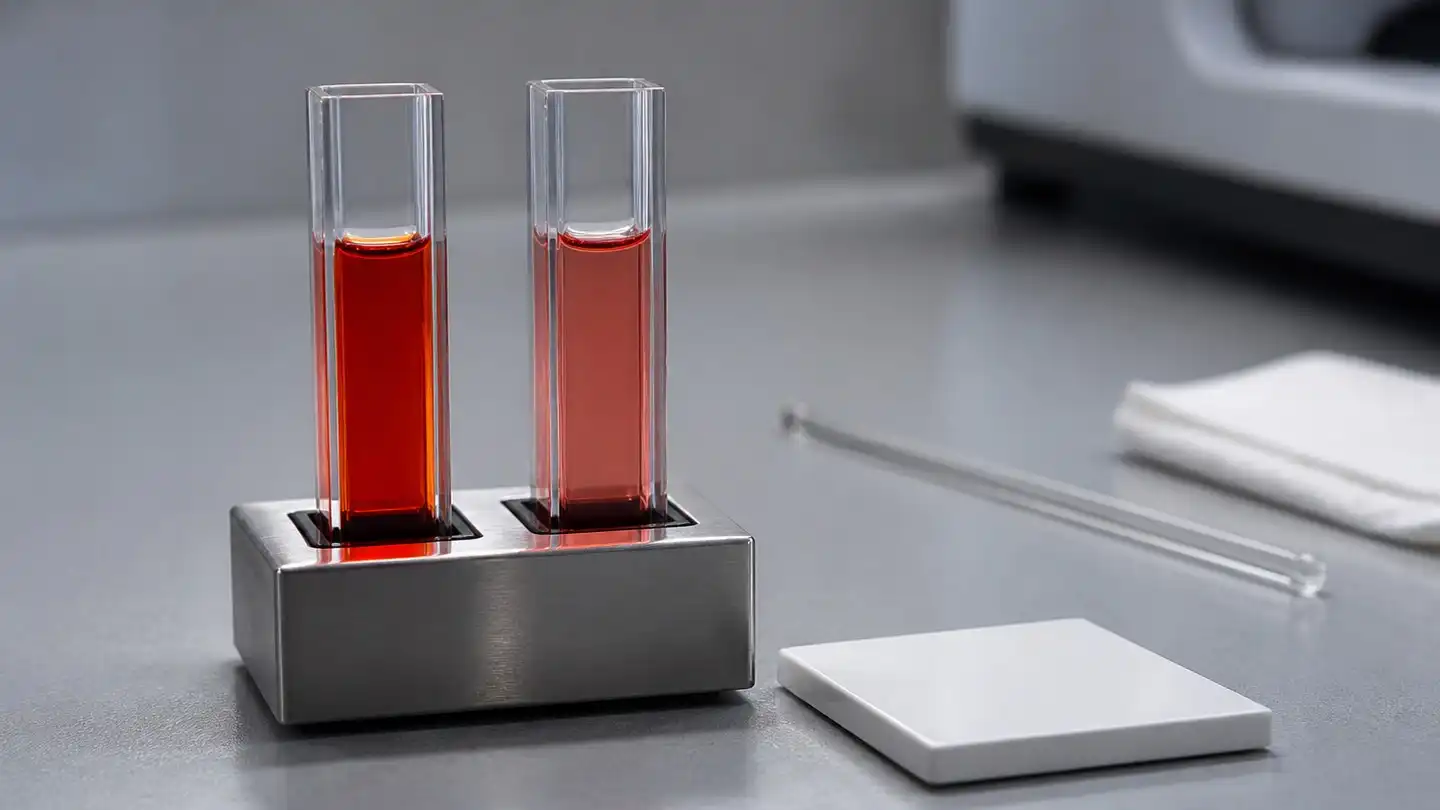
Designing a Forced Oxidation Study for a Beverage
A forced or accelerated study is a designed experiment, not a storage cupboard. Four variables must be fixed in advance and recorded in the trial plan: temperature, light exposure, headspace oxygen and sampling interval. They apply equally whether the test article is a water-dispersible powder or an oil-based preparation — our astaxanthin oil grade is specified in comparable terms and can run as a parallel arm in the same study.
Temperature, and what an acceleration factor is worth
Elevated temperature is the standard lever because most degradation reactions in a beverage follow an Arrhenius dependency. Published kinetic work on a carotenoid-coloured beverage stored at four temperatures between 10 °C and 45 °C reported Arrhenius behaviour with activation energies below 50 kJ/mol and identified oxidative reactions as the dominant pathway. That figure matters: a modest activation energy means a modest acceleration factor, which lets you rank formulations and detect failure modes quickly. It does not license a claim that eleven weeks at 40 °C equals two years at ambient, because the reaction limiting shelf life under acceleration may not be the one limiting it at 20 °C.
Light exposure and headspace oxygen
Light is a separate stress variable, and in the same kinetic study illumination in the low thousands of lux measurably accelerated carotenoid loss relative to dark storage. Retail lighting is intermittent rather than continuous, so an illuminated condition is best reported as a light dose alongside a time, not as a duration alone. Headspace oxygen should be declared rather than assumed: it is the variable most likely to differ between trial and commercial fill, since a laboratory sample closed over air, a pilot fill with nitrogen flushing and a production container with measured headspace are three different experiments.
Sampling intervals and the analytical plan
Sampling should be dense enough early to catch a rate and sparse enough later to catch a plateau. If peroxide value is on the plan, the grid must resolve both its rise and its fall, which usually needs a finer early schedule than retention does. Every interval should be analysed for every indicator in one run, from the same batch and fill configuration, so the readings describe the same moment in the same container.
| Study variable | How to define it in the protocol | Common mistake |
|---|---|---|
| Temperature | At least three levels including one reference condition near the intended storage temperature; record the actual cabinet temperature | Reporting a single elevated condition and quoting one acceleration factor as if it were validated |
| Light exposure | State illuminance and daily on/off cycle, or report cumulative light dose; include a dark control | Leaving samples on a bench and describing them only as "stored at room temperature" |
| Headspace oxygen | Declare fill method (air, nitrogen flush, oxygen scavenger) and, if measurable, headspace oxygen at t = 0 | Assuming laboratory fills match production filling |
| Sampling interval | Dense early grid, tapering grid later; identical analysis package at every point | Uneven sampling that cannot be fitted to a rate model |
| Container | Same container type, same volume, same closure as the commercial pack | Studying glass vials and shipping in PET |
Formulation and Packaging Levers That Move the Measured Number
A stability specification is only useful if the team can act on it. Four levers change the measured outcome most often, and each can be written into the trial plan.
Dispersion form and droplet size
In an emulsified system the interfacial area available to pro-oxidants scales with droplet size. Reducing droplet size raises interfacial area per unit of oil, which published work on oil-in-water emulsions associates with faster lipid oxidation — a finer emulsion can improve mouthfeel and physical stability while making the measured oxidative profile worse. Ingredient form matters for the same reason: a water-dispersible grade, an emulsified oil and a lipid-carrier powder present the carotenoid to the aqueous phase differently and will not give the same retention curve at equal inclusion mass. Co-ingredients of poor aqueous solubility also change how the powder wets out, and therefore how evenly the carotenoid is distributed between containers.
Co-ingredient antioxidants oxidise too
Adding an antioxidant co-ingredient is not automatically protective in a measured trial. Polyphenol-rich botanicals, including bulk green tea extract used as a functional component, are themselves readily oxidised species: their oxidation consumes dissolved oxygen and can generate products that shift colour and flavour. Ascorbic acid behaves similarly, protecting a carotenoid under some conditions and accelerating loss under others depending on metal availability, pH and oxygen supply. Every candidate co-ingredient therefore belongs in the study as an arm of its own, measured with the same indicator panel, rather than assumed to be a net positive.
Chelators, oxygen scavengers and headspace management
Trace transition metals catalyse hydroperoxide decomposition, so a chelating agent changes the rate at which a measured peroxide value climbs. Oxygen scavengers and nitrogen flushing reduce the oxygen available to the reaction rather than the reactivity of the reactants, and their effect shows mainly early in the retention curve. Both act on the same variable — available oxygen — so a matrix already running at low headspace oxygen will show little incremental effect from a scavenger, and a trial that changes both at once cannot attribute the improvement correctly.
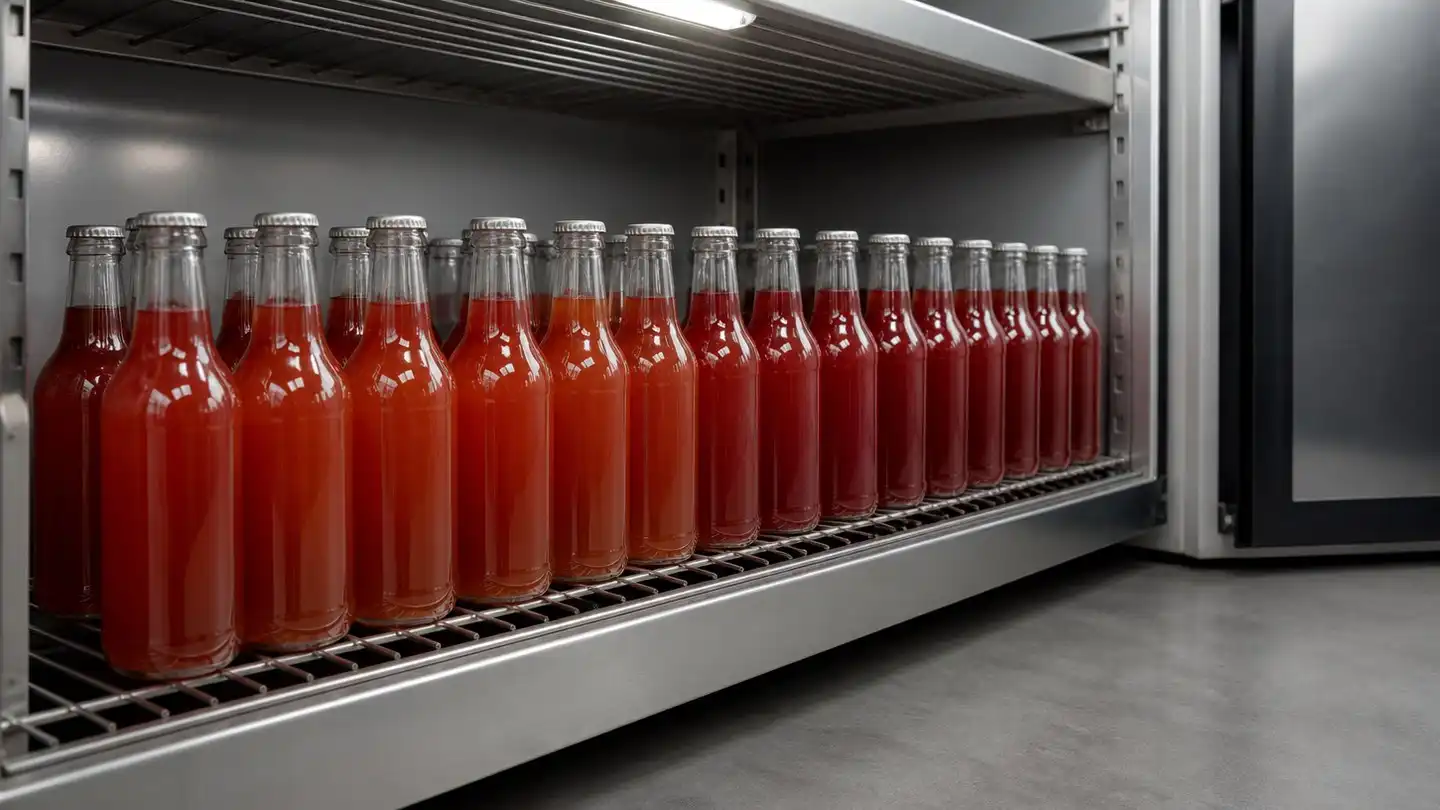
PET, can and the light-barrier question
Container choice sets the physical boundary conditions of the experiment. Clear PET transmits light and a measurable flux of oxygen through wall and closure, making it the harshest common format for a light- and oxygen-sensitive carotenoid. A metal can is opaque and an absolute barrier to both, which makes it the reference case for what the formulation achieves when the package contributes nothing. Between those extremes sit UV-blocking or oxygen-barrier PET, multilayer structures and aluminium-laminate formats. Packaging therefore belongs in the trial design rather than the marketing brief: it is the lever with the largest single effect on measured retention, and the easiest to demonstrate reproducibly.
Writing the Result Into Commercial Documents
The study becomes commercial once it is written into three places, each with a different audience and level of detail.
The stability specification line
A specification line for oxidative stability should state the indicator, the method, the acceptance limit and the test conditions. "Oxidative stability: conforms" is not a specification; it is an opinion. A workable line reads as a method, a matrix, a condition set and a limit — for example, retention of the labelled astaxanthin content not less than a stated percentage after a stated period under a stated temperature and light condition, measured by the named HPLC method, with colour difference reported against the same reference. The limit is a commercial decision; auditability comes from putting the test conditions in the sentence.
The PO and COA item
On the purchase order, the relevant item is the incoming material specification: identity, assay and assay method, specification range, particle size, and the stability data package available on request. On the certificate of analysis, the equivalent item is the assay result obtained by the declared method. Keeping the supplier's assay method aligned with the beverage laboratory's extraction method removes the most common cause of a mismatch that looks like a stability failure but is really an analytical one.
The shelf-life substantiation file
The file should contain the protocol, raw results for every indicator at every interval, batch and fill records, the packaging description, and a short statement of the assumption used to convert the accelerated result into a shelf-life figure, including its limitations. Where accelerated data is the only evidence available, the file should say so and state what real-time confirmation is planned. Regulatory status is separate and jurisdiction-specific: in the United States the permitted use of a colour additive is governed by the listing regulations in 21 CFR Part 73 for colour additives exempt from certification, while in the European Union the framework is Regulation (EC) No 1333/2008 on food additives. Both must be checked against the intended use before a label claim is drafted.
Working With a Supplier on the Measurement Plan
A supplier can only support a stability specification if it holds the data behind it: astaxanthin content and assay method, specification range, particle size, source material and the certificates the product page lists. Ask for the assay method before agreeing the sampling plan, confirm it matches your own extraction method, and request the retention data your conditions require rather than a generic stability statement. To discuss a specification, a sample or a trial plan, contact our team at wgt@allwellcn.com, or review the material specification on our Natural Astaxanthin Powder product page.
This article provides technical and commercial information for industry professionals and is not medical advice; permitted use levels, regulatory status and label claims must be confirmed against the rules of the target market and your own product data.
References
- Evaluation of astaxanthin stability under varying temperatures and ultraviolet irradiation durations based on Raman spectroscopy. Food Chemistry: X, 2024;24:101947. https://doi.org/10.1016/j.fochx.2024.101947 (verified at PMC11582459)
- Smart Method for Carotenoids Characterization in Haematococcus pluvialis Red Phase and Evaluation of Astaxanthin Thermal Stability. Antioxidants, 2020;9(5):422. https://doi.org/10.3390/antiox9050422 (verified at PMC7278830)
- Development and Characterization of Astaxanthin-Containing Whey Protein-Based Nanoparticles. Marine Drugs, 2019;17(11):627. https://doi.org/10.3390/md17110627 (verified at PMC6891650)
- Recent Advances on Nanoparticle based Strategies for Improving Carotenoid Stability and Biological Activity. Antioxidants, 2021;10(5):713. https://doi.org/10.3390/antiox10050713 (verified at PMC8147144)
- Astaxanthin from Shrimp By-Products Enhances Oxidative Stability of Lard During Storage. Foods, 2025;14(15):2585. https://doi.org/10.3390/foods14152585 (verified at PMC12346407)
- Carotenoid degradation kinetics in a carotenoid-coloured beverage stored under dark and illuminated conditions at 10, 20, 35 and 45 °C; Arrhenius temperature dependency with activation energies below 50 kJ/mol. PubMed record PMID 35159635. https://pubmed.ncbi.nlm.nih.gov/35159635/
- United States Code of Federal Regulations, Title 21, Part 73 — Listing of Color Additives Exempt from Certification. https://www.ecfr.gov/current/title-21/chapter-I/subchapter-A/part-73
- Regulation (EC) No 1333/2008 of the European Parliament and of the Council of 16 December 2008 on food additives. https://eur-lex.europa.eu/legal-content/EN/TXT/?uri=CELEX%3A32008R1333