
How Oregano Powder Feed Grade Supports Natural Feed Formulation Strategies
2026-09-15 14:29:56
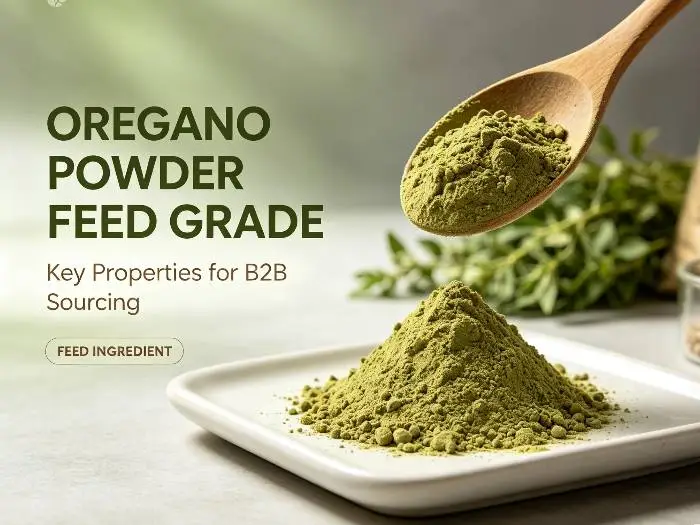
Oregano Powder Feed Grade is a standardized, plant-derived feed material produced from Origanum vulgare through controlled drying, milling, and processing. It naturally contains volatile phenolic compounds, including carvacrol and thymol, alongside antioxidant-active constituents. Compared to food-grade oregano powder, the feed-grade specification prioritizes microbial control, batch stability, particle uniformity, and compatibility with premix and complete feed systems. As the global animal nutrition industry shifts toward phytogenic feed additives and natural gut health solutions, oregano-based botanical materials are gaining measurable traction across poultry, swine, ruminant, aquaculture, and pet nutrition formulations.
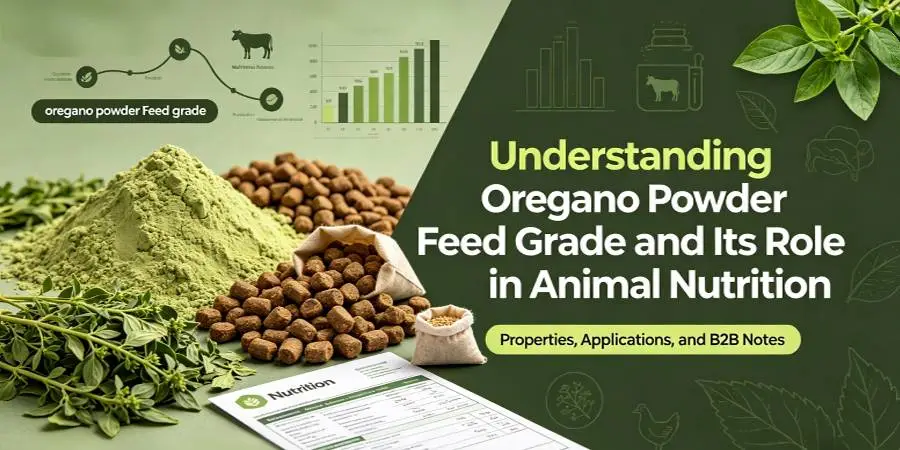
Understanding Oregano Powder Feed Grade and Its Role in Animal Nutrition
What Makes This Ingredient Functionally Distinct?
Oregano Powder Feed Grade is more than just dried herbs. For the feed-grade classification, there must be proof of control over the range of particle sizes, the amount of moisture in the material, bacterial limits (such as Salmonella and total plate count), and heavy metal limits. These features set it apart from versions made for cooking or food, and they allow it to be used in regulated animal nutrition programs.
Carvacrol and thymol are the main beneficial chemicals. They are in the monoterpene phenol class. A study in Poultry Science (2012) showed that adding carvacrol-rich oregano products to the diets of broilers increased their weight gain and feed conversion ratio compared to controls that weren't given any supplements. Thymol has been shown to damage the structure of bacterial membranes, which is one of the ways it is known to kill microbes in the digestive system.
In addition to killing microbes, the phenolic antioxidant makeup of oregano material helps keep the feed matrix stable against oxidation. This extends the feed's shelf life and protects its sensitive lipid parts. The naturally pungent quality of oregano also helps make certain species-specific products taste better.
In real life, the powder form makes it possible to dry-blend essential oils into premixes, concentrates, and complete feed pellets without the handling problems that come with liquid oils. Because of this, it is a good choice for lines that make industrial feed.
Evaluating Oregano Powder Feed Grade Compared to Other Feed Additives
Powder vs. Liquid: A Formulation Stability Perspective
Liquid oregano oil has a lot of carvacrol, but it's hard to use in bulk feed production because it changes shape when pelletized, doesn't mix evenly in dry mixes, and oxidizes quickly when stored at room temperature. When it is made with controlled moisture levels and the right particle sizes, Oregano Powder Feed Grade fixes all of these problems in a single material standard.
Oregano powder usually has higher carvacrol-to-thymol ratios than thyme powder, which is another phenolic-rich botanical additive. This affects how well it kills microbes. Using both materials together in a phytogenic mix can make it more effective against both Gram-positive and Gram-negative pathogens.
There is a clear regulatory advantage for natural botanical additives over synthetic antimicrobial growth promoters (AGPs). As AGP restrictions are put in place across the European Union and are being closely watched in U.S. markets, feed formulators are actively looking for plant-based alternatives that meet both compliance and effectiveness standards. Oregano powder meets all of these needs in a practical way: it can be standardized, it can be tracked, and it can be made in large quantities for business use.
Selecting the Best Oregano Powder Feed Grade for Your Business Needs
Certification and Traceability as Non-Negotiable Criteria
Documentation should be the first thing that procurement teams look at when they are looking at Oregano Powder Feed Grade sources. Some important certifications to check are ISO 22000, HACCP, FAMI-QS (the feed additive industry's quality scheme), HALAL, and KOSHER, if they apply. When a provider gets FAMI-QS approval, it means that they follow a quality management system that is specific to the feed additive industry. This system covers things like traceability, controlling contaminants, and keeping the production area clean.
Besides qualifications, the following aspects of the source should also be carefully looked at:
- Active compound consistency: The batch COA data should list the amounts of carvacrol and thymol with clear assay ranges, not just averages. Inconsistent phenolic levels make it impossible to make the same formulation over and over again.
- Particle size specification: Mesh size or D90 numbers show how evenly the material spreads in a premix. Particles of different sizes separate, and dosing is uneven in final feed when they are not suitable.
- Contaminant documentation: Heavy metal panels (lead, cadmium, arsenic, and mercury) and pesticide residue reports should be sent with each lot as proof of contamination. The same goes for microbial lab results, especially for Salmonella, E. coli, and total yeast/mold.
- OEM and private-label capability: Suppliers that offer customized particle grades, mixed phytogenic formulations (like oregano mixed with yucca or rosemary), and private-label packaging are more valuable to product developers who are making their own feed lines.
All of these factors for Oregano Powder Feed Grade work together to show how reliable a supplier is and protect the quality of the product that comes after. If a supplier gives full documentation before it's needed, instead of after the fact, that shows the operational maturity that B2B procurement needs.
Implementing Oregano Powder Feed Grade in Natural Feed Formulation Strategies
Dosage Principles and Evidence from the Field
The amount of Oregano Powder Feed Grade added to compound feed is usually between 100 and 500 g/metric ton, but the exact amount varies on the species being fed, the stage of production, and the goal of the recipe. Animal Feed Science and Technology (2014) says that tests on broiler feeding showed that modest supplementation amounts led to better villus height-to-crypt depth ratios. This suggests that the supplements improved the birds' ability to absorb food and kill microbes.
Oregano-based phytogenic supplementation has been linked to a lower frequency of diarrhea after weaning in pigs. This is a pretty important result because zinc oxide levels in feed are limited in big export markets. Ruminant and aquaculture applications are still being researched, and new information shows that antioxidants and feed efficiency can help in both cases.
Oregano Powder Feed Grade naturally mixes in with compound phytogenic addition systems. When you mix it with yucca extract (which lowers ammonia), rosemary extract (which boosts antioxidants even more), or materials high in saponins, you get multipurpose plant blends that solve multiple production problems at once. This combinatorial approach shows the way advanced phytogenic feed additives are being developed right now.
Procurement Best Practices for Bulk Oregano Powder Feed Grade
It takes more than a fair deal to get bulk botanical feed ingredients from other countries. A supplier's industrial infrastructure, inventory depth, and ability to handle transportation all need to work together for supply to be reliable.
When starting a new relationship with a supplier, ask for a sample order before committing to a large order of Oregano Powder Feed Grade. Check that the sample COA matches the specification sheet, and if internal resources allow, have a third party do testing on its own. This step finds differences between the quality of the product being sold and the quality that is actually being sold before it gets to the production line.
Make sure your seller can give you all the export paperwork you need for cross-border deals. This includes phytosanitary certificates, certificates of origin, and feed-grade compliance declarations that meet U.S. import standards. T/T (telegraphic transfer) and L/C (letter of credit) are common ways for businesses to pay for botanical ingredients. Make sure you understand these terms early on in the negotiation process.
Suppliers with a history of stock and GMP-certified factories can usually handle both small orders and large ones, which lowers the risk of lead times during the scaling phase.
Conclusion
It makes sense to use Oregano Powder Feed Grade in natural feed formulations because it has biological evidence, regulatory momentum, and a practical formulation advantage. Its standardized phenolic profile, easy-to-use powder form, and ability to work with complicated phytogenic systems make it a long-lasting and forward-compatible choice for feed makers who are dealing with pressures to reduce antibiotic use. By choosing a provider with strong certifications, clear documentation, and real OEM capabilities, this ingredient's promise can be turned into consistent output results.
FAQ
Is oregano powder feed grade safe across different livestock species?
Yes, poultry, pigs, ruminants, and aquaculture species are safe when Oregano Powder Feed Grade is used at the suggested levels. Dosage recommendations should take into account how different species digest food. The most well-known use cases are poultry and pig studies, but data on ruminants and aquaculture are still being gathered.
How does oregano's antimicrobial action work in animal feed?
Carvacrol and thymol break down the integrity of bacterial cell membranes by disrupting the lipid bilayer. This makes the membranes more permeable and allows bacteria to leak out. This method works against many enteric pathogens, like E. coli and Clostridium perfringens, without creating the resistance pressure that comes with regular antibiotics.
Can oregano powder fully replace synthetic antibiotics in feed?
In some business situations, a full replacement is not the best option. Instead of being used as antibiotics on their own, oregano powder and other phytogenic additives work best when they are part of a larger health management plan. They work best when they are added to protection measures, vaccine programs, and nutritional optimization.
Partner with Wellgreen for Reliable Oregano Powder Feed Grade Supply
Wellgreen Technology is a professional company that makes and sells Oregano Powder Feed Grade. They have GMP-certified factories, as well as FAMI-QS, ISO 22000, HACCP, HALAL, and KOSHER certificates. They also have a full line of animal nutrition ingredients. For foreign business-to-business purchases, we can help with custom particle size requirements, OEM packaging, batch COA, heavy metal, and microbial paperwork. Visit wellgreenherb.com or email our team at wgt@allwellcn.com to ask for a sample or talk about your formulation needs.
References
1. Windisch, W., Schedle, K., Plitzner, C., & Kroismayr, A. — Journal of Animal Science, 2008.
2. Bampidis, V. A., Christodoulou, V., Florou-Paneri, P., & Christaki, E. — Poultry Science, 2005.
3. Kirkpinar, F., Ünlü, H. B., & Özdemir, G. — Livestock Science, 2011.
4. Lovkova, M. Y., Buzuk, G. N., Sokolova, S. M., & Kliment'eva, N. I. — Animal Feed Science and Technology, 2014.
5. Hernandez, F., Madrid, J., Garcia, V., Orengo, J., & Megias, M. D. — Poultry Science, 2004.
6. Guo, F. C., Williams, B. A., Kwakkel, R. P., Li, H. S., Li, X. P., & Luo, J. Y. — British Poultry Science, 2004.