
How to Select Organic Barley Grass Powder for Beverage Production
2026-11-17 14:52:00
Barley grass powder looks simple on a purchase order and behaves like a composite material on a beverage line. It brings chlorophyll that shifts colour with heat and pH, fibre that swells and settles, protein that foams, and a grassy note that either reads as fresh or as hay depending on how the crop was dried. Selecting organic barley grass powder for beverage production is therefore a qualification exercise, not a price comparison, and the criteria that matter are the ones the filling line will test for you.
Start From the Beverage, Not From the Powder
The same lot can suit a ready-to-drink green juice and fail in a stick pack. A drink is judged on colour, mouthfeel and how much sediment gathers at the base of the bottle over shelf life. A powdered mix is judged on how fast it wets out in a shaker and whether it cakes in the sachet. The selection criteria follow from that difference, so the brief has to be written before samples are requested.
Three variables decide most of the outcome: the particle size cut, the drying route that produced the powder, and the moisture content it is released at. Ask for all three in writing, and ask for the method used to measure each.
Particle Size Is the First Screening Question
Why a mesh number is not enough
A fine cut disperses faster and settles more slowly, but it also dusts at the filling head and can be harder to wet than a granulated material, because fine particles clump on contact with water before they disperse. A coarser cut wets more predictably and separates visibly in a bottle.
| Declared item | What it predicts on a beverage line | How to verify it |
|---|---|---|
| Sieve cut or mesh size | Wetting speed, dusting, sediment rate in a bottle | Stacked sieve analysis to the declared cut, on the lot offered |
| Bulk and tapped density | Fill weight consistency at a volumetric filler; hopper flow | Both values recorded, not density described as "free flowing" |
| Moisture content | Caking in a sachet, and chlorophyll degradation in storage | Loss on drying, run per lot |
| Appearance and colour | Batch-to-batch visual match; the shade the consumer expects | Colorimeter reading against a retained standard under fixed light |
| Solubility or dispersibility | Residue on the sieve after a fixed wetting test | State the test conditions; a bare percentage is not auditable |
| Microbiological profile | Release criterion for a low-acid beverage | Plate count, yeast and mould, pathogen screen, methods stated |
Two suppliers can both quote "80 mesh" and deliver materially different behaviour, because the top cut, the fines fraction and the drying history all matter. Ask for a distribution rather than a single number, and keep a retained sample of every approved lot.
The Drying Route Explains the Colour
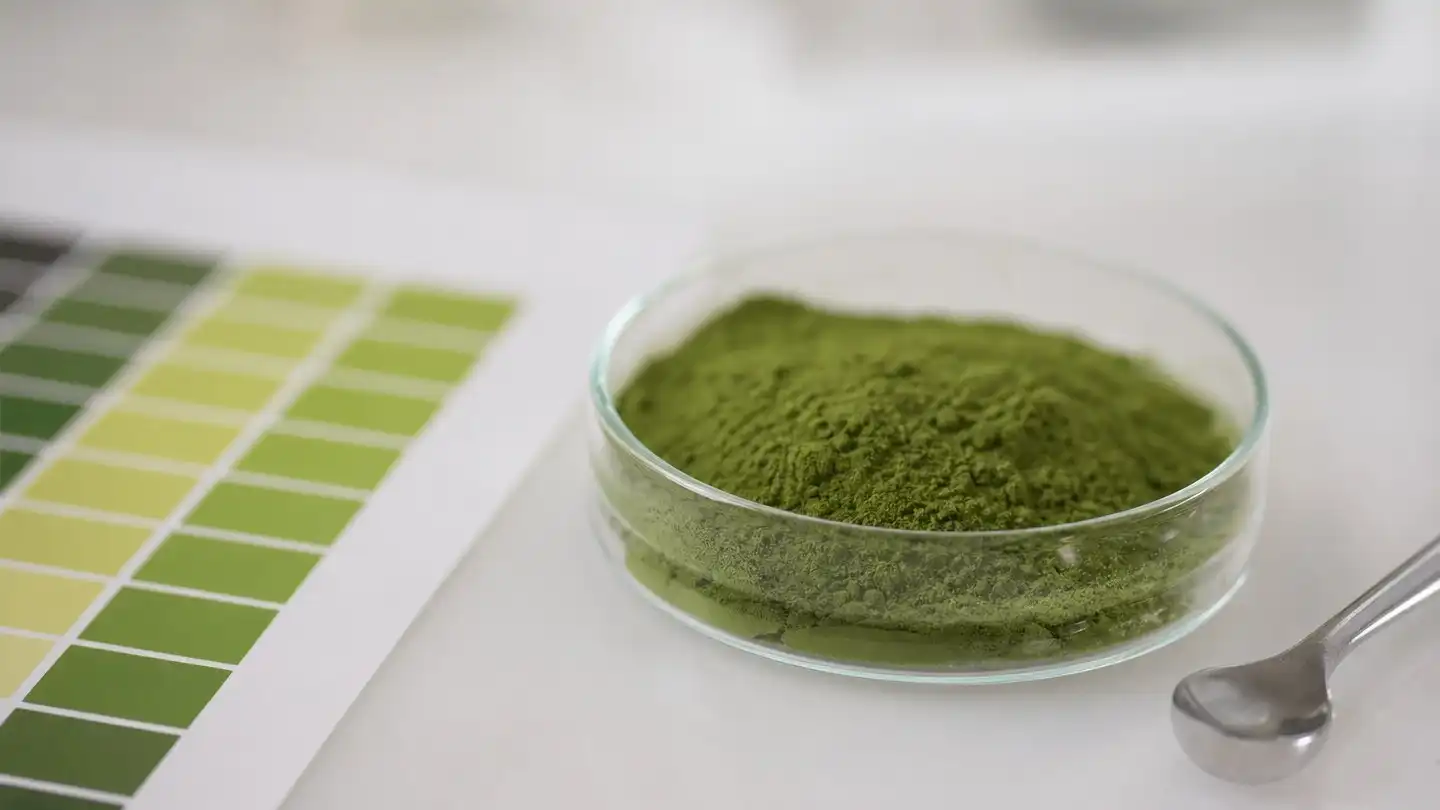
Barley grass is dried to stabilise it, and the route chosen by the supplier shows up in the colour of the powder and in how that colour survives processing. Lower-temperature drying tends to preserve a brighter green and a fresher aroma; a harsher cycle costs less and produces a duller material with more of a cooked note.
This matters commercially because colour is what the consumer sees through a clear bottle. If the product is sold on a vivid green, the drying route is a specification item, not a supplier detail. Ask for a photograph of the powder as supplied, a colorimeter reading, and a small sample of the previous lot for comparison.
Chlorophyll, Heat and pH
What degrades the green
Chlorophyll is the reason the category exists and also the reason colour fades. It is sensitive to heat, to light and to acid, and it degrades into olive-brown pigments as the molecule loses its central metal ion. A beverage that is pasteurised, stored in clear packaging and acidified will lose its green faster than the same beverage in an opaque carton at neutral pH.
None of that can be fixed by the ingredient alone, but the ingredient sets the starting point. Selection work should therefore include a heat challenge: hold a dispersion at the process temperature for the process time, cool, and compare the colour with an unheated control. If the difference is unacceptable, the answer lies in the process or the pack rather than in a different supplier.
Dispersion and Sediment in a Bottle
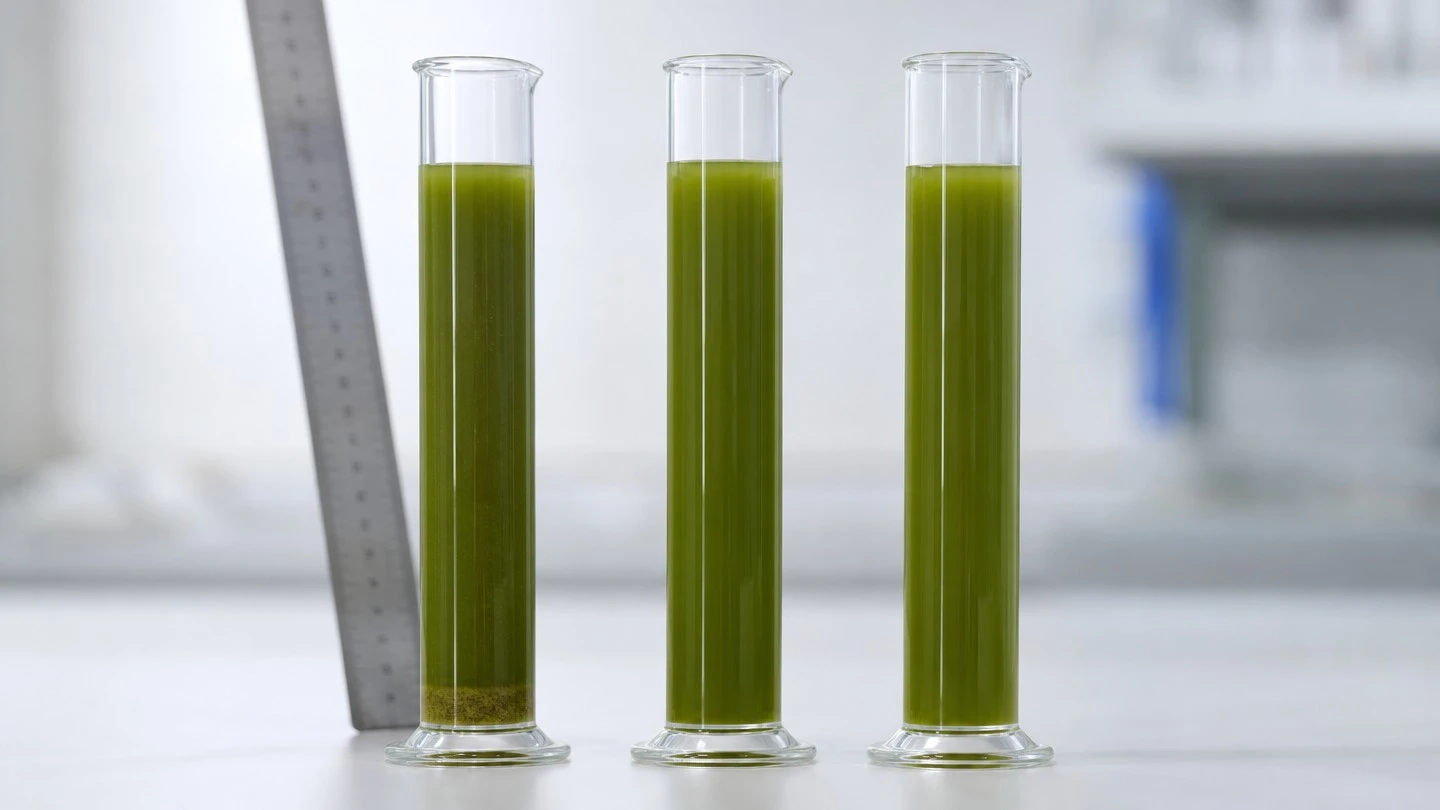
Barley grass does not dissolve. It disperses, and what stays suspended depends on particle size, the viscosity of the continuous phase and the hydrocolloid system around it. Sediment that appears after two weeks is usually a particle size problem the formulator has been trying to solve with thickener.
Run a settled-height test before committing to a supplier. Disperse a fixed dose in the finished base, fill a graduated cylinder, and read the sediment height at one hour, one day and seven days. Photograph the cylinders. Comparing three suppliers this way takes an afternoon and settles a question that a specification sheet cannot. The mechanics of dispersion in powdered beverage systems are described in this note on powder suitability for beverage applications, and they apply to any botanical powder regardless of species.
Flavour Consistency Between Lots
Barley grass carries a grassy, slightly sweet note that becomes hay-like or bitter as the material ages or as the leaf fraction increases. Because the flavour is mild, small shifts are noticed: a drink that tasted fresh in the sample can taste tired in production without any analytical value moving outside its range.
A second variable is the leaf-to-stem ratio of the incoming crop. Stems carry less colour and a more neutral taste, so a lot blended with a higher stem fraction looks paler and tastes flatter without any analytical result moving. Ask how the supplier controls that ratio, and whether the answer is an agronomic programme or a sorting step after drying.
The practical control is a retained reference sample plus a documented sensory check at receipt. Two or three people, a fixed dilution, a fixed vocabulary and a simple five point scale are enough. The result is not science; it is a traceable record that lets a buyer reject a lot with evidence rather than an opinion.
Microbiological and Residue Control
What organic status does and does not change
Leaf material grown close to the ground carries a microbiological load, and organic production removes the option of correcting it chemically. The specification therefore has to combine a realistic limit with a treatment step the supplier can describe, and the buyer has to know which of the two is doing the work.
Pesticide residue testing matters even for organic material, because it verifies that the organic claim is real rather than declared. A multi-residue screen from an accredited laboratory, linked to the lot number, is the document that supports the claim in an audit. The programmes a supplier operates inside are listed on the quality and accreditation page; they establish the framework, and lot data establishes the material.
Organic Documentation at the Right Level
Certificate scope and the transaction certificate
Two documents are needed. The organic certificate shows which operator and which scope are certified; the transaction certificate shows that this consignment came through that scope. A certificate covering the farm but not the drying and milling operation leaves a gap that a retailer audit will find.
Check the scope statement line by line before writing an organic claim onto packaging. Where the powder is processed by a third party, ask who holds the certificate for that step and how the chain of custody is documented between the two operators.
Building a Supplier Scorecard
| Criterion | What to score | Weighting guidance |
|---|---|---|
| Specification completeness | Particle distribution, density, moisture, microbial limits, all with methods | High: incomplete documents predict future disputes |
| Colour and sensory consistency | Retained-standard comparison across three consecutive lots | High for clear-pack products |
| Organic chain | Certificate scope plus transaction certificate per shipment | High where an organic claim is made |
| Dispersion performance | Settled-height test in your own base | Medium to high, depending on format |
| Documentation turnaround | Time to supply COA, allergen statement and residue reports | Medium: a proxy for how deviations will be handled |
| Production capacity and lead time | Ability to hold a grade across campaigns, not one lot | Medium: consistency is worth more than a lower price |
Score each supplier on the same evidence set and keep the evidence. A scorecard that is not backed by lot documents becomes a memory of a conversation, and it will not survive a change of buyer.
A Selection Trial That Fits in One Week
Run the trial on the finished base rather than on water. A green drink with fruit solids, acid and a stabiliser behaves quite differently from plain water, and the supplier that wins in water does not always win in the product.
Three suppliers, one base, five measurements. Disperse each at the same dose in the same base, then record wetting time, sieve residue, colour after the heat challenge, sediment height at day seven and a simple sensory score against the retained reference. Photograph the cylinders and the powder samples on the same day under the same light.
The result is usually decisive. One supplier will be clearly better on colour and one on dispersion, and the choice becomes a question of which attribute the product is sold on. That is a commercial decision the technical data can inform but not make.
Documents to Request Before Approval
- Specification sheet with methods for every declared item
- Lot certificate of analysis for the offered material
- Particle size distribution and bulk density data
- Microbiological limits with sampling plan
- Pesticide residue and heavy metal reports from an accredited laboratory
- Organic certificate with scope, plus transaction certificate per shipment
- Allergen and additive declaration
- Storage statement and shelf life, with the basis for the shelf life claim
The application side — how the powder performs in green blends and finished products — is covered in this note on barley grass in green superfood blends, and the private-label route in this overview of OEM solutions for barley grass products.
Conclusion
Selecting barley grass powder for beverage production comes down to evidence: a particle distribution instead of a mesh claim, a colour reading instead of a description, a transaction certificate instead of an organic logo, and a settled-height test in your own base instead of a promise about solubility. A supplier that can produce all four is a supplier that can be held to a specification.
If you are qualifying a grade for a green beverage or a powdered drink mix, we can send the specification sheet, current lot certificate, residue reports and a sample set at two particle cuts so the dispersion work can be done in your own laboratory. Write to wgt@allwellcn.com with the pack format, the process route and the base composition, and the technical team will respond against those constraints.
References
- International Organization for Standardization. ISO 3310-1 — Test sieves: technical requirements and testing. 2016.
- International Organization for Standardization. ISO 4833-1 — Microbiology of the food chain: colony count at 30 °C. 2013.
- International Organization for Standardization. ISO 21527-1 — Microbiology of food and animal feeding stuffs: enumeration of yeasts and moulds. 2008.
- Codex Alimentarius Commission. General Standard for Contaminants and Toxins in Food and Feed (CXS 193-1995, as amended). FAO/WHO.
- United States Department of Agriculture. National Organic Program, 7 CFR Part 205. Current edition.
- U.S. Food and Drug Administration. 21 CFR Part 101 — Food Labeling. Current edition.
This article is intended for business-to-business ingredient sourcing and formulation discussion. It does not provide medical, nutritional, or regulatory advice for any specific product or market.