
Organic Barley Grass Powder for Green Drink and Smoothie Mixes
2026-11-06 09:35:20
A Green Drink Is a Suspension Problem in Disguise
Most green drink failures are reported as flavour problems and traced back to physics. A sample is called chalky when the powder never wetted out evenly, brown when chlorophyll broke down, inconsistent when half the solids settled before filling. Organic barley grass powder from Wellgreen’s organic barley grass range is a milled leaf material, and the line-critical specification is the one governing dispersion: at least 95% passing 100 mesh.
The trials below are the ones a buyer can run before committing to a container load.
Dissolved, Suspended, Settled: Three States Buyers Conflate
Dissolution is molecular: a solid breaks into molecules or ions, and the result is clear. Suspension is mechanical: particles stay distributed through motion, viscosity or the yield stress of a gel, and the result stays cloudy. Sedimentation is the failure mode of the second state.
The soluble fraction adds taste, not colour
A leaf powder gives up sugars, organic acids and some salts within seconds. That fraction adds acidity and flavour, not body or the visible green.
The dispersed fraction carries the colour
Chloroplast fragments, cell-wall fibre and protein aggregates never dissolve. They are why the drink looks green and what settles, flocculates and fades, so fully soluble is the wrong specification; fast wetting and stable suspension are the right ones.
What 100 Mesh Actually Changes at the Mixer
A 100 mesh cut corresponds to openings near 150 µm in the US sieve series, and 95% through caps the coarse tail at a few percent. That tail matters more than its share suggests: large particles register as grit, and since settling velocity scales with the square of diameter, they lead the sediment.
Halving particle diameter cuts settling velocity by roughly three quarters, which is why formulators reach for finer milling. Finer powder also traps more air, wets more slowly, dusts and cakes harder, so over-milling worsens the mixing problem without solving the separation problem.
Keep a controlled 100 mesh cut and give the continuous phase a yield stress instead: xanthan for shear-thinning body, gellan for a fluid gel that holds particles at rest, propylene glycol alginate where acid stability is needed.
Incoming Specification and Acceptance Checklist
Table 1 maps published product statements to the acceptance items QA should hold on file; where the page is silent, request the declared limit and method.
| Attribute | Published statement | Acceptance item to request | Why it matters in a green drink |
|---|---|---|---|
| Appearance | Green fine powder | Visual against a retained standard; colour read as L*a*b* | Colour carry-through in the finished drink |
| Particle size | ≥95% through 100 mesh | Sieve result per lot, method stated | Wetting speed, grit, settling rate |
| Water content | Not published | Declared limit plus test method | Caking and flow on the filling line |
| Bulk and tapped density | Not published | Measured value, both densities | Sachet fill volume and sinkability |
| Shelf life | 24 months | Production date coding and stability basis | Inventory rotation and export planning |
| Packaging | Aluminium foil bag; fibre drum | Liner type, net weight, seal integrity | Moisture and light barrier in transit |
| Storage | Cool, dry conditions | Agreed warehouse temperature band | Hygroscopic pick-up before use |
| Organic status | EOS / NOP (NOP aligned with the USDA National Organic Program) | Certificate plus scope and transaction documents | Organic claim eligibility in target market |
| Quality systems | ISO 9001:2015; ISO 22000; HACCP | Current certificates with validity dates | Supplier audit and change control |
| Religious compliance | Halal; Kosher | Certificates naming the certifying body | Market and customer eligibility |
| Microbiology | Not published | Limits and methods, e.g. ISO 4833-1, ISO 6579-1, ISO 21527-1 | Ambient-stable drink safety design |
| Contaminants | Not published | Heavy metals and pesticide residue scope on the COA | Alignment with your market specification |
pH, Electrolytes and the Flocculation Problem
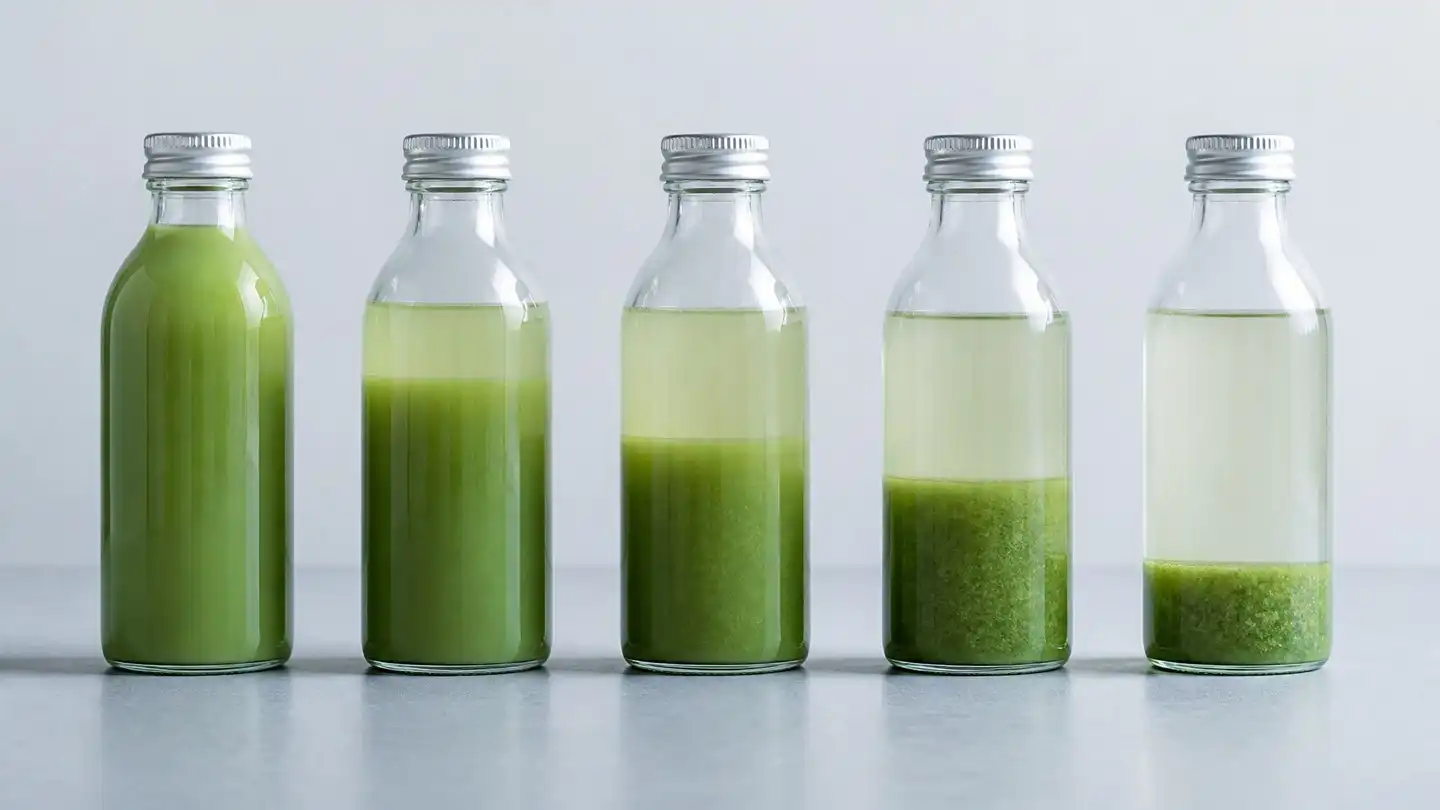
Flocculation precedes sedimentation: particles clump into aggregates that settle far faster than singles, and the drink splits into a pale top layer and a dense green heel.
Charge neutralisation near the isoelectric point
Suspended particles carry a surface charge that keeps them apart. As pH approaches the isoelectric point of the soluble protein fraction, repulsion weakens and particles aggregate, which is why a formula that holds at pH 5.5 can separate at pH 4.0 unchanged. Citrate or malate buffering keeps the system out of that window instead of chasing it with more hydrocolloid.
Divalent cations and polymer incompatibility
Calcium and magnesium salts, common in electrolyte formats, bridge negatively charged polysaccharide surfaces and pull particles into aggregates. The same ions stiffen anionic hydrocolloids unpredictably, so a dose that works in deionised water can over-thicken in a mineral base. Test in the water you will use, and check combined hydrocolloids for thermodynamic incompatibility.
Chlorophyll Colour: Four Fade Pathways
Chlorophyll is a magnesium porphyrin: the colour survives only while the magnesium stays in the ring. Lose it and the molecule becomes pheophytin, which reads olive to brown. Four exposures drive that loss.
Acid acts fastest: below roughly pH 6, pheophytinisation accelerates, which puts pressure on low-pH, fruit-forward formats. Heat is next, and thermal load matters more than peak temperature, so a long pasteurisation can cost more colour than a short hotter step. Light and dissolved oxygen act together over shelf life, and trace metals catalyse the same reactions inside the particle.
Countermeasures are unglamorous: amber or opaque packaging, nitrogen purge to lower dissolved oxygen, a buffered pH outside the fast-fade window, and the shortest thermal process the safety design allows. Read colour as L*a*b* and report ΔE and hue angle rather than judging by eye, because the eye adapts and the instrument does not.
Masking the Grassy Note Without Erasing the Green
The green aroma comes from volatile aldehydes formed when leaf lipids meet oxygen during harvesting and milling — hexanal and its C6 relatives. They read as fresh-cut grass at low concentration and as hay at high, so the first lever is a supplier specification on volatiles, not a flavour house brief.
Citrus top notes are the most efficient mask: limonene and citral sit close enough in odour space to reframe the green note as lime rather than lawn. A modest acid level sharpens that impression and cuts the drying finish. Steviol glycosides with a clean late profile, or erythritol for bulk, avoid the liquorice tail of some high-intensity systems.
There is a direct conflict: the acid and citrus that mask most effectively also accelerate colour fade. The useful experiment is a small factorial — two acid levels, two citrus levels, two sweetener systems — scored for green intensity, grassy intensity and colour after storage. Train the panel on grassy versus green first, or the results will be unreadable.
Hygroscopicity, Caking and Flow on the Line
A 100 mesh leaf powder has a large specific surface and equilibrates quickly with ambient humidity. Moisture gathers at particle contacts, bridges form, and a bag that flowed at reception becomes a block after a humid weekend.
Foil bags with an intact liner, plus a desiccant where climate demands it, are the first control. The second is temperature equalisation: move drums into the production room the day before opening so condensation does not form on cold powder. The third is rotation strict enough that no bag reaches the end of its 24-month window in a warm warehouse.
For feeding, request bulk and tapped density so the filler can be set correctly, and characterise flow with angle of repose or the Hausner ratio. Cohesive fine powders feed most reliably from loss-in-weight screw feeders with a mechanical agitator; vibratory trays tend to rat-hole or flood, which shows up as fill-weight variation on the checkweigher.
Fill Weight, Use Level and Cost per Unit
Use level belongs in the formulation record as a percentage of finished beverage weight, so it survives scale-up. A screening bracket of roughly 0.5–1.5% of beverage mass is a reasonable start for a green drink, to be validated in your own matrix against colour, body and flavour targets.
Cost per unit then follows arithmetic: fill weight in kilograms multiplied by landed cost per kilogram, plus pack, plus conversion and labour. At low fill weights the packaging line dominates, which is why a slightly higher use level with a cheaper carrier can beat a minimal fill in an expensive stick pack. For blends rather than single-ingredient products, the trade-offs between grass powder, other greens and carriers are covered in this guide to using barley grass powder in green superfood blends.
Cold Water Versus Warm Water: A Controlled Comparison
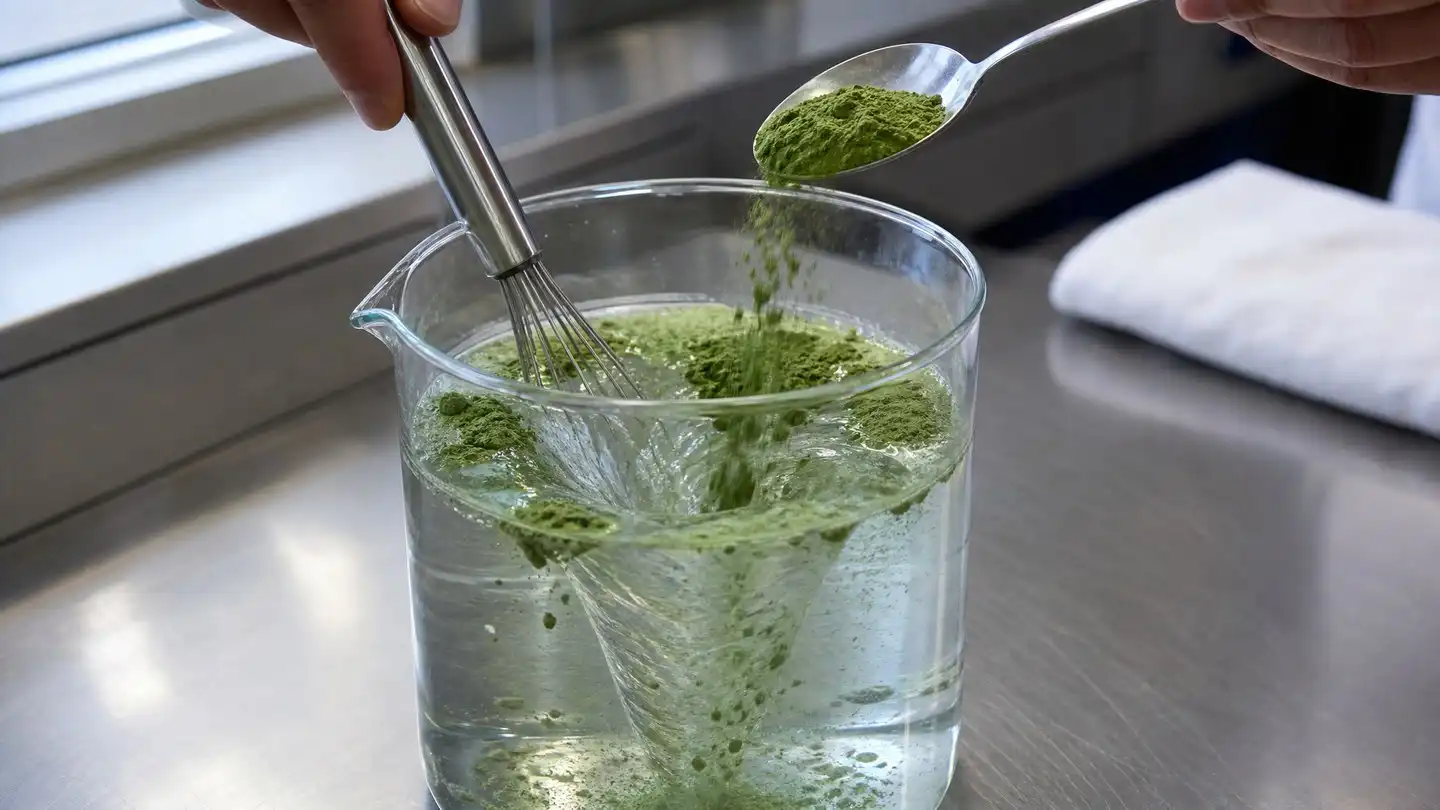
Cold water is the harder test: consumers use tap and chilled water in shaker bottles. Warm water wets faster because viscosity and surface tension fall, but it also drives colour loss and volatilises fresh-green top notes. The comparison in Table 2 quantifies that trade-off.
| Variable | Cold run | Warm run | Reading to record |
|---|---|---|---|
| Water temperature | 5–10 °C | 40–45 °C | Actual temperature at powder addition |
| Powder charge | Same weight, same lot | Same weight, same lot | Weigh to 0.01 g |
| Addition method | Into vortex, 300 mL beaker | Into vortex, 300 mL beaker | Identical pour time and height |
| Shear | Fixed rpm, fixed duration | Fixed rpm, fixed duration | Same impeller and geometry |
| Wetting | Time to full submergence | Time to full submergence | Seconds; note floating rafts |
| Dispersion quality | Lump count after shear | Lump count after shear | Residue on a defined sieve, weighed |
| Colour | L*a*b* at 0 and 60 min | L*a*b* at 0 and 60 min | ΔE and hue angle shift |
| Separation | Sediment at 2 h and 24 h | Sediment at 2 h and 24 h | Height as % of total; photo log |
| Aroma | Covered cup, 40 °C serve | Covered cup, 40 °C serve | Grassy intensity, 5-point scale |
These steps make the comparison executable at bench scale in one morning.
- Condition both water batches overnight and record the reading before use, not the set point.
- Weigh identical charges from one lot into identical beakers; log the lot number.
- Fill each beaker to the same volume and stir at the same rpm, forming a visible vortex without pulling air.
- Add powder at the vortex shoulder over a fixed pour time and start the stopwatch at first contact.
- Record wetting time, shear for a fixed period, then stop; do not extend shear to rescue a poor result.
- Pour through a pre-weighed sieve, rinse the beaker into it, dry and weigh the residue.
- Split each dispersion: one part for immediate L*a*b*, one held at 4 °C and 25 °C for 2 h and 24 h sediment.
- Repeat on a second day and report the pair, not the better run.
Read the output as a cost curve: if warm water halves wetting time but shifts hue angle visibly within the hour, the warm route needs opaque packaging and a shorter hold, and the cold route needs a dispersing aid.
Designing a Suspension Stability Trial for RTD Systems
Once a bench dispersion holds, the question is whether it survives thermal processing and shelf life. Table 3 is a compact screening design for a ready-to-drink base.
| Factor | Level 1 | Level 2 | Level 3 | Measure | Pass criterion |
|---|---|---|---|---|---|
| Hydrocolloid system | Xanthan alone | Gellan fluid gel | Xanthan plus PGA | Sediment height at 4 °C and 25 °C | No visible heel at 4 weeks |
| Homogenisation | Low shear only | Single stage | Two stage | Particle size distribution; haze | No agglomerates above 100 mesh |
| pH set point | Near neutral | Mid range | Acidified | ΔE, hue angle, charge behaviour | Colour drift within agreed tolerance |
| Electrolyte load | Deionised base | Low mineral | High mineral | Viscosity, floc size, sediment | No floc visible at 40× |
| Dissolved oxygen | Unaerated | Nitrogen purge | Purge plus deaeration | ΔE over 4 weeks | Purge runs fade measurably slower |
| Thermal load | High-temperature short time | Tunnel pasteurisation | Retort | Hue angle, viscosity, sediment | Colour and body retained |
| Storage condition | 4 °C | 25 °C dark | Light box at 25 °C | Weekly photo log, L*a*b* | Light runs isolate photo-fade |
A control with no hydrocolloid separates the stabiliser effect from lot variation, which is what scale-up exposes. One sealed, dark-stored sample per lot gives a reference when a complaint arrives six months later.
From Bench to Production: Parameters Worth Locking
Bench success rarely transfers unchanged: production adds volume, residence time and a metal system that can strip the dispersed phase. These points belong in the batch record, validated on your own equipment.
- Powder induction. A tank eductor or in-line high-shear head wets powder under vacuum and avoids the floating raft that forms on a still surface.
- Hydration hold. Hydrocolloids need time at temperature to reach full viscosity; filling earlier produces sediment that appears in the warehouse, not the pilot kitchen.
- Filtration. Never pass a green drink through a 100 mesh screen downstream of powder addition; you will filter out the ingredient and call it a clarity improvement.
- Deaeration. Dissolved and entrained oxygen both attack colour and foam the filler; vacuum deaeration after hydration addresses both.
Buyers moving from trial order to programme, including private label, can review the OEM route in this overview of OEM solutions for organic barley grass powder products.
Documentation and Supplier Qualification
For a natural leaf powder, the certificate pack is part of the specification: current documents with dates and scopes, not a marketing list: the specification sheet, a COA per lot, organic certificates under EOS and NOP scope, ISO 9001:2015 and ISO 22000 certificates, HACCP documentation, and Halal and Kosher certificates.
Read the scope line rather than the logo: a certificate for a trading operation is not the same document as one for the processing site, and the difference surfaces in an audit. A COA result without method and limit is an observation, not an acceptance decision. Wellgreen’s quality accreditation documentation can be reviewed against your own questionnaire before an approval visit.
Consistency is the other half of qualification. Ask how a lot is released, what the retained sample policy is, and how a specification change is notified; the answers should still hold on the tenth container.
Conclusion
Dispersion, not positioning, is where a green drink formula succeeds or fails. Keep the 100 mesh cut, give the continuous phase a yield stress, keep pH off the isoelectric window, and protect chlorophyll from acid, heat, light and oxygen as carefully as you protect flavour.
Run the cold-versus-warm comparison and the suspension matrix before scaling, and you will know a powder lot better than any brochure allows. Where a project needs formulation support or private label manufacture, the OEM and ODM development service page sets out how that engagement is structured.
To move to sample, request the specification sheet, a lot-specific COA and a 100 mesh organic barley grass sample from the organic barley grass powder product page, or write to wgt@allwellcn.com with your target format, pH range and process conditions so the dispersion questions are answered against your matrix.
References
- U.S. Food and Drug Administration. 21 CFR Part 182 — Substances Generally Recognized as Safe. 2025.
- U.S. Food and Drug Administration. 21 CFR Part 184 — Direct Food Substances Affirmed as Generally Recognized as Safe. 2025.
- International Organization for Standardization. ISO 4833-1 — Microbiology of the food chain: horizontal method for the enumeration of microorganisms, colony count at 30 °C. 2013.
- International Organization for Standardization. ISO 6579-1 — Microbiology of the food chain: horizontal method for the detection of Salmonella spp. 2017.
- International Organization for Standardization. ISO 21527-1 — Microbiology of food and animal feeding stuffs: enumeration of yeasts and moulds, colony count technique in products with water activity greater than 0.95. 2008.
This article is intended for business-to-business ingredient sourcing and formulation discussion. It does not provide medical, nutritional, or regulatory advice for any specific product or market.