
Organic Shiitake Mushroom Powder for Plant-Based Soup Mixes
2026-11-05 18:17:46
Soup mixes are formulated on paper as a dry blend, but they are judged in a bowl of hot water. Two minutes after the water goes in, the consumer sees whether the powder wetted out cleanly or floated in dry islands, and tastes whether the savoury note arrived evenly or in a bitter spike. Reading organic shiitake mushroom powder as a disperse-phase ingredient — with a particle size distribution, a wetting behaviour and a settling tendency — is more useful to a formulation team than reading it as one flavour line on a cost sheet. This article covers what the specification measures, how the powder behaves at rehydration, and how to trial it.
The Specification Defines Behaviour, Not Just Purity
Buyers read a certificate of analysis as a compliance document; formulators should read it as a set of physical predictions. Solubility sets how much powder enters the continuous phase, the sieve cut sets how fast water reaches each particle, and the storage statement predicts hopper behaviour.
The table below maps each declared item to the line behaviour it governs. Values are those published on the product page, to be confirmed lot by lot against the COA.
| Declared item | Declared value | What it governs on the line | Receipt check |
|---|---|---|---|
| Appearance | Fine brown powder | Visual match in dry blend; colour carry-through in broth | Visual against retained standard; colorimeter L*a*b* |
| Solubility | ≥95% | Share of solids entering the continuous phase; sediment load | Disperse, centrifuge, gravimetric residue |
| Particle size | 95% passing 80 mesh | Wetting rate, dusting, segregation risk in dry blend | Sieve analysis on a stacked shaker |
| Heavy metals | ≤10 ppm total; Pb ≤1, As ≤2, Hg ≤1, Cd ≤0.1 ppm | Market eligibility of the finished mix | Third-party ICP-MS report per lot |
| Total plate count | ≤1,000 cfu/g | Hygiene of the dry handling chain | ISO 4833-1 plate count |
| Yeast and mould | ≤100 cfu/g | Off-note development in stored mix | ISO 21527-1 |
| E. coli / Salmonella | Not detected | Release criterion for most retail soup programmes | ISO 6579-1 for Salmonella |
| Shelf life and storage | 24 months; cool, dry | Blend dating and warehouse layout | Retained samples at 6, 12 and 24 months |
| Certification | EOS/NOP organic; ISO 9001:2015; ISO 22000; Halal; Kosher; HACCP | Documentation package for retailer and export audits | Certificate validity dates |
| Marker assay | Polysaccharide by HPLC, declared per lot | Batch-to-batch identity of the raw material | Chromatogram, not a summary line |
Two rows do most of the formulation work: solubility sets the ceiling on suspended solids, and the sieve cut sets the floor on wetting speed.
Particle Size Is the First Control Lever
What the 80-mesh cut actually sets
An 80-mesh sieve passes particles up to roughly 180 µm, so 95% of a compliant lot sits below that threshold. Rehydration is surface-driven: water wets the outside of a particle, softens it, then diffuses inward. Halving diameter roughly quadruples exposed surface per unit mass, which is why a finer cut hydrates faster but also dusts more, floats longer and lifts turbidity.
Coarser material settles and leaves specks; finer material disperses well but clouds the broth. The 95% passing 80 mesh is a window, not a point, and the retained fraction matters as much as the passing one.
Fines, coarse fractions and segregation
Dry blends separate by size and density whenever they are poured, conveyed or vibrated. A mostly fine powder migrates downward through a coarse salt or starch bed during filling, so the first sachets from a hopper run richer than the last. Trending the size distribution of incoming lots anticipates that drift before it becomes a complaint.
Wetting, Sinking and the Clump That Forms in the First Second
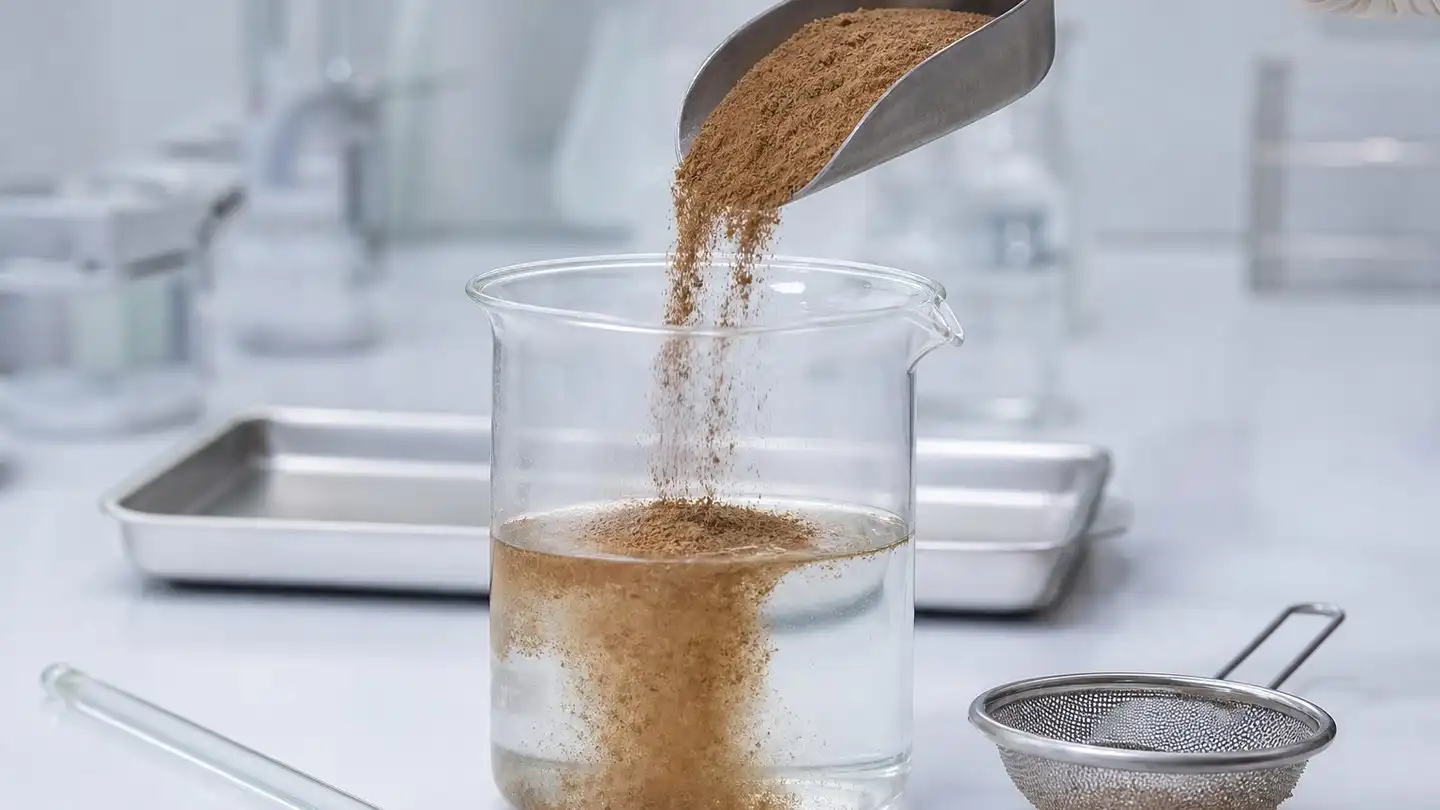
Most rehydration failures happen in the first second. A particle that lands without sinking stays dry inside a bubble of air, and its surface hydrates into a gel skin that slows further ingress. The result is a lump with a dry core that survives stirring.
This is surface chemistry rather than mushroom chemistry. Fine particles carry high surface energy and cluster at the air–water interface, and the surface-active components behind the savoury profile make the powder slightly hydrophobic at first contact. The countermeasures are mechanical: high-shear pre-dispersion, a two-stage addition in cold water first, or dry dilution with salt.
Solubility, Turbidity and Sediment
The declared ≥95% solubility describes the fraction passing into the continuous phase under a defined test. The remainder is cell-wall solids — fibre, chitin-associated material, insoluble protein — and that is the fraction which settles. A broth at 2% loading will carry a visible sediment layer on standing, which is normal for a whole-food powder and should be designed into the product rather than argued with.
Three levers exist. Raising the loading lifts colour and sediment in proportion; reducing particle size keeps solids suspended but raises turbidity; a small xanthan or pre-gelatinised starch addition holds solids in suspension and stabilises body, at the cost of a thicker mouthfeel. A clear broth needs a clarified ingredient, not a whole-body powder.
Teams still deciding between a culinary powder and a clarified ingredient should read up on what organic shiitake powder is and how it is milled before fixing a turbidity target, because the milling route largely determines what the powder can do in water.
Colour Consistency Across Batches
Soup is judged with the eyes first, and a cream soup that shifts from tan to grey-brown between lots reads as a failure even when flavour is identical. Colour comes from native pigments and from non-enzymatic browning during drying, so it is a process fingerprint. A finer grind scatters more light, so the control is a colorimeter reading on a standardised slurry, trended lot by lot.
Umami Contribution: Nucleotides and Glutamate Working Together
Shiitake carries two savoury systems at once: free L-glutamate, and 5′-nucleotides — principally guanylate — which amplify glutamate perception through a well-described synergy at the taste receptor. That is why the powder rounds out a vegetable stock at a fraction of the glutamate-only loading, and can replace part of a yeast extract in a clean-label brief.
The engineering consequence is that umami is not linear with dose. Below a threshold the powder reads as background body; slightly above it the savoury note jumps and can swamp delicate aromatics such as leek or carrot. That is why the trial below uses three levels rather than one screening point. Wider applications are reviewed in this guide to shiitake powder uses in the food industry.
Compatibility with Starches and Plant Proteins
Starch systems
In a base thickened with native or modified starch, powder and starch compete for the same water. Powder added to a cold slurry before gelatinisation hydrates evenly; powder added to a gelatinised base at 90 °C sits on the surface and lumps. Pre-slurrying, or a cold-swelling starch, removes most of this.
Plant protein systems
Pea, soy and faba isolates bring their own buffering and their own tendency to foam. Shiitake powder at culinary levels does not destabilise a protein-stabilised emulsion, but it adds insoluble solids that can nucleate foam collapse under shear. In a cream-style soup, adding it after the protein is hydrated and before the final homogenisation pass gives more uniform colour and fewer specks.
Salt, Acid and Heat: Where the Savoury Note Is Lost
Salt is friendly. It lowers water activity, improves dispersion by competing for water at the particle surface, and masks the slight bitterness a high loading can show. Acid is not: nucleotides are acid-labile, so a broth held below pH 4 loses savoury intensity faster, and a tomato soup needs a higher loading than a cream soup.
Heat is a time-and-temperature problem, not a threshold. A short pasteurisation or retort cycle at neutral pH costs less savoury character than a long simmer, and the loss sits largely in the nucleotide fraction. For retorted products, holding back part of the powder until after the heat load protects that fraction while the bulk supplies body and colour.
Moisture Pick-Up, Caking and Blend Homogeneity
Dried fungal powder is hygroscopic, and a soup mix combines ingredients with very different sorption isotherms. Salt pulls moisture strongly, starch holds it, and the powder turns sticky at the surface before it is wet through — which is how a free-flowing blend becomes a brick in a humid climate.
Two controls matter. Measure water activity on the equilibrated blend, not on individual components, because a blend drifts upward as salt and powder exchange moisture. Then match packaging to the market: aluminium-foil laminate with a low moisture vapour transmission rate, plus a desiccant where required. Adding the powder last cuts dust, and a short high-intensity mix breaks soft agglomerates better than a long gentle one.
Homogeneity needs a number. Sample the blender at three positions and two depths, assay the marker or read colour, and calculate the coefficient of variation; a blend that looks uniform can still carry a wide spread in the marker.
Powder or Extract: Choosing the Disperse Phase
A powdered fruiting body and a standardized shiitake extract solve different problems. The extract concentrates the marker, disperses readily because it is largely soluble, and contributes little colour or body. The powder carries the full culinary profile — colour, sediment, savoury depth, the mouthfeel of a real stock — at a loading measured in percent.
Soup usually calls for the powder, because it is a high-water, high-volume system where colour and body are part of the product. The extract belongs where the sensory target is neutral and the dose is small; blending both is a legitimate third route.
Cost per Portion, Not Cost per Kilogram
Price per kilogram is the wrong unit for a soup mix, because the powder is used at a few percent and the portion is a few grams. The number that matters is cost per prepared serving:
Cost per portion = (dose in g ÷ 1,000) × landed price per kg × (1 + process overage)
Run that with your own quoted price and dose. A 20% price difference moves cost per portion by the same 20%, while a half-point change in dose moves it further. Work that trims dose through better dispersion usually returns more than a price negotiation.
A Three-Level Dosing Trial You Can Run in a Pilot Kitchen
The design below answers three questions at once: at what dose the savoury note becomes perceptible, at what dose the broth becomes visually acceptable, and whether the powder disperses unaided. Three levels are the minimum that reveals a curve rather than a point.
| Trial factor | Level A | Level B | Level C | Recorded response |
|---|---|---|---|---|
| Powder dose (% of dry mix) | Low | Mid | High | Perceived savoury intensity (panel score) |
| Water temperature at addition | 70 °C | 85 °C | 95 °C | Time to full wet-out (s) |
| Agitation | None (standing) | Manual, 10 s | Overhead stirrer, 300 rpm | Lump count after 2 min |
| Observation window | 0, 2, 5 and 15 min after addition | Sediment height; turbidity; colour L*a*b* | ||
| Replication | Triplicate per cell, randomised order | Coefficient of variation | ||
Run it in this order so the data stays interpretable:
- Fix the base. Use one starch, one salt level and one protein source across all cells, from a single master batch, so only the powder variable changes.
- Prepare three dry pre-blends at the low, mid and high dose, each dry-diluted with the salt fraction so the powder enters the water as separated particles.
- Weigh identical water charges into identical vessels and bring them to temperature on one hotplate, so the only difference between cells is the addition step.
- Add the pre-blend at a fixed rate over a fixed time, start the timer at first contact, and note when the last dry island disappears. That number is your wetting time.
- Hold each sample undisturbed for 15 minutes, photograph against a grey card, score sediment height, and read colour and turbidity on the cleared upper layer.
- Repeat every cell three times in randomised order and taste blind, scoring savoury intensity, bitterness and any raw-mushroom note.
- Plot savoury score against dose. Where the curve steepens is your minimum effective level; where bitterness or colour turns objectionable is the ceiling. Choose inside that band, then confirm in the finished mix with the real starch and protein system.
A trial of this kind takes a day and yields the two numbers a specification sheet cannot: wetting time in your water, and the dose at which the panel stops tasting mushroom and starts tasting savoury.
What Good Looks Like on the Line
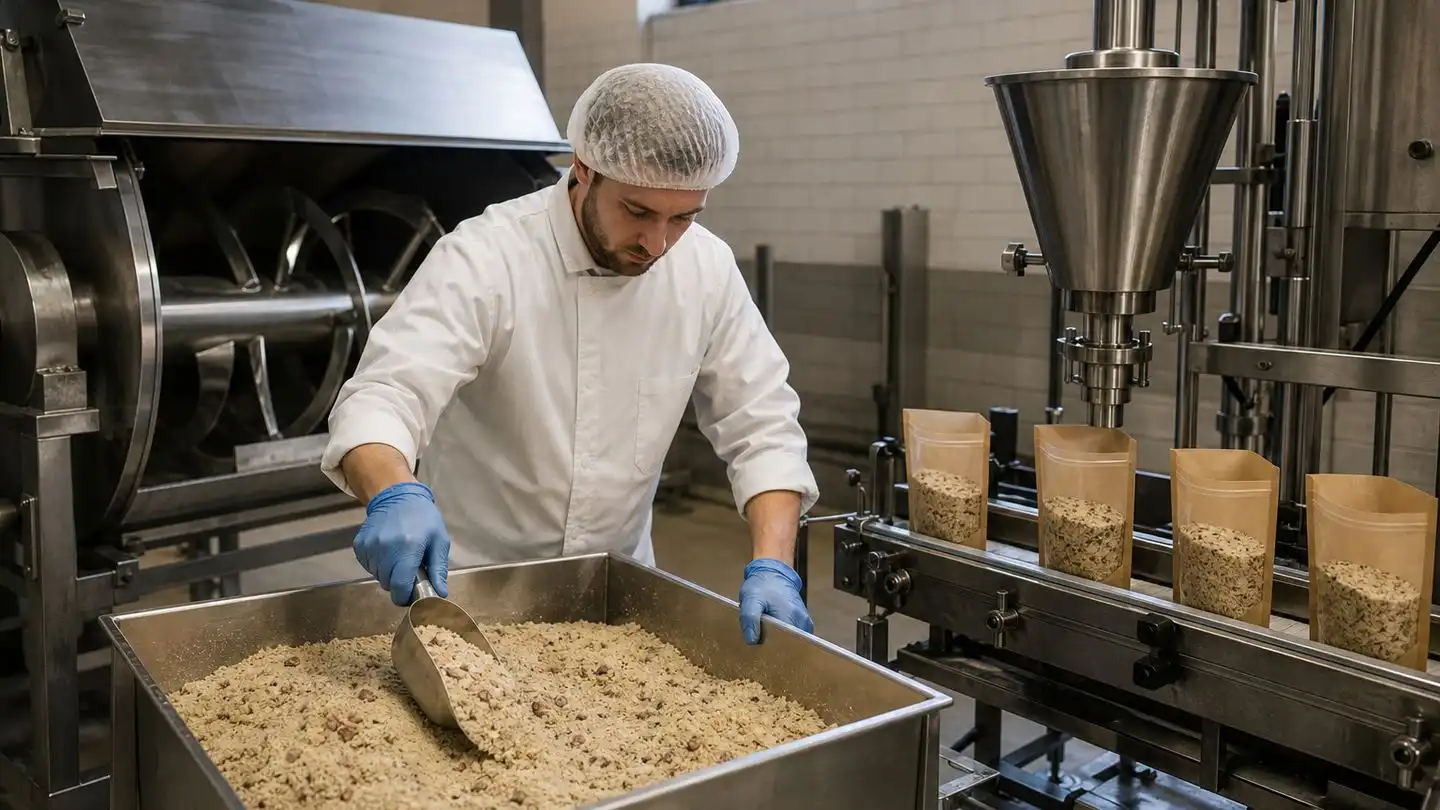
Once the dose is fixed, scale-up is mostly about keeping the measured behaviour from changing. Keep the powder out of the final mixing stage if the blender generates heat, charge it after salt and starch, and verify sieve and hopper seals, because a fine hygroscopic powder finds every gap.
Documentation closes the loop. Certificates, COAs and audit records are what a retailer's technical team asks for, and Wellgreen's quality accreditation overview sets out the framework behind the documents supplied with each lot.
Next Step: Specification, Sample and a Trial Run
If you are building or revising a plant-based soup mix, Wellgreen can supply the specification sheet for this organic shiitake mushroom powder, a lot-specific COA including the HPLC polysaccharide result, and a sample for your own bench trial. We can also discuss dispersion behaviour in your starch and protein system and review the dose levels you plan to test. Write to wgt@allwellcn.com with your application and pack size.
References
U.S. Food and Drug Administration. 21 CFR Part 182 — Substances Generally Recognized as Safe. 2024.
U.S. Food and Drug Administration. 21 CFR Part 184 — Direct Food Substances Affirmed as Generally Recognized as Safe. 2024.
International Organization for Standardization. ISO 4833-1 — Microbiology of the food chain: horizontal method for the enumeration of microorganisms, colony count at 30 °C. 2013.
International Organization for Standardization. ISO 6579-1 — Microbiology of the food chain: horizontal method for the detection of Salmonella spp. 2017.
International Organization for Standardization. ISO 21527-1 — Microbiology of food and animal feeding stuffs: horizontal method for the enumeration of yeasts and moulds. 2008.
Codex Alimentarius Commission. Guidelines on Nutrition Labelling (CXG 2-1985, as revised). FAO/WHO. 2021.
This article is intended for business-to-business ingredient sourcing and formulation discussion. It does not provide medical, nutritional, or regulatory advice for any specific product or market.