
Organic Shiitake Mushroom Powder for Seasonings and Savory Snacks
2026-11-19 14:00:00
Seasoning is the most cost-sensitive place to put an expensive ingredient and the most visible place when it goes wrong. A savoury snack coating is judged in the first three seconds, before any claim on the pack is read, and a dry rub is judged by whether the powder sits on the surface or falls to the bottom of the bag. Using organic shiitake mushroom powder in these formats is therefore a question of adhesion, particle size and flavour carry-through, not simply of adding an umami line to a blend.
Why Mushroom Powder Belongs in a Savoury Blend
Dried shiitake carries a savoury character that comes from its own nitrogenous compounds and from the nucleotides that develop during drying. In a seasoning blend it contributes depth rather than a distinct mushroom identity at low dose, and a recognisable mushroom note at higher dose. That range of behaviour is what makes it useful and what makes the dosing decision consequential.
It also carries a declaration consequence. Where the powder is used for flavour it is an ingredient on the label; where a concentrated extract is used it may be declared differently depending on the market. Deciding which of the two the product needs comes before the supplier conversation.
Particle Size Decides Whether the Powder Stays on the Snack
Seasoning adhesion is a physical problem. A fine powder with a large surface area and low mass is easy to dust and easy to lose; a coarser powder sits on the surface but can feel gritty. In a coated snack the seasoning is usually applied to a surface that has been wetted with oil, and the particle has to be caught by that film before it falls away.
Adhesion and dusting
Fines below the sieving cut behave differently from the bulk of the powder: they adhere to the oil film readily but also become airborne at the seasoning drum. A supplier who can deliver a cut with the fines fraction controlled gives a plant a more predictable coating weight per kilogram of snack.
Sedimentation in a dry blend
In a shaker or a sachet, a fine mushroom powder in a blend dominated by coarse salt crystals will separate during transport. The top of the pack becomes mushroom-heavy and the bottom salt-heavy. Matching the sieve cut of the mushroom powder to the salt grade is the simplest control, and it is a specification item rather than a formulation insight.
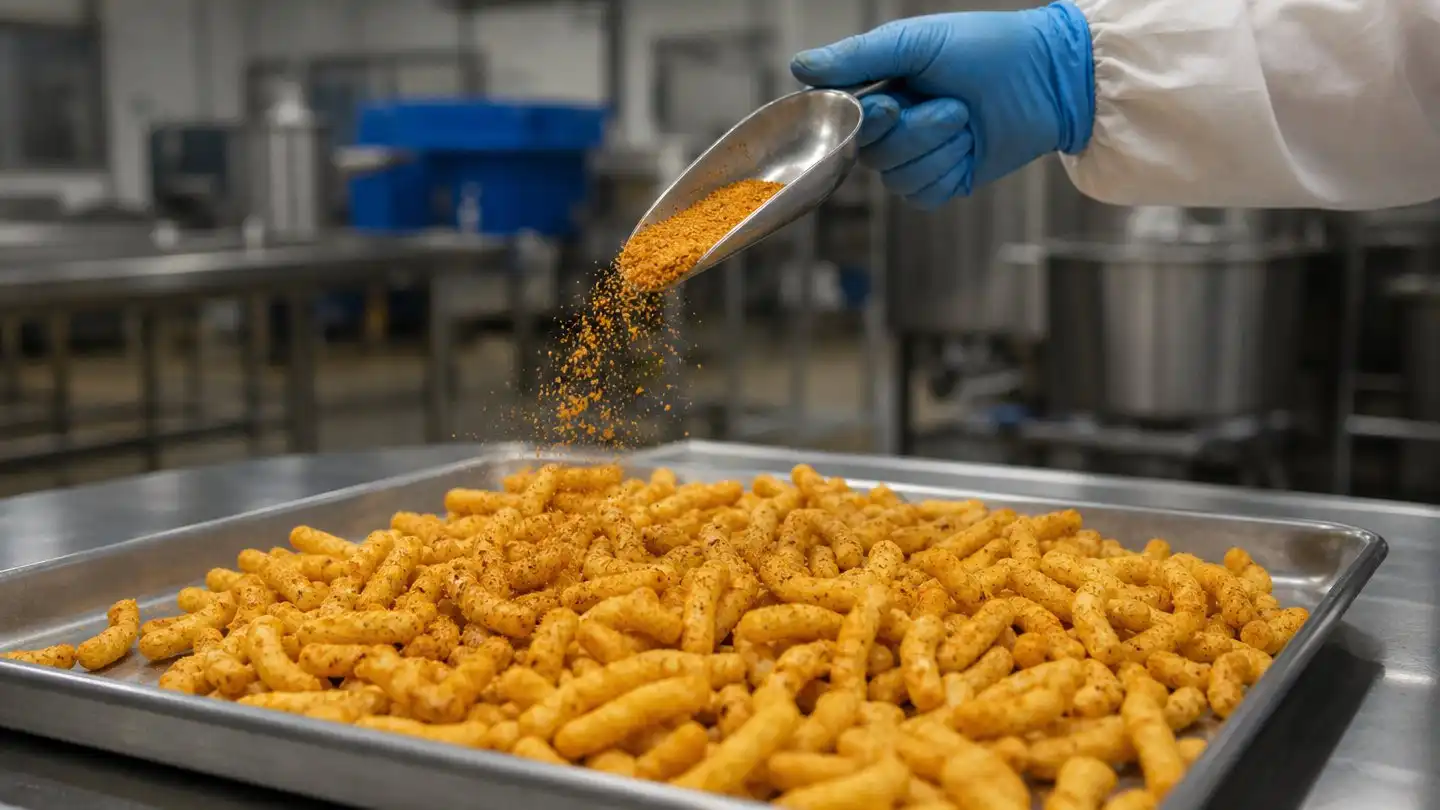
There is a second reason particle size matters: it changes the amount of seasoning that actually reaches the consumer. A plant sets a coating weight and checks it by weighing, but the fraction that adheres is a function of the surface oil, the powder's mass and the time in the drum. Two blends applied at the same nominal rate can deliver different flavour intensities, and the difference is recorded as a coating weight, not as a flavour result.
Salt, Moisture and Caking in the Sachet
Salt is hygroscopic and a mushroom powder is not inert. In a sachet the two exchange moisture at the interface, and a powder that was free flowing at packing can be a brick after a humid summer. The moisture limit on the certificate therefore has to be read against the pack format, not against a drum.
Two controls help. A moisture limit agreed for the specific format, and a packaging specification that states the moisture vapour transmission rate of the film. Where a product is sold in a paper-based sachet, the film is doing less work than the buyer assumes.
Flavour Carry-Through in Hot Processes
Frying and roasting
Top notes are volatile and a frying line removes them. A mushroom powder applied before frying contributes depth but loses aroma; applied after frying it retains more but adheres less reliably. The compromise is usually a split addition, with part of the dose in the base and part in the topical seasoning.
Extrusion
In an extruded snack the powder passes through a barrel at temperature and pressure, which is a much harsher environment than a coating drum. Volatiles are lost and colour darkens. Where the brief requires a recognisable mushroom note, the economically sensible route is usually a light addition in the base for depth plus a topical application for the aroma, and the supplier should be told both doses when the grade is specified.
Choosing Between Powder and Extract
This is the first specification decision, and it is often made by price. The comparison is only fair when both are compared at equal flavour contribution in the finished product.
| Attribute | Dried mushroom powder | Concentrated extract |
|---|---|---|
| Flavour identity | Whole-mushroom character, including the earthy and fibrous notes | Concentrated savoury note with less of the fibrous background |
| Dose needed in a blend | Higher, because the material is closer to the dried mushroom | Lower per unit of flavour contribution |
| Carrier and bulk | No carrier; contributes body to the blend | Usually carried on a diluent, which must be declared |
| Colour contribution | Visible brown tone in the blend and on the snack | Darker and more concentrated per gram |
| Labelling | Declared as mushroom powder, straightforward | Declaration depends on carrier and market rules |
| Cost per kilogram | Lower | Higher |
| Cost per unit of flavour | Can be competitive in a blend where bulk is wanted | Usually lower where only the savoury note is needed |
Blends that need body as well as flavour usually favour the powder. Clean-label coatings that must declare a short ingredient list often favour the extract at a lower dose, provided the carrier is acceptable on that list. The application notes for the extract side are set out in this overview of shiitake extract.
Dosing in a Seasoning Blend
Dose is set by the flavour target, and the flavour target should be measured rather than assumed. A workable approach is to use the seasoning blend as the unit: fix the blend's application rate on the snack, then adjust the mushroom share within the blend, tasting at each step against a reference. That separates two variables that are otherwise confused — how much seasoning goes on the product, and how much mushroom is in the seasoning.
In practice a mushroom powder will be a minority component of a savoury blend, contributing alongside salt, sugar, yeast-derived savoury ingredients, spices and acids. Its job is depth, and depth is easy to overdo: at higher shares the mushroom note dominates and the blend reads as one-dimensional.
Specification Items That Predict Performance
| Item | What it controls in a seasoning application | How to verify |
|---|---|---|
| Sieve cut and fines content | Adhesion on the snack, dusting at the drum | Stacked sieve analysis on the lot offered |
| Bulk density | Segregation against salt and sugar in a blend | Tapped and untapped values recorded |
| Moisture | Caking in the sachet, and colour stability | Loss on drying per lot |
| Colour | Visible tone of the blend and the finished snack | Instrumental reading against a retained standard |
| Microbiological profile | Release criterion for a ready-to-eat snack | Plate count, yeast and mould, pathogen screen with methods |
| Heavy metals | Market eligibility | Accredited laboratory report per lot |
| Organic status | Validity of the organic claim on the pack | Certificate scope plus transaction certificate per shipment |
The microbiological line deserves particular attention in a ready-to-eat application, because there is no kill step after the seasoning is applied. The supplier's treatment method and the lot data behind it belong in the approval file, not in a sales conversation.
Colour is the other half of the consumer's first impression, and it moves with the drying history of the raw material rather than with the flavour. A blend that matches on taste can still look wrong if the powder has darkened. Holding a retained standard and comparing each lot under fixed light is cheap, and it is the only way to keep a visual specification from drifting into opinion.
Where the Powder Fits Beyond Snacks
The same physical logic applies in other savoury systems. In a clean-label context the powder contributes savoury depth without a declared flavour additive, which is the argument set out in this note on shiitake powder in clean-label foods. In nutritional and fortified formulas the requirement shifts toward consistency and declaration, as described in this review of applications in nutritional formulas.
Across all of them, the preparation steps are the same: define the flavour target, choose powder or extract, fix the particle size against the application method, and confirm the microbiological position for the process.
A Pilot Trial That Answers the Coating Question
Three seasoning blends, one snack base, one drum. Blend A uses the incumbent savoury system; blend B replaces part of it with mushroom powder at the same application rate; blend C holds the mushroom share but coarsens the cut by one sieve step. Apply all three at the same coating weight, then weigh the pickup, photograph the surface, and taste blind.
Pickup weight is the number most plants forget to record, and it is the one that explains why a change "tasted weaker" when the blend was reformulated correctly: less seasoning adhered, so less flavour arrived. The remaining variable, how the blend behaves in storage, is answered by holding sachets for four weeks and checking flowability.
Supplier Documents to Hold
- Specification sheet with sieve cut, density and moisture, each with a method
- Lot certificate covering flavour-relevant and safety items
- Microbiological limits with the sampling plan and treatment description
- Heavy metal and pesticide residue reports from an accredited laboratory
- Organic certificate with scope and a transaction certificate per shipment
- Allergen and carrier declaration
- Storage and shelf-life statement, with the basis for the shelf life
The company-level frameworks behind these documents are listed on the quality and accreditation page. The broader view of how mushroom powders are used across savoury categories is in this review of uses in the food industry.
Conclusion
In a seasoning or a snack coating, mushroom powder earns its cost through depth of flavour and through the body it adds to a blend — and it loses that value if the particle size fights the application method or if the moisture limit was written for a drum rather than a sachet. Get the cut, the density and the microbiological position right, and the powder becomes a predictable line in the formula rather than an expensive experiment.
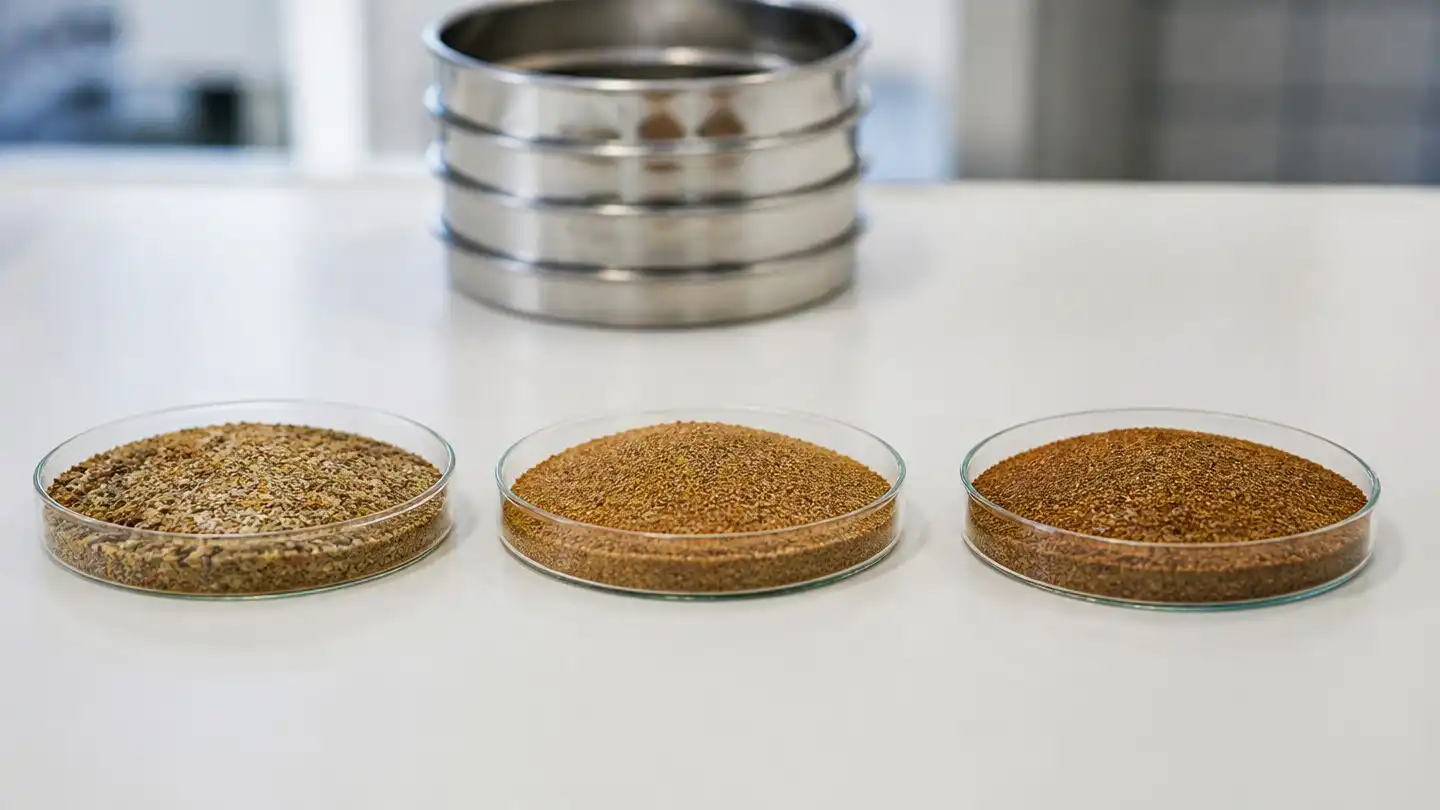
If you are formulating a savoury seasoning or a snack coating, we can supply the specification sheet, the current lot certificate, and samples at two sieve cuts so the adhesion and pickup work can be run on your own line. Send the application, the salt grade in the blend and the process route to wgt@allwellcn.com, and the technical team will respond with the grade that matches the coating method.
References
- International Organization for Standardization. ISO 3310-1 — Test sieves: technical requirements and testing. 2016.
- International Organization for Standardization. ISO 4833-1 — Microbiology of the food chain: colony count at 30 °C. 2013.
- International Organization for Standardization. ISO 21527-1 — Microbiology of food and animal feeding stuffs: enumeration of yeasts and moulds. 2008.
- Codex Alimentarius Commission. General Standard for Contaminants and Toxins in Food and Feed (CXS 193-1995, as amended). FAO/WHO.
- United States Department of Agriculture. National Organic Program, 7 CFR Part 205. Current edition.
- U.S. Food and Drug Administration. 21 CFR Part 101 — Food Labeling; ingredient declaration. Current edition.
This article is intended for business-to-business ingredient sourcing and formulation discussion. It does not provide medical, nutritional, or regulatory advice for any specific product or market.