
Peppermint Extract Powder for Instant Tea and Beverage Mixes
2026-11-10 09:41:28
An instant tea sachet is judged twice: once when the consumer tears it open and sees whether the powder is uniform and free-flowing, and once when cold water hits it and they watch whether it wets out or floats in dry islands. Both judgements happen before anyone tastes anything, and both are decided by physical properties rather than by flavour strength. For a buyer, that means peppermint extract powder has to be evaluated as a disperse-phase ingredient with a particle size distribution, a wetting behaviour and a volatile load that survives storage — not as a line on a flavour cost sheet.
Instant Tea Is a Dehydration Problem Before It Is a Flavour Problem
Bottled beverages keep their aroma in a closed liquid system. Powdered mixes lose it twice: once in the drying tower that makes the base, and again across eighteen months in a sachet with a measurable moisture vapour transmission rate. A peppermint note added to a powder therefore has to be dosed with both losses in mind, and the supplier conversation needs to separate the two.
The base decides how much of that loss the finished product can absorb. A sugar-based mix with a low water activity holds volatiles differently from a maltodextrin-heavy mix that is more hygroscopic, and both differ from a spray-dried tea base that already carries its own aroma load. Requesting the base composition alongside the peppermint specification is not an unusual ask; it is the only way to compare two quotes.
Reading a Peppermint Specification for a Powdered Mix
A certificate of analysis written for a liquid flavour house and one written for a dry blend are not interchangeable documents. The second has to describe the powder's physical state, because that state governs how the ingredient behaves in the sachet rather than in a tank.
| Specification item | What it controls in an instant mix | How a buyer verifies it |
|---|---|---|
| Appearance and colour | Visual uniformity of the dry blend; any speckling visible through a clear sachet | Retained standard comparison under D65 light; colorimeter reading |
| Volatile oil content | Flavour intensity per unit weight and the dosing rate used in costing | Declared method on the COA; in-house distillation check on receipt |
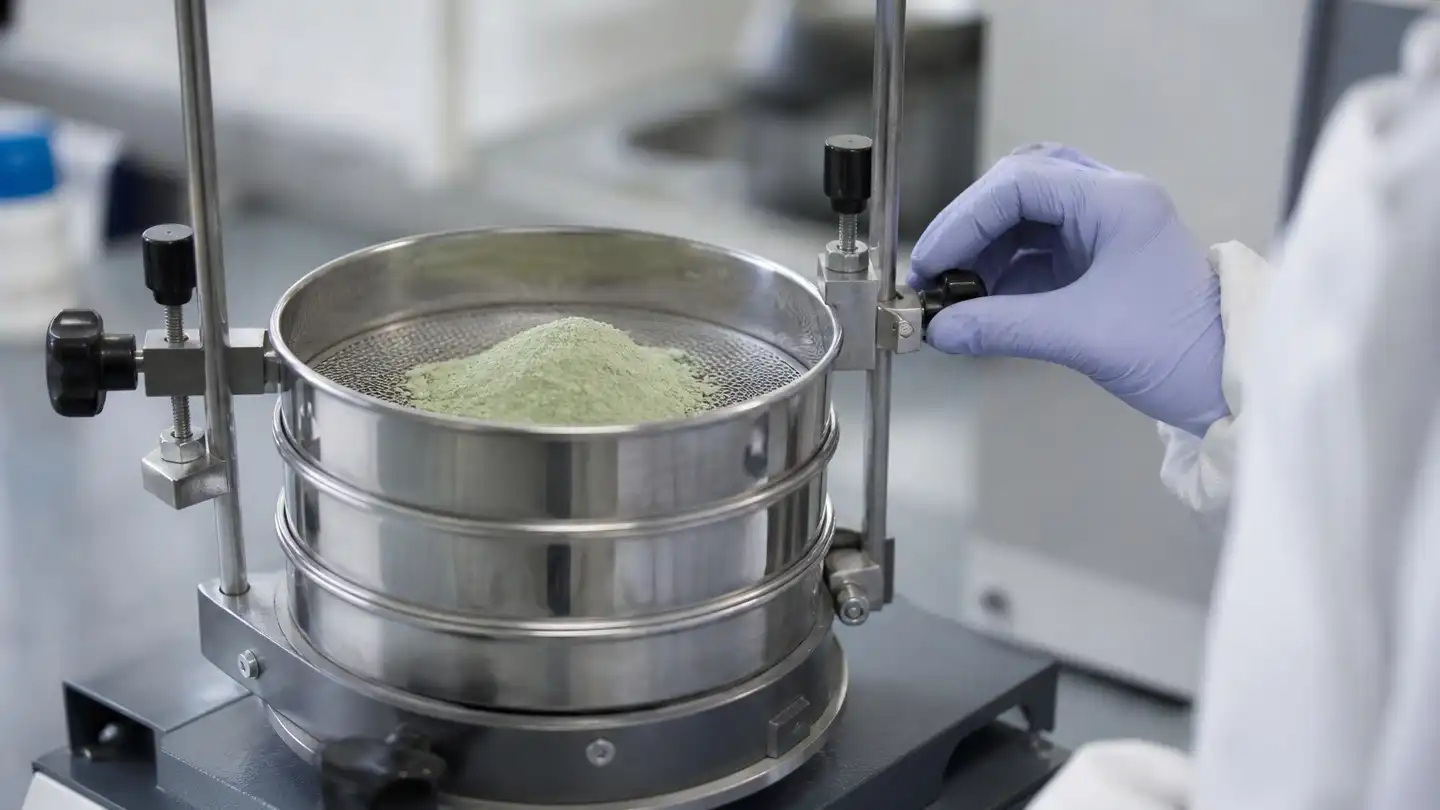
| Particle size distribution | Wetting rate, dusting at the filling head, segregation against sugar crystals | Sieve analysis on a stacked shaker to the declared mesh cut |
| Moisture content | Caking risk in the sachet, and volatile loss over shelf life | Loss on drying, run per lot rather than per campaign |
| Bulk density | Fill weight consistency at a volumetric filler | Tapped and untapped density, both recorded |
| Carrier or diluent identity | Label declaration, allergen status, and how the powder behaves in cold water | Named on the specification sheet, not only on the invoice |
| Microbiological profile | Release criterion for a low-moisture food | Plate count, yeast and mould, and pathogen screen per lot |
The carrier line deserves particular attention. A true extract dried onto a carrier and a diluted powder sold under the same name can look identical on a label and behave quite differently in a beaker. The comparison between a concentrated extract and a milled leaf powder is set out in this extract versus leaf powder comparison, and it is worth settling before any sensory work begins.
Volatile Oil Retention: Where the Menthol Goes
Menthol and menthone are small, volatile molecules. They migrate into headspace, into packaging film, and into the surrounding matrix if that matrix has free water. Retention is therefore a function of the whole pack, not only of the ingredient.
Losses during drying and blending
When peppermint is plated onto a carrier and dried, the inlet temperature and the residence time set how much volatile survives. A supplier running a lower inlet temperature and a longer residence time may deliver a higher retained volatile load than one running a hotter, faster cycle, at a higher cost per kilogram and a different moisture content. Ask for the retained volatile figure on the finished powder, not the volatile content of the oil that went in.
What a sealed-bag sensory panel can tell you
A simple accelerated storage check answers most retention questions. Hold sealed sachets at an elevated temperature for a fixed period, then compare against a refrigerated control with a small trained panel using a defined vocabulary. The output that matters is not a preference score but a threshold: the point at which the peppermint note stops being recognisable as peppermint. That number belongs in the purchase specification.
Cold-Water Wetting: The Practical Test
Most complaints about instant mixes are dispersion complaints wearing a flavour costume. If the powder clumps, the drink tastes weak at the top of the cup and gritty at the bottom, and no reformulation of the flavour system will fix it.
The 250 ml beaker protocol
Weigh a fixed dose into 250 ml of water at the temperature printed on the pack, stir with a defined paddle for a defined time, then pour through a sieve and weigh the residue. Run the same protocol against the incumbent material and a reference sample, and record both the residue mass and the time to full wetting. This is unglamorous work, and it is the only reliable way to compare two suppliers whose certificates look alike. The physical handling questions that come up when a powder is scaled into a beverage line are covered in this note on powder suitability for beverage applications, which is a useful cross-check because the same mechanics apply across botanical powders.
Flavour Balance in a Sweetened Instant Mix
Peppermint reads as cooler and sharper in a sweetened mix than in water. Sugar and acid both shift the perceived balance: acid lifts the top note, sugar rounds the mid-palate and lengthens the finish. A dosage that tastes correct in water can taste thin in a sweetened tea base and harsh in a low-sugar version of the same product.
That is why the trial matrix should include the finished base at two sweetness levels rather than water alone. It is also why a supplier that can supply the same peppermint grade over successive campaigns is worth more than one offering a lower price on a single lot: rebalancing a flavour system after a grade change costs far more than the per-kilogram difference.
Write the target sensory profile into the specification as measurable anchors rather than adjectives. "Cooling intensity at a fixed dose, scored on a five point scale by a three person panel against a retained reference" is auditable. "Natural mint flavour" is not, and it will not survive the first lot that arrives slightly different.
Segregation in a Multi-Component Dry Blend
Fine peppermint powder in a mix dominated by coarse sugar crystals will not stay evenly distributed through a hopper, a filler and a sachet. Vibration moves small particles down and large particles up, and the result is a batch with a flavour gradient no certificate can detect.
| Failure mode | Where it shows up | Mitigation to agree with the supplier |
|---|---|---|
| Particle size mismatch against sugar | Flavour variation between sachets in one carton | Match the sieve cut to the base, or request a granulated grade |
| Density mismatch | Peppermint-rich and peppermint-poor zones after transit | Declare bulk density; adjust blend order and mixing time |
| Dusting at the filling head | Product loss, cleaning burden, operator exposure | Coarser cut or a light agglomeration step |
| Hygroscopic caking | Hard lumps that never wet out | Moisture limit plus a moisture-barrier sachet film |
None of these are supplier faults on their own. They become supplier faults when the specification does not state a particle size, a density and a moisture limit, and the material then cannot be held to anything.
Colour and Clarity in the Cup
Consumers read a pale, clear infusion as clean and a cloudy one as heavy. A peppermint powder that carries insoluble plant matter will leave a haze even when the flavour is correct, and haze is very hard to explain on a label. If clarity matters for the product, say so at the specification stage and test it under the same light and dilution the consumer will use.
Clarity testing also protects the buyer against a substitution. A milled leaf material and a clarified extract can both be sold as peppermint powder, and the difference becomes obvious the moment both are dispersed at the same dose and left to stand for an hour. Photograph the two beakers side by side and keep the image with the approved sample; it settles arguments faster than any written description.
Microbiological Control for a Low-Water-Activity Mix
Dry mixes are not sterile and do not need to be. They do need a declared profile with limits, a sampling plan and a release decision that is made per lot. A certificate that reports a single plate count without stating the method, the dilution and the sampling plan gives a buyer very little to audit against.
The documents that support this side of the file — management system certificates and the plant's own programme — are listed on the quality and accreditation page. They are useful for supplier qualification, but they do not replace lot data, and the two should be kept separate in the vendor file.
Packaging Format Changes the Specification
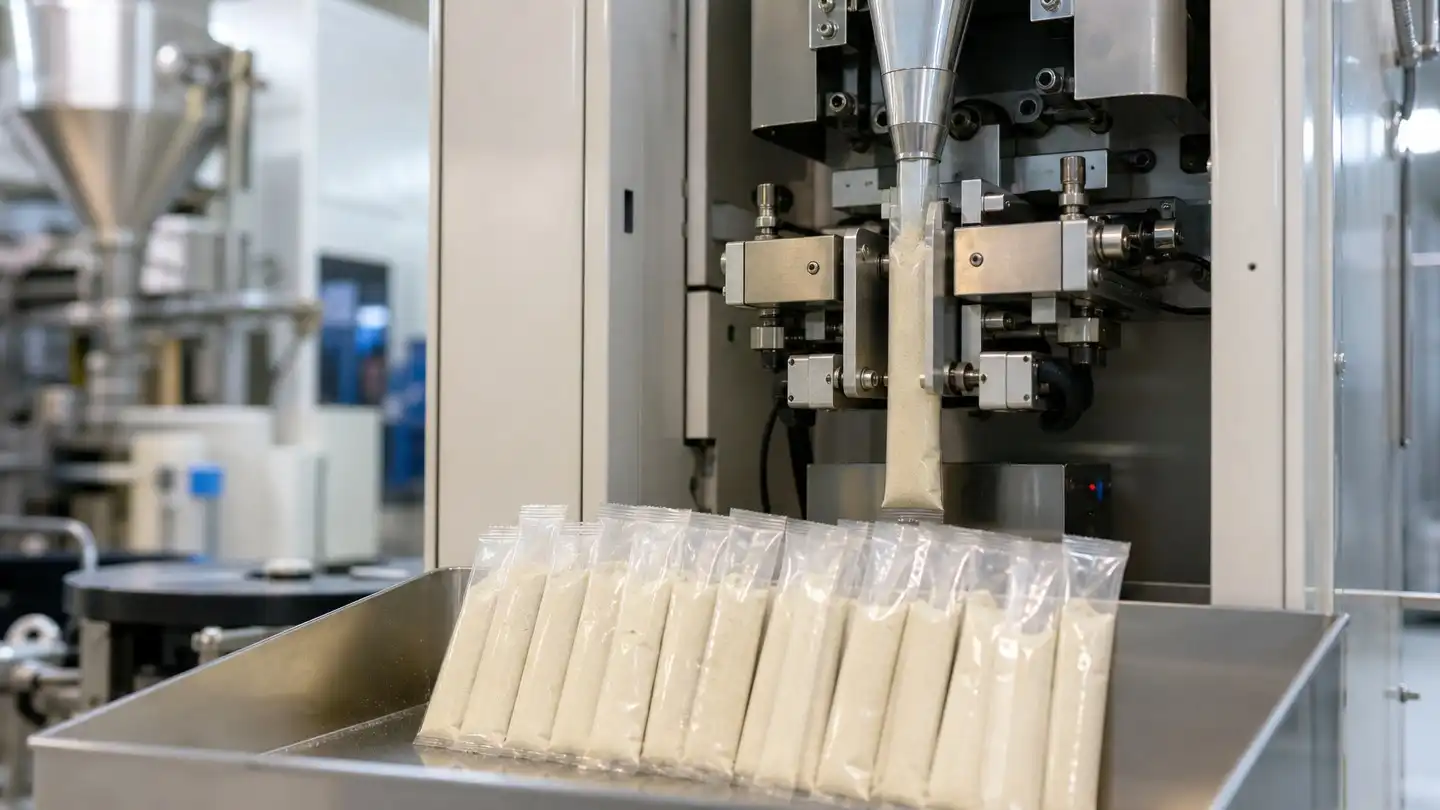
A 25 kg fibre drum with a double polyethylene liner and a 2 g stick pack are different chemical environments. The stick pack has a high surface-to-volume ratio, a thin film and a long retail shelf life; the drum is opened repeatedly in a factory and exposed to workshop air each time. A specification written for the drum will not automatically hold for the sachet.
Ask the supplier which packaging the stability data was generated in. If the answer is the drum and the product ships in sachets, the retention work has not been done for the format that matters.
Documents to Request Before the First Trial
- Specification sheet naming the carrier, the declared volatile content and the sieve cut
- Certificate of analysis for the actual lot offered, with methods stated
- Allergen and additive declaration, including any carrier of allergen concern
- Microbiological limits with the sampling plan attached
- Heavy metal and pesticide residue reports from an accredited laboratory
- Material safety data sheet and storage statement
- Retained-sample policy and the change-notification clause in the supply agreement
A supplier that answers all seven without a follow-up email is telling you something useful about how the next deviation will be handled. The fuller background on how these powders are described and traded is in this guide to peppermint extract powder.
A Three-Lot Trial Protocol
One lot proves nothing. Three consecutive lots, tested blind against the incumbent, is the smallest programme that separates normal variation from a real change. Fix the dose, fix the water temperature, fix the panel and the vocabulary, and record residue mass, wetting time, and the threshold at which the peppermint note is still recognisable after accelerated storage. Keep a retained sample of each lot for the life of the product.
If you are specifying a peppermint grade for an instant tea or a powdered beverage mix, we can send the current peppermint powder specification, a lot certificate and a sample for your beaker work, and we can discuss carrier options against your base. Write to wgt@allwellcn.com with the base composition and the target dose, and the technical team will respond with the matching grade rather than a generic quotation.
References
- U.S. Food and Drug Administration. 21 CFR Part 182 — Substances Generally Recognized as Safe. Current edition.
- U.S. Food and Drug Administration. 21 CFR Part 101 — Food Labeling; ingredient declaration and allergen labeling. Current edition.
- International Organization for Standardization. ISO 6571 — Spices, condiments and herbs: determination of volatile oil content. 2008.
- International Organization for Standardization. ISO 4833-1 — Microbiology of the food chain: horizontal method for the enumeration of microorganisms; colony count at 30 °C. 2013.
- International Organization for Standardization. ISO 21527-1 — Microbiology of food and animal feeding stuffs: enumeration of yeasts and moulds. 2008.
- International Organization for Standardization. ISO 3310-1 — Test sieves: technical requirements and testing. 2016.
This article is intended for business-to-business ingredient sourcing and formulation discussion. It does not provide medical, nutritional, or regulatory advice for any specific product or market.