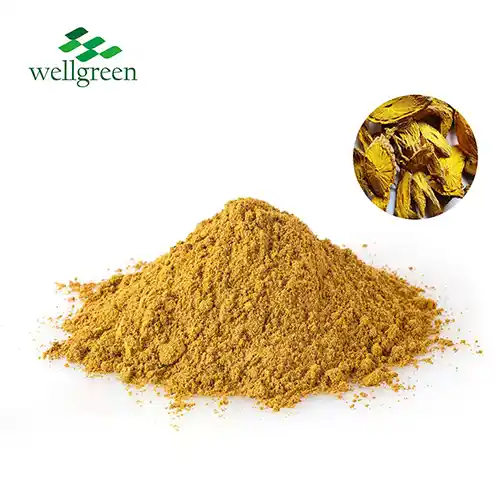
What Makes Chaga Mushroom Extract Powder a Popular Choice for Functional Ingredient Manufacturers?
2026-09-20 14:28:22
For a formulator, the important question about Chaga Mushroom Extract Powder is not whether to use it but which specification to sign off before the first production batch. Extraction ratio, assay method, particle size, solubility, colour and batch-to-batch tolerance decide whether the ingredient behaves predictably in a capsule, a stick pack, a ready-to-drink line or a gummy. This article works the problem from the formulator's side of the table — the technical parameters that need a decision and the trade-offs behind each one — while the application-led overview of Chaga extract in functional food and beverage development covers where the ingredient is used across categories.
Understanding the Specification Behind Chaga Mushroom Extract Powder
A Chaga specification is a short document that fixes six things: identity, extraction route, standardised marker, physical form, contaminants and packaging. Two suppliers can quote the same headline grade and still deliver materials that behave differently, because the headline number usually describes only one of the six.
What the Extraction Ratio Actually Tells You
A ratio grade such as 10:1 states how much raw material was consumed per unit of finished powder. It is a process descriptor, not a composition claim. Two 10:1 lots from different raw-material seasons can carry materially different amounts of the water-soluble fraction, so the ratio alone gives a formulator nothing to build a label declaration or a blend calculation on.
Published work on Inonotus obliquus polysaccharides makes the point concrete. A recent review of preparation methods reports polysaccharide yields from hot-water extraction ranging from roughly 4% to 8%, and that ultrasound- or microwave-assisted extraction changed both yield and purity — in one cited study from about 2% to 3% yield and about 64% to 73% purity against the hot-water baseline [1]. The extraction route is a real variable, and the ratio is not a substitute for an assay.
Ratio Grades and Assay Grades Are Different Products
Wellgreen lists both families on its product page: ratio grades at 5:1, 10:1 and 20:1, and polysaccharide-standardised grades from 10% to 50%, tested by UV and HPLC. Choosing between them is choosing between convenience and control.
- Ratio grades are quick to specify and easy to source from several suppliers, because the descriptor is a process parameter rather than a measured value.
- Assay grades anchor the specification to a number that can be re-tested on incoming goods, which is what makes a label declaration defensible and a blend calculation repeatable.
- The method matters as much as the number. A UV polysaccharide figure is not interchangeable with an HPLC figure, so the specification should name the method and have it documented on the certificate of analysis.
- A declared β-glucan content is a separate line item, needing its own specification entry and its own method.
Sclerotium Versus Mycelium: A Substrate Decision With Analytical Consequences
The starting material shows up in the data. A comparative study of commercial Chaga materials measured β-glucan at roughly 5.7–11.9% in authentic Chaga canker, while fermented grain products sat close to their cereal substrates — around 1% for rice-based material and around 5% for oat-based material. The same study found α-glucan at 46–74% in grains and 33–68% in fermented grain products, against less than 2% in authentic Chaga canker, and used an iodine–starch reaction to confirm starch in the fermented products [2].
Sclerotium and mycelium also differ structurally. A study comparing cultivated mycelium with sterile conk and birch heart rot found that conk-derived polysaccharides were mainly β-glucan with a narrow molecular-weight distribution, while mycelial polysaccharides contained both higher- and lower-molecular-weight populations [3]. A specification written for birch-grown sclerotium is therefore not transferable to a grain-fermented material, and the substrate belongs in the document as a fixed line rather than an assumption.
Manufacturing and Standardisation Parameters That Shape the Specification
Extraction and drying determine how much of the fraction the formulator is paying for actually survives processing, which is why standardisation carries so much weight in a Chaga grade — a point developed in the companion article on standardised Chaga extract in functional mushroom formulations. Two decisions do most of the work.
Extraction Route and Solvent System
Hot-water extraction is the conventional route for the water-soluble fraction. Adding a controlled ethanol step brings an alcohol-soluble fraction into the extract, which is why dual-extract grades are specified when the brief calls for a broader marker profile rather than a single polysaccharide number. The specification should state both the extraction route and the drying method, because the same raw material processed two ways will not assay the same.
Tolerance, Not Just Target, Belongs in the Specification
A target value without a tolerance is not a specification. A workable document states a target, an acceptable range, a sampling plan and a retest rule for every marker. A range that is too tight raises the cost of consistent supply; a range that is too wide turns batch release into a negotiation. The middle ground is tight ranges on the parameters that carry a label or a process consequence — assay markers, moisture, micro limits — and looser ranges on cosmetic attributes such as shade, measured against a customer-approved reference standard.
| Specification line | What the formulator is deciding | Consequence if left open | Where it lands in the document |
|---|---|---|---|
| Identity and plant part | Inonotus obliquus, sclerotium versus mycelium, region of origin | Marker profile does not match the development sample | Identity section, with substrate stated explicitly |
| Extraction route | Water only, or water plus ethanol (dual extract) | Water-soluble and alcohol-soluble fractions are present in unknown proportion | Process description |
| Assay marker | Ratio descriptor, polysaccharide %, or declared β-glucan %, with the test method named | No incoming-goods test is possible; label data cannot be substantiated | Assay section, method named per marker |
| Target and tolerance | Acceptable range, sampling plan, retest rule | Batch release becomes a case-by-case negotiation | Each assay line, plus a general sampling clause |
| Physical form | Particle size, bulk behaviour, solubility and dispersion performance | Filling, mixing and reconstitution failures appear only at production scale | Physical parameters section |
| Contaminant and micro limits | Elemental panel, micro panel, moisture ceiling | Market-access testing blocks the launch batch | Certificate of analysis template |
Choosing the Grade by Dosage Form, Not by Habit
The most expensive specification mistake is choosing a grade before the delivery format is fixed. Capsules, sachets, beverages, gummies and tablets constrain the powder in different ways, and the constraint should drive the grade — especially in multi-mushroom blends, where mixing precision depends on the least cooperative powder in the formula.
| Delivery format | Physical properties that dominate | Grade logic |
|---|---|---|
| Two-piece capsule | Bulk density, flow, absence of fine dust | Assay-based grade, because capsule fill weight is fixed and the label declaration depends on a consistent marker |
| Stick pack or sachet | Dispersion on opening, resistance to caking, moisture pick-up | Assay-based grade with a low moisture ceiling and a documented sieve result |
| Ready-to-drink beverage | Solubility, sediment behaviour, colour contribution | Grade optimised for dispersion rather than for the highest achievable ratio |
| Gummy or chew | Flavour load, colour contribution, thermal exposure in the depositor | Lower-inclusion, more concentrated grade where the flavour budget is tight |
| Tablet | Compressibility, particle-size distribution, batch-to-batch flow | Grade specified jointly with the excipient system, not in isolation |
| Topical or beauty base | Colour, ash level, compatibility with the emulsion | Grade selected for colour and cleanliness of dispersion |
Procurement Parameters That Belong in the Specification
Commercial terms are settled with procurement, but several of them change the technical document: lead time, packaging format, seasonal availability and the supplier's ability to hold a grade constant across harvests all either allow or prevent consistency at the receiving dock. The same parameters sit at the centre of the bulk Chaga extract supply discussion for nutraceutical and wellness ingredient buyers.
Particle Size and Sieve Data
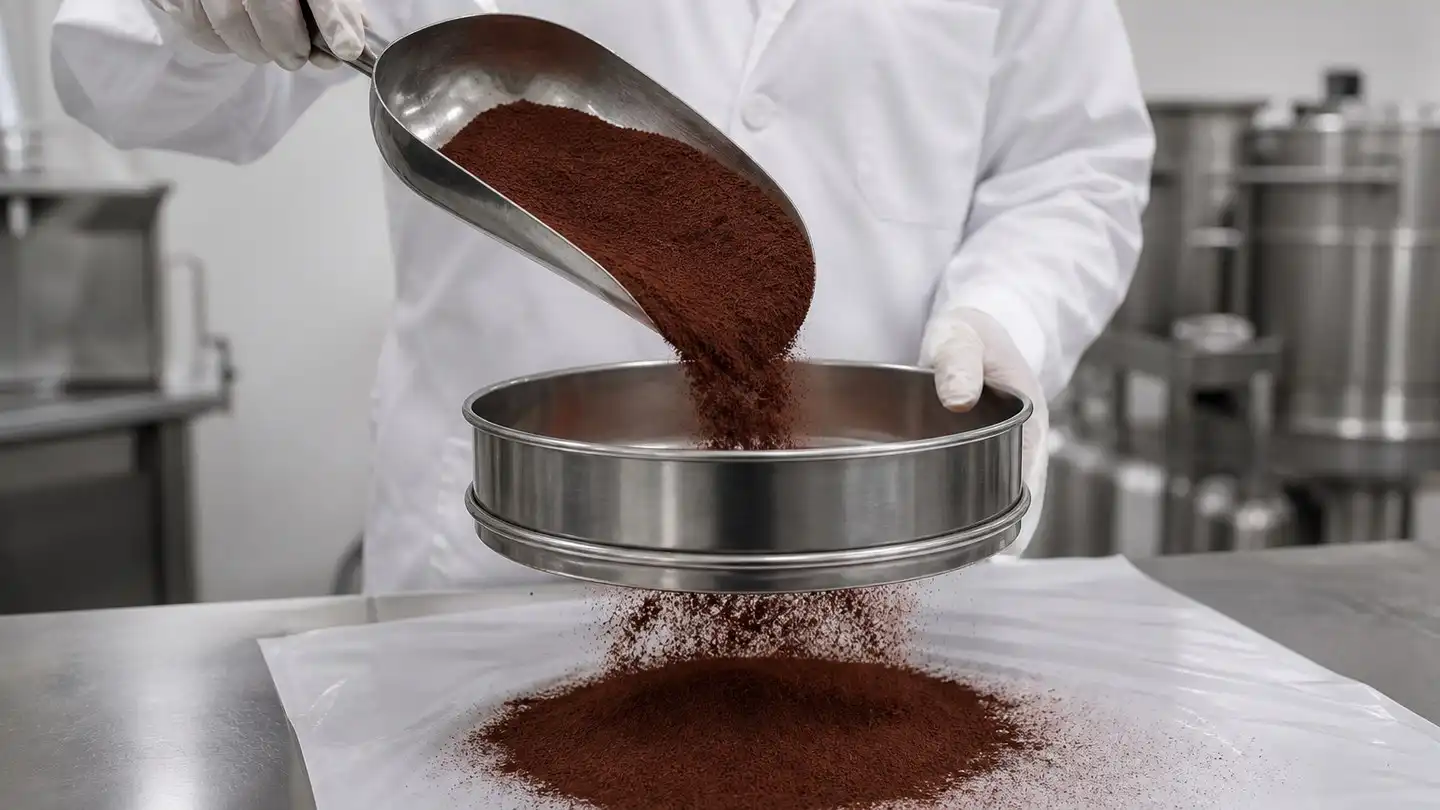
Particle size drives flow, filling accuracy and mouthfeel. A single mesh figure is not enough: the specification should state the sieve designation, the percentage passing that sieve and the tolerance around it, since a powder described only as "fine" cannot be verified on receipt. Consistency here is also what keeps blend ratios stable when several extracts are combined in one formula.
Solubility, Dispersion and Reconstitution Behaviour
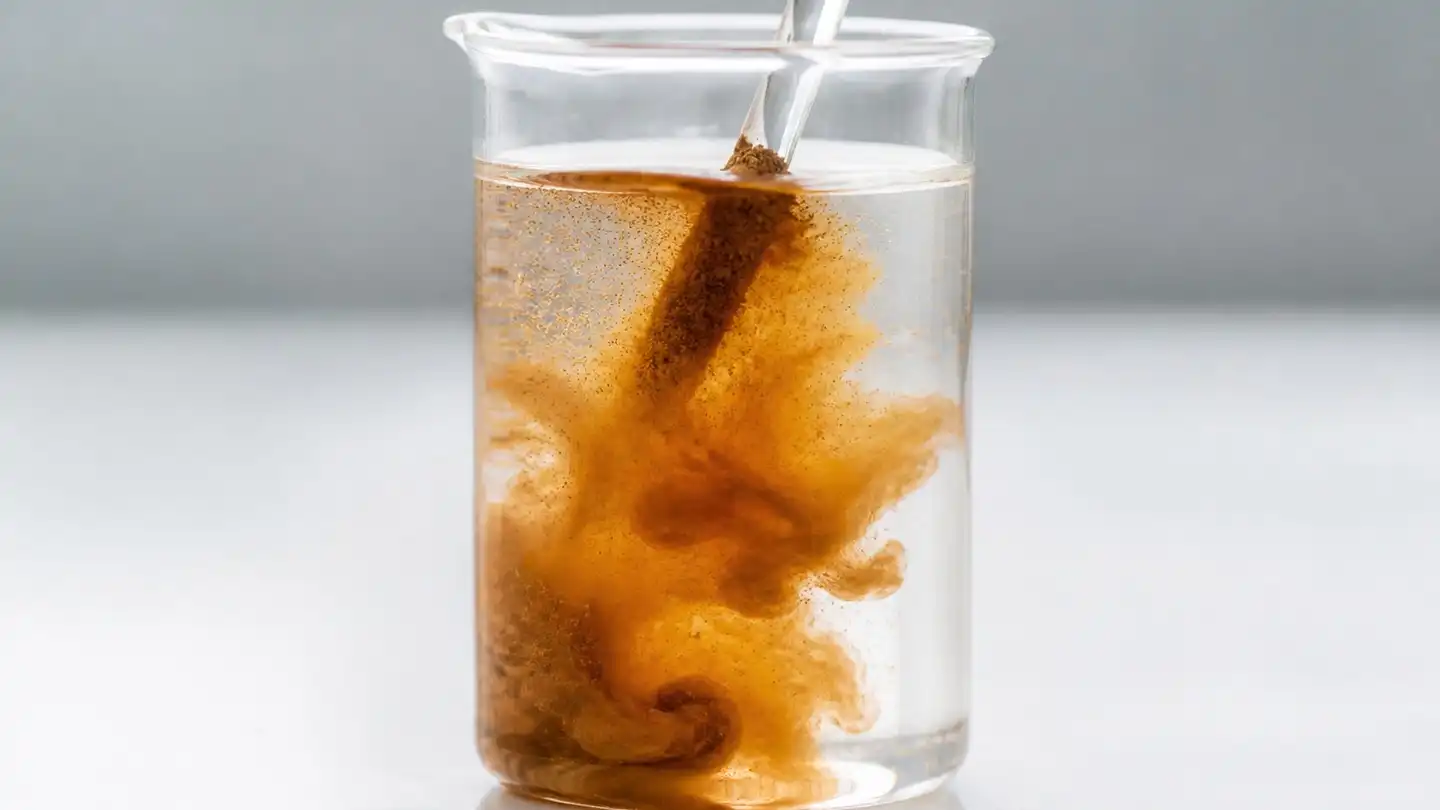
Solubility is a performance characteristic, not a yes-or-no property. What matters in practice is how quickly the powder wets out, whether it forms lumps, how much sediment remains after a defined dispersion step and how the dispersion behaves on standing. These are testable, and they belong in the specification as a laboratory method rather than as a supplier's description of "easily dispersible".
Colour, Flavour and Batch-to-Batch Tolerance
Chaga is a strongly coloured ingredient, and the melanin-rich fraction carries that colour: in the comparative study cited earlier, whole Chaga canker and a 1:1 canker extract showed clear pigment absorbance, while mycelium and fermented grain materials showed only trace absorbance [2]. A beverage, a gummy and a capsule have very different colour budgets, and an earthy, woody flavour that suits a coffee or cocoa base can sit awkwardly in a fruit system.
Colour, aroma and assay should be specified together with a documented tolerance, using a retained qualification-batch sample as the visual standard. Without it, a colour shift between lots becomes a consumer-visible defect rather than a quality-control decision.
Regulatory and Documentation Lines to Fix Before Scale-Up
The documentation set should be agreed at qualification, not discovered at the border: a specification sets the elemental panel, the microbiological panel and the moisture ceiling, and the certificate of analysis should carry a tested value and a method for each line rather than a blanket "conform".
Elemental testing is not optional for a mushroom-derived material. Edible fungi take up metals from the substrate they grow on, and a survey of 244 edible-mushroom samples using ICP-MS found concentrations decreasing in the order cadmium, arsenic, chromium, lead, mercury [7] — which is why the elemental panel is a standard negotiation point for buyers in North America and Europe.
On the regulatory side, the framework depends on market and positioning. In the United States, dietary supplement manufacturing is governed by the current good manufacturing practice regulation at 21 CFR Part 111, which requires manufacturers to establish specifications for each component and to verify that those specifications are met [4]. In the European Union, a food ingredient not used for human consumption to a significant degree before 15 May 1997 falls under the novel food framework of Regulation (EU) 2015/2283 and must be authorised before it is placed on the market [5]. Where an organic claim is intended, the reference point is the USDA National Organic Program, which sets the national standards and accredits the third-party certifiers that verify them [6].
Wellgreen's Chaga product pages list EOS/NOP, ISO 9001:2015, ISO 22000, Halal, Kosher and HACCP; those are the certifications to raise in a specification discussion, and each document should be requested in its current, in-scope form rather than referenced from a website banner. Label claims remain the brand owner's responsibility and depend on the target market's rules and on the tested data the specification is designed to produce.
Conclusion
Specifying Chaga Mushroom Extract Powder is a sequence of technical decisions: fix identity and substrate, choose the extraction route, decide whether the spec is anchored to a ratio or to an assay, set targets with real tolerances, then let the dosage form dictate the physical parameters. Buyers who work in that order end up with a document a supplier can be held to, a quality team can verify on receipt and a product developer can build a label on.
FAQ
Is a 10:1 ratio the same as a 10% polysaccharide grade?
No. The ratio describes how much raw material was consumed; the polysaccharide figure is a measured concentration obtained by a stated method. Only the measured value can be re-tested on incoming goods and used as a label declaration.
Should the test method be named in the specification?
Yes, for every assay line. UV and HPLC produce different numbers for the same marker, so a specification that states a percentage without naming the method cannot be defended in a supplier dispute or reproduced by a second laboratory.
Does the delivery format really change the grade I should specify?
It changes the physical parameters first. Capsules are dominated by bulk density and flow, beverages by dispersion and sediment behaviour, gummies by colour and flavour load. Choosing the format before the grade prevents an expensive specification revision after the pilot batch.
Can one specification cover both a sclerotium extract and a grain-fermented material?
Not usefully. The two materials differ in marker profile and in interference from residual substrate, so each needs its own identity and assay lines. Treating them as interchangeable is the most common cause of a development sample that cannot be reproduced in production.
Source Chaga Mushroom Extract Powder With a Spec You Can Hold a Supplier To
Wellgreen manufactures Chaga Mushroom Extract Powder at a GMP-certified facility with in-house testing, offering ratio grades at 5:1, 10:1 and 20:1 and polysaccharide-standardised grades from 10% to 50% tested by UV and HPLC, with a batch-specific certificate of analysis and full batch traceability. Send your target specification, delivery format and packaging requirements to our technical sales team at wgt@allwellcn.com, or review the current grade and particle-size data on the Chaga Mushroom Extract Powder product page before you write the brief.
Disclaimer: This article provides technical and commercial information for industry professionals and is not medical advice. Any use level, regulatory status or label claim must be confirmed against the requirements of the target market and the buyer's own product data.
References
- Zhang, S.; Zhang, W.; Wu, X.; Li, S.; Shi, D.; Li, H.; Liu, T.; Gong, A. — "Inonotus obliquus Polysaccharides: Preparation, Structural Characteristics, Structure–Activity Relationships, Biological Activities and Applications." Nutrients, 2026; 18(7): 1125. doi: 10.3390/nu18071125. pmc.ncbi.nlm.nih.gov/articles/PMC13075156
- Windsor, C.; Kreynes, A.E.; Chilton, J.S.; Chioffi, W.A.; Krishnamurthy, A.; Ishii, M. — "Comparative Study of Chaga (Inonotus obliquus) Dietary Supplements Using Complementary Analytical Techniques." PMCID: PMC11988691; PMID: 40243601. pmc.ncbi.nlm.nih.gov/articles/PMC11988691
- "Comparison of Polysaccharides Extracted from Cultivated Mycelium of Inonotus obliquus with Polysaccharide Fractions Obtained from Sterile Conk (Chaga) and Birch Heart Rot." PMCID: PMC8000984; PMID: 33800424. pmc.ncbi.nlm.nih.gov/articles/PMC8000984
- U.S. Food and Drug Administration — 21 CFR Part 111, "Current Good Manufacturing Practice in Manufacturing, Packaging, Labeling, or Holding Operations for Dietary Supplements." ecfr.gov/current/title-21/chapter-I/subchapter-B/part-111
- European Parliament and Council — Regulation (EU) 2015/2283 on novel foods. OJ L 327, 11.12.2015, pp. 1–22. eur-lex.europa.eu/eli/reg/2015/2283/oj
- U.S. Department of Agriculture, Agricultural Marketing Service — National Organic Program. ams.usda.gov/about-ams/programs-offices/national-organic-program
- Qin, G.; Liu, J.; Zou, K.; He, F.; Li, Y.; Liu, R.; Zhang, P.; Zhao, G.; Wang, T.; Chen, B. — "Analysis of heavy metal characteristics and health risks of edible mushrooms in the mid-western region of China." Scientific Reports, 2024; 14: 26960. doi: 10.1038/s41598-024-78091-1. pmc.ncbi.nlm.nih.gov/articles/PMC11541732
- Wellgreen — Chaga Mushroom Extract Powder product specification. wellgreenherb.com/standardized-extract/chaga-mushroom-extract-powder