
What Should Nutraceutical Manufacturers Check Before Buying Milk Thistle Extract Powder?
2026-10-13 16:15:53
When a nutraceutical manufacturer issues a purchase order for milk thistle extract powder, the commercial risk is already fixed: the specification, the assay basis and the analytical method sit in documents that will only be compared against real material weeks later. This botanical is unusually exposed to that gap, because the headline figure on a datasheet — the silymarin percentage — can be produced by more than one analytical route, and it describes a mixture rather than a single molecule. This is a pre-purchase and risk-control guide: it covers how a declared figure can be non-comparable between methods, what “silymarin” is actually being counted as, why extract ratio and standardisation are not interchangeable, how extended material can still carry a high declared percentage, and which document and physical checks detect identity and substitution risk. It stops short of receiving inspection and supplier auditing, which are separate exercises.
Why Pre-Purchase Verification Decides the Outcome
In high-volume botanical trade, the documents exchanged before a PO are the only real control a buyer has. Once material is in transit, the conversation shifts from choosing a specification to negotiating over one.
The silymarin category carries a documented structural risk. The ABC-AHP-NCNPR Botanical Adulterants Prevention Program (BAPP) published a Botanical Adulterants Prevention Bulletin on milk thistle fruit in 2020. The announcement of that bulletin reports that silymarin content in some commercial dietary supplements is much lower than label claims, that part of that gap can be explained by the use of different analytical methods — HPLC-UV rather than spectrophotometric methods — and that published data also point to fraudulent products in which silymarin has been removed without the buyer's knowledge. It is described as the first BAPP bulletin to focus on depleted extracts, where constituents are knowingly removed from a concentrated standardised extract and the remaining material resold without declaring the removal.
Method Versus Claim: A Silymarin Percentage Is Not Self-Explaining
Two suppliers can both quote “80% silymarin” and describe materially different materials. A spectrophotometric (UV) determination measures total absorbance in a region where the whole flavonolignin family absorbs, so it is a family-level estimate. A chromatographic (HPLC) determination resolves and sums named flavonolignins against a stated reference standard, so it is a component-level measurement. BAPP identifies exactly this method dependence as one explanation for label-versus-analysis gaps, so an unqualified percentage cannot be used to rank two offers.
The size of the gap can be seen inside a single material. Wellgreen's published data for its silymarin 80% grade illustrate it: the certificate of analysis on that page records Assay (Silymarin) by UV at 80.08%, while the HPLC section of the same document sums the individual flavonolignins separately — silychristin and silydianin at 14.85%, silybin A and silybin B at 8.23%, and isosilybin A and isosilybin B at 6.38%. Neither figure is wrong. They answer different questions, and a buyer who does not know which question was asked cannot compare a UV-based offer with an HPLC-based one.
Making a Supplier State the Method Behind a Number
A method name by itself is not enough. What a buyer should require in writing before the order is a short chain of statements rather than a single figure:
- the analytical method, named to a documented procedure — a pharmacopoeial monograph chapter or a numbered in-house method — not simply “HPLC” or “UV”;
- the reference standard used for calibration, identified by name and source, with its stated purity where an external standard is used;
- what the result is calculated as and on which basis — which marker or marker group, and whether the calculation is on an as-is or a dried basis;
- whether single flavonolignins were resolved at all, and if so which ones;
- the acceptance criterion actually applied to the batch, expressed the same way the result is expressed.
When a supplier answers those five points, a percentage becomes a specification. When a supplier will not, the number is a marketing input.
What Is Being Counted as “Silymarin”?
Silymarin is a collective term rather than a single analyte, and the difference matters more here than in most botanical categories. The Expanded Commission E monograph on milk thistle fruit describes preparations standardised to a concentration of 70 to 80% of three flavonolignins — silibinin, silychristin and silydianin — which it states are collectively known as silymarin.
The same monograph records that pharmacopoeial-grade milk thistle fruit is specified as containing not less than 2% of silymarin, calculated as silybin, and that botanical identity must be confirmed by thin-layer chromatography together with macroscopic and microscopic examination. Two lessons follow directly. A family-level figure and a single-component figure are different specifications, and a dominant component such as silibinin is not a proxy for the whole complex. Identity confirmation is also a separate test from assay, so a specification containing only an assay value is incomplete.
| What the datasheet states | What the figure actually counts | What it does not establish | What to request before the order |
|---|---|---|---|
| Silymarin, stated as a percentage by UV | Total absorbance of the flavonolignin family | The share of any named flavonolignin in the material | Method reference, wavelength and the reference standard used |
| Silymarin, stated as a percentage by HPLC | The sum of named flavonolignins against a stated standard | That the same marker set or calculation basis was used as the comparison offer | Method identity, standard identity and the calculation basis |
| A single flavonolignin, such as silibinin, stated as a percentage | One component of the complex only | The presence or level of the remaining flavonolignins | The full flavonolignin profile with each named component |
| An extract ratio, such as a whole-number ratio | An input-to-output mass balance for the extraction | Any assayed content whatsoever | A separate standardised assay figure with its method |
Extract Ratio Versus Standardisation: Two Different Documents
An extract ratio and a standardisation claim answer different questions. The ratio is a production and mass-balance statement: how much raw material was extracted to produce a given quantity of extract. Standardisation is an assay statement: the measured content of a marker or marker group in the finished extract. A ratio is therefore not a potency claim, and a standardised percentage is not a ratio.
Both can legitimately appear on one datasheet for the same product. Wellgreen's milk thistle extract powder page, for example, carries a whole-number extract ratio alongside its stated test methods, and separately declares silymarin at 80% or above with a particle size range and a loss-on-drying limit. The trap is assuming that one implies the other, because a high ratio can be met by material that has already had its marker content taken out, while a standardised percentage says nothing about how much raw material the extract represents.
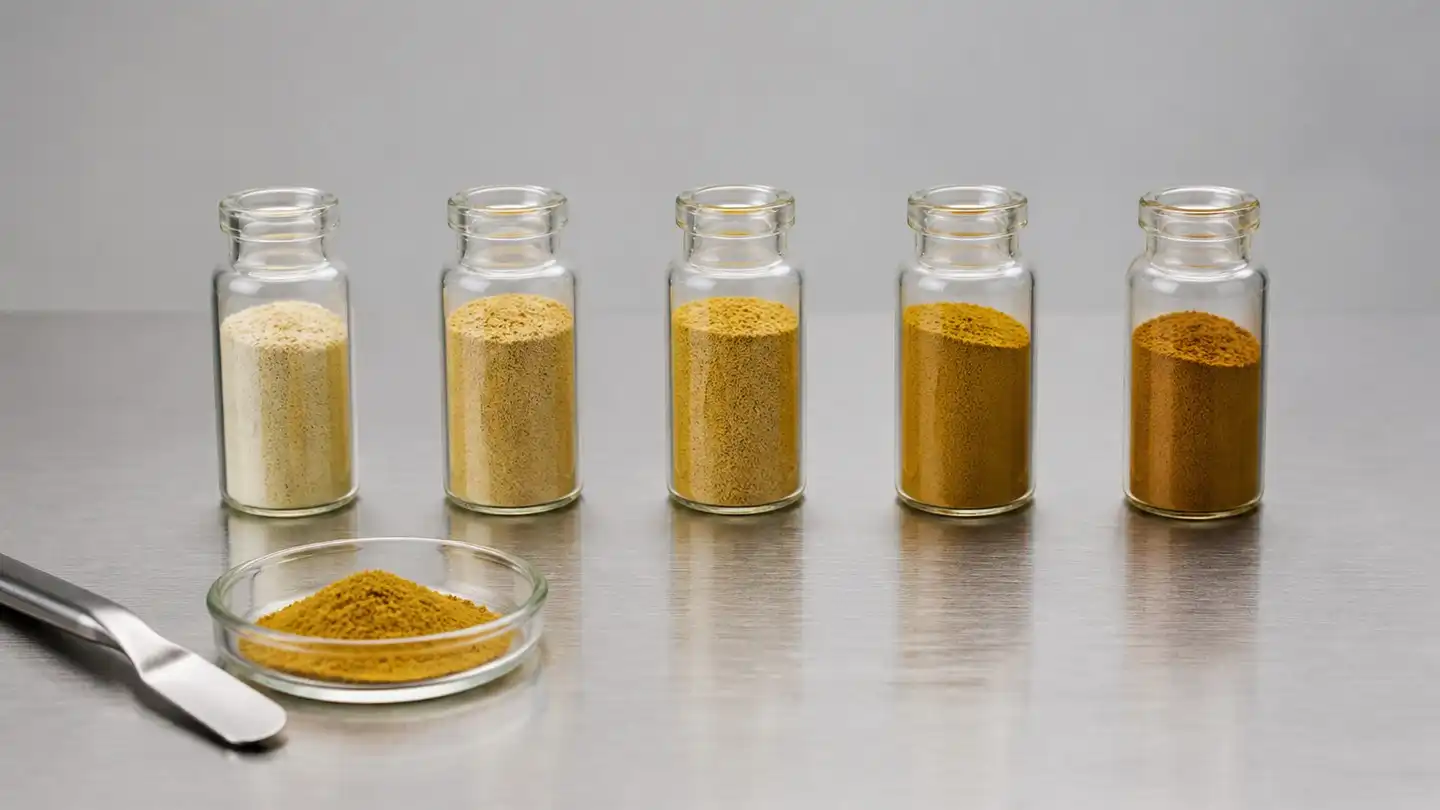
Dilution and Carrier Extension: A High Percentage Can Still Arrive Thin
Extending a standardised botanical is not automatically a defect, and it is not always undeclared: a legitimate product may be built on a carrier system when the application needs a free-flowing or dispersible powder, in which case the carrier belongs in the specification. Wellgreen's guide to bulk MCT oil powder specifications, carriers and quality standards sets out how carrier systems and quality standards are controlled for exactly that kind of powder, which is a useful model for how a carrier declaration should be documented in any powder specification.
The problem arises when extension is undeclared, or when it is hidden behind a marker basis that the carrier does not affect. BAPP's bulletin describes depleted material moving back into the market with the removal of constituents left unstated. Extended material can present in a similar way: the declared percentage can still be met or approached when the assay is performed on a narrow marker basis, while the received material carries a much larger share of carrier, spent material or diluent than the buyer assumed.
Signals That Flag Extended or Depleted Material
- Bulk density and flow behaviour that do not fit the declared particle size and the presence or absence of a carrier.
- Appearance, shade and odour drifting between lots while the declared assay stays fixed.
- A particle-size distribution that does not match the declared mesh range, or a mesh claim with no distribution data behind it.
- Marker sums that do not reconcile with the family-level figure, or a component list that omits the minor flavonolignins entirely.
Identity and Substitution Risk in a High-Volume Category
High-volume botanical materials attract substitution because the incentive is proportional to the tonnage, and because processed powders remove the morphological features that would otherwise give a substituted species away. The inexpensive responses are documentary and physical, and they belong in the pre-purchase file rather than in the warehouse.
- The Latin binomial and the plant part declared consistently on the datasheet, the certificate of analysis and the commercial documents, with the plant part appropriate to the material being bought.
- Identity confirmed against a reference standard by thin-layer or high-performance thin-layer chromatography, as the Commission E monograph describes for pharmacopoeial-grade material, rather than inferred from an assay value.
- One lot number carried through the certificate, the packaging label and the shipping documents, so a received batch can be traced to a single analytical record.
- A batch-specific certificate with method identity, acceptance criteria and results for every declared parameter, rather than a generic sheet with an example result.
For a US-market finished product the buyer's own obligation is not optional: 21 CFR 111.75 requires that a dietary ingredient be tested for identity before use, using at least one appropriate test or examination. That obligation is another reason the supplier's documentary package has to be assembled at purchase-order stage rather than at intake. Where a buyer wants a structured documentary assessment, the framework used for other high-volume actives transfers directly — Wellgreen's guide to how buyers evaluate berberine hydrochloride powder suppliers sets out how purity verification, manufacturing compliance, traceability documentation and independent laboratory confirmation are assessed in sequence.
The Contaminant and Quality Panel for a Seed-Derived Extract
The panel should follow the material rather than a generic template: because the starting material is a fruit and seed, the risk profile includes mycotoxins as well as the usual botanical set. The pre-purchase file should name the tests, the limits and the methods for each of the following, and the certificate should report them per batch.
- Elemental impurities, assessed and controlled on a risk basis; the ICH Q3D guideline published by the European Medicines Agency provides the risk-assessment framework for elemental impurities in a regulated material.
- Pesticide residues, screened against the maximum residue levels that apply in the destination market, with the European Commission's EU Pesticides Database used to confirm the applicable active substances and levels.
- Mycotoxins, appropriate to a seed-derived botanical.
- Microbiological limits, including total plate count, yeast and mould, and the absence of specified pathogens.
- Residual solvents, tied to the extraction solvent actually declared, rather than asserted without a process reference.
- Loss on drying, ash, solubility and particle-size distribution, each with an acceptance criterion.
Identity, assay, carrier declaration and contaminant clearance are then reported on documents the buyer can hold a supplier to. Wellgreen's page on how to ensure the quality and purity of milk thistle extract powder covers the same documentary discipline from the supplier side.
Pre-Purchase Verification Table
The table below turns the discussion above into questions to put in writing before a purchase order is issued; each answer should reference a document that will accompany the batch.
| Verification item | Question to put in writing before the order | Evidence that closes the question |
|---|---|---|
| Assay basis | Which method generates the declared silymarin figure, and what is the result calculated as? | Method procedure named to a monograph chapter or numbered in-house method, plus the calculation basis |
| Reference standard | Which reference standard calibrates the assay, and what is its stated purity? | Named standard with source and purity statement |
| Flavonolignin profile | Which single flavonolignins were resolved, and at what levels? | Component-level results including the minor flavonolignins |
| Extract ratio | What extraction ratio is claimed, and on what input-to-output basis? | Ratio statement separate from the assay figure |
| Carrier or excipient | Is any carrier, diluent or anti-caking component present, and at what declared level? | Declared carrier identity and level in the specification |
| Particle size and density | What mesh range and density are specified, and what distribution data supports them? | Distribution data with an acceptance criterion |
| Identity | How is identity confirmed separately from assay? | Chromatographic identity test against a reference standard |
| Plant part | Which plant part does the material come from, and is it consistent across documents? | Latin binomial and plant part aligned across datasheet, certificate and invoice |
| Elemental impurities | Which elements are specified, at what limits, and by which method? | Risk-based assessment with per-batch results |
| Pesticide residues | Which residue list and limits apply to the destination market? | Screening results against the applicable maximum residue levels |
| Mycotoxins | Which mycotoxin limits apply to a seed-derived material? | Per-batch results with a stated limit |
| Microbiology | Which microbiological limits and which named organisms are specified? | Per-batch microbiological results |
| Residual solvents | Which solvent was used, and what limits apply to it? | Solvent declaration with matching residual-solvent results |
| Documentation and certification | Which certifications apply to this site and this product, and can current copies be provided? | Dated third-party copies, plus a batch-specific certificate |
The Go / No-Go Decision Table
Once the answers are in, the decision is usually visible. The table below maps the signals that matter most.
| Signal observed before the order | Proceed | Do not proceed |
|---|---|---|
| The declared silymarin figure | The supplier states the method, the reference standard and the calculation basis in writing | The figure cannot be tied to a documented method after a direct request |
| The component data | The individual flavonolignins are reported, including the minor ones | Only a family-level figure is offered, with no component detail available |
| The ratio and the assay | Ratio and standardisation appear as separate, clearly labelled statements | The ratio is offered in place of an assay figure |
| The carrier position | Any carrier or diluent is declared with its level | Carrier content is neither declared nor denied when asked about directly |
| The certificate | A batch-specific certificate lists method, criterion and result for every parameter | Only a generic or example certificate is available |
| The contaminant panel | Limits and methods are named for the full panel, including mycotoxins | The panel is described only as “conforms”, with no limits or methods |
| Traceability | One lot number runs through certificate, label and shipping documents | Lot numbers change between documents, or are absent |
Assembling the Pre-Purchase File
A workable pre-purchase file is short: a specification stating each parameter with a method, a limit and a basis; a certificate format completed per batch; written answers on the method chain behind the silymarin figure; a carrier declaration; a contaminant panel with named methods and limits; and a traceability statement linking one lot number across documents. With those items in place before the order, the batch received has something concrete to be measured against.
Work With Wellgreen
Wellgreen supplies milk thistle extract powder for nutraceutical, food and dietary supplement applications, and provides a documentation package covering the points discussed above. Buyers who want a specification, a batch-specific certificate structure or a method statement before committing to an order can send the parameters they need to wgt@allwellcn.com, and the technical team will confirm what can be documented on the certificate and on which basis.
This article addresses ingredient specification and procurement documentation only. It is not a statement about the use or suitability of any finished product, and it does not replace a buyer's own quality, regulatory and legal assessment.
References
- ABC-AHP-NCNPR Botanical Adulterants Prevention Program. “Milk Thistle Extract Adulteration Bulletin Released by Botanical Adulterants Prevention Program.” American Botanical Council, 19 October 2020. https://www.herbalgram.org/news/press-releases/2020/milk-thistle-extract-adulteration-bulletin/
- “Milk Thistle fruit.” Herbal Medicine: Expanded Commission E Monographs, American Botanical Council. https://www.herbalgram.org/resources/expanded-commission-e-monographs/milk-thistle-fruit/
- Petrásková L., Káňová K., Křen V. “Simple and Rapid HPLC Separation and Quantification of Flavonoid, Flavonolignans, and 2,3-Dehydroflavonolignans in Silymarin.” Foods, 2020, 9(2):116. doi:10.3390/foods9020116. https://pmc.ncbi.nlm.nih.gov/articles/PMC7073671/
- Electronic Code of Federal Regulations. 21 CFR 111.75 — What must you do to determine whether specifications are met? https://www.ecfr.gov/current/title-21/chapter-I/subchapter-B/part-111/subpart-E/section-111.75
- European Medicines Agency. “ICH Q3D Elemental impurities — Scientific guideline.” https://www.ema.europa.eu/en/scientific-guidelines/ich-q3d-elemental-impurities
- European Commission. “EU Pesticides Database.” https://food.ec.europa.eu/plants/pesticides/eu-pesticides-database_en