
What Should Sports Nutrition Brands Check When Sourcing Tongkat Ali Extract Powder?
2026-10-19 14:00:02
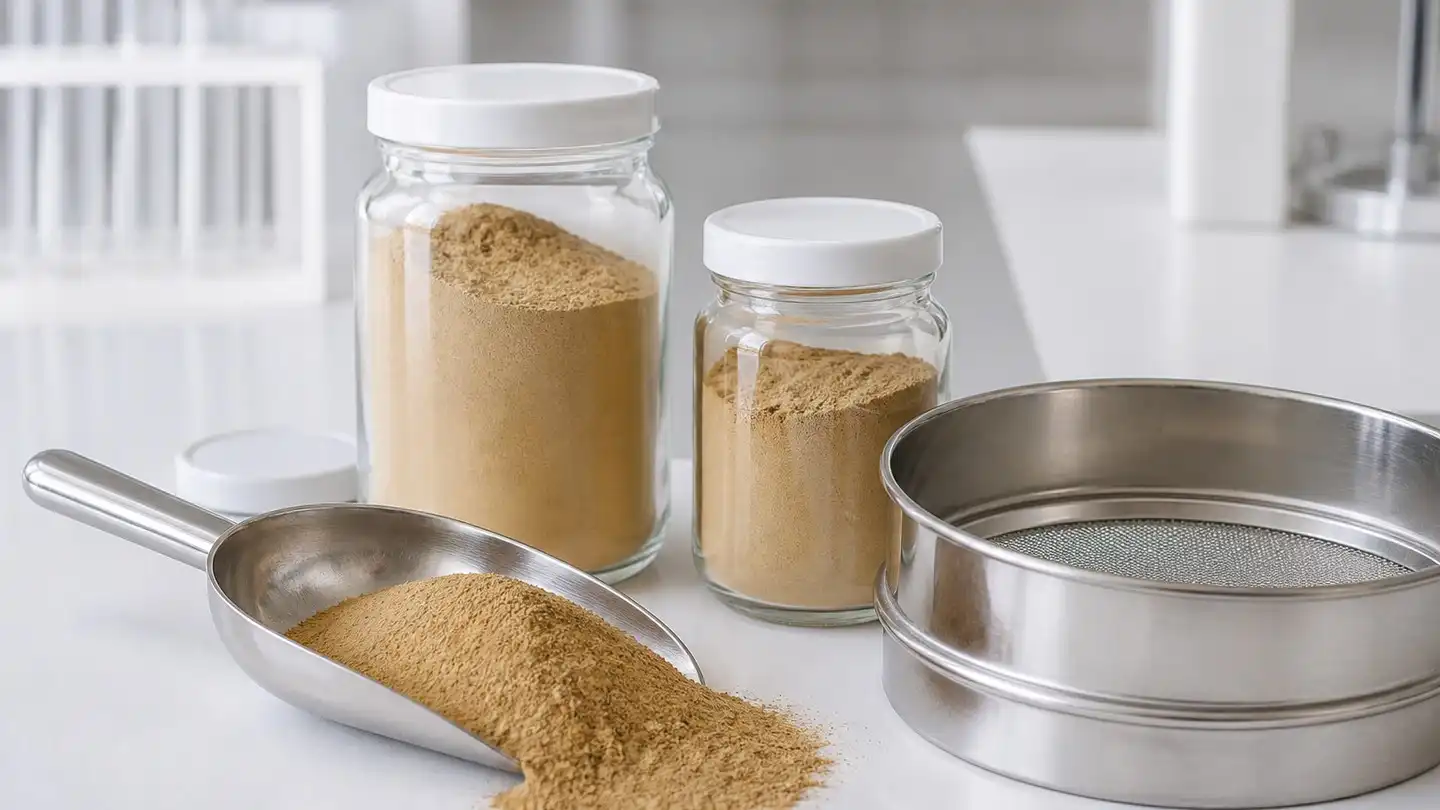
Sourcing Tongkat Ali Extract Powder for a sports nutrition label is not the same job as buying a botanical ingredient for a general food product. The powder may look identical on the bench, but the questions a sports nutrition brand has to answer—and the documents it must be able to produce on demand—sit in a different category. A food buyer worries about identity, safety and shelf life; a sports brand must also demonstrate how a finished lot relates to the controlled-substance expectations of the programmes its consumers actually rely on. The root-derived, tan-brown material described on our Tongkat Ali Extract Powder specification is supplied against a written specification, and this article is written for the procurement, quality-assurance and regulatory readers who have to decide whether any supplier's documentation is strong enough to build a sports product on.
What a Sports Nutrition Brand Needs That a Food Buyer Does Not
Every ingredient buyer wants a certificate of analysis. What separates a sports nutrition programme is the need to prove something a food buyer is never asked to prove: that a batch has been assessed against the substances prohibited in sport, and that the assessment is documented in a way an anti-doping body, a retailer's quality team or a national governing body can trace back to a specific lot.
That obligation sits with the brand, not the ingredient seller. The ingredient-level question is therefore not whether the plant is banned—it is not—but whether the brand can show, with independent evidence, what was tested, who tested it, against which list, and for which lot.
Third-Party Testing Arrangements: What Actually Exists
Sports-facing supply chains generally recognise three credible independent schemes, each with a published scope. NSF's Certified for Sport® programme audits and tests finished products against a banned-substance panel and is recognised or recommended by organisations including USADA, Major League Baseball, the NHL and the NFL. The Informed Sport programme, run by LGC, tests every batch of a certified product before release and is built specifically around elite-sport risk. BSCG offers a family of programmes—its Certified Drug Free plan tests every finished-product lot against a menu it describes as covering more than 450 substances—and publishes a comparison of how the major schemes differ.
The key point for procurement is that these are finished-product certifications, granted to the brand that puts the product on the shelf. An ingredient supplier cannot hand a sports brand a borrowed badge. What an ingredient partner can genuinely provide is the raw material for the brand's own certification pathway: a lot-specific, independently generated test report the brand can reference.
What a Certificate Does—and Does Not—Prove
A banned-substance report proves exactly what its wording says, and no more. It describes a defined panel of target substances screened in a defined sample of a defined lot, by a named laboratory, on a stated date. It does not prove that the ingredient can never be contaminated; it proves that this screen, on this sample, found no finding above the reporting thresholds. So read the panel and the limits, not the logo, and check which edition of a reference list the report was built against, since those lists change annually.
Manufacturing certifications are a different class of evidence and are frequently misread as anti-doping proof. GMP and ISO or HACCP certificates describe how a facility is controlled; they say nothing about banned-substance screening. A supplier that leads with a GMP certificate when you asked about controlled-substance testing has, in effect, answered a different question.
Reading the Answer: Laboratories, Schemas and Supplier Statements
When a supplier replies, separate the response into two parts. The first is who tested: an accredited, independent laboratory is worth more than an in-house bench, and the recognised benchmark for a testing laboratory is accreditation to ISO/IEC 17025, which addresses the competence to produce valid results. The second is what was tested: a report naming the lot, the method and the result, versus a sentence in an email.
A supplier's own written assurance is a compliance statement, not a test report. It belongs in a supplier-qualification file, but never at the top of the evidence stack. If a supplier cannot or will not share an independent report and can only state that its product is "suitable for athletes", record that as a limitation, not a feature. Our guide to choosing pure Tongkat Ali extract powder products sets out how the same separation—statement versus measured evidence—applies to authenticity and identity checks.
Label and Lot Integrity
Traceability is the connective tissue of a sports nutrition defence file. It is also the part most often lost between the supplier's warehouse and the retail shelf, because supplier lot numbers and brand lot numbers rarely match.
Batch Coding and Retained Samples
Ask how material is coded at the supplier, whether internal batch numbers are printed on the outer packaging or only held in an ERP system, and how long the supplier retains a sealed sample of each batch. Retained samples are what make a retrospective test possible months after delivery—a retail complaint or a regulator's query can usually only be answered if somebody still holds material from the original lot.
Connecting the COA Lot Number to the Retail Lot
A certificate of analysis is only useful if the brand can walk from the code printed on the retail pack, through the brand's own production lot, back to the supplier's COA. That requires an explicit mapping the supplier agrees to maintain, ideally written into the supply agreement rather than left to email requests. When the two numbering systems are unrelated and no cross-reference exists, the audit trail breaks precisely where it is needed.
What to Request When a Finished Product Is Audited
If a retailer or an anti-doping body raises a question about a finished product, the brand will be asked to assemble, quickly, the incoming COA for the relevant lot, the banned-substance report covering it, retained-sample availability, and the supplier's traceability record. A supplier that can produce all four within a defined response window turns a crisis into a routine file pull; one that cannot is a single point of failure in the recall plan.
Specification Content That Matters for a Sports Product
The specification is the contract. A value that is irrelevant for one format can be decisive for another, so read the spec line by line and ask what each figure is measured against.
Declared Marker Content and the Method Behind It
Some suppliers standardise to a named compound—in this botanical, eurycomanone is the most common—and quote a percentage by HPLC. Others supply ratio extracts and quote a UV or TLC method, as the extract on our product page does with its stated test methods and ratio specifications. Both approaches can be legitimate; what matters is internal consistency. The declared basis on the specification, the result on the COA and the description the brand carries forward must all describe the same thing, measured the same way. A named method with no chromatogram, reference standard or validation note is a method you cannot audit.
Ratio Versus Standardisation
A ratio figure such as 10:1 expresses how much raw material went in, not what came out. Standardisation expresses how much of a defined marker the finished powder carries. The two answer different questions; a team that treats a ratio as a marker content will over-pay for the wrong guarantee. Specify the basis you will test against, and insist the COA reports that same basis.
Plant Part, Identity and Physical Attributes
Confirmation of the plant part used is part of raw-material identity, and it belongs in the specification alongside the botanical name. For a sports product, the physical attributes decide whether a powder behaves in production: mesh or particle size and its pass-through percentage, moisture content, bulk and tapped density, and behaviour in water—solubility or dispersibility and residue. These are engineering values, not marketing values, and they should be stated as ranges with test methods. Carriers and excipients belong in the same conversation, because a declared carrier is a declared ingredient.
Carrier Declarations
If a powder is standardised or standardised onto a carrier, or blended for flow, every added material must be named with its function. Undisclosed carriers create two problems at once: a labelling problem and a specification problem. Buyers comparing powders on declared active content alone will miss the fact that the carrier differs. Our note on MCT oil powder specifications, carriers and quality standards illustrates how much of a specification's real content lives in the carrier system rather than the headline figure—the principle transfers directly to any carrier-assisted botanical powder.
| Document to request | What to ask for | What it establishes | Common weak point |
|---|---|---|---|
| Specification sheet | A dated, revision-controlled version | The baseline each COA is tested against | Undated PDFs with no revision number |
| Certificate of analysis | Per-lot COA with lot number, methods and results | Links a specific lot to measured values | One template reused across many lots |
| Method detail | The method behind each declared value | Whether a figure is measured or inferred | A method named but never described |
| Retained-sample statement | Confirmation that a sealed lot sample is held, and for how long | Enables re-testing after a retail query | Silence on retention period |
| Banned-substance report | An independent report naming the laboratory, the scheme and the lot | Addresses controlled-substance exposure with evidence | A supplier sentence offered instead of a report |
| Allergen and contaminant declarations | Signed statements covering allergens, heavy metals, microbiology and pesticide residues | Supports label wording and retail compliance | Vague, conditional wording |
| Traceability map | The route from raw material to finished lot code | Connects the incoming COA to the retail pack | No cross-reference between internal and customer codes |

Allergen, Contaminant and Prohibited-Substance Declarations
Declarations are where wording matters most and varies most between suppliers. One supplier's allergen statement may be a blanket "contains none of the regulated allergens"; another's may be a precise account of the eight or nine the facility handles, cross-contact controls and cleaning validation. Those are not equivalent documents. Ask for the wording in full, in writing, and ask what is actually tested versus what is merely asserted.
Contaminant declarations follow the same pattern. Heavy-metal, microbiological and pesticide-residue results are meaningful only when tied to a method, a limit and a lot. On prohibited substances, insist on the distinction already drawn: an independent test report is evidence, while an assurance is a promise.
Contract Terms Worth Fixing
Documentation is fragile unless the supply agreement keeps it alive. Four clauses repay the drafting effort. A change-control notification requires the supplier to tell the brand before altering anything that touches the specification—raw-material source, processing, carrier or test method. A batch-to-batch COA supply clause makes a per-lot certificate a delivery condition, not a favour. A recall-cooperation clause commits the supplier to assist with traceability and retained samples within an agreed window. Finally, a defined specification-amendment process states who may change the spec, how it is versioned and how much notice applies. Without these, a specification is a snapshot rather than a standing commitment.
A Supplier-Qualification Scorecard
Score suppliers on evidence, not on rapport. Weight the criteria so that documentation and transparency dominate, because those are the two things a sports brand cannot reconstruct after a problem appears. Our analysis of how buyers evaluate botanical powder suppliers uses the same logic for a different ingredient: technical requirements, regulatory documentation and supply-chain reliability, assessed separately before price is allowed into the room.
| Criterion | What you are scoring | Weight | Evidence to demand |
|---|---|---|---|
| Documentation depth | Completeness, control and currency of the specification, COA and declarations | 30% | Revision-controlled spec, per-lot COA, full method detail |
| Testing transparency | Independence of laboratories and willingness to share reports | 30% | Named ISO/IEC 17025 laboratory; scheme report on request; openness to counter-testing |
| Supply reliability | Batch-to-batch consistency, lead-time record and change discipline | 25% | Historical COA trend, change-notification clause, lead-time history |
| Commercial fit | Sampling, packaging, responsiveness and clear terms | 15% | Sample turnaround, packaging specification, unambiguous quotation |
Conclusion
For a sports nutrition brand, the choice of a Tongkat Ali extract supplier is a documentation decision as much as a purchasing one. The ingredient is not a controlled substance, but the brand's obligation to demonstrate controlled-substance diligence is real, and it can only be met with lot-specific, independent evidence and an unbroken traceability chain. Weight the scorecard toward suppliers who can hand over a controlled specification, a per-lot certificate, an independent test report and a traceability map—and who are unbothered when you ask to verify them.
Wellgreen supplies Tongkat Ali Extract Powder against a written specification, with the certifications and test methods published on its product page, and it expects buyers to ask exactly the questions above. To request the current specification, a sample lot and a documentation pack, contact the team at wgt@allwellcn.com, or review the full Tongkat Ali Extract Powder page for the declared specification and stated test methods.
Disclaimer: This article provides technical and commercial information for industry professionals only; it is not medical advice, and use levels, regulatory status and label claims must be confirmed against target-market rules and your own product data.
References
- World Anti-Doping Agency. The Prohibited List. https://www.wada-ama.org/en/prohibited-list
- U.S. Food and Drug Administration. Current Good Manufacturing Practices (CGMPs) for Dietary Supplements. https://www.fda.gov/food/dietary-supplements/current-good-manufacturing-practices-cgmps-dietary-supplements
- U.S. Food and Drug Administration. FDA 101: Dietary Supplements. https://www.fda.gov/consumers/consumer-updates/fda-101-dietary-supplements
- NSF. Certified for Sport®. https://www.nsfsport.com/
- LGC. Informed Sport—Banned Substance Testing & Certification. https://sport.wetestyoutrust.com/
- Banned Substances Control Group (BSCG). Third-Party Certification and Testing. https://www.bscg.org/
- International Organization for Standardization. ISO/IEC 17025—Testing and Calibration Laboratories. https://www.iso.org/ISO-IEC-17025-testing-and-calibration-laboratories.html
- European Parliament and Council. Regulation (EU) No 1169/2011 on the Provision of Food Information to Consumers. https://eur-lex.europa.eu/legal-content/EN/TXT/?uri=CELEX%3A32011R1169