
Yucca Extract Feed Grade Supports Better Ammonia Management in Animal Nutrition
2026-09-17 18:07:38
Yucca extract feed grade is one of the few botanical feed additives a formulator can specify to a number, act on, and verify in the barn. Standardised to a declared steroidal saponin content and derived from Yucca schidigera, it is used by poultry, swine and aquaculture producers to lower aerial ammonia, improve litter condition and protect feed conversion. This guide covers the mechanism, the published dose ranges, the regulatory position in the United States and the European Union, and the checks QA teams should complete before a first order.
Understanding Yucca Extract and Its Role in Animal Nutrition
What Makes Yucca schidigera Extract Unique?
Yucca schidigera is a desert plant native to the Mojave region of the southwestern United States and northern Mexico. The commercial extract turns on two fractions: a group of steroidal saponins — surface-active compounds, and the fraction most suppliers standardise and sell against — and a glycol fraction associated with ammonia-binding capacity in the animal nutrition literature, as described in Cheeke's review of Yucca schidigera and Quillaja saponaria saponins.
That combination separates yucca from a simple adsorbent. Saponins are surfactants: they bind ammonia directly and interact with the microbial activity that produces it. The commercial consequence is that the active is defined by an assay value, so the ingredient can be bought, blended and scaled like any other standardised raw material. Wellgreen standardises feed-grade yucca extract from 10% to 98% saponins with customisable particle size, so the grade follows the line rather than the other way round.

Regulatory Standing and Safety Profile
United States. Yucca schidigera extract is listed for use as a natural flavouring substance under Title 21 of the Code of Federal Regulations, Section 172.510. A 2026 review published in Animals reports that on this basis it may be added to animal feed as a flavouring agent at a maximum inclusion level of 125 mg/kg in complete feed. That ceiling matters commercially: 100 g per tonne of complete feed equals 100 mg/kg and sits inside the limit, while some rates quoted in the research literature exceed it.
European Union. The extract is authorised as a sensory feed additive for all animal species and is currently subject to re-evaluation under Regulation (EC) No 1831/2003. Confirm the current entry in the European Union Register of Feed Additives at the time of order rather than relying on an older specification sheet.
Safety evidence. In a 35-day broiler study using liquid yucca in drinking water at 0.5 and 1 mL/L, serum markers of liver and kidney function were not affected at either level. That is a study-specific finding at the doses tested, not a general safety guarantee, and it does not replace species-specific tolerance data for your market.
How Yucca Extract Reduces Ammonia in Poultry and Swine Housing
Ammonia in a livestock building comes from nitrogen, and the conversion is biological. Poultry excrete most of their nitrogen as uric acid; urease-producing bacteria in the hindgut and litter hydrolyse it to urea and then to free ammonia, which volatilises. The rate is temperature-dependent, which is why the problem concentrates in warm, densely stocked houses with wet litter.
The performance cost is well documented. Miles and colleagues reported body-weight reductions in broilers of approximately 2%, 17% and 21% at ammonia concentrations of 25, 50 and 75 ppm respectively, and University of Georgia extension guidance recommends holding house ammonia below 25 ppm. The same 25 ppm figure appears in occupational health guidance for farm workers, which makes air quality a bird-performance issue and a workplace-compliance issue at once.
Saponin-standardised yucca addresses the source rather than the symptom. Published trials consistently report lower nitrogen in the litter alongside lower aerial ammonia, because the effect is on nitrogen retention and excretion rather than odour perception alone — so the outcome shows up in litter analysis. The boundary is worth stating: yucca changes nitrogen chemistry, not ventilation rates, drinker maintenance or stocking density, and belongs as one component of an ammonia-management programme.
What the Published Data Show
- Laying hens, dietary inclusion (Chepete et al., 2012): comparing 0, 50, 100 and 200 ppm of Yucca schidigera in the diet, the 100 ppm level significantly reduced ammonia emissions by 44% and 28% on the first and second days of manure storage respectively.
- Broilers, liquid supplementation in drinking water (Ayoub et al., 2019): litter nitrogen at day 35 fell from 1.20% in the control group to 0.72% at 0.5 mL/L and 0.56% at 1 mL/L. Litter moisture decreased significantly, and feed conversion ratio improved from 1.93 in controls to 1.67 at 1 mL/L (p = 0.05).
Together the two trials tell the same commercial story: solid-phase nitrogen in the litter falls, air ammonia falls with it, and the litter stays drier — the variable producers tend to notice first.
Comparing Yucca Extract with Other Ammonia-Control Feed Additives
Procurement teams usually compare yucca saponins against four other options. Each works through a different mechanism, and that difference explains most of the cost argument.
| Additive group | How it acts | Practical implication |
|---|---|---|
| Yucca saponins | Surface-active; binds ammonia and interacts with ammonia-producing microbial activity; lowers nitrogen in excreta | Active at low inclusion rates; standardised by assay; supports clean-label positioning |
| Zeolites and activated charcoal | Physical adsorption of ammonia already formed | Does not reduce ammonia generation; requires higher mass inclusion |
| Acidifiers | Lower gut or litter pH, suppressing part of the bacterial population | Ammonia effect is indirect and varies with species and litter conditions |
| Synthetic urease inhibitors | Targeted enzyme inhibition | Highly specific, but under close regulatory scrutiny in several markets and hard to present as clean label |
| Plant essential oils | Antimicrobial action on gut and litter microflora | Broad-spectrum; ammonia effect is secondary to the antimicrobial mode of action |
Two points follow. First, yucca saponins and the adsorbents are not alternatives on a like-for-like basis: an adsorbent captures ammonia that has already formed, while yucca acts on the nitrogen route before it volatilises. Second, because saponins work at low inclusion rates, the meaningful comparison is cost per tonne of complete feed at the dose that meets your specification — built from your own quotation and assay requirement, not a catalogue price per kilogram.
Procurement Guide for Yucca Extract Feed Grade
What Buyers Should Verify Before Sourcing?
Four items belong on the checklist.
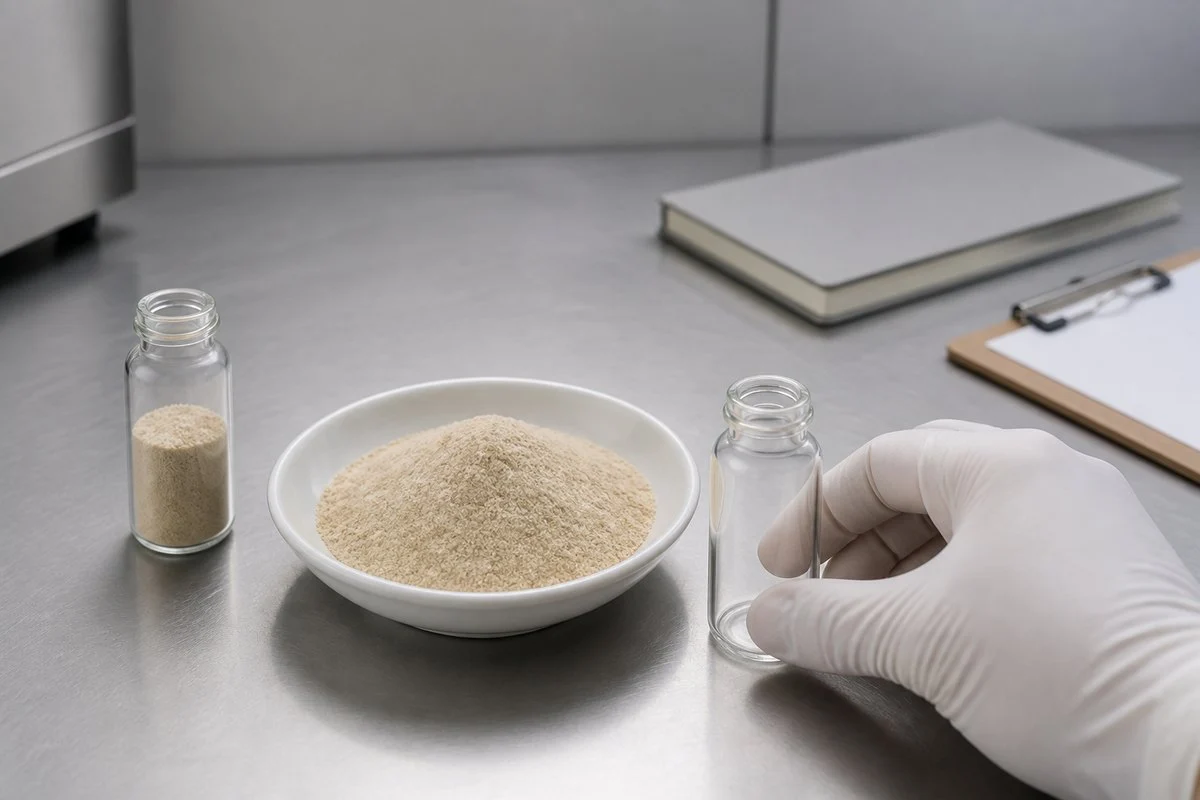
- Saponin assay data and the analytical method. Every batch COA should state the measured saponin content and the method used (UV or HPLC). A percentage without a named method cannot be compared against another supplier's.
- Feed-grade compliance documentation. Look for GMP certification, ISO 22000 and FAMI-QS, the scheme built for the specialty feed ingredients supply chain.
- Particle size specification. Consistent granulometry protects premix homogeneity and flow. Ask for D50 and D90 values measured on the grade you will actually receive.
- Contaminant and microbiological limits. Request the full panel for the delivered batch — heavy metals, mycotoxins and microbial load — not a generic specification sheet.
A typical published specification for feed-grade yucca extract looks like this:
| Parameter | Typical specification |
|---|---|
| Botanical source | Yucca schidigera |
| Active | Steroidal saponins, standardised 10% – 98% |
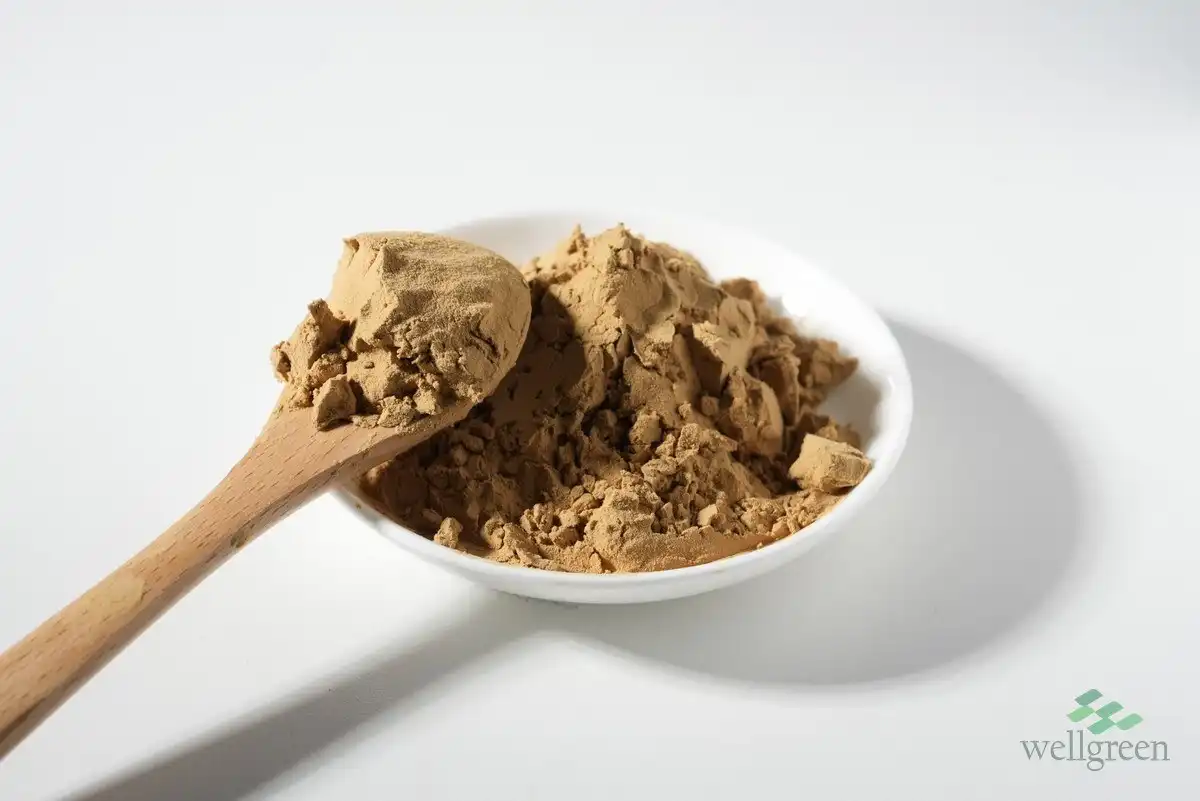
| Appearance | Light yellow to brownish powder |
| Moisture | ≤ 5.0% |
| Heavy metals | < 10 ppm (ICP-MS) |
| Particle size | Standard or customised; D50 / D90 reported on request |
| Certification | FAMI-QS, cGMP, ISO 22000 |
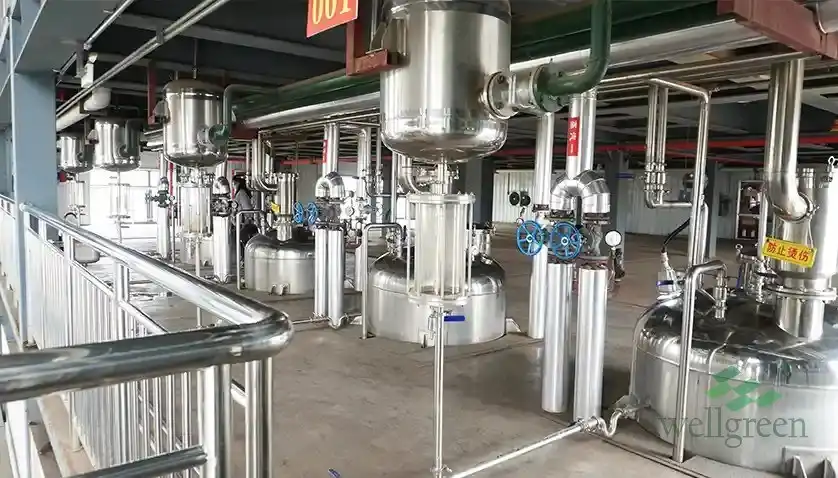
Wellgreen manufactures under a cGMP-certified quality system and ships with a documentation package covering COA, MSDS and certificate of origin. Concentration and particle size are customisable, so a programme can start on a trial quantity and scale to an annual contract without changing supplier or specification.
Real-World Applications and Documented Results
In commercial poultry production, saponin-standardised yucca has been evaluated in both layer and broiler systems. Chepete and colleagues measured the ammonia effect directly in manure storage; Ayoub and colleagues tracked litter nitrogen, litter moisture and feed conversion across a full broiler cycle. Su and colleagues reported improved feed efficiency and antioxidant status in broilers receiving dietary yucca extract, and Oelschlager and colleagues tested Yucca schidigera-derived saponin under a mixed Eimeria challenge — the more demanding test, because it measures the additive in a flock under enteric stress.
The same mechanism travels to species where ammonia is a water-quality problem rather than an air-quality problem. A 2026 review of Yucca schidigera extract synthesises the species-specific evidence across pigs, poultry, ruminants and aquatic animals, including its role in ruminal nitrogen metabolism and intestinal barrier integrity. In recirculating aquaculture systems the metric is total ammonia nitrogen (TAN), and the argument is the same one that applies in a poultry house: nitrogen retained by the animal is nitrogen that does not have to be managed downstream.
As restrictions on antibiotic growth promoters tighten, producers are looking for plant-derived alternatives that solve a defined production problem without leaving synthetic residues. An additive standardised by assay and documented to a recognised feed scheme fits that brief better than one sold on botanical origin alone.
Conclusion
Yucca extract feed grade is a standardised botanical ingredient with a defined mechanism, published dose ranges and an established regulatory framework in the two largest feed markets. Its steroidal saponins act on the nitrogen route that produces ammonia, which is why the effect appears in litter analysis and barn air, and why feed conversion improves alongside air quality in the trials that measure both.
For buyers, three specification decisions carry most of the risk: saponin content sets the inclusion rate, the inclusion rate determines whether the dose fits the regulatory ceiling in the destination market, and the analytical method behind the assay determines whether two suppliers' numbers can be compared at all.
FAQ
What is the recommended inclusion rate for yucca extract in feed?
Published trial work sits roughly between 50 and 200 g per tonne of complete feed, with 100 g per tonne (100 ppm) among the most frequently cited levels. Wellgreen's standard guidance is 60 to 120 g per tonne of complete feed, depending on the saponin concentration of the grade supplied. Note that 125 g per tonne equals 125 mg/kg, the maximum inclusion level reported for yucca extract used as a flavouring agent in feed in the United States — confirm your intended dose fits the applicable regulatory route in your market before finalising the formulation.
Is yucca extract suitable for all livestock species?
Yucca schidigera extract is authorised in the European Union as a sensory feed additive for all animal species and is listed for use as a natural flavouring substance in the United States, and published application data cover poultry, pigs, ruminants and aquatic species. What varies by species is the effective dose and the regulatory route, not the availability of the ingredient. Species-specific levels and market rules should always be confirmed before commercial use.
What saponin concentration should I specify for a premix application?
A mid-range grade such as 60% saponins is usually the practical balance between potency and handling: the inclusion volume stays low enough for accurate weighing while remaining easy to disperse in a carrier. Where precise micro-dosing is the priority, grades above 80% are the better fit. If your premix line has limited weighing resolution, a lower assay grade with a larger inclusion volume can be the more reliable route.
How does yucca extract compare in cost-efficiency to zeolites?
The two work by different mechanisms, so a straight price-per-kilogram comparison is not informative. Zeolites and activated charcoal adsorb ammonia that has already formed and are typically included at much higher mass; yucca saponins act at low inclusion rates on the nitrogen route that produces it. Compare cost per tonne of complete feed at the dose required to meet your specification, net of any effect on litter management and feed conversion, and build that comparison on your own numbers.
Partner with Wellgreen for Reliable Yucca Extract Feed Grade Supply
Wellgreen is a manufacturer and supplier of Yucca Extract Feed Grade, standardised across a 10% to 98% saponin range with customisable concentration and particle size. Production runs under a cGMP-certified quality system with FAMI-QS and ISO 22000 certification, and every shipment is released with a COA, MSDS and certificate of origin. Trial quantities and bulk programmes are both supported.
To discuss a specification or request a sample and COA, write to wgt@allwellcn.com. Our quillaja extract and oregano powder feed grade lines are specified on the same basis, and custom OEM and ODM development is available for premix and blend applications.
This article is technical and commercial information for feed industry professionals, not veterinary advice. Inclusion rates, species suitability and regulatory status must be confirmed against the applicable rules and your own formulation data before commercial use. For background on how this ingredient is positioned across feed applications, see our article on how yucca extract feed grade works as a natural feed additive.
References
1. Cheeke, P. R. (2000). Actual and potential applications of Yucca schidigera and Quillaja saponaria saponins in human and animal nutrition. Journal of Animal Science, 77(Suppl. 1).
2. Chepete, H. J., Xin, H., Mendes, L. B., Li, H., & Bailey, T. B. (2012). Ammonia emission and performance of laying hens as affected by different dosages of Yucca schidigera in the diet. Journal of Applied Poultry Research, 21(3), 522–530. doi:10.3382/japr.2011-00420
3. Miles, D. M., Branton, S. L., & Lott, B. D. (2004). Atmospheric ammonia is detrimental to the performance of modern commercial broilers. Poultry Science, 83(10), 1650–1654. doi:10.1093/ps/83.10.1650
4. Ayoub, M. M., Abd El-Hack, M. E., et al. (2019). Effects of liquid yucca supplementation on nitrogen excretion, intestinal bacteria, biochemical and performance parameters in broilers. Animals, 9(12). PMC6940917
5. Saeed, M., Arain, M. A., Naveed, M., et al. (2018). Yucca schidigera can mitigate ammonia emissions from manure and promote poultry health and production. Environmental Science and Pollution Research, 25(35), 35027–35033. doi:10.1007/s11356-018-3546-1
6. Oelschlager, M. L., Rasheed, M. S. A., Smith, B. N., Rincker, M. J., & Dilger, R. N. (2019). Effects of Yucca schidigera-derived saponin supplementation during a mixed Eimeria challenge in broilers. Poultry Science, 98(8), 3212–3222. doi:10.3382/ps/pez051
7. Su, J. L., Shi, B. L., Zhang, P. F., Sun, D. S., Li, T. Y., & Yan, S. M. (2016). Effects of yucca extract on feed efficiency, immune and antioxidative functions in broilers. Brazilian Archives of Biology and Technology, 59. doi:10.1590/1678-4324-2016150035
8. Applications and action mechanisms of Yucca schidigera extract in animal production. (2026). Animals, 16(15), 2376. doi:10.3390/ani16152376
9. Regulation (EC) No 1831/2003 of the European Parliament and of the Council on additives for use in animal nutrition. EUR-Lex 32003R1831
10. U.S. Food and Drug Administration. 21 CFR 172.510 — Natural flavoring substances and natural substances used in conjunction with flavors.
11. University of Georgia Cooperative Extension. Controlling ammonia generation in poultry houses. Precision Poultry.