
Yucca Saponins 30% vs 60%: A Feed Grade Guide
2026-11-17 17:34:32
The label says saponins 30 or 60 percent - and the quotation says two very different numbers per kilogram. This brief decides the question the way a feed mill actually faces it: what the percentage really measures, why two "60%" lots can perform differently, what the published broiler, swine, ruminant and aquaculture evidence says about dose, what each grade costs per unit of active at the mixer, how each behaves through pelleting and water lines, and what the US, EU and Chinese rulebooks allow in 2026. By the end you will know which grade belongs in which line - and how to pilot it in a month.
Key takeaways
Grade is an active-delivery decision, not a prestige label. The 60% grade wins on cost per unit of saponin whenever its price stays below double the 30% price - and it arrives with half the inert carrier, half the premix space and half the freight per active[13][14].
The percentage is only as real as its method. Declared saponin rides on UV colorimetry against a reference standard, while B50 measures haemolytic behaviour (lower is stronger)[7][13]. Two "60%" lots from different suppliers can behave differently; buy method, standard and batch numbers, not adjectives.
The published dose corridor is grade-blind and mass-based: 100-125 mg/kg diet for broiler growth and ammonia work, 500 mg/kg for coccidia-adjacent gut protection under challenge, and 0.5-1 mL/L liquid in water for 8 hours daily[1][2][3]. Hold the grams and switch the grade, and you change the saponin delivery - deliberately or by accident.
Regulation is the quiet tiebreaker. The US flavouring listing caps yucca at about 125 mg/kg complete feed, so inside that fixed mass slot the 60% grade simply delivers double the actives[2][12]; the EU keeps yucca under sensory-additive re-evaluation, and China lists it in the Feed Additives Catalogue[2].
Pilot before you premium. Four houses or two pond pairs, litter nitrogen plus handheld NH₃ readings plus FCR, one composite assay per arm - a month of data settles the grade question your supplier quotations opened.
1. The Direct Answer: Which Grade Belongs in Which Line
Direct answer: buy 30% saponin yucca extract for volume feed routes where the premix slot is generous, the price per kilogram stays below half of the 60% quote, and carrier mass and colour are harmless. Buy 60% whenever three things are true: its price per kilogram is less than double the 30% price (so cost per active unit wins), your law caps additive mass rather than actives (the US 125 mg/kg flavouring ceiling is the classic case), or your application meters actives through water - ponds, lines and high-pressure dosing - where every gram of inert carrier is residue you pay to ship and clean.
Everything else in this brief is footnotes to that sentence. Five rules of thumb, before the evidence:
The break-even is arithmetic. Ignore brand stories: 60% becomes the cheaper active the moment its price per kilogram stays under double the 30% price for the same assay method. A quote sheet with both tiers side by side answers 80% of procurement's questions before the first trial.
Mass-capped markets choose themselves. Under a 125 mg/kg inclusion ceiling, 30% delivers 37.5 g of saponin per tonne at the cap; 60% delivers 75 g - double the ammonia-binding and gut-effect potential inside the identical legal footprint[2][12].
Water-based routes are premium routes. Dosing by pond volume or by drinker line converts purity directly into operational cost: fewer kilograms handled, less carrier cloud, less biofilm food in the lines[1][15].
30% is not the "weak" grade - it is the carrier-inclusive workhorse, often the smarter buy for finisher mash, litter treatments and dry blending where the extra plant matrix is harmless[13][14].
Whatever you choose, verify it like a specification, not a certificate. The percentage on the drum only means what the named method and reference standard behind it mean - Section 3 is the shortest education in that gap available to your QA team.
A quick orientation before the numbers: the same plant material comes to market as spray-dried extract powder (30% or 60% declared saponins), as concentrated liquid (a pre-drying concentrate, pH 4.5-5.5) and as unextracted raw yucca powder. The raw straight powder - B50 2-5 mg, only partly soluble - is a different ingredient class and the floor against which both extract grades are worth explaining[13][14].
2. What "30%" and "60%" Actually Measure - and What They Hide
Direct answer: the declared number is the fraction of the powder that a stated colorimetric method recognises as saponins - steroidal saponin compounds (chiefly yucca saponins and yuccaols) that share one behaviour: they complex cholesterol in cell membranes, they foam, and their glycoside fraction binds ammonia-rich volatiles. The number says something real and three things nothing at all: not which molecules, not their purity route, not their functional strength.
Here is the composition stack of a standardised spray-dried yucca extract, as the 2026 Animals review summarises the commercial preparations: steroidal saponins (the surfactant actives), polyphenols and sapogenins (the antioxidant and signalling fraction - the Nrf2 and NF-kappaB pathway activity the review catalogues), polysaccharides and the plant matrix left from the extraction, plus the spray-drying carrier[2]. A 30% powder is roughly 300 g of saponin and 700 g of everything else per kilogram; the 60% grade is a deeper concentration of the saponin fraction with proportionally less matrix.
| Attribute | Yucca extract 30% | Yucca extract 60% | Yucca raw powder (for contrast) |
|---|---|---|---|
| Declared saponins (UV) | 30% minimum | 60% minimum | Not standardised |
| B50 (haemolysis index) | 4-8 mg | 4-8 mg | 2-5 mg typical |
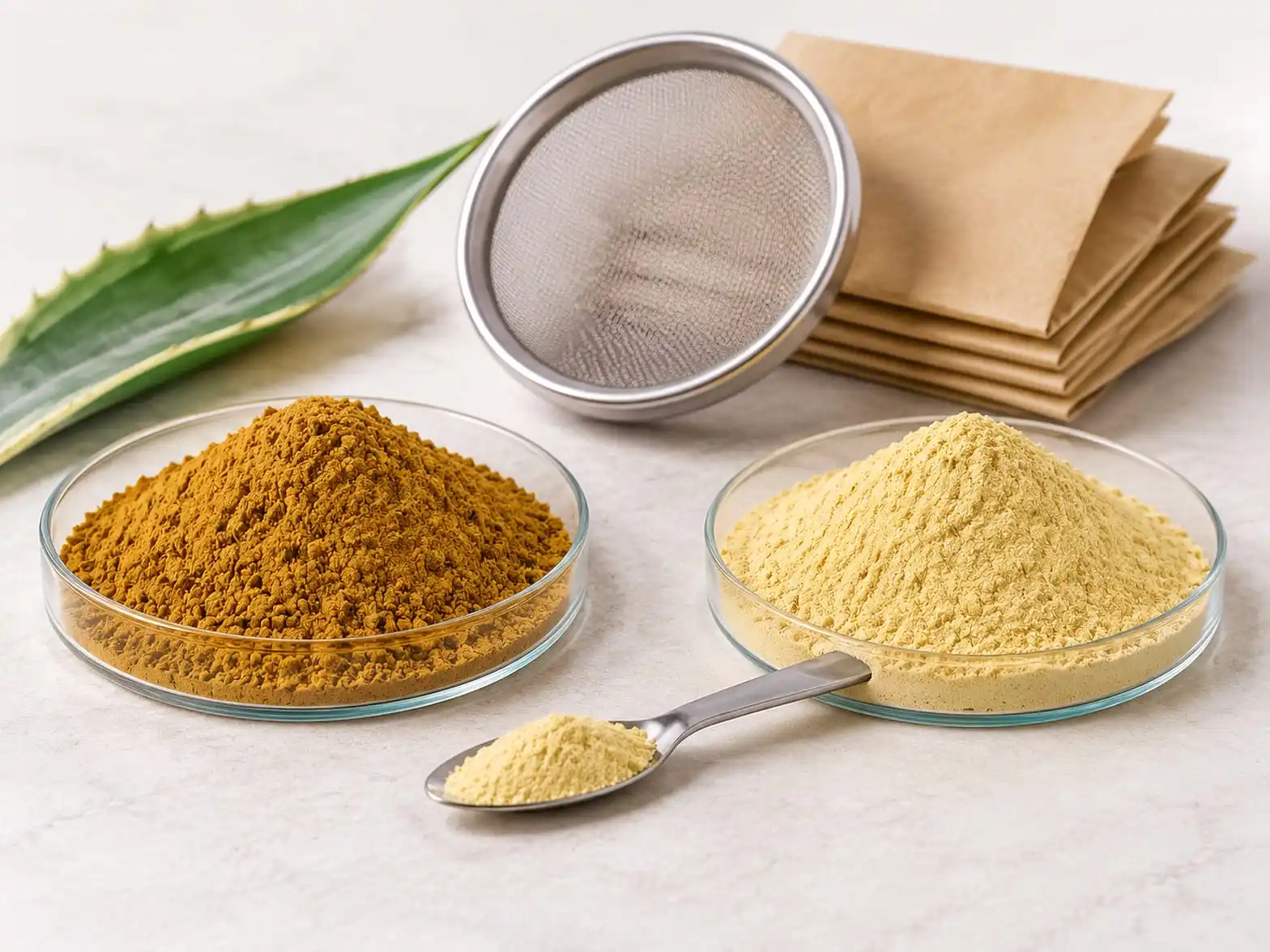
| Appearance | Brown-yellow powder | Light yellow powder | Green-brown plant meal |
| Water solubility | 100% (tested at 99% or better, 1 g/100 mL) | 100% | Partial - the visual grade test |
| Typical role | Volume feed dosing, litter-side programs, dry premixes | Mass-capped inclusions, water lines, ponds, high-pressure houses | Low-pressure odor masking, pet-treat dusting |
| Inert mass per kg of saponin | ~2.3 kg of product | ~1.7 kg of product | Far more - unstandardised |
One nuance from our own release data belongs in this section because it explains why honest suppliers over-specify rather than target exactly: a released 30% lot of ours assayed at 32.57% against the 30% minimum[13]. Declared percentages are floors under a named method, not averages - which is exactly why comparing your current supplier's "30%" against a new quotation's "30%" without both COAs on the table is guessing. Our full grade family, including the 40% and 80% tiers some markets request, is laid out in the companion spec guide "Saponin content in yucca extract: 40% vs 60% vs 80%".
3. The Assay Problem: Why Two "60%" Lots Are Not One Product
Direct answer: because the industry's declared number is a colour reaction, not a molecule count. Yucca saponins are quantified by UV spectrophotometry after a colour development (or by B50 haemolysis as a behaviour proxy), and both routes answer relative to whoever's reference standard the lab chose. HPLC and LC-MS exist and disagree happily with the colorimetry; the 2021 Molecules review of yucca analytical methods exists precisely because no single method is harmonised[7]. The difference between your best supplier's 60% and your worst supplier's 60% can be larger than the step from 30% to 60%.
Three mechanisms behind the gap, in the order a QA manager meets them:
Reference standard drift. Colorimetric saponin assays report "saponins, as % of mass, relative to standard X." Standard identity varies by lab tradition - a Quillaja-derived total saponin standard, a purified yucca saponin, or a house extract calibrated long ago. Different standards, different slope factors, different "percentages" from the same drum.
Co-reacting matrix. Polyphenols and carbohydrate degradation products from spray-drying participate in colour development. A darker, matrix-rich 30%-class lot can read above its true saponin content; conversely an aggressive purification can cut colour response without cutting activity. This is why the haemolytic B50 and the UV percentage can drift apart inside the same supplier's spec.
What nobody prints. Extraction solvent ratios, concentration temperature and spray-drying inlet heat all shape final saponin profile (the Molecules review walks the degradation chemistry)[7]. Our own process answer is documented for buyers in the manufacturing explainer: water-ethanol extraction, controlled concentration and drying curves set to protect the saponin fraction.
The purchase-order consequence is simple, and it is the most professional line you can add to a yucca spec: "Declared saponin content by UV method, reference standard named on the COA; B50 reported alongside; a retained sample from every shipment available for referee HPLC testing for 24 months." Suppliers who flinch at that sentence are answering the grade question for you.
4. What Saponins Actually Do in the Animal
Direct answer: four mechanisms carry the whole yucca story, and each one cares about delivered saponins, not about the number on the drum - which is why grade selection is a dosing question in disguise. The mechanisms: ammonia binding and urease-pathway modulation in the gut and the litter; membrane effects on cholesterol-rich targets (protozoa, some bacteria, coccidia stages); surfactant-driven emulsification that helps fat and nutrient uptake; and polyphenol signalling - the Nrf2/ARE antioxidant and NF-kappaB inflammatory pathways the 2026 review documents across species[2].
The ammonia ledger. Poultry excreta is a nitrogen time bomb: roughly 70% of the nitrogenous load arrives via the uric-acid pathway, and microbial uricase turns it into ammonia fast in warm, wet litter[1]. Yucca works at both ends of that pipeline: the extract's glyco-fraction has direct ammonia-binding capacity, saponins and polyphenols suppress gut urease and uricase activity so less nitrogen is liberated inside the bird, and the litter gets less substrate to volatilise[1][2]. Grade consequence: this mechanism is dose-of-actives dependent - double the saponins at equal inclusion mass means a deeper cut in litter nitrogen, exactly the result the liquid-dosing trial quantified[1].
Membranes. Steroidal saponins complex cholesterol in cell membranes and increase their permeability; protozoa and Eimeria stages are membrane-rich targets, which is the shared mechanism behind the anticoccidial and antiprotozoal data[2][3]. Grade consequence: this is the mechanism with the steepest dose-response - the oocyst trials that beat anticoccidials ran standardised material at 500 mg/kg[2][3].
Surfactancy. The same amphiphilic structure emulsifies fat in the digesta - the physical basis of the feed-efficiency reports, and of why saponin bitter loads and fat handling need to be balanced in high-inclusion mash diets[2].
Signalling. The polyphenol fraction upregulates antioxidant defences (Nrf2 pathway) and tones down inflammatory signalling (NF-kappaB), improving barrier integrity under challenge - relevant to heat-stress and high-density programs where "ammonia control" is really "welfare economics"[2].
The mechanism map is also the limitation map. The 2026 review states it plainly: most trials test one dose without dose-response curves, and composition varies wildly between raw powder, extract powders and compound products - which is the literature's way of saying grade and assay discipline are your job, not the meta-analyst's[2].
5. Broiler Evidence: Ammonia, Litter Nitrogen, FCR and Oocysts
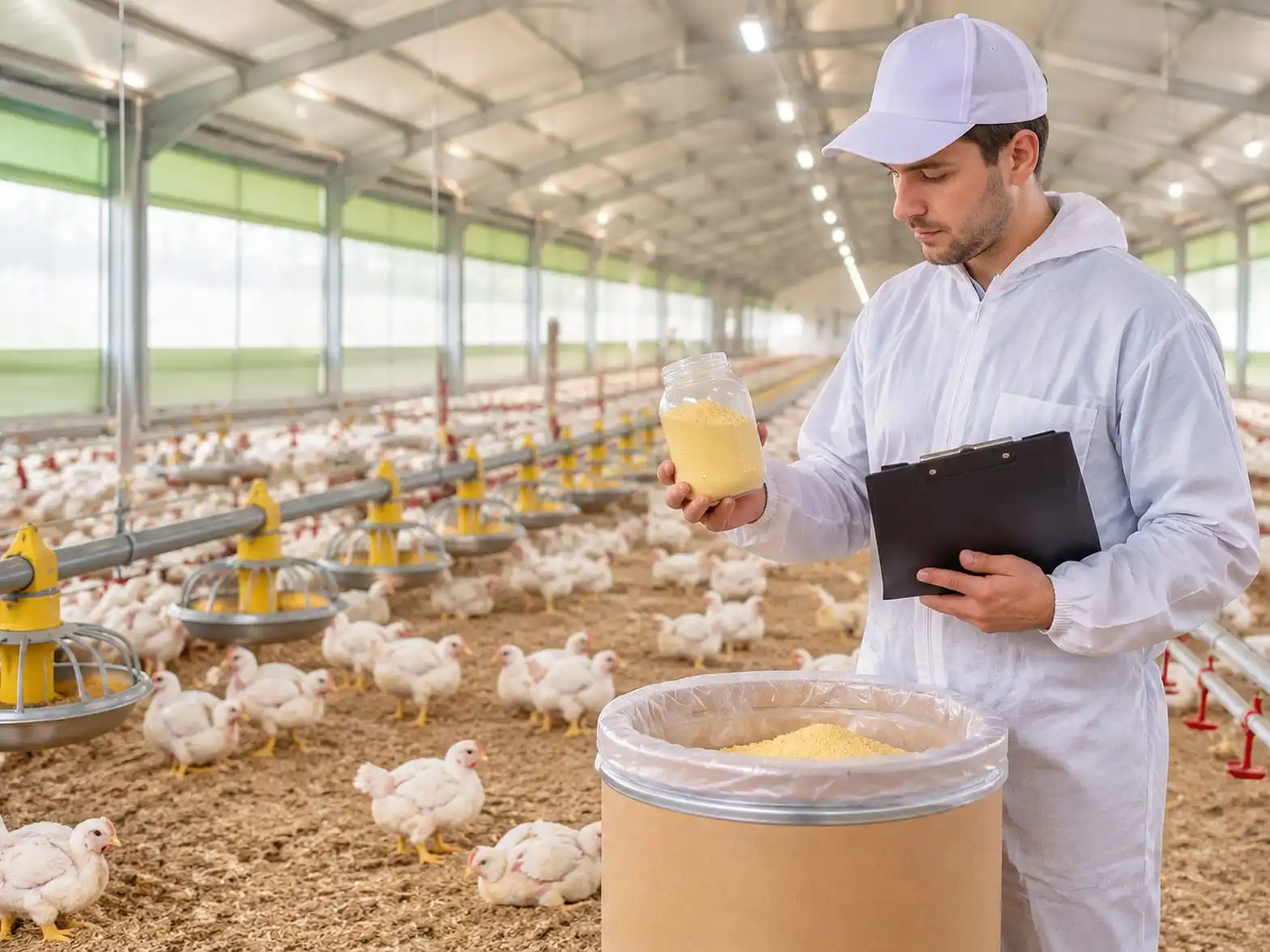
Direct answer: the broiler literature gives you a usable dose corridor and two honest cautions. Corridor: 100-125 mg/kg of extract powder in the diet for growth and ammonia work, 500 mg/kg of a standardised high-saponin product for coccidia-adjacent gut protection, and 0.5-1 mL/L of liquid extract in drinking water for 8 hours a day for the litter-nitrogen play - the dose used in the Egyptian trial that cut litter nitrogen, suppressed E. coli and improved FCR in 270 Cobb broilers without touching liver or kidney function[1][2].
What the numbers say, line by line:
Litter and air. The water-route trial above measured significantly lower litter nitrogen at days 21 and 35 versus control, alongside better FCR and higher IgM and IgG[1]. Feed-route dosing at the 100-125 mg/kg corridor reproduces the ammonia effect without water-line plumbing[2], and industry trials with saponin combinations (yucca and quillaja, alone and together) report manure-ammonia reductions in commercial-style houses[11].
Performance and economics. The 2026 review's synthesis: 100-125 mg/kg gives optimal intestinal-morphology and immune outcomes in 1-42 day broilers[2]. An Indian winter trial quantified the money: yucca supplementation returned a benefit-to-cost improvement of about 57% per bird at local feed prices - the kind of number your nutritionist can re-run with your prices in ten minutes[8].
Coccidia adjacency. In a controlled challenge trial, 500 mg/kg of a standardised saponin product (declared at minimum 10.5% saponins - note how low that "standardised" bar sits relative to feed-grade 30/60) cut oocyst counts below the anticoccidial group: 114 versus 243 OPG[2][3]. Separate work has mapped how quillaja-yucca saponin combinations interact with live coccidiosis vaccination programmes[4]. The caution: saponins permeabilise parasite membranes; ionophores kill the parasite outright; under heavy challenge the drugs stay in the program[2].
Layers and breeders. 100-500 mg/kg corridors with reported gains in lay rate, shell quality, and lower excreta moisture and ammonia - thinner evidence base than broilers, same grade logic[2].
Grade read-across: every broiler dose above is a product-mass figure, so the grade you buy silently multiplies the actives behind it. A mill switching from 30% to 60% at unchanged inclusion is running the coccidia-adjacent dose at half the price of running the growth dose at the high grade - which is precisely why the switch has to be a decision, not a procurement substitution.
6. Swine and Ruminants: Barn Gas, Protozoa and the Honest Methane Note
Direct answer: swine data supports yucca inside compound additive programs - one 22-week wean-to-finish trial carried 700 mg/kg of extract inside a commercial additive package that also included beta-mannanase, and reported lower harmful-gas emissions and higher vaccine antibody titres[2]. In ruminants the honest headline from the 2026 saponin reviews is asymmetry: yucca's steroidal saponins reliably depress ammonia-N and usually suppress ciliate protozoa, but their methane response is variable and sometimes absent - unlike triterpenoid-rich quillaja - because steroidal saponins are gentler on membranes and rumen microbes adapt[5][6].
Pigs. The practical case is air quality in intensive units (the same urease-and-binding logic as poultry, applied to slurry surfaces) plus the immunostimulant observation above; pre-weaning calf dosing in the review runs about 9 g/head/day[2]. Barn gas is a mass-of-inclusion problem; 60% earns its premium when dosing through a constrained premix or a liquid line.
The protozoa lever. Saponins disrupt ciliate protozoa membranes - releasing bacterial nitrogen and shifting hydrogen flow toward propionate rather than methane, the classic rumen-modifier mechanism the nutrition reviews describe[6]. The payoff pattern: better nitrogen economy and microbial protein flow, with methane down as a side effect, not a guarantee.
The methane caution. The critical 2026 narrative review says it directly: Yucca schidigera "consistently reduces ammonia-N and often decreases protozoa, yet its methane response is variable and sometimes absent"[5]. If your customer is writing methane-reduction claims into contracts, yucca is one tool in a rotation (lipids, nitrate, quillaja blends), not the signature. Grade note: at rumen doses the carrier mass of 30% is a real ration-volume question for small ruminants - high-grade or nothing.
Feed efficiency framing. Where dairy and beef trials report FCR-style gains, they report them at product-mass inclusions with wildly different saponin bases - the comparison trap the review calls out[2][5]. Standardising to cost per active unit (Section 8) is the only way to make a supplier meeting comparable.
7. Aquaculture: The Pond Is Where the High Grade Earns Its Premium
Direct answer: in ponds and tanks you dose per volume of water, every gram of carrier is suspended solids you did not ask for, and the active is doing an extracorporeal job - binding and suppressing ammonia in the water column and on the gill-gut interface. That combination makes aquaculture the clearest economic case for the 60% grade or the liquid, and the 2026 review's practical guidance points the same way: prioritise yucca extract in high-density, high-temperature and ammonia-prone systems, where its cost-effectiveness in ammonia binding beats probiotics or zeolite used alone - and pairs synergistically with Bacillus programs[2][9][10].
The evidence base: shrimp-pond work documents measurable ammonia reduction from waterborne yucca application, including the Mexican trials run with commercial growers[9][10], and the review's species tables extend the case across fish and shrimp systems for growth, survival and stress windows (grading, transport, harvest). The mechanism fits the medium: saponins' membrane effects support the gill and gut barriers exactly when thermal stress and stocking density load them, while the ammonia-binding chemistry works in the water itself[2].
Grade math at pond scale, done the way farm accountants count: cost per hectare-centimetre of treated water per active gram. A 30% powder delivers 300 g of saponins per drum-kilo and 700 g of dissolved or suspended carrier - in a pond, carrier is not neutral: it feeds turbidity, settles on the bottom as organic load, and in biofloc systems muddies the floc accounting. The 60% grade halves the handled mass, halves the storage footprint on a humid farm shed, and doubles active per scoop - and scooping is how the dose actually gets paid for at 6 a.m. The same reasoning routes pond operators to the liquid format where dosing pumps exist: fully soluble, no dust, dosed by flowmeter[15].
8. The Math That Decides It: Cost per Active Unit
Direct answer: run one ratio and the procurement argument ends. Write P30 and P60 for your two quotations in currency per kilogram. The 60% grade is the cheaper active whenever P60 is less than 2 times P30; below that line the stronger grade is buying you carrier discount, premix space and freight per active, and above it the 30% remains the volume workhorse. Everything else - colour, dust, palatability, regulatory mass caps - is a second-order term you can add afterwards.
| Line | 30% grade | 60% grade |
|---|---|---|
| Quoted price per kg (example) | 6.00 | 10.50 |
| Saponins per kg | 300 g | 600 g |
| Cost per kg of saponins | 20.00 | 17.50 - wins |
| Inclusion for 75 g saponins per tonne feed | 250 g/t | 125 g/t |
| Feed cost per tonne at that active level | 1.50 | 1.31 |
| Inert carrier per tonne of feed | 175 g | 50 g |
| Freight and storage per active unit | baseline | ~48% lower |
The worksheet teaches three transferable lessons. First, at these example prices the "cheaper bag" of 30% powder costs more per unit of the thing that actually binds ammonia - the per-kilogram comparison that procurement departments default to is structurally misleading[13][14]. Second, the carrier row is a quality row: that 175 g of extra plant matrix per tonne is hygroscopic sugar chemistry riding into your pellets - the same physics we mapped for ammonia control in livestock feed at the litter end, arriving at the mixer end. Third, the 2x-price break-even moves by itself with freight rates, premix-slot pressure and any mass-based regulatory cap - which under US flavouring rules is not elastic at all: 125 mg/kg is 125 mg/kg whichever drum you open, and only the high grade doubles actives inside it[2][12].
Read prices honestly: the 60% grade is a deeper process - more concentration, more purification, more loss management per kilogram of finished powder - so quotations that show P60 above double P30 are telling you a real cost story, and you should re-run Table 2 including carrier-side savings (drying load, dust control, bag count) before deciding. Our own commercial line: quote both tiers, compare per active, buy by application - the same worksheet our sales team sends with dual-tier quotations[14].
9. Pellet, Mash or Water Line: Process Fit by Format
Direct answer: both grades are spray-dried, 80-mesh and fully water-soluble, so neither is a process problem - but they load your process differently. 30% delivers actives wrapped in carrier mass and caramel colour, which volume mills love in dry premix and mash; 60% and liquid deliver more active per handled gram, which is what constrained premix slots, water lines and pond boats actually need.
Complete-feed dry dosing. The volume case for 30%: metered from the micro-ingredient bin, carries evenly, colours pellets in the familiar yucca amber the litter-bird market expects, and its carrier helps free flow in humid mills when drums are handled right (sealed liners, cool floor - the same powder-physics discipline as every hygroscopic botanical). If the slot is generous and P30 is far under half of P60, this is where the money is.
Premix and concentrate lines. The grade conversation turns fast at 0.25% premix inclusion: every gram of yucca displaces another micro-ingredient, and a 60% grade buying the same saponins in half the mass frees carrier, volume and often a label line. High-value premixes (creep feeds, aqua starter, medicated-feed alternates) run high grade almost by definition.
Pelleting. Saponins are not fragile molecules, but mills should still verify, not assume: pilot one batch, run a post-pellet assay on the composite at your standard conditioning window and keep the number in the spec file - the referee assay clause from Section 3 pays its first dividend here. Carrier load does the rest of the work: the 60% grade's lower sugar mass slightly reduces the moisture pickup that softens pellet durability in humid storage[7][13].
Water lines and cool pads. Fully soluble powder dissolves at either grade; the operational difference is residue and dosing concentration: at equal tank strength the 60% puts double the active and half the carrier organics in the line - less biofilm food between flushes. Where dosing is continuous, most integrators skip the jug and run liquid yucca, dosed by pump, pH 4.5-5.5, the format the broiler-literature water corridor was built on[1][15].
Liquid top-dress and dust control. On dry mash and litter-side applications, 30% powder or diluted liquid sprayed on the pellet after cooling delivers the contact chemistry where it matters - the manure surface - with the cheapest handled active[2][13].

10. The Regulatory Envelope, 2026: US, EU, China
Direct answer: yucca is one of the few botanical feed additives with clean paper in all three major systems - and the paper is where the grade decision quietly gets made. The United States lists Yucca schidigera among natural flavouring substances (21 CFR 172.510) and the current review literature states the GRAS flavouring use in animal feed at a maximum of 125 mg/kg in complete feed - a mass ceiling that rewards the concentrated grade[2][12]. The European Union authorises yucca extract as a sensory (flavouring) feed additive for all animal species, with the dossier cycling through re-evaluation under Regulation (EC) No 1831/2003; EFSA's published safety benchmark for a 15% yucca preparation sits at 250 mg/kg complete feed[2]. China lists yucca extract in the Feed Additives Catalogue for all production species[2].
Three consequences a formulator should carry out of this section:
Mass caps are the 60% grade's home turf. Where the law counts milligrams of additive rather than milligrams of saponin, grade is leverage: the same legal footprint delivers double the active. US-facing programs should treat 125 mg/kg as the design box and choose the grade that fills it.
The EU dossier conversation is about the product, not the plant. Sensory-category authorisation travels with a specified preparation; when a re-evaluation tightens maximum use levels or purity criteria, the grade you stocked determines whether reformulation is a paper edit or a drum return. Ask your supplier which EU-listed preparation their powder corresponds to - a question roughly half the market cannot answer.
Pet food is its own shelf. AAFCO-recognised flavouring use in pet food follows the same flavouring-logic and ppm conventions; a feed-grade spec sheet gets you most of the way, but the pet-food customer's audit file wants its own COA stack and palatability data[2]. The application walkthrough for pet and treat programs is in our feed and pet-food applications guide.
No jurisdiction yet publishes a harmonised "saponin content" ceiling for yucca preparations - the 2026 review flags exactly this gap - which means grade claims remain a matter between your supplier's COA and your referee method. That is freedom, and it is homework[2][7].
11. The Specification to Paste Into Your Purchase Order
Direct answer: a professional yucca spec is one page and eleven lines. It turns the grade debate from opinion into acceptance criteria - and it is written the same way whether you buy 30% or 60%, with only the numbers changing.
Identity: Yucca schidigera extract (whole-plant, water-ethanol extraction), spray-dried; declared grade 30% or 60% saponins.
Assay clause: saponins by UV colorimetry, reference standard named on the COA; referee method HPLC on dispute, cost to loser.
B50: 4-8 mg reported per lot, method stated (haemolysis index).
Physical: 98% through 80 mesh; bulk as-received; pH 4.1 plus or minus 0.2 at 20% w/w solution.
Solubility: 99% or better, 1 g in 100 mL water, no sediment ring at 10 minutes.
Moisture: loss on drying 5.0% maximum, measured value printed (our released lots run around 3.9%).
Contaminants: heavy metals as individual results (lead, arsenic, cadmium, mercury); aflatoxin and pesticide screens by third-party lab (SGS or equivalent); micro panel - TPC 1,000 CFU/g max, yeast and mould 100 max, E. coli / Salmonella / Staphylococcus not detected.
Documents per shipment: batch COA, MSDS, TDS, extraction flow chart, composition sheet, declaration for GMO and irradiation status.
Packaging: 25 kg fibre drum, double PE liner (or foil bags to your pack spec); desiccant policy stated; pallet pattern agreed before the first booking.
Retention: retained sample per batch available for 24 months; shelf life 24 months under cool dry storage.
Systems: manufacturer under ISO 9001, ISO 22000, HACCP; FAMI-QS for feed markets; Halal and Kosher where the destination asks - the certificate wall to check against is public on our quality page[13][14].
Eleven lines, and every argument in Sections 2, 3 and 8 has quietly become a contract term. The same document doubles as your incoming-QC script: first delivery, pull the composite, run the named method, photograph the dissolve test, file against the COA. Suppliers who quote both grades love this spec; the ones who grade by colour do not.
12. Grade Decision Matrix and a 30-Day Barn Trial
Direct answer: route the brief through the matrix, then run the four-week trial before committing annual volume. The grade question always collapses into three inputs - mass cap exposure, dosing route and price ratio - and the trial measures the only referee that matters: your own litter, your own pond, your own feed conversion.
| Application | Grade call | Decisive reason |
|---|---|---|
| US-facing broiler program, in-feed | 60% | 125 mg/kg mass cap is fixed; grade is the only way to buy more actives inside it[2][12] |
| EU premix, sensory-additive category | Per dossier - usually 30% | Flavouring-function use levels are low; carrier harmless; optimise price per active against the re-evaluation file[2] |
| Water-line / cool-pad dosing | 60% or liquid | Half the carrier organics per active dose; trial corridor is published for the liquid route[1][15] |
| Intensive shrimp / fish ponds | 60% | Pond volumes price actives directly; carrier becomes turbidity and bottom load[2][9][10] |
| Finisher pig mash, litter-odor program | 30% | Volume dosing, generous inclusion, carrier irrelevant, price per active wins[2] |
| Ruminant methane-claim programs | 60% within a rotation | Steroidal-saponin methane response is variable; when you dose at all, dose with headroom and pair partners[5][6] |
| Pet-food dusting / treat inclusion | 30% (or raw where unspecific) | Low dose, cost-first, carrier colour acceptable in brown kibble[13] |
| Creep feed / aqua starter / high-value premix | 60% | Premix-slot competition makes grams of carrier expensive[2][13] |
Week 1 - Bench screen. Both tiers in, dissolve tests photographed, pH and mesh verified, COA methods compared line by line. Set the referee assay with your lab now, not after a dispute.
Week 2 - Dose sheet. Fix the target in saponins per tonne (or per hectare-centimetre), convert through Table 2, and write both arms' grams-per-tonne before anyone touches a drum.
Weeks 3-4 - Live block. Four houses or two pond pairs minimum: control, 30% arm, 60% arm at equal actives, and the fourth unit at your current program's active level to detect drift. Read litter nitrogen, handheld NH₃ at bird height, FCR and mortality; ponds get TAN readings at fixed times plus turbidity notes.
Week 5 - Close-out. Cost per tonne of live weight (or per kg of harvest) for every arm; the grade answer arrives as arithmetic. Keep the dosing card your supplier writes for your species, format and standard - ours ships per specification with every trial[14].
That is the whole decision: the 30% grade is the volume workhorse that earns its keep when mass is cheap and actives are modest; the 60% grade is the dose-density tool for capped, metered and water-borne applications - and the price ratio decides which one your quotation sheet is actually recommending. Wellgreen supplies both tiers from the same FAMI-QS line, with the referee-ready paperwork either way.
13. Frequently Asked Questions
Is 60% yucca saponin always better than 30%?
No - "better" is a price-ratio question. 60% wins the moment its price per kilogram stays under double the 30% price, because the same legal or practical inclusion slot then delivers twice the actives[2][12]. It also halves carrier mass - less premix space, less freight per active, less hygroscopic sugar into the pellet. Where 30% is far below half price and the carrier is harmless (finisher mash, litter programs, brown kibble dusting), the volume grade remains the rational buy[13][14].
What is B50 and does the same B50 mean the same product?
B50 is a functional index from the haemolysis assay - the amount of extract producing 50% red-cell haemolysis under the stated method; lower means stronger[13]. Our powder grades carry a 4-8 mg declaration window. But saponin composition, not just quantity, drives haemolytic behaviour, so two lots can share a B50 at different percentages - and vice versa[7]. Buy against both numbers; they police different failure modes.
How do you convert inclusion rates from 30% to 60% yucca?
Identify the currency of the brief. Product-mass briefs (most published trials: 100-125 mg/kg diet) hold grams per tonne constant - switching grades then deliberately doubles the saponin[2]. Saponin-mass briefs halve the product and keep the active. Either way: re-verify premix slot volume, pellet colour, water-line dose and one composite assay before production[13][14].
Which grade should I buy for broiler ammonia control?
Both routes work at their published corridors: 100-125 mg/kg of extract powder in feed, or 0.5-1 mL/L of liquid in water for 8 hours daily - the water trial significantly lowered litter nitrogen at days 21 and 35 while improving FCR and immune markers[1][2]. Buy by route: capped or tight premix slots take 60%; continuous water dosing takes liquid; generous feed slots at good price ratios take 30%[13][15].
Does the higher-saponin grade hurt palatability, dust or pellets?
Saponins are bitter, so at equal product inclusion 60% doubles bitter load - screen your sensitive species before whole-program switches. At equal active exposure, pellet behaviour barely differs: 60% contributes less caramel-coloured carrier, slightly lighter pellets and a smaller hygroscopic sugar load[2][13]. Verify post-pellet recovery once per conditioning window; the carrier, not the saponin, is where moisture drama starts.
Can yucca saponins replace coccidiostats?
Under heavy challenge, no - and the literature says partner, not replacement. A standardised product at 500 mg/kg dropped oocyst counts below the anticoccidial group (114 vs 243 OPG) in a controlled trial[2][3], and quillaja-yucca combinations have been studied alongside live vaccination programmes[4]. But membrane-permeabilising actives vary with gut pH, solubility and matrix where ionophores act directly - high-pressure houses keep the drug and run yucca for the ammonia-gut loop[2].
Is 60% worth paying for in aquaculture ponds?
Almost always: ponds meter actives per volume, carrier becomes turbidity and bottom load, and shrimp-pond work documents ammonia reduction from waterborne yucca[9][10]. The 2026 review's guidance - prioritise yucca in high-density, high-temperature, ammonia-prone systems - is a high-grade argument by construction[2]. On extensive ponds with hard budgets, price the liquid or 30% per hectare-centimetre before defaulting.
What regulatory limits apply to yucca extract in feed?
US: natural flavouring listing (Yucca schidigera named in 21 CFR 172.510) with the review-literature ceiling of 125 mg/kg complete feed under the GRAS flavouring use[2][12]. EU: authorised sensory (flavouring) additive, all species, under Regulation 1831/2003 re-evaluation; EFSA safe benchmark 250 mg/kg complete feed for a 15% preparation[2]. China: Feed Additives Catalogue, all species[2]. No harmonised saponin ceiling exists anywhere - your COA is the law of the drum.
What should I check on a yucca COA before first use?
The eleven-line spec in Section 11 is the checklist: named method and standard behind the percentage, B50 with method, mesh 98% through 80, loss on drying measured (5% max), solubility 99%+ with the 1 g/100 mL test, pH at 20% solution, individual heavy metals, micro panel, third-party pesticide and aflatoxin reports, solvent statement, batch-linked retention[13][14]. A COA without a printed measured value is a marketing sheet.
What are MOQ, samples and lead times for the two grades?
Standard practice on both tiers: free 50-100 g bench samples, 1 kg minimum for trial orders, 25 kg fibre drums with double PE liners for production, 7-20 working days lead time from a 5,000-tonne annual capacity, batch COA in every shipment, FOB/CIF/DDP quoting - liquid in 25-litre drums, IBCs on request[13][14][15]. Custom saponin targets and B50 windows are routine OEM work.
14. Sources and Further Reading
Ayoub M.M. et al. Effects of Liquid Yucca Supplementation on Nitrogen Excretion, Intestinal Bacteria, Biochemical and Performance Parameters in Broilers. Animals 2019 (9:1097). pmc.ncbi.nlm.nih.gov
Applications and Action Mechanisms of Yucca schidigera Extract in Livestock, Poultry and Aquatic Animals. Animals 2026 (16:2376) - dose corridors, mechanisms, regulatory synthesis. pmc.ncbi.nlm.nih.gov
Kozłowski K. et al. Yucca schidigera Improves Performance and Lowers Oocyst Counts in Eimeria-challenged Broilers. Animals 2022. pmc.ncbi.nlm.nih.gov
Concurrent use of saponins and live coccidiosis vaccines. Poultry Science association paper (QY saponin/vaccination interaction). pmc.ncbi.nlm.nih.gov
Why Do Dietary Saponins Produce Inconsistent Responses in Ruminants? 2026 narrative review - steroidal (yucca) vs triterpenoid behaviour in the rumen. pmc.ncbi.nlm.nih.gov
A Review of Effect of Saponins on Ruminal Fermentation, Health and Productivity. 2023 - protozoa suppression and the propionate shift. pmc.ncbi.nlm.nih.gov
Structure, Bioactivity and Analytical Methods for the Determination of Yucca Saponins. Molecules 2021 - why colorimetry and chromatography disagree. mdpi.com
Evaluation of Yucca schidigera extract as feed additive on performance of broiler chicks in winter season. Veterinary World - benefit-cost data from a field trial. pmc.ncbi.nlm.nih.gov
The potential of Yucca schidigera extract to reduce ammonia pollution originating from shrimp farming. pubmed.ncbi.nlm.nih.gov
GlobeSeafood Source Advocate. Yucca extract reduces ammonia concentrations in Mexico shrimp trial. globalseafood.org
Koppen M. (Cargill). Effect of saponins from Yucca and Quillaja, added alone or in combination, on broiler performance and ammonia emissions. Engormix. engormix.com
eCFR. Title 21, Section 172.510 - Natural flavoring substances (Yucca schidigera listed). ecfr.gov
Wellgreen. Yucca extract powder - specifications, grades and sample COA. wellgreenherb.com
Wellgreen. Yucca extract powder (animal nutrition) - documents, testing and supply. wellgreenxa.com
Wellgreen. Yucca liquid - format, pH and packaging. wellgreenherb.com
Wellgreen R&D (Emily Green). Saponin content in yucca extract: 40% vs 60% vs 80%. wellgreenxa.com/info
W
About Wellgreen Technology Co., Ltd.
Since 2011 Wellgreen has manufactured plant-extract ingredients for feed, food and nutrition formulators in 60+ countries. Yucca is a flagship line: spray-dried Yucca schidigera extract at 30% and 60% standardised saponins (B50 4-8 mg, 100% water-soluble, 98% through 80 mesh), concentrated liquid at pH 4.5-5.5, and custom grade or B50 targets as OEM - released under ISO 9001, ISO 22000, HACCP and FAMI-QS systems with batch COA and two-year retained samples. This brief was prepared by the Wellgreen feed R&D team from released-lot COAs and the cited public literature; it is formulation and procurement guidance, not veterinary advice.
Quote Both Grades. Pilot the One Your Math Picks.
Send your species, dosing route and lead market. You will get dual-tier quotations (30% and 60%, same assay method on both COAs), free 50-100 g bench samples with named-standard assay reports, a dose-conversion worksheet built on Table 2, and a dosing card written for your barn or pond - then drums in 7-20 days if the trial says go.