
Wellgreen Wraps SupplySide West 2026: Buyers Arrived With Spec Sheets
2026-11-11 18:55:40
The most distinctive thing about this year's botanical extract conversations at SupplySide West 2026 was what buyers carried: printed specifications, CoAs from previous suppliers, and in several cases a sample of material that had failed in production. Wellgreen closed three days at Booth 7751 — 28–30 October, Mandalay Bay Convention Center, Las Vegas — with a steady stream of extract buyers who had already defined what they needed and were testing whether this supplier could hit it.
That is a different conversation from the one most booths were having. Fewer visitors asked what the company sells. More opened a folder, pointed at an assay range, and asked whether the specification could be met at volume with documentation that would survive their own QA review. The three days were, in effect, a series of specification reviews conducted standing up.
| Show | SupplySide West 2026 |
| Dates | 28–30 October 2026 |
| Venue | Mandalay Bay Convention Center, Las Vegas, NV, USA |
| Booth | 7751 |
| Focus | Botanical and plant-derived extracts |
The Question That Started Most Conversations
"Can you hit this spec?" — not "what do you sell?" That single shift defined the show. Extract buyers arrived knowing their marker compound, their assay range, their application, and often the exact reason a previous lot was rejected: it went out of solution in a beverage, it darkened a gummy, it drifted below assay after three months on stability, or it simply did not match the reference standard their own lab uses.
The conversations that followed were technical and specific. A buyer asking about broccoli extract wanted to know which glucoraphanin level was achievable and by which analytical method, not whether the product exists. A buyer asking about apple cider vinegar wanted to confirm that the mother was retained at the percentage they needed, because that detail is written into their label. A buyer asking about beet root wanted solubility and color performance in a drink, because a specification that reads correctly on paper can still fail in a batch tank.
Visitors who came with a document left with a specific answer, a sample commitment, or a clear "not at that specification." Visitors who came without one generally left with a catalog — a different outcome, and a fair reflection of how much the conversation depends on the buyer's own definition of the material.
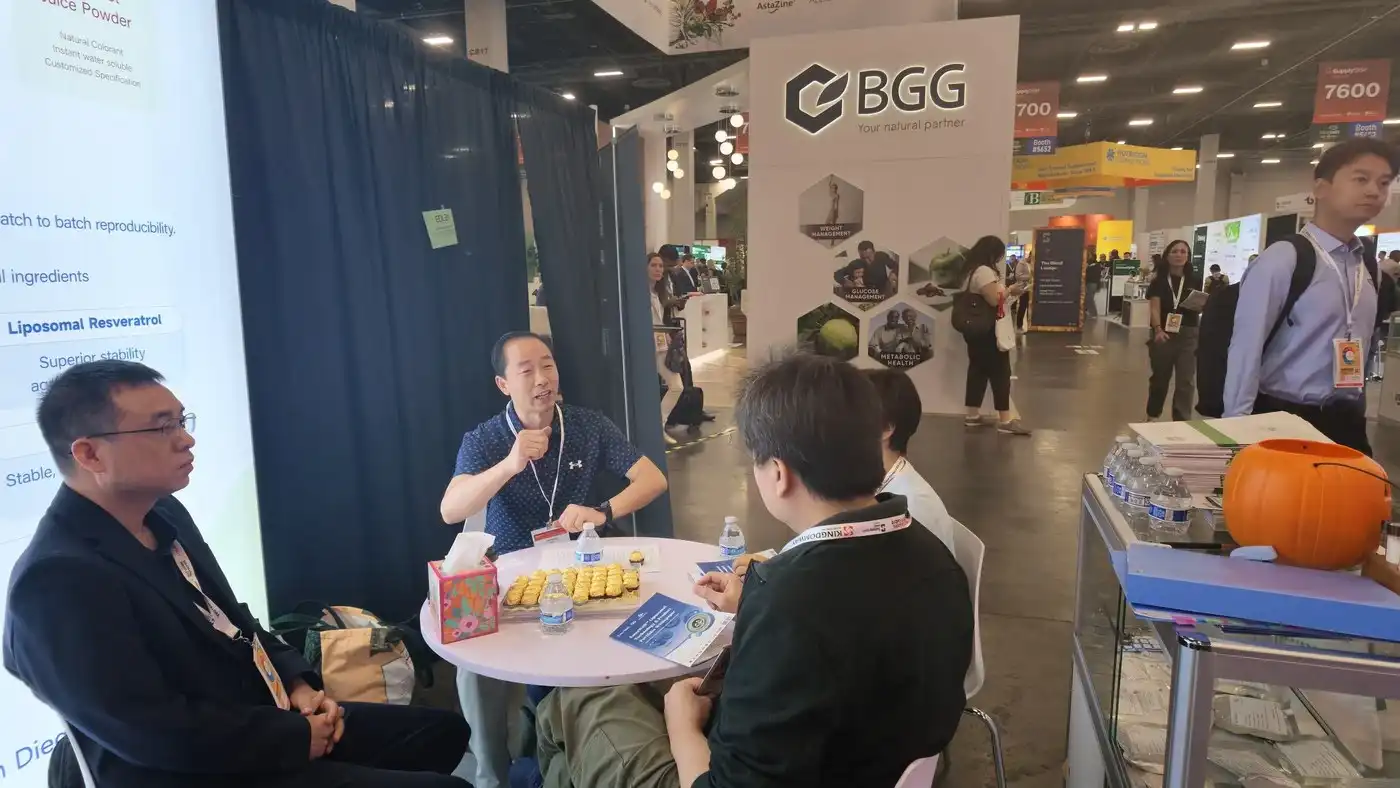
The botanical extract wall at Booth 7751, with the EncapsWell liposomal range displayed alongside it.
What Extract Buyers Actually Brought to Booth 7751
The specification requests clustered around a set of products where the details matter commercially.
Broccoli extract. Requests ranged across the full offered span: 1% to 23% glucoraphanin, 1% to 10% sulforaphane, plus organic broccoli powder and premix formats for formulators who need a defined delivery ratio rather than a single number. The recurring question was not the top of the range but the method behind it — how the glucoraphanin figure is assayed, and whether the customer's own HPLC method would return the same result.
Apple cider vinegar powder. The decisive detail was the mother. Buyers needed 5% organic or 5% and 10% conventional grades with the mother retained, because the label claim and the marketing story both depend on it. Several conversations turned on whether that retention survives the drying process at commercial scale, which is exactly the question a spec sheet alone cannot answer.
Yucca schidigera extract. Purchasing split between supplement and feed applications. Supplement buyers wanted 30%, 50%, or 60% saponins with a defined sarsasapogenin range; feed buyers wanted the same consistency plus documentation that fits a regulated formulation.
Beet root juice powder. Interest centered on natural color and nitrate functionality: instant water solubility, color stability across pH, and a specification that can be customized to the application rather than bought off a shelf.
Rosemary extract. Standardized carnosic acid and carnosol grades, with the oil-soluble versus water-soluble choice driving the conversation, since the wrong grade fails in the wrong matrix regardless of assay.
Organic powders and high-purity actives. The organic range — apple cider vinegar, barley grass, goji, shiitake, lion's mane, matcha — drew clean-label buyers who needed USDA or EU organic scope confirmed in writing. On the high-purity side, requests came in for artemisinin 98%, taxifolin, mangiferin, quercetin dihydrate, and berberine HCl, usually from buyers who already had a customer waiting on the material.
Three Spec Details That Decided the Conversation
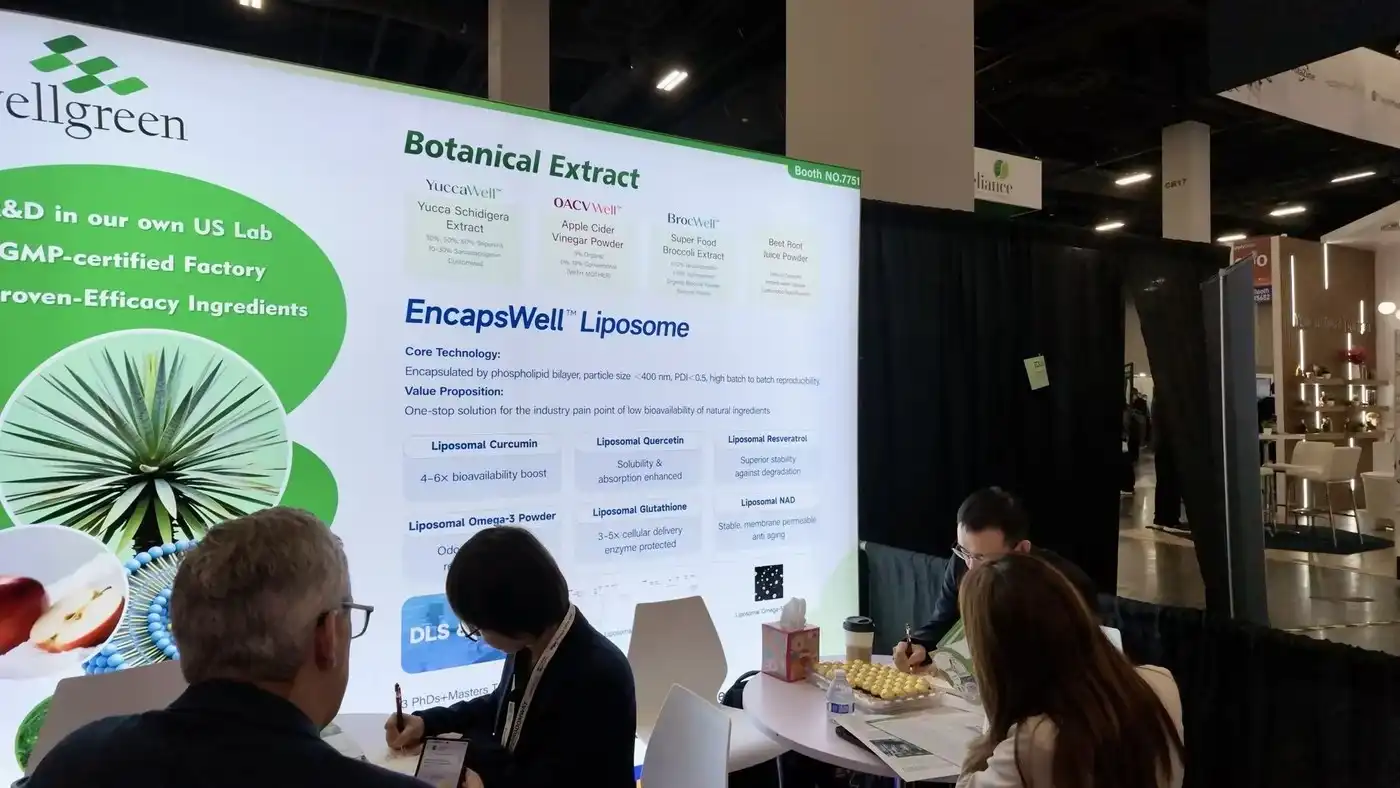
Specification review in progress: assay range, application, and certification checked against the material on display.
Across three days, the same three details separated a productive meeting from a polite exchange, and none of them appear on a typical product page.
The assay method behind the number. A 60% saponins figure or a 23% glucoraphanin figure means little without the analytical method attached. Two suppliers can quote the same percentage and deliver materials that behave differently, because the methods behind the numbers differ. Buyers who asked for the method first generally reached a decision faster, and several asked to compare against their own in-house result before committing to a sample.
The co-factors a specification usually omits. Apple cider vinegar is the clearest example: whether the mother is retained is commercially decisive and technically easy to lose, yet it is often absent from a one-line spec. The same logic applies to extract ratios, carrier systems, and the difference between a standardized extract and a standardized extract that still performs in a finished product.
Physical properties after extraction. Solubility, mesh size, bulk density, and color are frequently the real reason a technically compliant extract fails in production. A powder that meets assay but will not disperse in a beverage line is, for the buyer, a non-conforming lot. Bringing those parameters into the specification conversation at the booth moved several projects forward faster than a price discussion would have.
Documentation Answered the Origin Question
The second half of nearly every meeting was about proof. Where does the material come from, who standardizes it, and what documentation follows the batch?
Wellgreen operates self-owned plantations and in-house laboratories, so raw material origin does not depend on a third party's paperwork. Material moves from cultivation through extraction, standardization, and QC release inside one integrated chain, with batch documentation at each step. That vertical structure is what allows an origin question to be answered with a document rather than a description.
Manufacturing runs in a 73,000 m² facility with 5,000 tons of annual capacity, certified to cGMP, ISO, FSSC 22000, HACCP, Kosher, Halal, USDA Organic, EU Organic, and FAMI-QS. The certification that drew the most specific questions at this show was FAMI-QS, from feed-grade buyers who needed botanical actives inside a regulated feed formulation. Organic scope came second: buyers wanted to know which powders the USDA and EU scopes actually cover, not simply that an organic certificate exists.
For a brand auditing a new supplier, the practical value is that identity, origin, and assay questions can be answered from one documentation set instead of being traced across several vendors — which is also what makes the first audit less expensive.
What Happens After the Show
Follow-up from Booth 7751 is organized around the specification that was discussed, not around a general catalog request.
Sample dispatch. Specification confirmation from the show is being matched to the correct grade, with samples sent along with the assay method and CoA for the lot. Buyers who brought a failed sample get a comparison against the proposed grade, so the difference is measurable rather than asserted.
Specification development. Where a requirement sits outside the standard range — a different assay window, a tighter mesh, a carrier change, an organic premix — the request moves into custom development, with the physical parameters reviewed alongside the chemical ones.
Organic and feed documentation. Organic scope statements and FAMI-QS documentation are being assembled per product so a buyer's QA team can review them before a trial order.
Application trials. Once the sample passes in the customer's own matrix, the specification is locked and the commercial discussion moves to volume, lead time, and packaging. For U.S. and Canadian buyers, U.S. stock shortens the transit leg of that trial.
For teams that met the group during the show, the useful next step is the same document that started the conversation: the specification sheet, the application and process conditions, the annual volume, and the certification requirement. Sent to wgt@allwellcn.com, that is enough to confirm feasibility and dispatch the right sample.
FAQ
Can I still request a sample after the show? Yes. Requests from the show are being processed in the order received. Include the specification, the intended application, and the annual volume so the correct grade and documentation are sent together.
Does Wellgreen publish the assay method for each extract? The method behind each specification is available with the specification sheet and CoA, so a buyer's laboratory can verify the result on the same basis rather than comparing numbers produced by different methods.
Are the organic powders certified to both USDA and EU standards? Yes, the organic powder lines are covered by USDA and EU organic scopes. The exact scope for each product is confirmed in its documentation package.
Can a specification be adjusted outside the standard range? Yes. Assay ranges, extract ratios, carrier systems, particle size, and solubility can be adjusted through the custom development and OEM/ODM program, with feasibility confirmed before a sample is dispatched.
Do you supply feed-grade botanical extracts? Yes. Yucca feed grade, oregano powder, quillaja extract, marigold lutein, rosemary antioxidant, and eucommia extract are supplied under FAMI-QS-covered operations, with documentation suitable for feed formulation review.
About Wellgreen
Wellgreen supplies plant extracts, organic powders, and pure actives to nutraceutical, functional food and beverage, personal care, and animal nutrition manufacturers worldwide. Production is vertically integrated — self-owned plantations, in-house extraction and standardization, and in-house QC laboratories — across a 73,000 m² facility with 5,000 tons of annual capacity. The operation is certified to cGMP, ISO, FSSC 22000, HACCP, Kosher, Halal, USDA Organic, EU Organic, and FAMI-QS.
The extract range includes YuccaWell™ yucca schidigera, OACVWell™ apple cider vinegar powder with the mother, BrocWell™ broccoli extract, beet root juice powder, rosemary extract, an organic powder range, and high-purity actives such as artemisinin 98%, taxifolin, mangiferin, quercetin dihydrate, and berberine HCl, plus feed-grade botanical actives.
Custom specification development and OEM/ODM programs are handled by the same technical team that supports standard grades, so a non-catalog requirement is reviewed by the people who set the specification. Specification sheets, assay methods, and CoA samples are available on request, and custom specification development is quoted per project.
Contact: wgt@allwellcn.com · +86 29 8845 3375
OEM/ODM services: wellgreenherb.com/oem-odm