Bitter Melon Extract Powder for Capsules, Sachets, and Multi-Ingredient Formulations
2026-10-08 15:35:25
Bitter Melon Extract Powder behaves differently in every format it fills. In a hard-shell capsule it is a fine, cohesive, moisture-sensitive solid that must flow and fill inside a narrow weight band. In a stick-pack it is one component of a dry blend whose particles must match every co-ingredient. In a multi-ingredient formula it usually sets the taste ceiling for the blend. Wellgreen's Bitter Melon Extract Powder is a yellow-brown fine powder standardised to 10–20% bitter gourd extract and 10% saponins, with 95% passing 80 mesh. This article is for the R&D, product development and QA people who must turn that sheet into a repeatable process.
Start With the Specification Fields That Decide Formulation
Late-surfacing formulation problems — weight variation, segregation, sticking, a taste that will not mask — usually trace back to a loosely agreed specification field.
Marker or characterisation basis
A specification must state what the headline number represents. A ratio such as 10:1 describes how much raw fruit went in, not what came out. An assay tied to a named marker and a stated method describes the material the formulator will physically handle. When the basis is ambiguous, two deliveries can both comply while behaving differently in the blender — different bulk density, different hygroscopicity, different bitterness.
Ratio extracts versus standardised extracts
Ratio extracts are economical per kilogram and awkward to formulate around, because the ratio speaks to input mass rather than output composition. A standardised extract, with markers controlled to a declared range by HPLC or UV, gives a fixed reference point for fill-weight calculations and label copy, and for capsules it is usually the only way to keep unit-to-unit marker content inside a defensible band.
Mesh, particle size and distribution
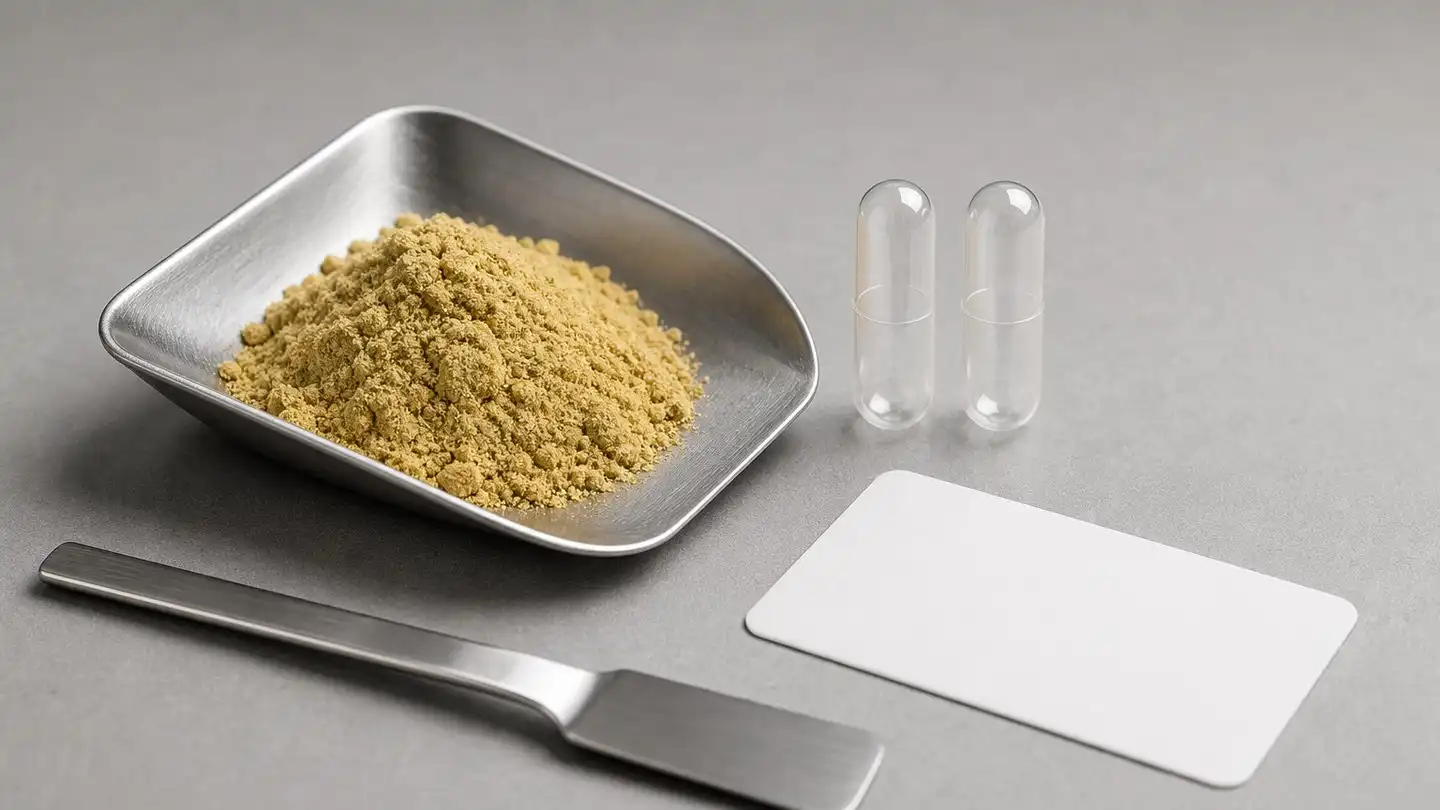
"80 mesh" is a sieve cut, not a distribution. Two lots that both pass 80 mesh can differ in median diameter and in the proportion of fines below roughly 50 µm, and those differences change flow, dusting, segregation potential and blending time. Ask for a distribution — at minimum a median and a span, ideally D10, D50 and D90 from laser diffraction. In capsule filling a fine cohesive fraction slows flow and widens weight variation; in sachet blending it migrates downwards through a coarser carrier during conveying.
Moisture, water activity, density and flow
Loss on drying at ≤5.0% gives total water; water activity gives how available that water is, and for a hygroscopic botanical the second figure better predicts caking. Bulk and tapped density, with the Hausner ratio and Carr index, decide whether a formulation can be filled volumetrically or needs weight-based filling. Flow, by angle of repose or powder rheometer, completes the picture. Record all four on every incoming lot: they drift with crop year and location.
Format by Format: What Each Format Demands
Table 1 sets the three formats side by side against the parameters that matter most.
| Process parameter | Hard-shell capsule | Tablet | Stick-pack / sachet | Multi-ingredient blend |
|---|---|---|---|---|
| Extract share of the unit | Often the only active; moderate to high | Moderate to high, bounded by tablet weight | Low to moderate per stick | Low; one of several actives |
| Particle size target | Fine and consistent; minimise free fines below 50 µm | Fine, with granulation if flow or dusting is poor | Matched to the coarsest co-ingredient | Matched across all co-ingredients |
| Flow requirement | High: filling is volumetric | High: die fill sets weight | Moderate to high: powder dosing accuracy | High: blend must stay mixed through conveying |
| Dominant risk | Fill-weight variance, sticking, hygroscopic caking | Weight and hardness variation, over-lubrication | Segregation, dust, taste, fill accuracy | Segregation and compounded bitterness |
| Critical in-process control | Fill weight across hopper levels; blend uniformity | Weight, hardness, friability, disintegration | Stick weight; blend uniformity | Uniformity sampling at multiple blend points |
| Lubricant / disintegrant relevance | Low; the shell opens by dissolution | High; lubricant and disintegrant choice sets behaviour | Not applicable in dry blends | Not applicable unless tableted |
| Moisture exposure | Blend-to-fill interval is the critical window | Compression room humidity and dwell time | Fill room humidity; headspace in the stick | Storage of the finished blend |
| Taste relevance | Effectively nil | Moderate; the tablet surface contacts the tongue | Decisive; taste is the product | Decisive and compounding |
| Packaging priority | Opaque moisture barrier | Opaque moisture barrier | High-barrier foil laminate | Foil laminate or barrier drum |
Capsules and Tablets: Filling a Fine, Cohesive, Moisture-Sensitive Powder
Fill weight and fill volume variance
Capsule filling is largely volumetric: the dosator or tamping pin selects a plug of powder and pushes it into the capsule body, so the weight delivered depends on bulk density and flow, not on a metered mass. Control incoming bulk density as tightly as marker content, or the same machine setting will deliver a different fill weight next month. Then quantify variance: sample start, middle and end of a run at high and low hopper levels and record the standard deviation against the label claim. A tablet press fills the die volumetrically too, but compression then fixes weight more reproducibly, shifting risk towards variation in hardness and friability.
Blend uniformity at low inclusion rates
Once the extract sits at a few percent of the blend, uniformity stops being automatic. The controlling variables are the particle-size and density differences between extract and diluent, and the blending mechanism. Cohesive fine actives disperse best when the carrier is coarse and in large excess: the fines lodge in surface asperities and stay put, which is the mechanism behind ordered, or interactive, blending. Published work on low-dose blends shows that excipient surface roughness, blending technique and processing time each influence content uniformity independently of the active itself [4]. Over-blending is the opposite failure: past a point, de-mixing and electrostatic charging work against you. Fix a blend time by experiment, hold it fixed, and verify it with uniformity samples from at least ten locations. The approach described for quercetin dihydrate powder in powder blends is a useful analogue for how particle form drives blend performance.
Flow, dusting, sticking and moisture pickup between blending and filling
Fine botanical extracts dust. Dust settles on hopper walls, feed frames and the capsule ring, changing powder-to-metal friction as a run progresses, so the first and last thousand capsules are not made under identical conditions. Minimise free fines in the specification, hold relative humidity stable rather than merely low, and include a glidant such as colloidal silicon dioxide where the formulation allows. Sticking — powder adhering to punches, tamping pins or dosator surfaces — is usually a moisture or surface-energy problem, and it appears in the second half of a shift as humidity rises. The blend-to-fill interval is the other exposure window: a blend that leaves the mixer free-flowing can cake in the hopper within the hour, so condition it in sealed containers and cap the interval as a documented process parameter. Where that exposure cannot be tolerated, encapsulating the extract, co-processing it with a hydrophobic excipient or film-coating the tablet reduces dependence on environmental control [8].
Lubricants, disintegrants and the interactions nobody plans for
Magnesium stearate and other hydrophobic lubricants reduce die-wall friction but coat particles, and a lubricant film on an already hydrophobic extract can slow wetting and delay disintegration. Over-lubrication is a common cause of a tablet that passes weight and hardness checks but fails on disintegration time. Disintegrants such as croscarmellose sodium and crospovidone act by swelling or wicking, and lose efficiency once blending smears lubricant across their surfaces. Lubricate last, for a bounded time, and test the finished unit.
Stick-Packs and Sachets: Keeping a Dry Blend Mixed
Particle-size matching across co-ingredients
Segregation is driven by differences in particle size and density, and the most effective countermeasure is to bring the extract's and its co-ingredients' distributions closer together. If the extract is fine and the carrier coarse, the fines percolate downward during vibration, conveying and hopper hold, so the first sticks filled from a batch can differ measurably from the last. Either match the co-ingredients to the extract, or coarsen the extract deliberately by granulation or roller compaction. The same reasoning applies to green powder blends such as barley grass powder in green superfood blends.
Dust control
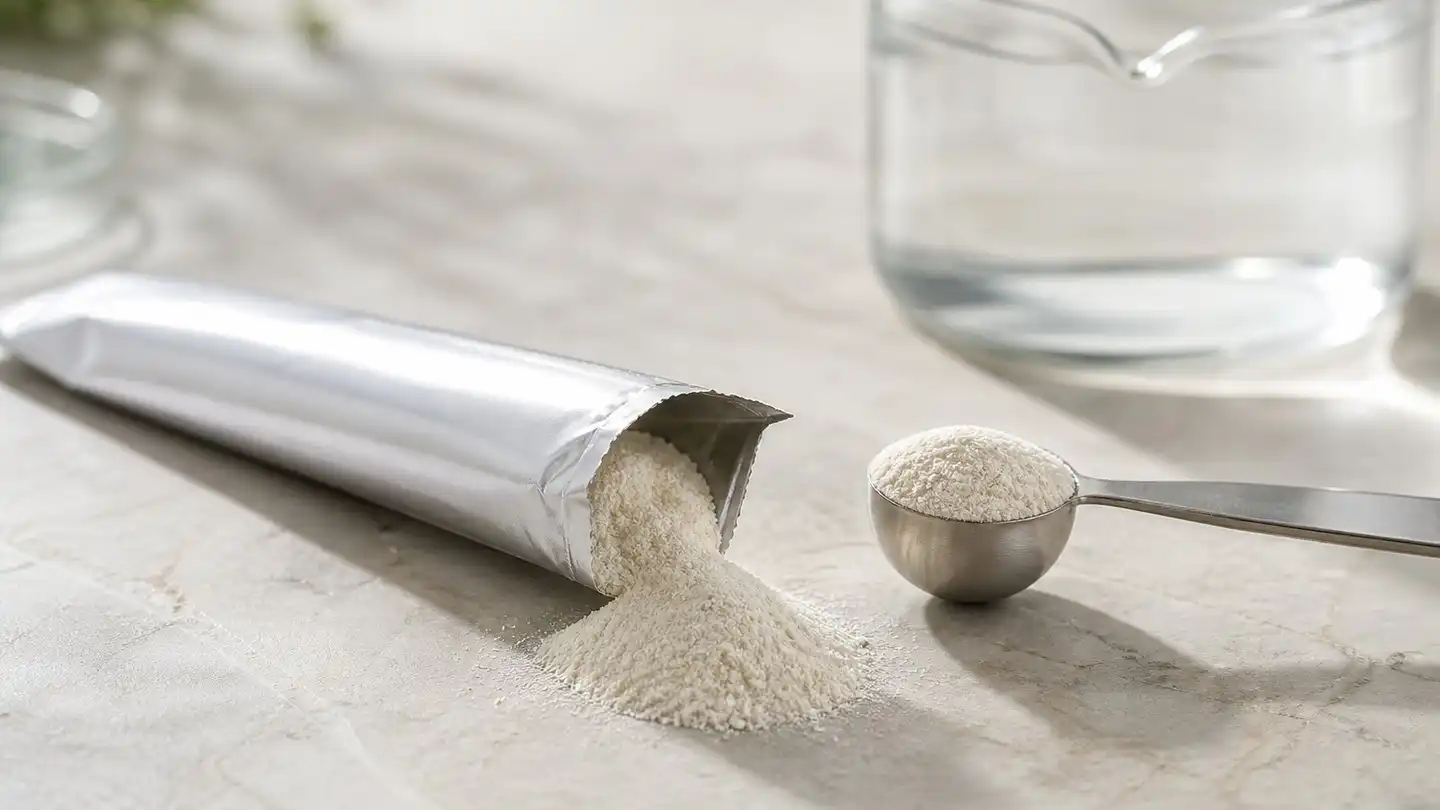
Sachet lines are less enclosed than capsule lines, so fines escape into the room rather than into a hopper — an operator-exposure and yield issue at once. Reducing the sub-50 µm fraction, using enclosed transfer points and keeping local extraction at the dosing head all help. Because most high-speed sachet lines fill by volume, dust also drifts fill weight.
Carrier and diluent selection
The carrier is not inert filler; it is the anti-segregation and taste-control device. Maltodextrin and isomalt-based carriers are common in stick-packs because they dissolve cleanly and dilute the extract's flavour load. A carrier with rough surface topography holds fine extract particles better than a smooth crystalline one, lowering segregation potential. Where the blend must flow on a volumetric filler, a coarser carrier with a narrow distribution beats a cheaper grade that will not move.
Sachet fill accuracy
Volumetric auger and cup fillers stay accurate only while bulk density and flow stay constant, so sachet fill accuracy depends on density control at goods-in, on the absence of aeration in the feed, and on blend stability through the run. Weigh every twenty-fifth stick across the start, middle and end of a batch; if the trend drifts, density is changing, not the filler setting.
Multi-Ingredient Formulations: Taste Is the Binding Constraint
Why bitterness sets the ceiling
Bitter melon carries cucurbitane-type triterpenoid bitter principles, and bitterness is not a linear sensation: it lingers and it compounds. In a blend that already contains several bitter botanicals, perceived bitterness is rarely the sum of the parts — it is often worse, because bitter compounds from different sources act on the same receptors. In a capsule this is invisible; in a stick-pack it is the entire product experience, and it limits how far the extract can be pushed up the formula. Practical work starts by finding the taste ceiling and building the formula underneath it.
The masking toolkit a formulator actually has
- Flavour systems. Sweet, acid and cooling notes change when bitterness is perceived, not only how strong it is, so build the system around the extract's own bitterness profile.
- Sweetener choice. High-intensity sweeteners differ in onset and linger; one that peaks early can leave the bitter aftertaste unaccompanied, while one with a longer tail often covers it.
- Encapsulation. Spray-drying or coacervation behind a polymer wall delays contact between the bitter principles and the taste receptors, and reduces hygroscopicity at the same time [8].
- Bitter blockers. Receptor-level inhibitors blunt the bitter signal itself, and help most when bitterness is not the only off-note.
- Carrier dilution. Raising the carrier fraction lowers the extract's contribution to the total load, at the cost of a larger stick weight.
- Acid, salt and temperature balance. The same blend tastes different in warm water than in cold, so taste work belongs in the intended preparation form.
Designing a sensory panel that finds the ceiling
A tasting panel is a measuring instrument, so it needs a defined method, a defined scale and controls. Table 2 sets out a defensible design.
| Panel design element | Practical approach | Why it matters |
|---|---|---|
| Panel size and screening | Eight to twelve assessors, screened for ability to detect and rank bitter reference solutions | Averaging insensitive assessors hides real differences |
| Attribute list | Fix the vocabulary before testing: immediate bitterness, bitterness intensity, aftertaste duration, sweetness, off-notes, mouthfeel | Prevents drift between sessions and between formulae |
| Scales | Structured 0–10 intensity scale with reference anchors at the low and high ends | Anchors make results comparable across panels and dates |
| Blinding and randomisation | Three-digit codes; random presentation order; no discussion between assessors | Removes order and carry-over bias |
| Carrier baseline | Include the full carrier blend without the extract as a control | Isolates the extract's contribution from the carrier's own taste |
| Serving protocol | Fixed dilution, water temperature, volume and time to first assessment | Taste is concentration and temperature dependent |
| Palate cleansing | Standardised rinse and rest interval between samples | Bitter carry-over is the largest single source of error |
| Replication | Each assessor evaluates each sample at least twice in separate sessions | Separates assessor variability from formula effect |
| Ceiling determination | Run a ladder of inclusion levels and record where the panel's mean bitterness crosses the agreed acceptability limit | Gives a defensible maximum load rather than an opinion |
| Masking-candidate screening | Test each masking tool at a fixed extract level, one variable at a time, before combining them | Prevents attributing a gain to the wrong tool |
Capsule-delivery strategies such as those used for maximizing the bioavailability of Polygonum multiflorum extract in capsules follow the same logic: engineer the powder's physical state first, and delivery follows.
Storage, Light and Moisture Protection
The product page states a two-year shelf life in a cool, dry place away from strong light and heat — the specification the pack must deliver to. Opaque primary packaging prevents the colour and flavour changes that follow light exposure, and a high-barrier foil laminate does the same for moisture in sachets and stick-packs. Bulk drums with a moisture barrier protect the interval between delivery and use. Stability, not novelty, is why a brand chooses a powdered format at all — the same reasoning that drives apple cider vinegar powder in capsules.
Scale-Up Checklist
- Lock the specification: marker, method, ratio basis, mesh and distribution, loss on drying, water activity, densities, flow.
- Characterise the powder as received, not as described, before the first trial batch.
- Fix blend time by experiment and hold it; verify uniformity from at least ten sampling points.
- Cap and document the blend-to-fill interval, and control filling-room humidity.
- Establish the taste ceiling by sensory panel before setting the inclusion level.
- Confirm fill and stick weight drift across hopper levels and a full shift.
- Verify the finished pack against the ingredient's stated stability conditions, and keep reserve samples.
If these formats are on your development roadmap, Wellgreen supplies Bitter Melon Extract Powder with batch-specific documentation and can discuss particle size, assay level and packaging format against your process. Send your target format and specification to wgt@allwellcn.com.
This article provides technical and commercial information for industry professionals. It is not medical advice and makes no statement about the effects of any ingredient. Use levels, regulatory status and label claims must be confirmed against the rules of each target market and against your own product data.
References
- U.S. Food and Drug Administration. Current Good Manufacturing Practice in Manufacturing, Packaging, Labeling, or Holding Operations for Dietary Supplements, 21 CFR Part 111. Electronic Code of Federal Regulations. https://www.ecfr.gov/current/title-21/chapter-I/subchapter-B/part-111
- U.S. Food and Drug Administration. Small Entity Compliance Guide: Current Good Manufacturing Practice in Manufacturing, Packaging, Labeling, or Holding Operations for Dietary Supplements (Docket No. FDA-2010-D-0605). https://www.fda.gov/regulatory-information/search-fda-guidance-documents/small-entity-compliance-guide-current-good-manufacturing-practice-manufacturing-packaging-labeling
- European Medicines Agency. ICH Q1A (R2) Stability testing of new drug substances and drug products — Scientific guideline. https://www.ema.europa.eu/en/ich-q1a-r2-stability-testing-new-drug-substances-drug-products-scientific-guideline
- Alyami H, Dahmash E, Bowen J, Mohammed AR. An investigation into the effects of excipient particle size, blending techniques and processing parameters on the homogeneity and content uniformity of a blend containing low-dose model drug. PLoS ONE. 2017;12(6):e0178772. doi:10.1371/journal.pone.0178772. https://doi.org/10.1371/journal.pone.0178772
- Jakubowska E, Ciepluch N. Blend Segregation in Tablets Manufacturing and Its Effect on Drug Content Uniformity — A Review. Pharmaceutics. 2021;13(11):1909. doi:10.3390/pharmaceutics13111909. https://pmc.ncbi.nlm.nih.gov/articles/PMC8620778/
- One of the major challenges of masking the bitter taste in medications: an overview of quantitative methods for bitterness. Frontiers in Chemistry. 2024;12:1449536. doi:10.3389/fchem.2024.1449536. https://pmc.ncbi.nlm.nih.gov/articles/PMC11349634/
- Toward Improving Medication Adherence: The Suppression of Bitter Taste in Edible Taste Films. Advances in Pharmacological Sciences. 2018;2018:8043837. doi:10.1155/2018/8043837. https://pmc.ncbi.nlm.nih.gov/articles/PMC6036852/
- Ng LH, Ling JKU, Hadinoto K. Formulation Strategies to Improve the Stability and Handling of Oral Solid Dosage Forms of Highly Hygroscopic Pharmaceuticals and Nutraceuticals. Pharmaceutics. 2022;14(10):2015. doi:10.3390/pharmaceutics14102015. https://pmc.ncbi.nlm.nih.gov/articles/PMC9611293/
- Crouter A, Briens L. The Effect of Moisture on the Flowability of Pharmaceutical Excipients. AAPS PharmSciTech. 2013;15(1):65–74. doi:10.1208/s12249-013-0036-0. https://pmc.ncbi.nlm.nih.gov/articles/PMC3909156/
- Regulation (EC) No 1924/2006 of the European Parliament and of the Council of 20 December 2006 on nutrition and health claims made on foods. EUR-Lex. https://eur-lex.europa.eu/legal-content/EN/TXT/?uri=CELEX%3A32006R1924