
Egg Yolk Lecithin: Emulsifying Performance and Quality Control - Wellgreen
2026-11-23 14:00:00
Most lecithin disputes are not disagreements about chemistry. They are disagreements about performance: the certificate says the lot is within specification, and the plant says the emulsion is not what it was last month. Both can be true, because a specification describes composition while a production line experiences function. Building quality control around egg yolk lecithin means measuring both, and connecting the two with a trend rather than a single release decision.
When Composition Is Correct and Function Is Not
The hardest case is a lot that meets every compositional limit and still performs differently. Before blaming the supplier, check three process possibilities: the addition temperature of the emulsifier, the homogenisation pressure, and the order in which the emulsifier entered the system. Lecithin added to a cold oil phase disperses differently from lecithin added to a warm aqueous phase, and the resulting droplet size can differ enough to change mouthfeel without any analytical value moving.
If the process is unchanged and the performance is not, the next step is a side-by-side bench run of the retained sample from the previous accepted lot against the new lot, in the same base, by the same operator, on the same day. That comparison removes process noise from the question and usually produces a clear answer within an hour.
Two Questions a Certificate Cannot Answer
The first question is whether this lot behaves like the last one. Compositional limits are ranges, and a material can sit inside every range while moving from one edge to the other across four deliveries. The second is whether the number on the certificate was produced by a method comparable to the one your own laboratory uses.
Neither question is answered by a pass or fail. Both are answered by keeping values, plotting them, and comparing the plot with what the process did. That requires modest discipline rather than new equipment.
The Analytical Set That Drifts in Storage
Lecithin is a lipid mixture, and lipids change. The items worth tracking on every lot are the ones that move with time and temperature, because those are the items that explain a performance shift that composition alone does not.
| Item | What movement indicates | Practical consequence |
|---|---|---|
| Acid value | Hydrolysis of the phospholipid or the carried oil | Emulsifying behaviour can shift before any visible change |
| Peroxide value | Oxidation of unsaturated fatty acids | Off-notes appear in a bland sauce or a white crumb |
| Moisture | Ingress through packaging or during handling | Weighing error and microbiological risk |
| Acetone-insoluble matter | Phospholipid share of the material | Dose arithmetic changes even when the grade name does not |
| Colour | Thermal history and oxidation | Visible in pale systems; a leading indicator |
| Consistency | Temperature history and lot-to-lot variation | Pumping and dosing behaviour at the plant |
A lot can pass every limit and still have doubled its peroxide value since the previous delivery. That is not a specification failure; it is a storage or transport signal, and it will show up in sensory terms before it shows up in a rejection.
Functional Performance: A Test You Can Run In-House
A workable emulsion capacity protocol
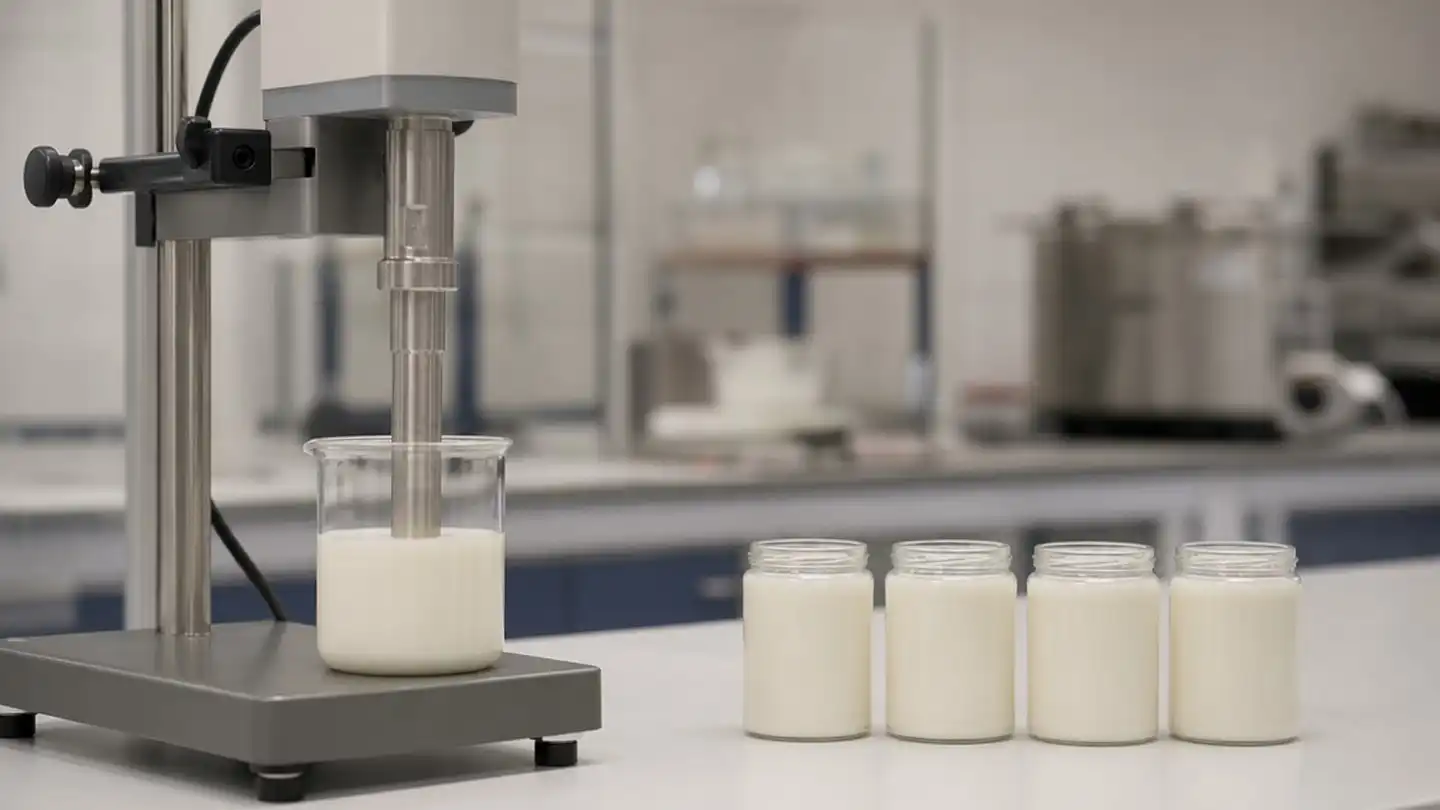
Disperse the lecithin at a fixed dose in a fixed oil-and-water system, homogenise under fixed conditions, and then measure how much additional oil the emulsion will take before it inverts or separates. Record the endpoint, the droplet appearance under a microscope and the time to visible separation at a fixed temperature.
None of this requires unusual equipment: a bench homogeniser, a burette, a microscope and a water bath are enough. What it requires is that every parameter stays identical between lots, including the oil, the water, the temperature and the operator's technique. The moment one parameter drifts, the test measures the laboratory instead of the material.
Setting an acceptance window from your own data
Run the test on five consecutive accepted lots and calculate the spread. The window is then defined from observed performance, not from a supplier's claim. A new lot that falls outside the window is investigated before it enters production, which is far cheaper than investigating a failed batch of finished product.
What a trend direction means
A second bench measure is worth adding where the application is sensitive to it: the time to visible separation at the process temperature rather than at room temperature. Lecithin systems that look stable in a beaker at 20 °C can separate within minutes at 85 °C, and a hot-hold test at the real process temperature takes the guesswork out of the hold time the plant can tolerate.
Batch-to-Batch Trending Instead of Single-Lot Release
A release decision looks at one lot. A trend looks at the sequence. Plotting acid value, peroxide value and the functional endpoint on the same time axis shows whether a supplier is stable, drifting slowly, or alternating between two raw material sources.
Alternation is the pattern that catches buyers out, because individual lots pass and the average is fine, while the process sees a step change every second delivery. Where the trend shows alternation, the question to the supplier is not about the specification but about the number of production lines or raw material sources feeding it.
Storage conditions deserve the same attention as testing. Lecithin held in a warm drum bay will age faster than the shelf life on the certificate assumes, and a buyer who stores material for six months before use is effectively extending the supplier's ageing curve with their own warehouse. Where the material is temperature-sensitive, a cool, dark location and a first-in-first-out rotation do more for consistency than an extra incoming test.
Sampling and Retained Samples
An assay is only as good as the sample, and lecithin is not perfectly homogeneous, particularly in semi-solid form. Draw incremental samples from top, middle and bottom, composite them, and retain a portion of each increment separately for the period defined in your own procedure.
Retained samples serve two purposes: they settle disputes about what shipped, and they let you re-test a lot when a performance question appears months later. A retained sample stored at the wrong temperature is worse than none, because it produces a misleading answer with apparent authority.
Where a supplier cannot provide a functional claim, the buyer's own bench test becomes the only defensible basis for approval. That is not a criticism of the supplier; it reflects the fact that emulsifier performance is system-specific and cannot be certified in the abstract. What a supplier can do is hold the composition steady and disclose changes, which is why the change-notification clause matters as much as the specification itself.
What Supplier Quality Control Should Look Like
Ask what the supplier tests on every batch and what is tested periodically. Every-batch items should include the values that move quickly; periodic items can include the wider panel. Also ask who performs the testing and whether the laboratory is accredited for the methods used, because an in-house result and an accredited result carry different weight in an audit.
The framework a supplier operates inside — the management systems and the certification scope — is set out on the quality and accreditation page. That framework is the context; the lot data is the evidence.
When a Lot Fails: Questions, Not Accusations
A failure is most useful when it is converted into information. Four questions cover most cases: which raw material source was used, what the previous lot's values were, whether the process or the material changed, and what the retained sample shows when re-tested.
Where the answer is a material change, ask for the change to be documented and for the specification to be updated rather than quietly absorbed. Where the answer is a process change at the customer's plant, the supplier's data becomes the reference that identifies it.
Egg Yolk and Soy Lecithin on the Same Bench
Comparing the two on a single bench is useful even when only one is under consideration, because it establishes what the category can do. Run the same protocol on a soybean lecithin and compare the endpoint, the droplet size and the sensory result in a neutral base.
The comparison normally shows a difference in the flavour contribution and in the droplet behaviour at equal phospholipid dose, which is why the two are not interchangeable in a bland system even when the analytical values are similar. Handling and dispersion differences follow the same logic described in this note on carrier specifications for powdered lipids, and the measurement discipline is the same as in this discussion of dispersion in powder blends.
Connecting Performance Data to Price
Once a functional endpoint exists, price can be expressed per unit of performance rather than per kilogram. Multiply the dose that achieved the endpoint by the price, and compare across suppliers. The result usually rearranges the ranking, because a material with a higher phospholipid share often reaches the same endpoint at a lower dose.
Where a spray-dried or carried form is used instead of a semi-solid, the comparison needs the carrier proportion, since the carrier contributes weight without contributing function. The effect of the drying route on density and flow is covered in this comparison of spray-dried and freeze-dried powders.
There is also a documentation benefit. A trend file that shows twelve months of values, three third-party verifications and one documented deviation is far more persuasive in a customer audit than a folder of individual certificates. It demonstrates that the buyer's own process controls the material, not only that the supplier claims to.
A Twelve-Month Quality Calendar
| Frequency | Activity | Output |
|---|---|---|
| Every lot | Analytical set plus functional endpoint | Release decision and trend point |
| Every quarter | Trend review against process complaints | Supplier conversation, specification review |
| Twice a year | Third-party assay of a retained sample | Verification of supplier data |
| Annually | Full specification review and supplier audit | Updated specification and approved supplier list |
| On change | Re-qualification after any notified change | Documented approval or rejection |

Conclusion
Quality control for egg yolk lecithin works when it measures function as well as composition, and when it reads each lot as a point on a trend rather than an isolated decision. The certificate tells you what the material is; the bench test tells you what it does; the trend tells you what will arrive next. A supplier that supports all three is a supplier whose specification means something in production.
If you are setting up an incoming inspection programme and need the analytical set, the current lot certificate and samples for a functional benchmark, send your application and process conditions to wgt@allwellcn.com. The technical team can supply specification sheets with methods and a sample set from consecutive lots so the acceptance window can be built from your own data.
References
- International Organization for Standardization. ISO 660 — Animal and vegetable fats and oils: determination of acid value and acidity. 2020.
- International Organization for Standardization. ISO 3960 — Animal and vegetable fats and oils: determination of peroxide value. 2017.
- U.S. Food and Drug Administration. 21 CFR Part 184 — Direct Food Substances Affirmed as Generally Recognized as Safe. Current edition.
- Codex Alimentarius Commission. General Standard for Food Additives (CXS 192-1995, as amended). FAO/WHO.
- International Organization for Standardization. ISO 4833-1 — Microbiology of the food chain: colony count at 30 °C. 2013.
- U.S. Food and Drug Administration. 21 CFR Part 101 — Food Labeling; allergen declaration. Current edition.
This article is intended for business-to-business ingredient sourcing and formulation discussion. It does not provide medical, nutritional, or regulatory advice for any specific product or market.