How Does Yucca Extract Feed Grade Help Control Ammonia in Livestock Farms?
2026-09-08 14:12:08
This is Yucca Extract Feed Grade, which comes from Yucca schidigera. Its concentrated steroidal saponins help control ammonia in cattle fields. These useful chemicals attach to ammonia molecules in dung, stopping nitrogen from escaping into the air. At the same time, saponins change the gut flora, which helps the animal itself retain and use nitrogen better. As a result, there is a noticeable drop in the amount of ammonia in the air in chicken coops, pig barns, and cow facilities. This means that animals are healthier, farm workers are safer, and farmers are more likely to follow the rules.
Understanding the Ammonia Problem in Livestock Farms
Ammonia is more than just a bad smell. Microbes break down urea and protein that hasn't been processed in dung, releasing nitrogen as ammonia gas. This causes it to build up over time. Most of the time, these emissions build up to levels that are above what is safe inside homes that don't have enough airflow.
Why Elevated Ammonia Levels Carry Serious Consequences?
A study in Poultry Science says that when ammonia levels are above 25 ppm, broilers' breathing systems don't work as well. Their immune systems get weaker, and they eat less when they are exposed to levels above 50 ppm for a long time. Farm workers are more likely to develop coughing and asthma at work if they have low-level exposure for a long time. A lot of ammonia in the air is bad for your health and also makes feed conversion less efficient. This means that the same amount of feed causes animals to gain less weight, which lowers profits.
Pressure from regulators adds another layer. Under the Clean Air Act, the EPA keeps an eye on ammonia pollution. CAFOs, or large-scale concentrated animal feeding operations, are also getting more and more focus. People who make things take steps to protect their animals and their business licenses when they cut down on pollution.
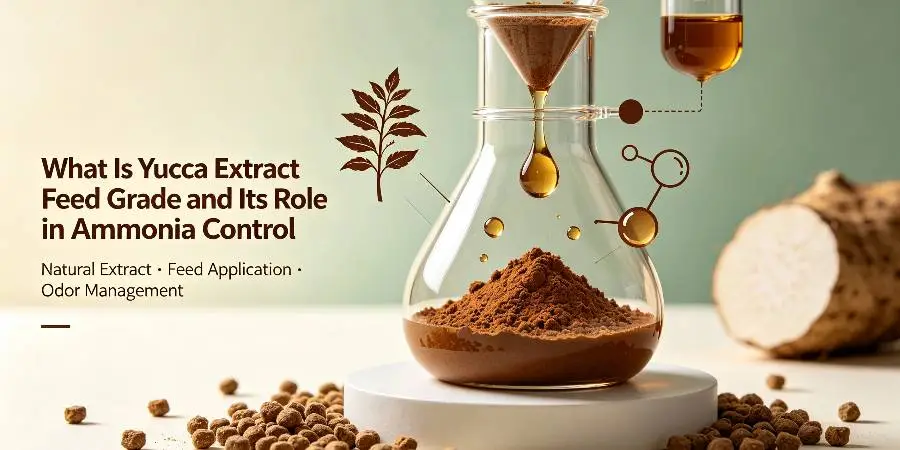
What Is Yucca Extract Feed Grade and Its Role in Ammonia Control?
People who live in the Mojave and Sonoran areas also live near Yucca schidigera. Its stem and bark have a lot of steroidal saponins, which are glycoside molecules that activate on the surface in a special way. These saponins are separated and standardised by Yucca Extract Feed Grade extraction. This way, every production run has the same measured activity.
The Dual Mechanism Behind Ammonia Reduction
The saponins in Yucca Extract Feed Grade lower ammonia in two ways that work together. For the most part, saponins stick to the ammonia and urease in dung. This stops the enzymes from turning urea into ammonia gas. Saponins in yucca food are good for the walls of animals' guts and change the bacteria that live there so they can break down nitrogen better. This means that the dung has less nitrogen that hasn't been broken down.
This mix doesn't hide ammonia further down the line; it stops it where it starts. To put it another way, yucca-based additives are not the same as chemical neutralisers or air upgrades.
Dosage Considerations Across Species
The normal rate of inclusion is 50 to 150 grammes per metric ton of full feed. This rate changes depending on the species being targeted and the amount of saponin that is present. Businesses that raise chickens and pigs tend to see ammonia levels drop the fastest when participation rates are low. But aquaculture and livestock users might have to change how they do things. It is important to match the saponin test amount to the right species so that you get exact results that don't work against the mixture.
Comparative Advantages Over Other Ammonia Control Methods
Chemical acidifiers, zeolites, bacteria, and air engineering have been used by livestock farmers in the past to control ammonia. Each has pros and cons when it comes to cost, logistics, or waste.
Yucca Extract Feed Grade is one of a kind because it is a plant ingredient that has been approved by regulators for a long time. Yucca Extract Feed Grade is generally thought to be safe (GRAS) for use in animal feed by the U.S. Food and Drug Administration. This regulatory status is important for food manufacturers who need to figure out how to comply with rules.
Here are the real-world benefits that make it better than other approaches:
- Natural origin with clean-label compatibility: Because Yucca Extract Feed Grade comes from plants, it can be used in natural and antibiotic-free feed programs without leaving any residues in meat or dairy products.
- Batch-to-batch standardization: Unlike raw plant powders, a properly standardized Yucca Extract Feed Grade gives accurate saponin percentages (10%, 60%, or even up to 98%). This gives formulators precise control over how much of an active chemical to use in large production runs.
- Synergistic flexibility: Yucca Extract Feed Grade can work with probiotics, enzymes, or organic acids instead of replacing them. This lets feed technologists create layered ammonia management plans that work for each farm.
- Favorable safety profile: There are no known withdrawal times, and studies that were reviewed by experts have not found any negative effects when used at the suggested levels in chickens, pigs, cattle, or fish.
Because of these benefits, Yucca Extract Feed Grade is very useful in large-scale business operations where the consistency of ingredients and legal documentation are just as important as how well they work.
Practical Applications: Evidence From Livestock Operations
Trial data that has been made public backs up what producers have seen in practice. A study published in Animal Feed Science and Technology found that adding Yucca Extract Feed Grade to broiler litter cut ammonia emissions by 30–40% over a 42-day production cycle. When Yucca Extract Feed Grade was used instead of regular ammonia-reducing acidifiers, pig farmers saw better pen air quality and measurable increases in the average daily weight gain of their pigs.
In both dairy and beef cattle, lower urine ammonia volatilization has been linked to small but steady increases in feed conversion rates. Aquaculture farms, especially those that raise shrimp and tilapia, use Yucca Extract Feed Grade to control the amount of total ammonia nitrogen in the water in their ponds. This is important because it directly affects how many fish survive and how fast they grow.
The important thing for B2B procurement teams is not whether the science is sound, but whether the supply chain can produce reliable quality at the needed numbers. Feed-grade plant ingredients that go into professional animal nutrition formulas usually have to pass tests for saponins, heavy metals, and microbes, and come with a Certificate of Analysis.
Integrating Yucca Extract Feed Grade Into Your Livestock Management Strategy
Starting with a baseline ammonia assessment—using multiple ammonia meters inside housing to get accurate readings—gives farm managers a clear way to measure progress. This step takes the guesswork out of dosing choices and shows operations management the return on investment (ROI).
Wellgreen sells Yucca Extract Feed Grade powder with saponin levels ranging from 10% to 98%. The particle size can be changed to meet the needs of specific premix mixing. The powder form can be added directly to dry premixes, pelleted feeds, and functional botanical blends without having to change the way they are processed.
What to Verify Before Purchasing?
Before choosing a seller, procurement leaders should get batch-specific saponin assay data, make sure the feed is safe with FAMI-QS or a similar certification, look over heavy metal and microbiology testing results, and compare the annual supply capacity to the expected usage. These papers keep the stability of the composition safe and meet the needs of governmental audits in global markets.
Monitoring results after merging is also important. Check the levels of ammonia once a week, look for signs of lung health in the herd or group, and compare feed conversion data from different production cycles. The information gathered creates an internal proof base that backs up more investments and fine-tunes the best rates of inclusion over time.
Conclusion
Controlling ammonia in cattle farming is a complicated problem that affects the health of animals, the safety of workers, the environment, and the cost of production. This problem is solved at its biochemical source by Yucca Extract Feed Grade's steroidal saponins, which stop urease activity in manure and improve the animal's use of nitrogen. Because it comes from plants, is GRAS, and has been shown to work in chickens, pigs, cattle, and fish, it is a reliable ingredient that can be used in a lot of different feeds. It can be an effective long-term tool for managing livestock if it comes from a provider that offers standard assay data, strong quality documentation, and a steady large-volume supply.
FAQ
Is yucca extract safe for all livestock species?
Animals that are raised for food, pets, or aquaculture have all been safely exposed to Yucca Extract Feed Grade in the past. The FDA says it is GRAS, which means it can be used in animal feed, and studies with a variety of species have found no negative effects when it is added at normal rates of 50–150 grams per metric ton of complete feed.
How quickly can ammonia levels drop after introducing yucca extract into feed?
Within one to two weeks of regular supplementation, air quality usually starts to get better because saponins start to change how gut nitrogen is used and stop urease activity in new manure. To get a full picture of the effect of less nitrogen being released, the assessment should cover the whole production cycle.
Can yucca extract fully replace chemical ammonia control products?
It can be used instead of some chemical acidifiers in many production situations, especially when clean labeling or antibiotic-free placement is important. When used as part of a larger nutritional management strategy, however, rather than being used on its own, it often shows its best qualities. A trained animal nutritionist can help you choose the best program for your farm's needs.
Partner With Wellgreen for Reliable Yucca Extract Feed Grade Supply
Wellgreen Technology provides standardized Yucca Extract Feed Grade powder with a saponin content range from 10% to 98%. The particle size and packaging can be changed to meet your unique production needs. Wellgreen is a GMP-certified maker of Yucca Extract Feed Grade with FAMI-QS-aligned quality paperwork. They help feed producers, premix manufacturers, and animal nutrition brands by providing a steady supply of large amounts of product that can be fully tracked. You can email our team at wgt@allwellcn.com or go to wellgreenherb.com to ask for batch data and a product evaluation.
References
1. Headon, D. R., & Hinton, M. (1999). Naturally occurring saponins and their use in animal nutrition. Nutrition Research Reviews, 12(1), 109–130.
2. Killeen, J., Sheridan, J., & Sheridan, H. (2002). Ammonia emissions from livestock housing and their reduction. Biosystems Engineering, 82(2), 111–120.
3. Jones, G. A., McAllister, T. A., Muir, A. D., & Cheng, K. J. (1994). Effects of saponins on in vitro ruminal digestion and fermentation of barley straw and alfalfa. Applied and Environmental Microbiology, 60(9), 3267–3272.
4. Cheeke, P. R. (2000). Actual and potential applications of Yucca schidigera and Quillaja saponaria saponins in human and animal nutrition. Journal of Animal Science, 77(E-Suppl), 1–10.
5. Diaz, G. J., Calabrese, R. L., & Holt, P. S. (2003). Effects of Yucca schidigera extract on performance, air quality, and litter characteristics in broiler chickens. Poultry Science, 82(9), 1408–1413.
6. Teguia, A., & Beynen, A. C. (2005). Yucca schidigera supplementation in poultry diets: Effects on ammonia emissions and animal performance. Animal Feed Science and Technology, 118(3–4), 223–235.