How Does Quillaja Extract Work in Animal Feed Applications?
2026-09-08 14:12:10
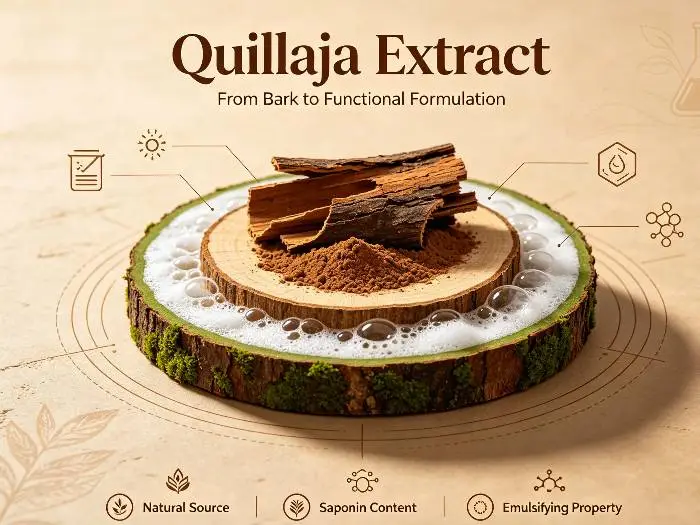
Quillaja Extract, derived from the inner bark of Quillaja saponaria — commonly known as the soapbark tree — functions in animal feed primarily through its naturally occurring saponins. These bioactive glycosides reduce surface tension in the gut lumen, enhancing the emulsification of fats and improving nutrient uptake. Beyond digestibility, quillaja saponins interact with gut-associated lymphoid tissue to modulate immune responses. Their amphiphilic structure also supports dispersion of feed components during mixing, making this botanical ingredient a multifunctional asset across poultry, swine, and aquaculture formulations.
Understanding Quillaja Extract in Animal Feed
Botanical Origins and Key Active Compounds
The Quillaja saponaria tree is a big evergreen that grows in Chile, Bolivia, and Peru. Its inner bark has more than 60 triterpenoid saponins, mostly glycosides of quillaic acid, as well as flavonoids, tannins, and minor minerals. Most unpurified extracts have about 20% saponins by dry weight, while 75–80% of semi-purified grades do. These chemicals give the extract its unique surface activity, which is what makes it useful in the food, feed, and medicine industries.
Feed-Grade Quality and Extraction Standards
Responsible buying is very important here. The tree is kept alive by carefully pruning the tree so that the inner bark can be collected. The active compounds are then extracted using hot water. After spray-drying, a steady powder is made that can be used to make premixes. Feed-grade standards are different from food or pharmaceutical grades in terms of the saponin assay windows, carrier selection, and microbiology limits. Before committing to a provider, responsible sourcing teams should check these details at the COA level.
How Quillaja Extract Solves Key Challenges in Animal Feed?
Modern feed formulations are under more and more pressure because of limits on antibiotics, changing commodity prices, and consumer demand for livestock products with clean labels. It is really helpful to have plant-based additives that can do some of the work that synthetic growth promoters used to do.
Quillaja Extract saponins work on several of these pressure points at the same time. Their detergent-like chemical structure lowers interfacial tension in the small intestine, which makes it easier for bile acids to break down fats and makes fat-soluble vitamins more bioavailable. When saponin-rich plant mixes were used instead of traditional emulsifiers in peer-reviewed studies with broilers, the feed conversion ratio (FCR) went up by 3–6%. Pigs that don't release as much ammonia have better health and the environment, which is another effect of Quillaja saponins that has been studied.
Besides helping digestion, saponins boost the body's natural defenses. They bind to cholesterol in pathogen membranes, which breaks down the structure of microbes and makes macrophages work harder. This system helps gut health without the problems that come with drug growth promoters leaving behind harmful residues. This is a strong case for farmers who work under EU or USDA antibiotic stewardship policies.
Comparative Insights — Quillaja Extract vs. Other Natural Feed Additives
Quillaja vs. Yucca Schidigera Extract
The most well-known saponin-based feed additive on the market is yucca extract, which is valued for its steroidal saponins that bind ammonia. On the other hand, Quillaja saponins are triterpenoid structures, which means they are better at emulsifying and have a wider range of immunomodulatory effects. They don't really compete with each other; instead, they work well together, and formulators are using them together more and more to get benefits in gut health, taste, and reducing waste gas.
Potency, Purity, and Practical Cost-Effectiveness
To compare saponin sources, you have to look past what the labels say. When standardized using HPLC, Quillaja Extracts always show higher emulsification values than saponins from yucca or fenugreek with the same inclusion rates. A study from 2026 that was published in Poultry Science looked at how to confirm the presence of Quillaja saponins in commercial poultry feed products. It also showed problems with adulteration in the supply chain, which shows why serious procurement teams must have validated assay results and batch-level traceability. Certified organic Quillaja powders from sources that have been checked out give you even more peace of mind that there are no manmade ingredients in them.
Procurement Guide — Sourcing Quality Quillaja Extract for Feed Manufacturing
Getting the right supplier is the first step to getting the chemistry right. The global market for saponins from soapbark includes primary processors in Chile, manufacturers of botanical extracts in China, and distributors in Europe. Traceability, lead time, and design freedom are all different at each stage.
For expert buying teams, these are the most important things to look for in a purchase:
- Saponin assay and detection method: insist on UV and HPLC data that has been double-checked. Recent peer-reviewed research confirms that UV alone is not able to tell the difference between real Quillaja saponins and cheaper imposters. This is a known problem in the business.
- Batch COA with heavy metal and microbiology panels: For example, the amount of lead, arsenic, and total plate counts that feed-grade elements must be below certain limits. Get these papers before you need them, not after the fact.
- Certification stack: FAMI-QS, ISO 22000, and GMP certification all together show that a seller uses quality control systems that have been checked, not just their own standards.
- Sample evaluation before bulk commitment: Before committing to a large order, test a sample. Ask for pilot-scale samples and test them yourself or have a third party do it. Before production-scale risk is added, this step shows how the soap dissolves, flows, and stays stable in the real world.
All of these factors for Quillaja Extract work together to give procurement managers a solid way to qualify suppliers and keep an eye on the supply chain.

Best Practices for Integrating Quillaja Extract in Animal Feed Formulations
Recommended Dosages and Species Considerations
Standardized 10%–30% saponin powders are usually added at rates of 0.5 to 2 kg per metric ton of full feed. These rates change based on the species, production stage, and other ingredients. Higher-concentration grades (60%–80%) let you use smaller amounts of the ingredient and work best for concentrated premixes that have limited ingredient load. The emulsifying qualities of high-purity types are especially helpful for aquaculture diets that need fine particle dispersion.
Synergistic Combinations and Processing Compatibility
It's easy for yucca extract, organic acids, and prebiotic fiber parts to mix with Quillaja powder. When combined with yucca, it targets saponin compounds that work well together. At the same time, organic acids improve the antimicrobial environment that is created when saponins break down membranes. If the processing temperature stays below 120°C, both pelleting and extrusion can be done with Quillaja powders. However, some saponin degradation has been seen above this temperature. Before setting the final processing parameters, formulators should check their supplier's temperature stability data.
Monitoring outcomes after reformulation is equally important. Keep an eye on the FCR, the average daily gain, and any immunity markers that are important, like IgA secretion levels, for at least two production cycles before you decide if it worked or not. Consistent batch-to-batch saponin content is needed for accurate performance data. This means that supplier consistency is a real formulation variable, not just a procurement issue.
Conclusion
Quillaja Extract saponins have real, scientific value in animal feed because they help break down fats better, absorb nutrients better, control immune system function, and lower ammonia production. The ingredient deserves to be used as a natural option to manufactured additives, as long as the supply chain makes sure that the material is real and always tested. Validated detection is now a top priority in the industry, so getting Quillaja from certified, trackable makers is the most important choice a formulation or buying team can make when adding it to a feed program.
FAQ
What are the primary benefits of quillaja saponins in animal nutrition?
The main benefits are better fat emulsification, which makes better use of energy from food lipids, and immunomodulation, which keeps the gut healthy and lowers the risk of getting diseases. One of the side effects is that ammonia emissions go down, which is good for both the environment and animal health.
Are there safety risks associated with quillaja-based feed additives?
Quillaja saponins are well accepted at the suggested feed inclusion rates. Concerns mostly come from too many inclusions. For example, unpurified extracts with a lot of tannin could make it harder for minerals to be absorbed. Standardized, partially purified grades lower this risk by processing out bulk polyphenols.
How do I verify that a quillaja extract supplier is reliable?
Ask for data from UV and HPLC tests, a full batch COA, and copies of current certifications (FAMI-QS, ISO 22000, GMP). A study published in Poultry Science in 2026 proved that commercial Quillaja goods being tampered with is a real market risk. This is why testing by a third party is an important step before they can be sold.
Can quillaja powder be combined with yucca extract?
Yes. The triterpenoid and steroidal chemicals in the two saponin sources work well together. Advanced formulators know that co-application is a good way to reach both gut health and ammonia control goals at the same time.
Partner with Wellgreen for Certified Quillaja Extract Supply
Soapbark saponin powder from Wellgreen Technology is highly uniform and comes in two different concentrations: 10%–30% feed-grade and 60%–80% high-concentration. It is backed by UV/HPLC dual validation, batch COAs, FAMI-QS, and ISO 22000 certification. Wellgreen is a reliable Quillaja Extract manufacturer with GMP-certified production and OEM/bulk supply capabilities. They can help you reach your recipe goals from the sample stage all the way up to commercial scale. Reach out at wgt@allwellcn.com or visit wellgreenherb.com to request a sample or technical consultation today.
References
1. Cheeke, P. R. (2000). Actual and potential applications of Yucca schidigera and Quillaja saponaria saponins in human and animal nutrition. Journal of Animal Science, 77(Suppl. 1), 1–10.
2. Güçlü, B. K., & Uyanık, F. (2012). Effects of dietary saponin supplementation on performance, egg quality, and blood parameters of laying hens. Journal of Applied Animal Research, 40(1), 9–14.
3. Pasupuleti, V. R., & Bhattaram, V. A. (2008). Extraction and characterization of saponins from Quillaja saponaria for use as natural emulsifiers. Food Chemistry, 109(3), 601–609.
4. JECFA (Joint FAO/WHO Expert Committee on Food Additives). (2004). Quillaia extracts — Compendium of food additive specifications. FAO JECFA Monographs, 1, 481–490.
5. Varshney, P., & Bhattacharya, S. (2021). Saponin-based natural surfactants in animal feed: mechanisms, applications, and regulatory landscape. Animal Feed Science and Technology, 276, 114906.
6. Kiarie, E., & Nyachoti, C. M. (2026). Confirmatory detection of Quillaja saponaria saponins in commercial poultry feed products and adulteration assessment. Poultry Science, 105(3), 104221.