
How Rosemary Extract Antioxidant Supports Natural Ingredient Stability
2026-09-21 14:20:02
The question formulators actually face is rarely whether rosemary extract can act as an antioxidant. That part is settled. The real question is whether a specific grade of Rosemary Extract Antioxidant will still be doing its job inside their fat phase, emulsion or premix after twelve months on a shelf — and how they would know before a customer complaint tells them. This article stays on that technical ground: the chemistry that interrupts lipid oxidation, the measurements that turn that chemistry into numbers, and the system variables that decide whether a documented effect survives scale-up. If you need the category view first, our breakdown of how rosemary extract antioxidant is used in food manufacturing covers where the ingredient is deployed; what follows is how to justify the decision with data.
Natural Ingredient Stability Is a Measurement Problem Before It Is a Claim
Lipid oxidation is a cascade, not a single event. It starts when a radical abstracts hydrogen from an unsaturated fatty acid, producing a hydroperoxide. Hydroperoxides are odourless, which is exactly what makes early oxidation so dangerous: the chemistry has already started while the sensory panel still reports a clean product. Only when those hydroperoxides decompose into aldehydes, ketones and short-chain acids do rancid notes, colour drift and loss of fat-soluble actives appear.
That sequence defines the technical task: an antioxidant that suppresses hydroperoxide formation has to be shown doing exactly that, at the primary stage, with a method sensitive enough to detect a difference long before a sensory panel could.
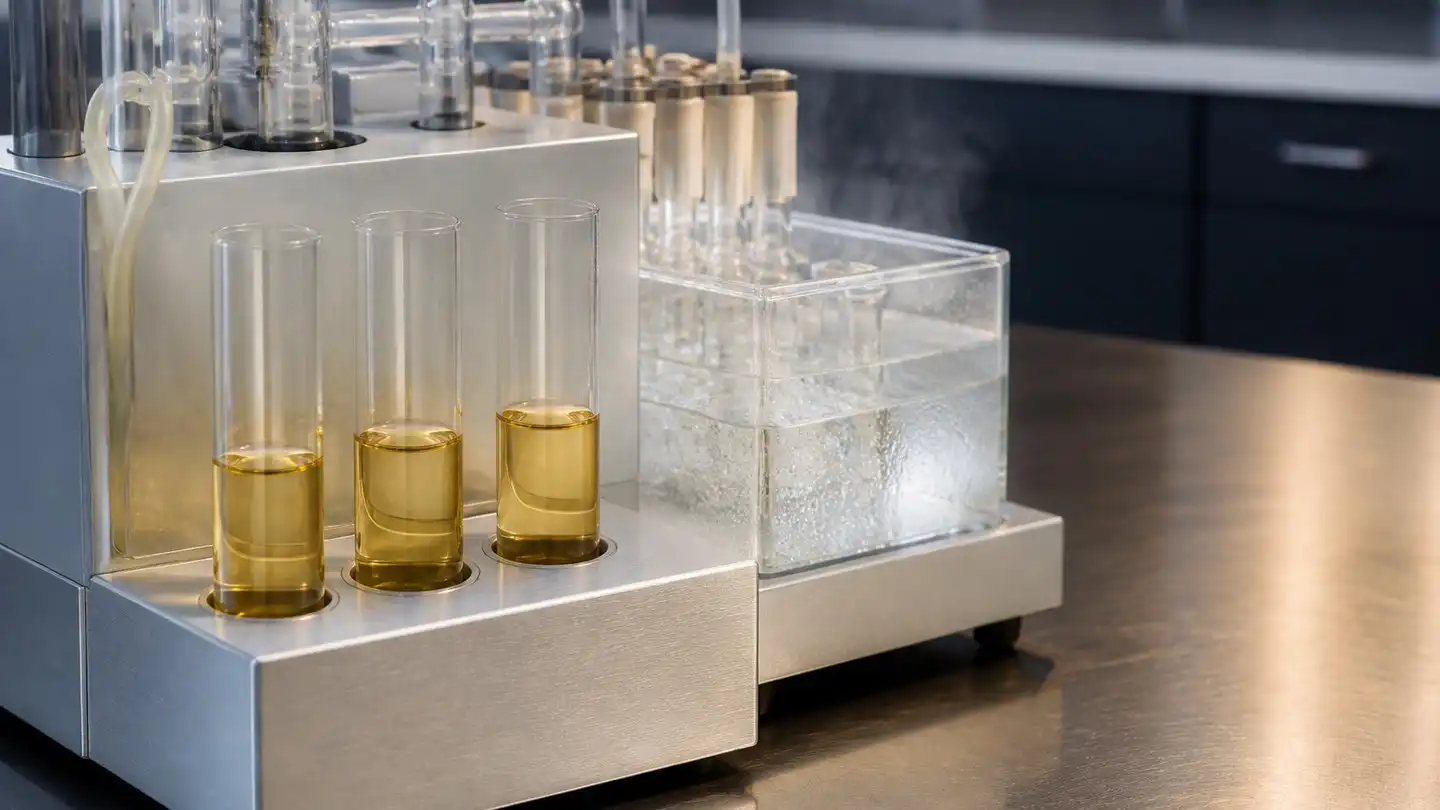
The Mechanism: How Rosemary Extract Antioxidant Interrupts Oxidation
A two-molecule relay: carnosic acid and carnosol
Rosemary's phenolic diterpenes do not behave identically, and that is a strength rather than a complication. In a detailed mechanistic study of the two major diterpenes, Loussouarn and co-workers demonstrated that carnosic acid behaves primarily as a chemical quencher of reactive oxygen species, being consumed and converted into oxidised derivatives — including carnosol — as it reacts. Carnosol, in turn, acts through a different route: it inhibits lipid peroxidation directly, in lipid oxidation conditions where no reactive oxygen species were being generated. In their model lipid system the two compounds were applied at 60 and 120 µM, and both protected linolenic acid and monogalactosyldiacylglycerol from oxidation, with the protective effect of α-tocopherol appearing slightly lower under those conditions.
For a formulator, the practical reading is that the extract carries a sacrificial molecule plus a secondary inhibitor, which means it keeps working as the first component is consumed. That is why "carnosic acid content" alone does not fully predict performance, and why the carnosol fraction and the overall diterpene profile belong in your specification discussion.
Removing the accelerators: metals, light and headspace oxygen
Radical scavenging is only one half of the job. The same oxidation sequence is accelerated by trace transition metals, by ultraviolet and visible light, and by dissolved or headspace oxygen. Transition metal ions such as iron and copper catalyse hydroperoxide decomposition, which is why rosemary extract is frequently combined with a chelating co-ingredient rather than used alone. The classic demonstration comes from Hraš and co-workers, who held sunflower oil at 60 °C for eleven days with rosemary extract, α-tocopherol, ascorbyl palmitate and citric acid. Rosemary extract gave the strongest antioxidative effect of the four, lowering the final peroxide value from approximately 200 meq/kg in the untreated control to approximately 120 meq/kg, and it combined additively with citric acid and, more strongly, with ascorbyl palmitate. The same study found a negative interaction when rosemary extract was blended with α-tocopherol under those conditions: "more antioxidants together" is not automatically better.
Where the molecules sit: oil phase versus water phase
Antioxidant performance in a mixed system depends on getting the active where the oxidation is happening. The phenolic diterpenes are lipid-soluble, so they partition into the oil phase and into the hydrophobic core of emulsions, which is where most lipid hydroperoxides form. The polar phenolic fraction partitions toward the aqueous phase and the oil–water interface. In a bulk oil this hardly matters; in a beverage emulsion, a dressing or a wet pet-food matrix it decides whether you are protecting the lipid, the interface, or only the water phase. The choice of delivery format therefore follows the continuous phase of the finished product.
Behaviour under heat
Thermal exposure is where botanical antioxidants are most often dismissed too early — usually because the wrong grade, or the wrong point of addition, was tested. Rosemary's diterpenes are comparatively resistant to the temperatures used in feed pelleting, extrusion and rendering, whereas tocopherols are more readily depleted under the same conditions. Wellgreen's product-page data for its Rosemary Extract Antioxidant reports that antioxidant activity was retained above 90% after exposure to 95 °C steam pelleting, and that addition of the product at 200–500 ppm in soybean oil extended the induction period measured in the supplier's Rancimat trial to roughly 3.5 times that of untreated oil. Those are supplier laboratory figures and should be treated as a starting hypothesis for your own matrix, not as a transferable inclusion level for your product.
Instrumental Methods That Turn the Mechanism Into Numbers
Oxidation has two measurable stages, and a credible stability dossier measures both. Primary oxidation products are hydroperoxides; secondary products are the carbonyls that carry the off-flavour. Relying on a single endpoint is the most common reason natural-antioxidant trials produce inconclusive results. The same principle governs how stability data is used to specify any powdered botanical input; for a worked example in a different ingredient category, see our notes on how quercetin dihydrate powder improves stability in functional food formulations.
| Measurement | What it captures | Where it earns its place | Practical notes |
|---|---|---|---|
| Peroxide value (PV) | Primary oxidation products — substances that oxidise potassium iodide under the test conditions, expressed as milliequivalents of peroxide per 1000 g of sample | Core endpoint for oils, fats and lipid-rich premixes; the earliest quantitative signal of the antioxidant effect | AOCS Cd 8b-90 is applicable to normal fats and oils; the method is empirical and gives erratic results at PV of 70 or above, so control the procedure precisely |
| p-Anisidine value (p-AV) | Secondary oxidation products, principally aldehydes formed when hydroperoxides decompose | Confirms whether suppression of primary oxidation also delays the sensory-relevant stage | Method adaptation is often required for atypical fat substrates and by-product fats |
| Composite oxidation indices | A single value combining primary and secondary figures to rank samples | Useful for comparing several candidate antioxidant systems in one table | Only meaningful when the underlying PV and p-AV data are reported alongside it |
| Oxidative stability index / induction period (Rancimat-type) | The time a sample resists oxidation while air is passed through it at a constant elevated temperature | Fast comparative screen across dose levels and candidate antioxidants; supplier data of this type is widely available for benchmarking | AOCS Cd 12b-92 describes the oil stability index; results are ranking tools, not shelf-life predictions on their own |
| Accelerated storage with PV and p-AV kinetics | The shape of the oxidation curve over time under forced conditions | Dose-response work and shelf-life extrapolation | Needs a full time series, not a single end-point sample |
| Headspace or dissolved-oxygen uptake | Consumption of the oxidant itself | Confirms protection in low-fat or packaged systems where oxidation is oxygen-limited | Most informative when read together with PV, since it detects the limiting factor |
| Trained sensory or flavour profiling | Perceptible rancidity and any aroma contributed by the extract itself | The stage that decides whether a technically effective dose is commercially usable | Run in parallel with instrumental sampling; perceptible change can precede or follow PV movement depending on the matrix |
| Active-content assay (carnosic acid) | How much of the specified active is present in the incoming material and remaining in the finished product | Connects incoming quality control to the performance you observe on the bench | Requires a validated HPLC method and lot-level certificates of analysis |
Designing an Accelerated Oxidation Study You Can Defend
Controls, comparators and the dose ladder
An antioxidant trial without a negative control measures nothing. Build the design around three reference points: an untreated sample of the identical base matrix, the current commercial benchmark (a synthetic antioxidant, a tocopherol blend, or your existing system), and the rosemary extract at several inclusion levels so that you produce a dose-response curve rather than a single data point. Retaining a sample of the base matrix without any antioxidant also exposes whether the raw material already carries antioxidant carry-over from an earlier process step.
Because supplier recommendations are almost always expressed for a generic oil, the dose ladder is the only way to establish where your own system saturates. This is also where the counter-intuitive result from Hraš and co-workers matters: an antioxidant can behave pro-oxidatively in a specific matrix under specific conditions. Treating the top of the dose ladder as a safety margin is a mistake, because some matrices plateau, and that point has to be found rather than assumed.
Sampling, endpoints and shelf-life extrapolation
Accelerated testing works by raising temperature or oxygen availability so the oxidation curve compresses into weeks instead of years. That compression has limits: above certain temperatures the reaction pathway itself changes, which is one reason the Hraš study worked at 60 °C. Extrapolation to real time therefore needs a documented kinetic assumption, validated against at least one real-time data point under your actual packaging and storage conditions, and the raw time series should stay in the dossier. A shelf-life statement built on a single accelerated end-point will not survive a technical audit.
System Variables That Decide Whether the Effect Appears
Two laboratories can test the same extract in the "same" oil and report different conclusions, because the outcome is governed by the matrix as much as by the ingredient. The variables below are the ones worth mapping before a trial is designed, not after it fails.
| Variable | Why it changes the outcome | What the test design must include |
|---|---|---|
| Fatty acid profile and degree of unsaturation | Highly unsaturated oils consume antioxidant faster and reach sensory rejection sooner at the same PV | Use the real production oil or fat, not a refined model oil with a different unsaturation profile |
| Trace metals and chelating co-ingredients | Iron and copper catalyse hydroperoxide breakdown, bypassing part of the radical-scavenging route | Samples with and without a chelating co-ingredient, using the actual ingredient supply rather than laboratory-grade substitutes |
| Light and headspace oxygen | Photo-oxidation and residual oxygen drive oxidation independently of temperature | Test in the intended packaging and light exposure, including the worst realistic case rather than only ideal storage |
| Process temperature and point of addition | Dispersing the extract into a hot fat phase gives a different distribution from post-process addition | Replicate the real addition sequence, and take a sample before and after the thermal step |
| Water activity and oil–water partitioning | The active must be present at the site of oxidation, and hydrophilic and lipophilic fractions migrate differently | Match the grade format to the continuous phase and measure both phases if the product is an emulsion |
| Co-antioxidant pairing | Interactions can be additive, neutral or negative; the rosemary/tocopherol combination showed a negative interaction in sunflower oil at 60 °C | Test the blend as a blend; borrowed synergy assumptions are unreliable across matrices |
| Carrier format and dispersibility | An oil-soluble liquid and a water-dispersible powder distribute differently in dry blends, emulsions and fat-coating steps | Run the trial with the format intended for production, at the same addition point |
| Inclusion level relative to oxidisable substrate | The antioxidant-to-substrate ratio, not the ppm figure alone, drives the observed effect | Express results relative to fat content so the outcome is transferable between recipes |
| Storage humidity and powder handling | Moisture uptake in powders reduces flowability and dispersion uniformity | Include a controlled-humidity storage arm for powder formats |
Sensory, Colour and Label Considerations to Test Early
Rosemary extract is not flavour-neutral at every inclusion level. The herbaceous, slightly resinous character that makes the extract recognisable is also the reason a technically successful trial can fail at the sensory panel. In the systems where that matters most — dairy analogues, mild-flavoured beverages, white or pale bakery, and premium pet food where palatability drives repeat purchase — the flavour contribution should be evaluated at the top of the dose ladder, not at the bottom. The underlying trade-off between effective load and acceptable sensory profile is the one described in our overview of how rosemary extract improves food shelf life.
Three mitigation routes are standard in practice. First, specify a deodorised or refined grade where the aroma load is intentionally reduced. Second, evaluate a lower effective load reached through a co-antioxidant or chelator combination, which can deliver a comparable induction period with less of the extract. Third, where the matrix already carries a flavour system, plan the flavour masking and the antioxidant trial together, so the flavour brief and the stability target are reconciled in one round of development rather than two. Colour also deserves an early check in pale systems, by running a colour measurement alongside the oxidation series.
Label implications follow the same logic: permitted wording differs by jurisdiction and category, so confirm the statement you intend to use before artwork goes to print. Planning the stability protocol and the label review in one project phase avoids re-opening a finished specification.
Incoming Material Quality Is a Variable You Control
A verification protocol is only as good as the material it tests. Because rosemary extract is standardised on carnosic acid content, two lots with different actual potency will produce different results in an otherwise identical trial — which is why incoming acceptance testing belongs inside the stability workflow rather than beside it. At minimum, confirm carnosic acid content by a validated HPLC method on every lot, review the certificate of analysis for the parameters that affect a lipid system, and retain a sample of each lot used in a trial so that any performance deviation can be traced back.
Wellgreen manufactures Rosemary Extract Antioxidant in liquid oil and water-dispersible powder formats, standardised between 5% and 20% carnosic acid, using supercritical CO₂ extraction followed by molecular distillation. The product family carries FAMI-QS, ISO 22000, Non-GMO and clean-label positions as listed on the product page. The oil format disperses rapidly in fat phases and suits direct injection or fat-coating steps, while the powder format is designed for dry premixes, mineral blends and mash feeds where flowability and uniform distribution matter.
Where This Fits With the Rest of the Series
Rosemary extract has now been characterised at both the mechanism level and the application level, which suits a data-driven procurement decision. If your next step is translating a verified specification into a purchasing decision, or connecting an oxidative-stability target to shelf-life claims in the finished product, the practical companion reading is our article on rosemary extract antioxidant applications in food and feed preservation.
Talk to Wellgreen About Your Stability Target
Send the technical team your matrix, your process window and the shelf-life target you have to reach. Wellgreen supplies Rosemary Extract Antioxidant with lot-level certificates of analysis and can supply samples for your own accelerated oxidation trial. For specification questions, documentation requests or a test-design discussion, write to wgt@allwellcn.com.
Disclaimer: This article provides technical and commercial information for industry professionals — ingredient suppliers, formulators, quality and procurement teams. It is not medical advice and makes no health, therapeutic or nutritional claim. Inclusion levels, regulatory status and permitted label statements vary by market and by application; confirm them against the regulations of your target market, your own product data and your own finished-product testing before commercial use.
References
- Loussouarn, M., Krieger-Liszkay, A., Svilar, L., Bily, A., Birtić, S., & Havaux, M. (2017). Carnosic Acid and Carnosol, Two Major Antioxidants of Rosemary, Act through Different Mechanisms. Plant Physiology, 175(3), 1381–1394. https://doi.org/10.1104/pp.17.01183
- Hraš, A. R., Hadolin, M., Knez, Ž., & Bauman, D. (2000). Comparison of antioxidative and synergistic effects of rosemary extract with α-tocopherol, ascorbyl palmitate and citric acid in sunflower oil. Food Chemistry. https://www.sciencedirect.com/science/article/abs/pii/S0308814600001618
- Zhang, Y., Yang, L., Zu, Y., Chen, X., Wang, F., & Liu, F. (2010). Oxidative stability of sunflower oil supplemented with carnosic acid compared with synthetic antioxidants during accelerated storage. Food Chemistry, 118, 652–662. https://doi.org/10.1016/j.foodchem.2011.02.082
- Varona, E., Tres, A., Rafecas, M., Vichi, S., Barroeta, A. C., & Guardiola, F. (2021). Methods to determine the quality of acid oils and fatty acid distillates used in animal feeding. MethodsX, 8, 101334. https://doi.org/10.1016/j.mex.2021.101334
- AOCS. Peroxide Value, Acetic Acid, Isooctane Method, Official Method Cd 8b-90 (reapproved 2025). https://library.aocs.org/Cd-8b-90/
- AOCS. Oil Stability Index, Official Method Cd 12b-92. https://library.aocs.org/Cd-12b-92/
- EFSA Panel on Food Additives and Nutrient Sources added to Food (ANS). (2018). Refined exposure assessment of extracts of rosemary (E 392). EFSA Journal. https://doi.org/10.2903/j.efsa.2018.5373
- Regulation (EC) No 1333/2008 of the European Parliament and of the Council of 16 December 2008 on food additives. EUR-Lex. https://eur-lex.europa.eu/legal-content/EN/TXT/?uri=CELEX%3A32008R1333
- Wellgreen. Rosemary Extract Antioxidant — product specification, formats, certification list and supplier-reported Rancimat and pelleting data. https://www.wellgreenherb.com/animal-nutrition/rosemary-extract-antioxidant