How to Choose a Reliable Cordyceps Militaris Powder Supplier for Ingredient Applications?
2026-09-07 15:16:57
Choosing the right Cordyceps Militaris Powder supplier comes down to verifying three non-negotiable pillars: bioactive consistency, certification integrity, and supply reliability. In a market flooded with variable-quality functional mushroom ingredients, procurement teams need more than a competitive quote. They need documented cordycepin and polysaccharide assay levels, traceable cultivation sources, and a supplier capable of scaling alongside their production demands. This guide walks through each critical evaluation layer so your sourcing decisions protect both product quality and long-term brand credibility.

Why Your Supplier Choice Directly Shapes Product Outcomes
In 2022, the global functional mushroom market was worth about USD 8.3 billion. It is still growing quickly, thanks to people's desire for adaptogenic diet and health solutions based on mushrooms. Because of this growth, Cordyceps Militaris Powder has become one of the most useful mushrooms for business. It is valued for its natural cordycepin, adenosine, and carbohydrate content.
But quality differences between suppliers are still a big risk when buying. The amount of active compounds in raw mushroom powders varies a lot depending on the substrate used for cultivation, the time of harvest, the drying method, and the post-processing steps taken. If a product is sold as a "standardized mushroom extract" but doesn't come with HPLC data that can be checked, it's basically an unknown variable in your formula.
If the quality of the raw materials isn't consistent, it can lead to inconsistent finished products and possible regulatory problems for companies that make nutraceuticals, pharmaceutical ingredients, functional drinks, and cosmetics. Choosing a reliable provider is not an administrative job; it is a choice about how to handle risk.
Establishing Core Metrics to Screen Suppliers
Bioactive Marker Verification
Cordycepin (3'-deoxyadenosine) and polysaccharides are the two most closely looked at signs in Cordyceps militaris powder sources. Suppliers you can trust offer clear test values for each batch of cordycepin content that has been confirmed by HPLC. A well-made fruiting body extract usually has much higher levels of cordycepin than alternatives derived from mycelium. This is because mycelium grown on grain substrates has a lot of starch, which makes it less effective. Ask the supplier directly if this is mycelium or a fruiting body. Is the substrate made from rice, and can you confirm that there is very little substrate left in the final powder?
Certification and Proof of Compliance
Certifications for Cordyceps Militaris Powder aren't just marketing tools; they're promises of quality that can be checked. Suppliers you can trust make sure they follow GMP, ISO, FSSC 22000, or HACCP standards by keeping records of their compliance. Organic certification is an extra layer of assurance that no synthetic inputs were used in the growing process. To get into the U.S. market, you have to test for heavy metals like arsenic, lead, cadmium, and mercury. This is because FDA and third-party retail standards require controlled contamination limits. Ask for Certificates of Analysis (COA) that are specific to each batch and compare them with data from a different lab.
Pricing Transparency and Logistics Capability
The way prices are set should clearly show the type of ingredient, its specifications, and the volume level—there shouldn't be any hidden minimums or unclear freight terms. When compared to selling through middlemen, suppliers who run their own factories usually have more stable prices and shorter wait times. Check to see if the provider can handle both small test orders and large-scale production. Also, make sure they offer cold-chain or moisture-controlled packing to keep the powder stable while it's being shipped.
Analyzing Supplier Options: What Differentiates a Strong Partner?
Evaluating potential suppliers requires looking beyond product data sheets. A genuinely capable B2B ingredient partner demonstrates transparency at every touchpoint. Here are the core differentiators that separate reliable manufacturers from commodity brokers:
- Whole powder vs. extract clarity: Suppliers should make it clear the difference between whole fruiting body powder and strong extract powder (10:1 ratio, for example). Each is used for a different preparation reason. The whole powder can be used in mushroom coffee blends and clean-label food applications. A 10:1 extract gives you increased active ingredients that work well for supplements in pill form.
- Batch traceability: Good suppliers keep records of the strain name, the cultivation batch, and the processing conditions. This traceability helps you stay in good standing with regulators and get ready for product recalls.
- Sensory profile documentation: For use in drinks and powder blends, color uniformity (usually a golden orange), odor profile, and dispersibility statistics are important. Cordyceps Militaris Powder can vary in color from batch to batch, but only if your supplier controls the light exposure and drying methods.
- Customization capability: If you need specific particle sizes, changed polysaccharide standardization, or custom packaging formats, a good supplier can make those changes without sending your order to a different company.
Matching Supplier Solutions to Your Application Requirements
Different uses for ingredients need suppliers with truly different skills, and a procurement method that works for all causes unnecessary friction.
Nutraceutical and supplement brands put a high value on clean excipient profiles, regular test levels, and powders that don't contain any fillers for Cordyceps Militaris Powder. Label correctness and dose stability depend on a pure Cordyceps Militaris Powder that doesn't have any added carriers or maltodextrin. Pharmaceutical-grade buyers add tested methods that have been proven to work, microbiology standards that have been closely monitored, and proof of being able to trace back to a baseline.
Water dispersibility, taste neutrality, and food-grade licenses are important to companies that make functional foods and drinks. It's best to use a hot-water extract for these uses because a raw mushroom powder with a lot of fiber might cause sedimentation in clear drinks. Cosmetic formulators put a high value on pure extracts, known active concentrations, and particle shapes that are safe for the skin.
OEMs and contract manufacturers work in all of these areas at the same time. They get the most out of providers who offer variable MOQ levels, quick sample return, and help with co-development for new formulations. When looking at sources for multi-category purchases, make sure that one maker can handle all of your products. This will cut down on the number of different vendors and make quality control easier.
Key Takeaways Before Making the Final Decision
A useful source vetting tool brings together all of the above evaluation layers. Before agreeing to work with a buying company, make sure of the following:
- The amounts of cordycepin and carbohydrate that were measured with HPLC were confirmed.
- The following certifications are currently in effect: GMP, ISO, organic (if applicable), and food safety management systems.
- Data from heavy metal and bacteria tests are provided for each batch.
- There are clear product specifications that separate the fruiting body from the mycelium and the extract ratio.
- Adaptable production capacity and a history of steady supply.
- Quick response to technical questions and willingness to give samples before buying.
When procurement teams use this checklist, they consistently report that ingredients are more consistent across production runs and that switching suppliers costs less over time. If a supplement company gets a Cordyceps militaris powder extract without checking to see if it has fruiting bodies or mycelium, for example, they might mix it with a mycelium powder that is high in starch, which would lead to label claim errors and the cost of reformulating. These things can't happen on your production line because you've checked everything out carefully.
Conclusion
Finding functional mushroom ingredients needs the same level of analysis as finding any other regulated raw material. The right Cordyceps Militaris Powder supplier will give you certified bioactive content, consistent quality across batches, and the freedom to grow as your production needs do. Protect your formulations, your customers, and your brand by judging sellers based on real data instead of claims they make on their marketing materials. If you stick to this plan, getting your ingredients will be a real competitive benefit instead of a weakness in your operations.
FAQ
What certifications should a cordyceps mushroom powder supplier hold?
As a minimum, look for GMP and ISO standards to ensure quality. Food safety management looks more trustworthy when it has FSSC 22000 or HACCP. For clean-label or organic lines of products, USDA or EU Organic certification proves that the crops were grown without using pesticides. All certifications should be up-to-date and can be checked with the organization that issued them.
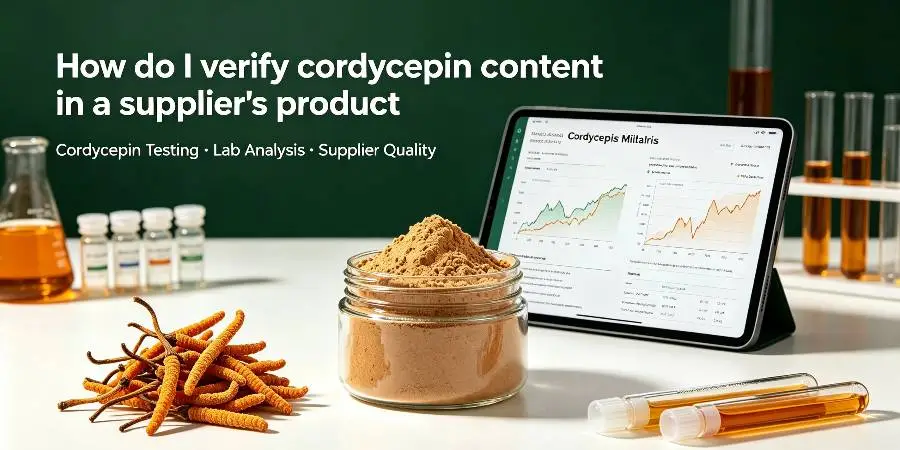
How do I verify cordycepin content in a supplier's product?
Ask for a batch-specific COA that lists the cordycepin percentage along with the analytical method used (which is usually HPLC). Verification by a third-party lab adds even more confidence. Be wary of suppliers who give you cordycepin levels without saying how they measured them.
What is the difference between whole mushroom powder and extract powder?
Whole powder keeps the whole fruit, including the fiber, and can be used in clean-label food uses. Extract powder, like one with a 10:1 concentration, has more active compounds per gram, which makes it better for encapsulated supplements where dose efficiency is important.
How do I assess batch-to-batch consistency?
Find out what the COA data is for three to five previous production runs and compare the microbiology results, cordycepin content, moisture levels, and color specs. Results that stay the same from batch to batch show that quality control systems are mature.
Source Your Next Functional Mushroom Ingredient with Wellgreen
Wellgreen Technology makes Cordyceps Militaris Powder and is GMP-certified. They offer verified 10:1 extract specifications, filler-free formulations, and full food safety documentation that includes ISO, FSSC 22000, and HACCP compliance. Our line of functional mushrooms helps nutraceutical brands, pharmaceutical formulators, beverage makers, and original equipment manufacturers (OEMs) by providing scalable supplies and quick technical support. Ask for a sample or talk about your unique needs today. You can email us at wgt@allwellcn.com or go to wellgreenherb.com.
References
1. Sung, G. H., et al. "Phylogenetic Classification of Cordyceps and the Clavicipitaceous Fungi." Studies in Mycology, 2007.
2. Tuli, H. S., et al. "Pharmacological and Therapeutic Potential of Cordycepin." Saudi Pharmaceutical Journal, 2013.
3. Das, G., et al. "Cordyceps spp.: A Review on Its Immune Stimulatory and Other Biological Potentials." Frontiers in Pharmacology, 2021.
4. Holliday, J., & Cleaver, M. "Medicinal Value of the Caterpillar Fungi Species of the Genus Cordyceps." International Journal of Medicinal Mushrooms, 2008.
5. Chen, P. X., et al. "Characterization of Cordycepin and Polysaccharides in Cultivated Cordyceps militaris." Food Chemistry, 2010.
6. Lindequist, U., et al. "The Pharmacological Potential of Mushrooms." Evidence-Based Complementary and Alternative Medicine, 2005.