Oregano Powder Feed Grade Enhances Flavor and Functional Feed Solutions
2026-09-07 15:16:53
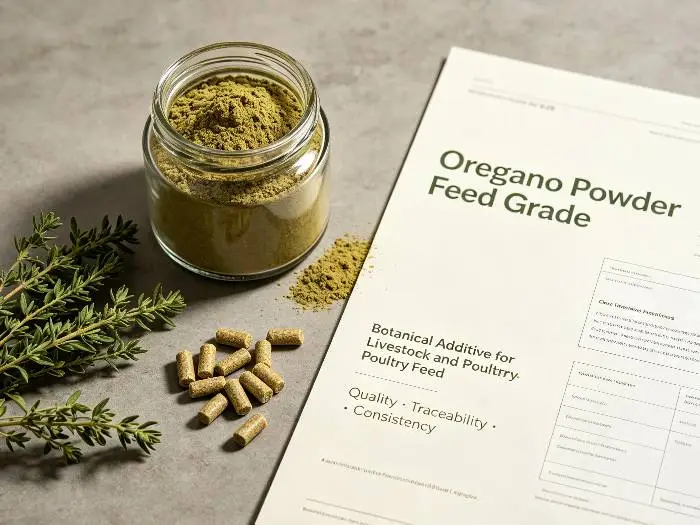
Oregano Powder Feed Grade is a plant-based feed ingredient made from Origanum vulgare that has been dried, ground, and processed in a normal way. Along with other bioactive phytochemicals, it naturally has volatile phenolic compounds, mostly carvacrol and thymol. In contrast to food-grade oregano, the feed-grade standard puts more weight on controlling microbes, batch stability, particle size accuracy, and working with both premix and full feed formulas. This plant-based ingredient is becoming more popular in aquaculture, pet nutrition, poultry, swine, and ruminant nutrition as the global animal nutrition industry moves toward phytogenic feed additives and natural gut health solutions.
Understanding Oregano Powder Feed Grade: Composition, Benefits, and Uses
What Makes It Bioactively Distinct?
The main good chemicals in Oregano Powder Feed Grade are carvacrol and thymol. The family they are in is the monoterpene phenol family. There are studies in Poultry Science and Animal Feed Science and Technology that show these substances can kill many types of bacteria, such as E. coli, Salmonella, and Clostridium perfringens. These phenolics kill microbes and are also strong antioxidants. This helps keep lipid-rich feed components from breaking down while they are being stored.
Dosage Ranges and Species Compatibility
Veterinary nutritionists usually suggest adding between 100 and 500 mg/kg of complete feed, depending on the species and the goal of the production. For chicken and egg layers and broilers, lower inclusion levels that try to keep the gut bacteria in balance are usually best. On the other hand, slightly higher rates may be used in baby feeds for pigs during the stressed time after they are weaned. Ruminants and fisheries are still looking for new ways to use it, but early tests show that it makes feed more digestible and increases the activity of stomach enzymes. Herbs like oregano can also help feed taste better in these situations. This is a useful benefit that formulators often miss when they look at phytogenic ingredients.
Comparing Oregano Powder Feed Grade with Other Herbal and Oil-Based Feed Additives
There are times when people who make feed have to choose between oregano essential oil, standardized extract powder, and whole-plant dried powder, and Oregano Powder Feed Grade is one of the options. How they work, how stable they are, and how much they cost are all very different. Each style has some good points.
Here's how the main forms stack up against factors that matter for procurement:
- The most carvacrol and thymol are found in oregano essential oil per gram, but it is hard to mix with dry premix because it is not a solid. Over time, changes that happen during processing and storage shorten the shelf life. It's also hard to do precise dosing in large feed mills without special micro-dosing equipment.
- Standardized oregano extract powder comes in a concentrated, spray-dried, or capsule form and has known amounts of carvacrol. It is easy to use like powder but has the bioactive power of oil. This makes it a good choice for nutraceutical and precision nutrition uses. Whole-plant powder, on the other hand, costs a lot less per kilogram.
- It's easy to use, doesn't cost much, and has a natural scent. Oregano Powder Feed Grade: Whole-plant dried. It can be used as a base ingredient in phytogenic blend products because it has a small but stable amount of bioactive compounds and a wide range of phytochemicals. Firms that make premix and full feed use dry mixing methods that work well with it.
If you compare oregano to plant powders like thyme, rosemary, or yucca, it has a different taste and a lot of antimicrobial properties. Progressive nutritionists are increasingly favoring formulation strategies that combine oregano with complementary plants like yucca (Yucca schidigera) or rosemary. These combinations create synergistic phytogenic systems that address multiple animal health goals at the same time.
How to Select the Best Oregano Powder Feed Grade Supplier: A B2B Procurement Guide?
Choosing a supplier for feed ingredients comes with real practical and legal risk. A plant ingredient that isn't well recorded or isn't always made the same way can make it hard to follow feed safety rules and affect how well animals perform. Procurement professionals should use strict criteria when qualifying a new source for Oregano Powder Feed Grade.
The following factors deserve priority attention during supplier evaluation:
- Certifications and compliance documents: For international purchases, you must have FAMI-QS feed safety certification, ISO 22000, HACCP, and GMP documentation. With HALAL and KOSHER licenses, you can get into more markets. Make sure that these certificates are up-to-date and can be checked.
- Botanical identity and origin traceability: Ask for proof of the plant species (Origanum vulgare), where it comes from, and when it is harvested. Adding cheaper relatives of oregano to products is a known problem in the industry.
- Analytical testing documentation: The batch COA should list the amount of water, particle size, total ash, heavy metals (such as lead, cadmium, arsenic, and mercury), pesticide residues, and microbiological indicators (such as total plate count, yeast/mold, and Salmonella).
- Particle size and mixing uniformity: The spread of particle sizes has a direct effect on the homogeneity of the blend in both premix and full feed. Make sure that the mesh specs that are offered meet the needs of your production line.
- OEM and private label support: Flexible MOQ, custom packing, and formulation support for composite phytogenic mixes cut development times by a large amount.
The most reliable way to find reliable sources for Oregano Powder Feed Grade before committing to large-scale purchases is to order samples from two or three of them at the same time and compare them analytically.
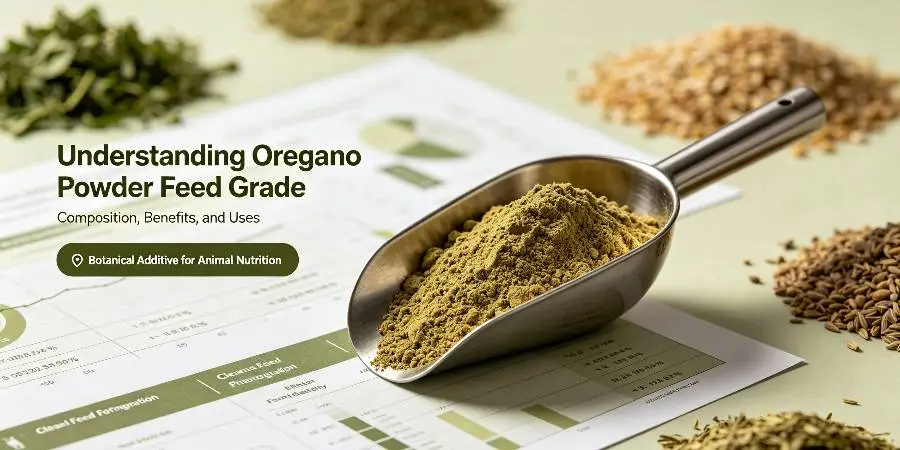
Implementing Oregano Powder Feed Grade into Your Animal Nutrition Program
Adding a plant ingredient to a feed program that is already in place involves more than just changing one inclusion rate. A structured method should be used for the integration process to make sure it works well and keep the security of the current formula.
The best way to include Oregano Powder Feed Grade is to make sure that it doesn't react badly with other antioxidants, enzymes, or mineral premixes that are already in the product. Because the volatile aromatic chemicals in oregano can change palatability, feed intake should always be tracked along with growth measures like average daily gain and feed conversion ratio during the trial phase.
A cost-benefit study always shows that well-run phytogenic projects are good for the economy. In commercial poultry trials, lower mortality rates, lower costs for antibiotic interventions, and better feed conversion efficiency have all shown a measurable return on investment (ROI) within a single production cycle. A 2021 study published in Livestock Science looked at several broiler trials and found that adding oregano-based phytogenic supplements increased the feed conversion ratio by an average of 3–5% compared to controls that weren't given supplements. This is a number that has real-world financial implications at a commercial scale.
Future Trends and Innovations in Oregano Powder Feed Grade Usage
The market for phytogenic feed additives is expected to grow a lot until the late 2020s. This is because more and more areas that raise cattle are banning antibiotic growth promoters (AGPs) and more and more people want animal goods that don't have any residue on them. Oregano Powder Feed Grade is at the center of this change.
Microencapsulated delivery systems that protect volatile phenolics through the upper digestive tract are still being studied. These systems would release active compounds preferentially in the hindgut, which is where antimicrobial activity is most important. Customized extract profiles, which change the ratio of carvacrol to thymol for certain pathogen targets, are another area of product development that is very active.
The dynamics of the supply chain are also changing. More and more, procurement teams are giving more weight to sellers who can source botanicals vertically integrated, have strong infrastructure for tracking products, and are willing to work with them to create new phytogenic formulas. The days of treating oregano as a common commodity are giving way to a model where supplier technical skills are just as important as the price per kilogram.
Conclusion
Oregano Powder Feed Grade holds a legitimately useful place in contemporary animal nutrition, not just as a trendy ingredient but as a phytogenic raw material that has been botanically proven to work. Its antimicrobial phenolics, natural aromatic properties, ability to be processed as a powder, and growing scientific support make it a reliable part of natural feed programs for many species. If you choose the right provider with the right certifications and analytical openness, those benefits will show up in consistent output results.
FAQ
What is the difference between food-grade and feed-grade oregano powder?
Feed-grade Oregano Powder Feed Grade is made with tighter rules about the amount of microbes, heavy metals, chemical residues, and particle size than food-grade material. It also needs to meet safety standards for feed like FAMI-QS and have full batch documentation that can be used for audits of livestock feed compliance.
Which animal species benefit most from oregano powder supplementation?
The most research backs up broilers, layers, nursery piglets, and swine finishing pigs. The use of ruminants and aquaculture is growing, and early data on feed intake and gut health measures are good. Low-level addition is also being looked at by pet food formulators because it has natural aromatic properties.
Can oregano powder replace synthetic antibiotics in feed?
It's not a direct one-to-one replacement, but it can be an important part of AGP-free programs when used with other nutrition and management strategies. When included at validated rates, published trials show improvements in the balance of microbiota in the gut and a decrease in pathogens.
What certifications should a reliable supplier hold?
The main rules for the feed industry are FAMI-QS, ISO 22000, HACCP, and GMP. Certifications like HALAL, KOSHER, and organic give niche markets more ways to use products.
Partner with Wellgreen for Reliable Oregano Powder Feed Grade Supply
Wellgreen Technology offers a professional-grade Oregano Powder Feed Grade supply backed by GMP manufacturing, FAMI-QS certification, and full batch testing documentation covering heavy metals, microbiology, and pesticide residues. As an experienced botanical extract manufacturer and supplier, we support OEM formulations, custom particle size specifications, and composite phytogenic blends. Contact our technical team at wgt@allwellcn.com or visit wellgreenherb.com to request samples and discuss your feed formulation requirements.
References
1. Bampidis, V. A., et al. "Use of Oregano (Origanum vulgare L.) Herb in Broiler Chicken Feeding." Animal Feed Science and Technology, 2005.
2. Hashemipour, H., et al. "Effect of Thymol and Carvacrol Feed Supplementation on Performance, Antioxidant Enzyme Activities, Fatty Acid Composition, Digestive Enzyme Activities, and Immune Response in Broiler Chickens." Poultry Science, 2013.
3. Windisch, W., et al. "Use of Phytogenic Products as Feed Additives for Swine and Poultry." Journal of Animal Science, 2008.
4. Yang, C., et al. "Antimicrobial Activity of Plant Extracts and Their Potential Applications in Livestock Feed." Livestock Science, 2021.
5. Benchaar, C., et al. "Effects of Addition of Essential Oils and Monensin Premix on Digestion, Ruminal Fermentation, Milk Production, and Milk Composition in Dairy Cows." Journal of Dairy Science, 2007.
6. Brenes, A., and E. Roura. "Essential Oils in Poultry Nutrition: Main Effects and Modes of Action." Animal Feed Science and Technology, 2010.