Milk Thistle Extract Powder for Functional Food and Nutraceutical Formulations
2026-10-02 14:00:02
Milk Thistle Extract Powder is one of the few botanical ingredients a formulator can build several products around. It arrives standardized and free-flowing, and it can be filled into a hard-shell capsule, compressed into a tablet, weighed into a sachet, or dispersed into a beverage. Each destination places a different demand on the same lot: a powder that encapsulates easily can be awkward to blend into a dry sachet, and a grade that wets out cleanly is not automatically the grade that compresses without sticking. This article looks at standardized milk thistle extract powder from the formulator's side of the bench — how it behaves in each dosage form, and which specification fields decide whether it can be run at all.
One boundary up front: this is a manufacturing-fit article about powder physics, specification wording and process risk, not physiological effects, intake levels or label claims.
Where Formulation Problems Actually Appear
Extracts fail in production for unglamorous reasons. A capsule fill weight drifts because the powder consolidates in the hopper. A tablet batch sticks to the punch faces because the lubricant was chosen for a different particle morphology. A sachet blend separates in the last two metres of a transfer line. A ready-to-mix drink settles into a beige layer minutes after reconstitution. None of these is a chemistry problem, and none shows up on a certificate of analysis.
| Dosage form | What the powder must do | Typical failure mode |
|---|---|---|
| Two-piece hard-shell capsule | Fill a fixed die volume consistently and flow without bridging in the hopper | Fill-weight drift, caking, slow or incomplete fills |
| Compressed tablet | Bond under compression without adhering to punches or dies | Sticking and picking, capping, hardness or disintegration failure |
| Stick pack or sachet (dry blend) | Match the carrier's particle-size band and stay mixed through transfer and filling | Segregation, dust in the seal zone, inconsistent unit load |
| Powder beverage or ready-to-mix drink | Wet out, stay dispersed, and hold the taste profile over shelf life | Floating islands on reconstitution, sedimentation, rising bitterness |
| Soft matrix: gummy, bar, filled chocolate | Disperse without a gritty mouthfeel and survive the matrix's moisture and heat | Grit, colour migration, marker loss during processing |
Close that gap by working backwards from the dosage form: each format imposes a short list of hard demands, each mapping onto a specification field worth negotiating with the supplier.
The Specification Fields That Decide Whether the Powder Can Be Formulated
Assay Basis Is a Formulation Input, Not Just a Number
The declared silymarin content is the first line anyone reads and the most commonly misread. A figure such as 80% silymarin does not describe one compound: silymarin is a flavonolignan mixture, and silybin makes up roughly half to two-thirds of it. Two lots can both declare 80% while carrying different proportions of the individual flavonolignans, which is why the assay method and its basis, UV or HPLC, matter to the formulator and not only to QA.
The direction of the arithmetic matters more. A higher marker content means less powder per unit — useful when capsule size is fixed — but also a smaller share of non-marker material, and that remainder often carries the colour, taste and solubility behaviour. Choosing a grade purely on the highest available number can shift the taste and dispersion profile underneath you. That trade-off is covered in our note on choosing the right milk thistle extract powder concentration.
Particle Size, Moisture and Solubility in the Intended Vehicle
Particle size does the most quiet work. Mesh range controls flow, dusting, blend homogeneity and the mouthfeel of anything not swallowed whole. An 80–100 mesh grade, such as the one Wellgreen lists on its product page, sits in the band that dry-blends predictably and fills capsules without excessive airborne loss.
Moisture sits next to it. Loss on drying below 5.0% is a common commercial limit, and it matters twice: for microbial risk and shelf life, and for flow, since water films between particles make a free-flowing powder cohesive. Solubility is the other field assumed rather than measured. Silymarin is lipophilic and poorly soluble in water — reported below 50 µg/mL — while dissolving readily in ethanol and acetone, which is why "soluble" means nothing until the intended vehicle is named.
| Specification field | Illustrative declared value | What it decides |
|---|---|---|
| Silymarin content | ≥80% | Powder weight per unit; share of non-marker material carrying colour, taste and solubility behaviour |
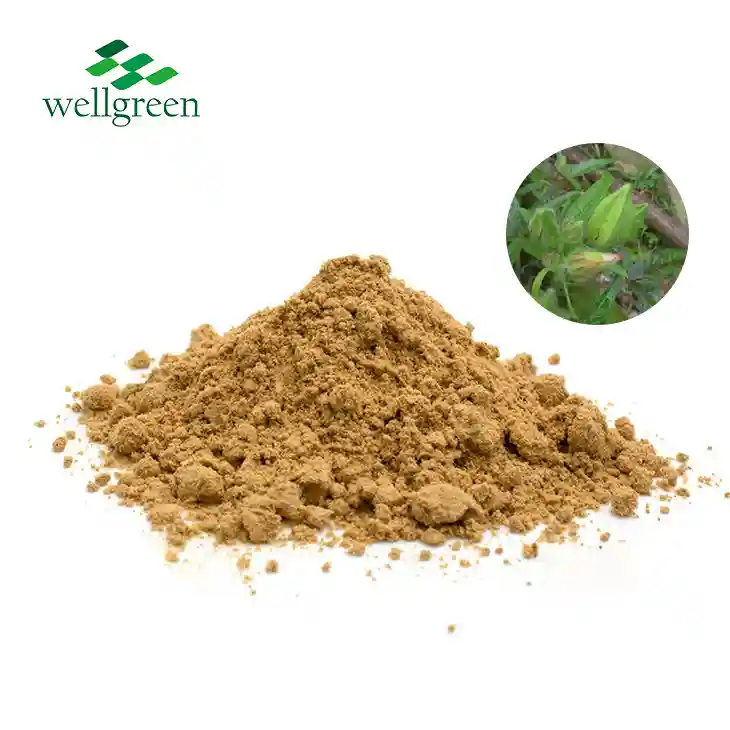
| Appearance | Fine yellowish-brown powder | Colour load in pale beverages, gummies and coated tablets |
| Solubility | Soluble in ethanol, acetone | Which vehicles are viable; whether an emulsifier or hydrocolloid system is needed |
| Particle size | 80–100 mesh | Flow, dusting, blend homogeneity, mouthfeel, seal-zone contamination |
| Loss on drying | <5.0% | Flow stability, caking risk, microbial risk, granulation behaviour |
| Heavy metals | <20 ppm | Incoming-QC acceptance and market-access documentation |
Values are those published on the Wellgreen product page for this ingredient, quoted as an example of a commercial specification set.
Capsule and Tablet Fill: Density, Flow and Compression Behaviour
Bulk and Tapped Density Set the Fill Window
Capsule fill is volumetric. The machine fills a die of fixed volume, so fill weight is whatever mass of powder that volume happens to hold, and that number moves with bulk density. A supplier change that alters bulk density by a few percent can push fill weight out of specification even when the assay is identical. Tapped density, and the compressibility index derived from it, describe how far that density shifts under load in the hopper.
The table below reproduces the flow ranking in USP general chapter 〈1174〉. That chapter places an angle of repose of 25–30° in the "excellent" band and anything above 66° in the "very, very poor" band, and it is explicit that neither measure is intrinsic to a powder: both depend on the test method.
| Compressibility index (%) | Flow character | Hausner ratio |
|---|---|---|
| 1–10 | Excellent | 1.00–1.11 |
| 11–15 | Good | 1.12–1.18 |
| 16–20 | Fair | 1.19–1.25 |
| 21–25 | Passable | 1.26–1.34 |
| 26–31 | Poor | 1.35–1.45 |
| 32–37 | Very poor | 1.46–1.59 |
| >38 | Very, very poor | >1.60 |
For tablet compression the same data becomes a compressibility question. A powder with a high compressibility index deforms readily but consolidates unpredictably in the die; one with a low index flows well but may not bond. Request bulk and tapped density, compressibility index and particle-size distribution alongside the assay, then trial the material on the intended press. See our companion note on using milk thistle extract in capsules and tablets.
Lubricant, Disintegrant and Sticking Interactions
Magnesium stearate is the usual lubricant and the usual suspect when a botanical tablet under-compresses. It works by forming a boundary film, so it is sensitive to particle surface area: a fine extract consumes more lubricant, reducing bonding and slowing dissolution. Sticking and picking are driven by moisture at the punch face and by the very fine fraction of the blend, so a tighter particle-size range is the more useful lever. Disintegrants need moisture and pore structure to act, so an over-dried blend can pass the press yet fail its disintegration test.
Stick Packs and Sachets: The Dry-Blend Problem
A stick pack is a dry blend in a narrow tube, and it is where particle-size mismatch becomes expensive. Segregation is driven mainly by differences in particle size, density and morphology, and risk rises as the active's share of the blend falls. A fine extract dispersed into a coarser sugar or polyol carrier sifts downward during filling, transfer and vibration, so the first sticks off the line and the last do not carry the same load.
Four controls do most of the work:
- Particle-size matching. Bring extract and carrier into the same size band rather than relying on mixer time; where the extract is appreciably finer, consider a granulated or agglomerated grade.
- Dusting control. Fines travel in air and coat the stick pack's sealing zone, a seal-integrity risk as much as a yield loss.
- Segregation testing. Sample across the fill run — start, middle and end of the hopper — not a single composite; sifting and fluidisation testers reproduce the mechanisms deliberately.
- Taste load. With no water and no dilution at the moment of consumption, the bitter and astringent fraction arrives undiluted. Granulation with a carrier, sweetener or flavour system beats flavouring a loose powder afterwards.
Food and Beverage Formats: Dispersibility, Sedimentation and Taste
Wettability, Dispersibility and Sedimentation
In a beverage the first obstacle is not solubility but wettability: a hydrophobic powder dropped onto water floats as a raft of dry islands. The second is sedimentation — the low aqueous solubility of silymarin means much of the load remains as suspended solids, and suspended solids settle. Formulators attack both with an emulsifier or hydrocolloid system, a water-dispersible grade, or a smaller particle size. For clear formats, ask a supplier not "is it soluble" but "in what vehicle, at what solids loading, and does it stay in suspension over the declared shelf life". A bench test answers more: disperse at the intended solids loading in the intended vehicle, hold one sample chilled and one at ambient, and record clarity and sediment volume at 0, 24 and 72 hours.
Carrying the Bitter and Astringent Taste Load
Flavonolignans taste bitter and drying, and the intensity tracks the amount of marker present. Taste-masking practice across the food and pharmaceutical industries converges on a limited set of tools: sweeteners, salts, acids, fats, peptides and amino acids, flavourants, cyclodextrins and polymers. Two mechanisms run in parallel — receptor-level blocking or modulation, and a physical barrier or competing dominant taste.
For a botanical format the barrier approach is usually more reliable, because it survives dilution in a finished beverage better than a flavourant does; cyclodextrin complexation and lipid or hydrocolloid encapsulation are both well established. Because solubility changes by orders of magnitude between water and ethanol, the vehicle and the masking system are one decision rather than two. The marker fraction itself is covered in our explainer on what silymarin is and why it is the key active.
Stability and Hygroscopicity Between the Drum and the Line
Stability work on a botanical extract is a packaging and handling exercise as much as a formulation one. The triggers are light, heat, moisture and oxygen. Silybin is stable under acidic conditions but loses stability with Lewis acids and under basic conditions, and prolonged heating above 100 °C disrupts its skeleton. Keep the extract away from alkaline components in a blend, and avoid drying or granulation steps that overshoot temperature.
Moisture is the most underestimated variable, because it acts on both chemistry and physics. Water activity — defined in 21 CFR 111 as the measure of free moisture available in a component — is the number to watch rather than total moisture alone. A hygroscopic extract that picks up water in an open drum will lose flow, cake in the hopper and carry a higher microbial risk, sometimes within one shift. Sealed, light-resistant packaging is the first control; hold-time limits on opened material are the second.
Formal stability design should follow a recognised protocol. ICH Q1A(R2) sets out the long-term, intermediate and accelerated conditions used to justify a shelf life, and applying that logic early will flag an incompatible excipient long before a consumer complaint does.
Writing the Purchase Specification Around the Line
The most effective thing a formulation team can do is write the specification in process language. Assay basis and method, particle-size distribution with the test method named, loss on drying, bulk and tapped density, and solubility in the intended vehicle are the fields that turn a certificate of analysis into a usable formulation input. Where a supplier publishes a full specification — the Wellgreen product page lists silymarin ≥80%, 80–100 mesh, loss on drying below 5.0% and heavy metals below 20 ppm — confirm those fields against your own dosage form rather than accepting them as a claim.
Two regulatory anchors are worth keeping in the file. Directive 2002/46/EC defines food supplements by dose form, and its examples — capsules, tablets, pills, sachets of powder, ampoules of liquids and other similar forms — map almost exactly onto the formats above. In the United States, 21 CFR 111 sets the GMP framework for the same products and defines component, batch, in-process material and water activity — the vocabulary your supplier's quality team already uses. Neither tells you what runs on your line, but both shape how the specification is written. Our note on ensuring the quality and purity of milk thistle extract powder covers the incoming-QC side.
Talk to Wellgreen About Your Formulation
Wellgreen supplies standardized Milk Thistle Extract Powder from a GMP-certified facility, with the specification published on the milk thistle extract powder product page and certificates listed there as ISO9001:2015, ISO22000, Halal, Kosher and HACCP. If you are working through a formulation-fit question, send your intended dosage form, target particle-size range and vehicle to wgt@allwellcn.com and ask for a sample, a certificate of analysis and a matched specification quote.
This article provides technical and commercial information about a botanical ingredient for industry readers; it is not medical advice, and use levels, regulatory status and label claims must be confirmed against the rules of your target market and your own product data.
References
- United States Pharmacopeia. 〈1174〉 Powder Flow. USP–NF general chapter, harmonized with the European and Japanese Pharmacopoeias (2024). https://www.usp.org/sites/default/files/usp/document/harmonization/gen-chapter/20230428HSm99885.pdf
- Bijak, M. (2017). Silybin, a Major Bioactive Component of Milk Thistle (Silybum marianum L. Gaernt.)—Chemistry, Bioavailability, and Metabolism. Molecules, 22(11), 1942. https://doi.org/10.3390/molecules22111942
- Di Costanzo, A., & Angelico, R. (2019). Formulation Strategies for Enhancing the Bioavailability of Silymarin: The State of the Art. Molecules, 24(11), 2155. https://doi.org/10.3390/molecules24112155
- Jakubowska, E., & Ciepluch, N. (2021). Blend Segregation in Tablets Manufacturing and Its Effect on Drug Content Uniformity—A Review. Pharmaceutics, 13(11), 1909. https://doi.org/10.3390/pharmaceutics13111909
- Paul, S., Yoo, O., Locher, C., & Lim, L. Y. (2026). Ingredients to Mask the Aversive Taste of Medicines: Lessons from the Pharmaceutical and Food Industries and Home Remedies Adopted by Caregivers. Foods, 15(8), 1413. https://doi.org/10.3390/foods15081413
- Directive 2002/46/EC of the European Parliament and of the Council of 10 June 2002 on the approximation of the laws of the Member States relating to food supplements. OJ L 183, 12.7.2002, p. 51–57. https://eur-lex.europa.eu/legal-content/EN/TXT/?uri=CELEX:32002L0046
- U.S. Food and Drug Administration. 21 CFR Part 111 — Current Good Manufacturing Practice in Manufacturing, Packaging, Labeling, or Holding Operations for Dietary Supplements. Electronic Code of Federal Regulations. https://www.ecfr.gov/current/title-21/chapter-I/subchapter-B/part-111
- International Council for Harmonisation. ICH Q1A(R2) — Stability Testing of New Drug Substances and Products. https://database.ich.org/sites/default/files/Q1A%28R2%29%20Guideline.pdf