
Milk Thistle Extract Powder Manufacturer for Standardized Botanical Ingredient Supply
2026-10-16 14:00:01
Qualifying a Milk Thistle Extract Powder manufacturer is not a sourcing formality. It is the point at which a brand commits to a partner whose quality system, analytical capability and production calendar will decide whether the finished product still matches its label a year from now. A specification — a silymarin figure, a mesh range, a moisture limit — is only a promise on paper; the questions that matter are whether the manufacturer can hold that promise batch after batch, and evidence it on demand. This guide sets out how procurement, QA and regulatory teams can qualify a supplier of milk thistle extract powder against those questions rather than against a price sheet.
Why Qualification Is a Programme Question, Not a Product Question
Most first-contact evaluations collapse into a comparison of catalogue lines. That approach works for commodity chemicals; it works far less well for standardised botanicals, where the starting material is a crop and the extract is defined as much by its process as by its assay. Two manufacturers can both declare the same silymarin content and still differ in ways that only surface months later: in how that figure was reached, how tightly it is held, and what happens when a harvest year misbehaves.
A supplier qualification is therefore a test of a supply programme rather than of a product. The programme has four examinable surfaces — the quality-management system, traceability and change control, capacity and scale-up behaviour, and documentation — and each can be inspected before a first order is placed.
What a Standardised Botanical Manufacturer Should Be Able to Evidence
Evidence, in this context, means material a buyer can read, keep and file — not assurances delivered on a call.
The Quality-Management Backbone: Read the Scope, Not the Logo
The certificate logo is the least informative part of a certificate. What matters is the scope statement: the sentence naming the site, the activities and the product categories covered. A food-safety certificate covering the packing of dried plant material does not describe an extraction plant, and an ISO 9001 certificate issued to a trading office does not describe manufacturing. Buyers should request the current certificate, note the issuing body, validity dates, legal entity and physical address, and then confirm that these match the entity that will appear on the commercial documents, the COA header and the shipment labels.
Wellgreen’s product page for this ingredient lists ISO 9001:2015, ISO 22000, Halal, Kosher and HACCP, and describes its facility as GMP-certified. That is a useful starting point and precisely the kind of summary a buyer should verify against the underlying certificates, because a listing tells you which certificates exist, not what each one actually covers.
Two further scope questions repay attention. First, does the certificate cover the blending and standardisation step, or only the finished packing operation? Second, is the certificate held by the manufacturing entity or by a parent group? Both are legitimate arrangements, but they change who is accountable when a batch fails and who signs the corrective-action response.
Analytical Capability: In-House Versus Outsourced
Ask which tests the manufacturer performs itself and which it sends out. A plant with in-house identity testing, assay, heavy-metal screening and microbiological controls can release material on its own schedule and investigate an out-of-trend result immediately. A plant that outsources everything is not automatically disqualified, but its release rhythm now depends on a third party’s queue, and its ability to re-test quickly after a deviation is limited.
Equally important is who owns the method. If the specification is tested by a method the manufacturer cannot describe, reproduce or transfer, the buyer inherits an unverifiable claim.
Holding the Standardisation Parameter Batch to Batch
Standardisation is a production act, not a label. The silymarin figure declared on Wellgreen’s product page — for reference, a minimum of 80% in its silymarin 80% grade — has to be achieved by controlled blending of extraction lots, with in-process checks that catch drift before release rather than after.
Three demands separate a controlled programme from a declared one. Ask for the tolerance window applied at release, and whether it is tighter than the label figure. Ask how a lot that assays below the window is handled — absorbed into a blend, reworked, or rejected and recorded. Ask whether blending records link each commercial lot back to the specific extraction lots it contains. The last question is the one that most often exposes a gap, because blending is where traceability is easiest to lose.

Traceability and Change Control
Traceability is the manufacturer’s ability to walk a finished lot backwards to the material it came from; change control is its obligation to tell you when that chain is altered. Both are testable, and both are usually asserted far more confidently than they are documented. A questionnaire that asks for a worked example separates the two positions quickly.
Raw-Material Lot to Finished Lot
Ask for a worked example. A single finished lot number should resolve to a raw-material receipt record, the supplier and harvest or collection period, the botanical identity check performed on intake, and the processing records in between. Identity is the critical link: a manufacturer that can document species confirmation of the incoming material has solved the problem that botanical supply chains most often fail on, because the risk is not usually a bad process but the wrong plant arriving at a good one. The techniques behind that confirmation — identity testing, chromatographic fingerprinting and, where warranted, DNA-based checks — are the same ones set out in Wellgreen’s guidance on ensuring the quality and purity of milk thistle extract powder.
What a Change-Control Notification Must Cover
“We will let you know if anything changes” is not a change-control commitment. A workable notification clause specifies that the manufacturer will inform the buyer in advance of any change to the extraction solvent, the raw-material source or region, the site of manufacture, a key sub-contractor, the analytical method, or the specification itself — and that the buyer may require re-qualification, a bridging batch or a stability study before the change takes commercial effect. Ask who inside the manufacturer is responsible for issuing that notice, and to whom it is sent, so the route does not depend on a sales contact’s memory.
Retained Samples and Reference Standards
Retention is the quiet infrastructure of a recall. Ask how long the manufacturer keeps a retained sample of each lot, where it is stored, and under what conditions, because a sample held in a warm office proves nothing. Reserve-sample expectations of this kind are set out in dietary-supplement GMP rules such as 21 CFR Part 111, which is a reasonable benchmark to cite in a supplier questionnaire even where the manufacturer sits outside that jurisdiction.
Reference standards deserve the same scrutiny. An in-house standard should be traceable to a pharmacopoeial or otherwise documented source, and it should expire. A manufacturer that cannot say when its working standard was last verified against a higher-order reference is relying on arithmetic rather than chemistry.
Capacity, Lead Time and Scale-Up Behaviour
Capacity questions are usually answered with a number. Buyers get further by asking how the number is produced.
Pilot-to-Commercial Consistency and Campaign Scheduling
The pivot from a development batch to commercial volume is where many botanical programmes quietly diverge. Ask what the manufacturer scales up by: a single extraction train or several, a fixed bed or a continuous line, and in what increments. Then ask whether the pilot material and the commercial material are released against the same specification by the same method — if the answer is no, the trial that won the business does not describe the product that will be delivered.
Botanical feedstock is seasonal, so production is typically organised as campaigns against stored raw material rather than as continuous flow. A sensible question is how many campaigns the manufacturer runs for this material in a year, and where a new order sits relative to the campaign calendar. That answer explains scheduling far better than any single delivery promise. The same discipline applies across standardised botanicals: the production walkthrough for bulk Boswellia serrata extract shows how a defined extraction and purification sequence is what makes campaign scheduling predictable in the first place.
Packaging and OEM Options
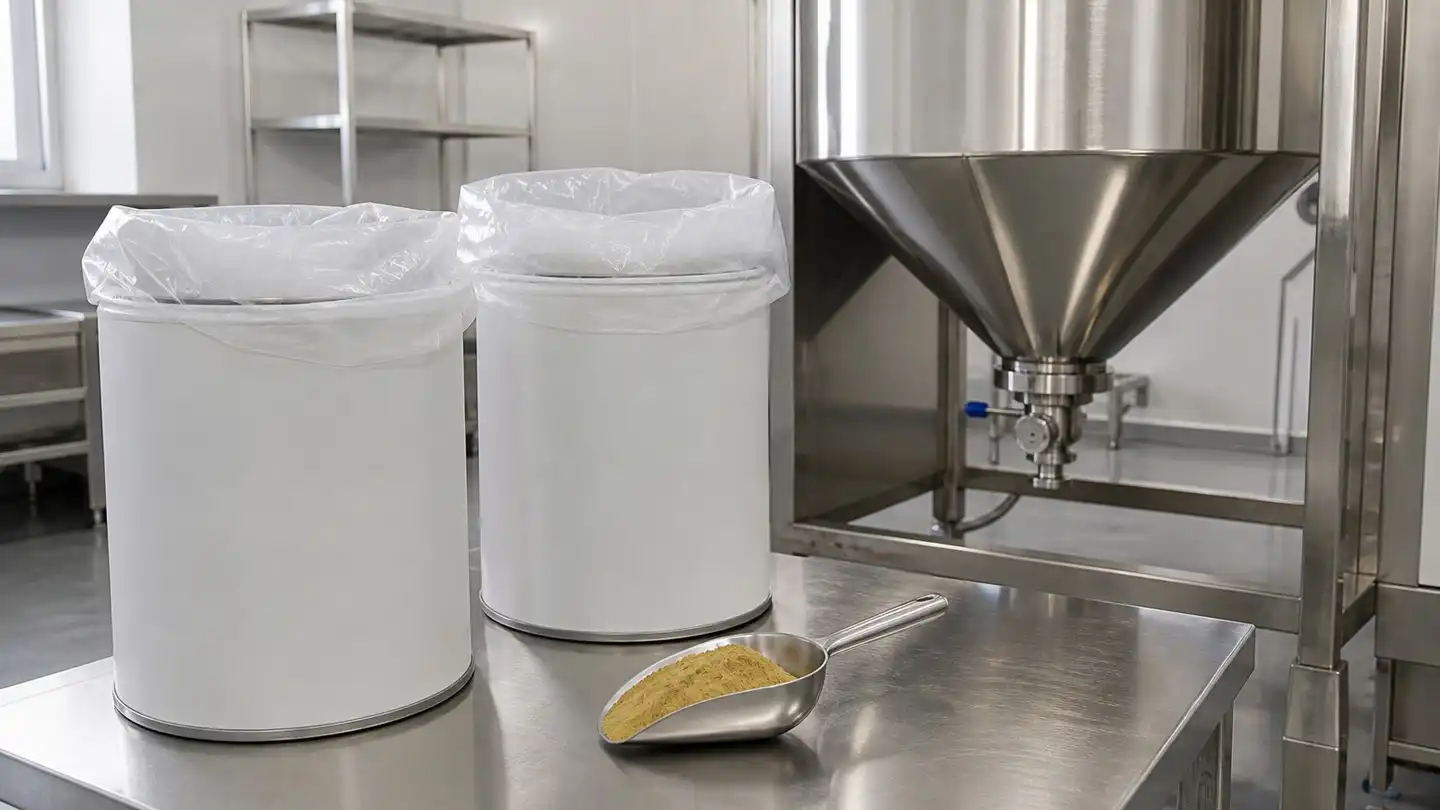
Format flexibility is a real capability, not a convenience. The product page for this ingredient describes foil-laminate bags and fibre drums as standard pack formats, with OEM options. Beyond the packaging itself, buyers should establish whether the manufacturer can hold a bespoke specification over time, adjust particle size within a documented range, and supply batch documentation in the buyer’s own template. OEM support that stops at the label is not OEM support.
Questions That Reveal Whether a Quoted Lead Time Is Real
A lead time is a forecast, and forecasts can be interrogated without quoting a figure. Ask whether the figure is measured from purchase-order receipt or from raw-material allocation, and whether it assumes material already in stock or produced to order. Ask what the last three deliveries of this material actually took, and what caused any extension. Ask what happens when a harvest is short: is the allocation to existing contracts protected, or is everyone queued? A manufacturer that answers these specifically, and can produce batch release dates to support the answers, is describing a schedule. One that cannot is describing a hope.
Documentation to Request Before a First Order
Qualification should be largely documentary. The table below lists the documents worth obtaining before a purchase order, and what each one actually tells a buyer.
| Document | What to check | Why it matters |
|---|---|---|
| Certificate of analysis (batch) | Lot number, test items, results, specification limits, release date, method reference | Shows the material was tested against a defined specification, and against which version of it |
| Specification sheet | Identity, assay, physical parameters, limits, rev/issue number | Defines the controlled product and anchors any future change control |
| Method of analysis | The named procedure behind the assay and identity tests, and whether it is in-house or compendial | A result is only meaningful if the method behind it is reproducible |
| Allergen and gluten statements | Declared allergens, gluten status, cross-contact controls on site | Feeds directly into finished-product labelling in most markets |
| Stability data | Study conditions, duration, packaging format tested, parameters monitored | Supports the shelf-life claim you intend to make, not only the supplier’s |
| Reference standard record | Source, traceability and expiry of the working standard | Distinguishes a calibrated assay from an unanchored one |
| Certificates | Scope statement, issuing body, validity dates, legal entity | The scope, not the logo, is what the certificate actually guarantees |
| Safety data sheet | Current revision, handling and storage instructions | Required for safe receipt, storage and internal handling |
| Regulatory support letter | Statements the manufacturer is willing to sign for your market | Confirms the supplier will support an inspection or filing, not just a shipment |
| Change-control notification terms | Trigger list, notice period, re-qualification rights | Converts a verbal assurance into a contractual obligation |
Audit Readiness: What to Look At, and Which Findings Matter
On a site visit, follow the material rather than the slide deck. Start at goods-in and trace one raw-material lot forward to a released finished lot, collecting the records as you go. Watch the weighing and blending steps, because that is where the standardisation claim is made or lost. Ask to see the instrument calibration programme and a recent out-of-specification investigation in full, including how it closed. Read the training records of the people actually operating the equipment.
Not every finding carries equal weight. The table below suggests how to triage what you see.
| Observation | Severity | Suggested buyer action |
|---|---|---|
| Certificate scope does not cover the manufacturing step, or the certificate is expired | Major | Do not release qualification until scope or validity is resolved in writing |
| Blending or standardisation records cannot be linked to the finished lot | Major | Request a full traceability reconstruction for a supplied lot before ordering |
| Instrument calibration overdue, or working standard beyond its expiry | Major | Require re-testing of affected stock at the supplier’s cost and a CAPA response |
| Out-of-specification investigation lacks a documented root cause | Moderate | Ask for the trend across the last twelve months, not the single closed case |
| Documentation errors in dating, revision control or sign-off | Moderate | Flag as a system weakness; require corrective action within a fixed window |
| Housekeeping or facility presentation issues without product contact | Minor | Note and re-check at the next audit; rarely a reason to walk away |
A Supplier-Qualification Scorecard You Can Adapt
Scorecards work when the weights reflect your own risk, so treat the figures below as a starting allocation rather than a template to adopt unchanged. Score each category, multiply by the weight, and compare totals between shortlisted manufacturers rather than against an absolute pass mark.
| Category | Weight | What earns a high score |
|---|---|---|
| Quality-management system and certificate scope | 20 | Certificates whose scope statement names the extraction and standardisation activities at the manufacturing site |
| Analytical capability and method ownership | 15 | Identity, assay and contaminant testing performed in-house with documented methods |
| Batch-to-batch control of the standardisation parameter | 15 | A defined release window, documented blending, and lot-level linkage to extraction lots |
| Traceability and change control | 15 | A worked lot reconstruction, plus a written notification clause with named responsibility |
| Documentation package completeness | 10 | All items on the checklist available before a first order, in a usable format |
| Capacity, scale-up and campaign scheduling | 10 | Pilot and commercial material released against the same specification, with a visible calendar |
| Packaging and OEM flexibility | 5 | Standard and bespoke pack formats, particle-size adjustment in a documented range |
| Audit performance and CAPA responsiveness | 10 | Few major findings, credible root-cause work, and timely closure |
Putting the Programme to Work
Wellgreen supplies milk thistle extract powder from a GMP-certified facility, with the certifications and specification parameters listed on the product page, and supports buyers with samples, specification sheets and complete documentation packages. To discuss a requirement, request the documents described above, or begin a supplier qualification, contact our team at wgt@allwellcn.com.
This article provides technical and commercial information for industry professionals; it is not medical advice, and any use levels, regulatory status or label claims must be confirmed against the rules of the target market and your own product data.
References
- Noviana, E., Indrayanto, G., & Rohman, A. (2022). Advances in Fingerprint Analysis for Standardization and Quality Control of Herbal Medicines. Frontiers in Pharmacology, 13, 853023. https://doi.org/10.3389/fphar.2022.853023 — PMC9201489
- Li, S., Han, Q., Qiao, C., Song, J., Cheng, C. L., & Xu, H. (2008). Chemical markers for the quality control of herbal medicines: an overview. Chinese Medicine, 3, 7. https://doi.org/10.1186/1749-8546-3-7 — PMC2488332
- European Medicines Agency, CHMP/CVMP/HMPC (2011). Guideline on quality of herbal medicinal products/traditional herbal medicinal products (EMA/HMPC/201116/2005 Rev. 2). ema.europa.eu
- European Medicines Agency, CHMP/CVMP/HMPC (2011). Guideline on specifications: test procedures and acceptance criteria for herbal substances, herbal preparations and herbal medicinal products/traditional herbal medicinal products (EMA/CPMP/QWP/2820/00 Rev. 2). ema.europa.eu
- International Council for Harmonisation (2000). Q7: Good Manufacturing Practice Guide for Active Pharmaceutical Ingredients, Step 4 version. database.ich.org
- U.S. Food and Drug Administration. 21 CFR Part 111: Current Good Manufacturing Practice in Manufacturing, Packaging, Labeling, or Holding Operations for Dietary Supplements. Electronic Code of Federal Regulations. ecfr.gov
- EFSA Scientific Committee (2009). Guidance on safety assessment of botanicals and botanical preparations intended for use as ingredients in food supplements. EFSA Journal, 7(9), 1249. https://doi.org/10.2903/j.efsa.2009.1249 — efsa.onlinelibrary.wiley.com
- World Health Organization (2011). Quality control methods for herbal materials. ISBN 9789241500739. who.int