
Mushroom Powder Microbiology Control: How Sterilization Affects Supplier Selection
2026-11-11 09:35:23
Mushrooms are grown on wet substrate, harvested by hand or by machine that leaves soil contact, and dried in equipment that is often the same equipment used for other crops. That history is why a mushroom powder arrives at a buyer's gate with a microbiological profile that a spray-dried carrier never has, and why the sterilization step is not a footnote in the supply agreement but one of the four or five decisions that shape the whole project. Anyone comparing two quotes for organic shiitake mushroom powder is comparing two sterilization strategies whether or not the quotation says so.
Why Mushroom Powders Sit in a Higher Microbiological Risk Band
Three properties combine. The raw material grows in a high-humidity environment where moulds and mesophilic bacteria are normal inhabitants rather than contaminants. The drying step reduces water activity but does not inactivate everything, so a dried mushroom flake can still carry a substantial vegetative load. And mushroom material is a good substrate: it holds nutrients and, once milled, presents a large surface area to any moisture that enters the pack.
The practical consequence is that a buyer cannot apply the same limits to a mushroom powder as to a refined isolate. The limits have to be set from the process capability of the specific supplier, and the process capability is determined by which sterilization route that supplier runs.
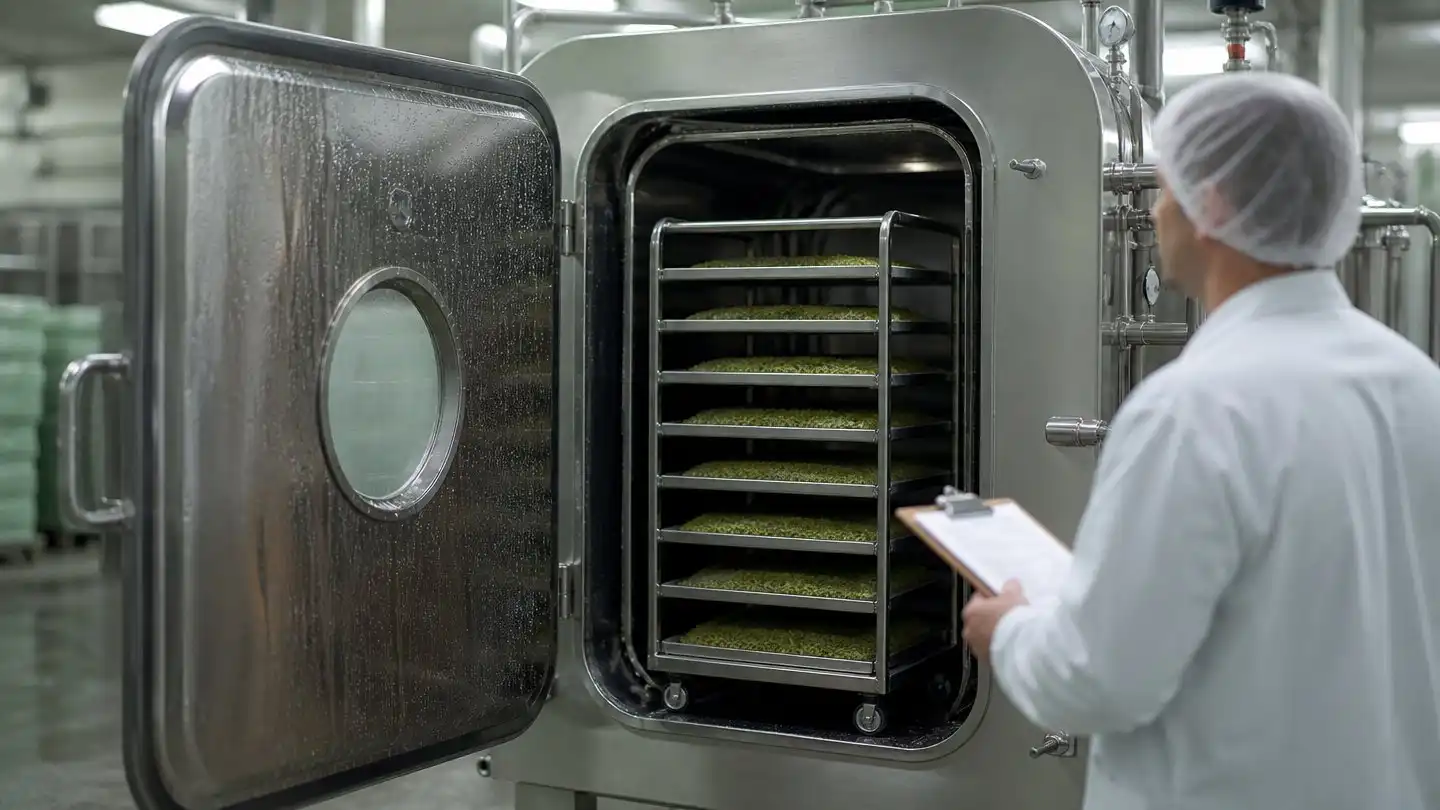
The Four Sterilization Routes Buyers Are Offered
Supplier quotations rarely name the route. Asking directly is the first quality question worth asking, because the route determines the residue file, the label implications and the sensory impact.
| Route | How it works | Typical buyer concerns | Documentation to request |
|---|---|---|---|
| Steam or moist heat | Controlled steam contact followed by drying back to specification moisture | Colour darkening, moisture regain, caking after treatment | Cycle record, before and after plate counts, re-drying data |
| Dry heat | Extended holding at elevated temperature in a dry atmosphere | Longer cycle, uneven penetration in dense powder beds | Temperature mapping of the bed, not only of the chamber |
| Ethylene oxide | Alkylating gas treatment in a sealed chamber | Residue limits, by-products, market acceptance | Residue test reports, aeration records, regulatory status per market |
| Ionizing radiation | Dose-controlled treatment at an approved facility | Labeling obligation, consumer perception, market eligibility | Dose certificate, facility licence, labeling statement |
Each route is legitimate where it is permitted and correctly validated. The problem is a supplier that will not say which one it uses, because then the buyer cannot check the residue position, the labeling position or the sensory position for the market being served.
What Each Route Does to the Powder, Not Just to the Count
A sterilization step is a process, and processes change materials. Buyers who evaluate only the microbiological result discover the side effects at the first production run.
Heat and colour
Mushroom powders darken under moist heat. In a soup base or a savoury snack coating the shift may be acceptable; in a light-coloured sauce or a cream-filled product it will be visible. Request a treated and an untreated sample of the same lot and photograph both under the same light before approving the route.
Volatiles and the savoury note
The compounds that give dried mushroom its savoury character are volatile, and any thermal step moves them. A supplier running a hotter, longer cycle can deliver a clean plate count and a flatter flavour. Comparing treated samples at the dose actually used in the finished product, rather than at neat concentration, is the only way to see whether the difference matters.
Moisture pick-up and caking
Steam treatment adds water that must be removed again. If the re-drying step is not controlled, the powder leaves the line at a moisture content higher than the certificate implies, and the buyer sees lumps three weeks later in a warehouse. Ask for the moisture result from the finished, post-treatment powder, and ask how often the dryer is validated.
Residues, By-products and Market Eligibility
Ethylene oxide is the route that most often causes trouble after the fact. Several markets set residue limits for the parent compound and for its reaction products, and enforcement has tightened across Europe and North America in recent years. A supplier that runs an ethylene oxide cycle but cannot produce a residue report for the specific lot is offering an unquantified risk.
Irradiation carries a labeling obligation in most markets where it is permitted at all, and some retail programmes refuse irradiated material outright regardless of the legal position. That is a commercial constraint, not a scientific one, but it belongs in the specification because discovering it after the first container ships is expensive.
Where a market restricts both routes, the supplier has to be able to offer a thermal programme and prove it works. That capability question is closely related to the compliance documentation discussed in this note on certification and compliance for mushroom powders, because the same file that supports a certification claim also supports the sterilization claim.
Reading a Microbiological Specification Properly
A certificate that lists numbers without methods is not a specification; it is a summary. The four elements that make it auditable are the analyte, the limit, the method and the sample size.
| Analyte | Why it matters for a mushroom powder | Method to see on the report |
|---|---|---|
| Total aerobic plate count | General hygiene of the drying and milling chain | ISO 4833-1, with dilution and incubation stated |
| Yeast and mould count | Mould load carried in from substrate and field drying | ISO 21527-1 or ISO 21527-2, stated explicitly |
| Enterobacteriaceae | Indicator of post-process handling hygiene | ISO 21528 series |
| Salmonella | Absence requirement in most markets | ISO 6579-1, with the sample weight stated |
| Listeria monocytogenes | Required by some retail and category standards | ISO 11290 series, presence or absence format |
| Water activity or moisture | The condition that decides whether survivors can grow in storage | Loss on drying or a water activity meter, per lot |
The moisture or water activity line is the one buyers most often skip, and it is the one that explains why a compliant lot fails six months later. Microbiology is a snapshot; water activity is the trajectory.
Two further habits make a micro specification work in practice. First, state whether each limit is a release criterion or an alert level, because suppliers read an unqualified number as a target to average rather than a line not to cross. Second, agree the consequence of a marginal result in advance: a lot that sits between the limit and the alert level is where buyers and suppliers argue, and the argument is cheaper before the container leaves than after it arrives.
Sampling Plans Decide the Answer Before the Test Does
A pathogen result is only as meaningful as the sample it came from. Ten grams drawn from the top of a drum cannot represent a tonne of powder. Ask how many incremental samples are taken, whether they are composited or tested individually, and whether the plan follows a recognized attribute sampling scheme for the lot size.
A supplier that samples from the blender discharge rather than from the finished drum is doing the honest thing, because the drum is where segregation happens. Worth asking which of the two it does.
Verifying the Claim: Documents and Third-Party Data
Supplier self-declaration has a place, and that place is not the release decision for a pathogen specification. The evidence hierarchy below is a practical way to sort what arrives in a vendor file.
| Claim made | Weak evidence | Evidence worth accepting |
|---|---|---|
| Sterilization route | Verbal statement from a sales contact | Process description in the quality manual plus a cycle record with dates and parameters |
| Microbiological results | COA with no method and no lot linkage | Lot-specific COA with methods, plus periodic third-party verification |
| Residue position | Certificate for a previous campaign | Residue report dated within the lot's production window |
| Management system | A certificate with no scope statement | Certificate showing scope covers the powder and the sterilization step |
| Organic status | Marketing page wording | Transaction certificate for the specific shipment |
The company-level programmes behind this documentation are published on the quality and accreditation page. Read them as the framework a supplier operates inside, then ask for the lot-level data that shows the framework is running.

Change Control: The Clause That Protects the Brand
Most supply agreements say that the supplier may improve processes without notice. That clause, read literally, allows a switch from steam to ethylene oxide in the middle of a retail season. Buyers who care about the sterilization route need a notification obligation written into the agreement, with a defined notice period and a right to re-qualify before shipment.
The same clause should cover the drying carrier, the milling cut and the packaging format, because each of those changes the specification the finished product was validated against.
Audit Questions That Reveal Capability
The questions below are the ones that separate a supplier running a controlled process from a trader buying treated material and reselling it.
A short list of questions separates a supplier that runs a controlled process from one that buys treated material and resells it. Ask where the sterilization happens, who owns the equipment, what the re-drying step is, how the chamber or bed is validated, what happens to a lot that fails the post-treatment count, and who signs the release decision.
A supplier that can answer all six on the spot is running the process. One that needs to check with a third party is brokering it, which is not disqualifying but does change the risk profile and the traceability chain.
What to Ask Before the First Order
- Which sterilization route, on which site, with which equipment
- Finished-product moisture after treatment, and the dryer validation interval
- Lot-level micro results with methods and sample weights
- Residue or dose documentation where a gas or radiation route is used
- Labeling implications for the target markets, in writing
- Organic transaction certificate if an organic claim is made
- Change-notification clause covering route, carrier and packaging
The technical profile of the material itself — mesh cut, solubility, and how it behaves in a soup base — is covered in this overview of what organic shiitake powder is, and the application side in this review of uses in the food industry. Read them alongside the microbiology file rather than instead of it.
Conclusion
Sterilization is where microbiology, sensory performance and market eligibility meet, and it is decided long before a certificate is printed. Buyers who ask which route is used, what it did to the powder, and what evidence exists for that specific lot end up with a supplier they can hold to a specification. Buyers who accept a plate count and a price usually discover the rest of the story at the first production trial.
If you are qualifying a mushroom powder for a savoury or functional food application, we can share the shiitake extract specification, the sterilization route used on the current lots, and the lot-level micro and residue documentation for review. Send the target market and the application to wgt@allwellcn.com and the technical team will answer against your limits rather than against a generic sheet.
References
- International Organization for Standardization. ISO 4833-1 — Microbiology of the food chain: horizontal method for the enumeration of microorganisms; colony count at 30 °C. 2013.
- International Organization for Standardization. ISO 21527-1 — Microbiology of food and animal feeding stuffs: enumeration of yeasts and moulds. 2008.
- International Organization for Standardization. ISO 6579-1 — Microbiology of the food chain: detection, enumeration and serotyping of Salmonella. 2017.
- International Organization for Standardization. ISO 11290-1 — Microbiology of the food chain: detection and enumeration of Listeria monocytogenes. 2017.
- Codex Alimentarius Commission. General Principles of Food Hygiene (CXC 1-1969, as revised). FAO/WHO.
- U.S. Food and Drug Administration. 21 CFR Part 179 — Irradiation in the Production, Processing and Handling of Food. Current edition.
This article is intended for business-to-business ingredient sourcing and formulation discussion. It does not provide medical, nutritional, or regulatory advice for any specific product or market.