
Natural Astaxanthin Powder Manufacturer for Nutraceutical and Cosmetic Formulations
2026-10-20 14:00:02
Buying natural astaxanthin powder for two different programmes from a single supplier looks straightforward until the two specification templates land side by side. A nutraceutical buyer and a cosmetics buyer are buying the same carotenoid pigment under two different rule-sets, and a manufacturer that genuinely serves both has to hold both templates without letting either drift toward the other. What follows sets out where the two specifications actually diverge, what each buyer's documentation file contains, how the delivered form has to be packed and stored, and the questions that separate a manufacturer that serves both segments from one that merely claims to.
Where the Two Specifications Actually Diverge
The first surprise for most procurement teams is that "the same material" is not the same specification. Two buyers can order from the same Haematococcus pluvialis stream and still be working to documents that share only a handful of line items. The divergence usually shows up in five places: the declared content and the method behind it; free versus esterified material and its carrier; the supplied form; the organoleptic parameters; and the microbial and heavy-metal limits.
Declared Content and the Analytical Method
A nutraceutical specification usually states a content figure that has to be reproducible batch after batch, because the finished unit is built around it. The two product pages show how the declared figure and the method travel together: the powder is listed at a specification range of 1% to 10% by UV/HPLC with a certificate-of-analysis line reading "Astaxanthin content UV% ≥5%", while the oil is listed at "Astaxanthin oil 10%" with a COA line reading "Astaxanthin (HPLC) ≥10.0%". The distinction is commercial as much as technical. A specification that names both the number and the method is auditable; a specification that names only the number is not. When the same material serves two segments, ask which method sits behind the declared figure and whether both templates name it in the same way.
Free Versus Esterified, and the Carrier or Delivery Form
In the algal matrix the pigment is largely esterified, and how a manufacturer presents it downstream changes what the buyer can do with it. The oil page describes astaxanthin oil as the carotenoid combined with carrier oils, and notes that phospholipids may be part of the delivered system. For a nutraceutical programme the practical question is whether the delivered form stays in a single, easy-to-handle phase. For a cosmetics programme the question is whether the carrier and the emulsification behaviour suit the base the formulator already works in. The same material on a different carrier behaves like a different ingredient on the plant floor, which is why the carrier vocabulary used in bulk carrier specifications and quality standards is worth reading before either template is frozen.
Supplied Forms: Powder, Oil, Oleoresin, Beadlet and Cold-Water-Dispersible
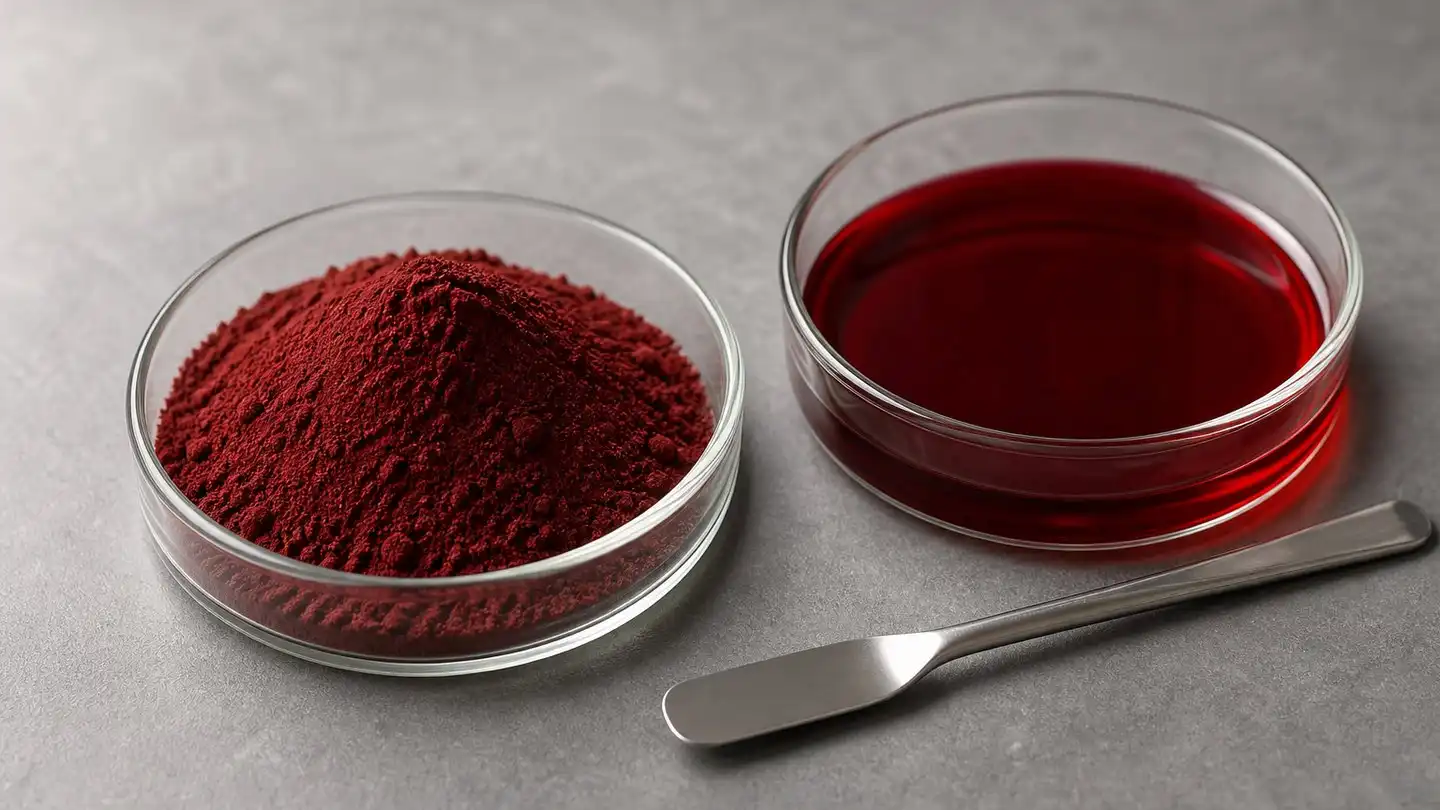
Across the market the material is offered as a powder, an oil, an oleoresin, a beadlet, and as a cold-water-dispersible powder, and the supplied form is the line item most often mis-specified between two segments. The Wellgreen product pages list a dark red powder at a specification range of 1% to 10%, and a dark red oil at 10%; both carry the same particle-size statement of 100% through 80 mesh and the same UV/HPLC test method. A nutraceutical buyer filling a capsule or a sachet is normally working in a dry or oil-based system and wants a powder or an oil that disperses predictably. A cosmetics buyer is more often working in an emulsion and will care about how the delivered form behaves at the point of incorporation. Setting the astaxanthin oil and powder pages side by side is the fastest way to see which specification lines are shared and which are not.
Odour, Colour and Appearance Parameters
Appearance is a shared line item, but the two segments weight it differently. Both product pages state a dark red colour: the powder as a dark red powder, the oil as a dark red oil. For a nutraceutical buyer the appearance line is largely a batch-consistency check. For a cosmetics buyer the same line sits closer to a formulation constraint, because the pigment colour is visible in the finished base and an off-shade lot is a customer-facing problem rather than an internal one. Odour occupies a similar position: the powder certificate carries a "Characteristic" odour and taste line, and the oil certificate carries "No other smell". Ask both buyers to write their own colour and odour tolerances into their templates rather than inheriting a generic line.
Microbial and Heavy-Metal Limits and Their Common Settings
This is the part of the two templates that most often turns out to be identical. The certificates on the product pages use the same heavy-metal ceilings: lead ≤1.0 ppm, arsenic ≤1.0 ppm, mercury ≤0.1 ppm and cadmium ≤1.0 ppm. The microbiological ceilings are close but not identical: total plate count ≤1000 cfu/g appears on both, moulds and yeast at ≤50 cfu/g on the powder against ≤100 CFU/g on the oil, and negative results for E. coli, Salmonella and Staphylococcus aureus on both. A manufacturer serving two segments should be able to explain why those two figures differ, and which template governs a given lot.
Table 1 sets the two requirement sets side by side.
| Requirement | Nutraceutical programme | Cosmetic programme |
|---|---|---|
| Declared astaxanthin content | Fixed figure with a named method; powder listed 1–10% by UV/HPLC, oil listed at 10% | Fixed figure weighted toward batch-to-batch constancy of the delivered colour |
| Method behind the figure | UV/HPLC, stated on the specification | HPLC figure preferred for the oil; method stated, never implied |
| Delivered form | Powder or oil matched to a dry or oil-based system | Form and carrier matched to the emulsion base |
| Appearance | Dark red powder / dark red oil as a consistency check | Same lines, treated as a formulation constraint because the colour is visible |
| Odour | Characteristic (powder) / no other smell (oil) as a release item | Same lines, plus a tolerance agreed with the finished-goods team |
| Heavy metals | Pb ≤1.0 ppm, As ≤1.0 ppm, Hg ≤0.1 ppm, Cd ≤1.0 ppm | Identical ceilings; ask for the same testing schedule |
| Microbiological | TPC ≤1000 cfu/g; moulds and yeast ≤50 cfu/g (powder); pathogens negative | TPC ≤1000 cfu/g; moulds and yeast ≤100 CFU/g (oil); pathogens negative |
| Certificate of analysis | Per batch, chemical and microbiological | Per batch, plus a colour and appearance statement |
Documentation: What Each Buyer Needs, and What Both Need
The two dossiers overlap more than either buyer expects, and the overlap is where a two-segment manufacturer either saves time or creates a discrepancy.
The Nutraceutical Dossier
A food or nutraceutical buyer is assembling evidence that the material may lawfully enter its chain. In practice that means a current certificate of analysis for every lot, naming the astaxanthin figure and its method alongside the heavy-metal and microbiological results; a specification sheet that matches the certificate; a safety data sheet; a statement of origin and traceability back to the algal material; allergen and, where relevant, GMO statements; and the food-safety certifications the manufacturer actually holds. The product pages list ISO9001:2015, ISO22000, Halal, Kosher and HACCP, and those are the certificates to request as current documents rather than as a logo on a slide. Where the material is sourced from is worth establishing before the file is assembled, since traceability claims follow the origins of natural astaxanthin used by supplement brands rather than the finished specification alone.
The Cosmetic Dossier
A cosmetics buyer is assembling a different file. The chemical and microbiological evidence looks much the same, but the surrounding paperwork does not: the buyer needs the trade or INCI naming used for the ingredient, a colour and appearance statement tied to the delivered lot, a statement of the carrier or delivery system, and whatever the brand's own regulatory team needs for the market it sells into. Solvent-residue and purity statements matter here in a way a capsule filler rarely asks about, because the material will sit in a base for a long shelf life rather than being consumed quickly.
Items Common to Both
Common ground: a batch-specific certificate of analysis, a specification sheet with the method named, a safety data sheet, origin and traceability documentation, and the quality-management and food-safety certificates. If a manufacturer hands the two segments two differently worded versions of the same certificate, that is the first thing to resolve.
Table 2 maps which document belongs to which file.
| Document | Nutraceutical | Cosmetic | Note |
|---|---|---|---|
| Batch certificate of analysis (content, method, heavy metals, microbiology) | Required | Required | Both should reference the same source lot |
| Specification sheet with the analytical method named | Required | Required | One shared document, not two variants |
| Safety data sheet | Required | Required | Same revision for both |
| Origin and traceability record | Required | Required | Traceable to the algal source material |
| Quality-management and food-safety certificates (ISO9001:2015, ISO22000, HACCP) | Required | Typically required by the brand's own audit | Held as current documents |
| Halal / Kosher certificates | Required where the market needs them | Not usually applicable | Listed on the product pages |
| Allergen and GMO statements | Required | Often requested | Keep both wordings identical |
| Trade or INCI naming for the ingredient | Not applicable | Required | Cosmetic-specific line |
| Colour and appearance statement for the delivered lot | Useful as a consistency record | Required | Cosmetic-weighted |
| Carrier or delivery-system statement | Useful | Required | Ties to the chosen supplied form |
| Solvent-residue statement | Occasionally requested | Commonly requested | Ask for the method, not just the word |
Packaging and Stability of the Delivered Form
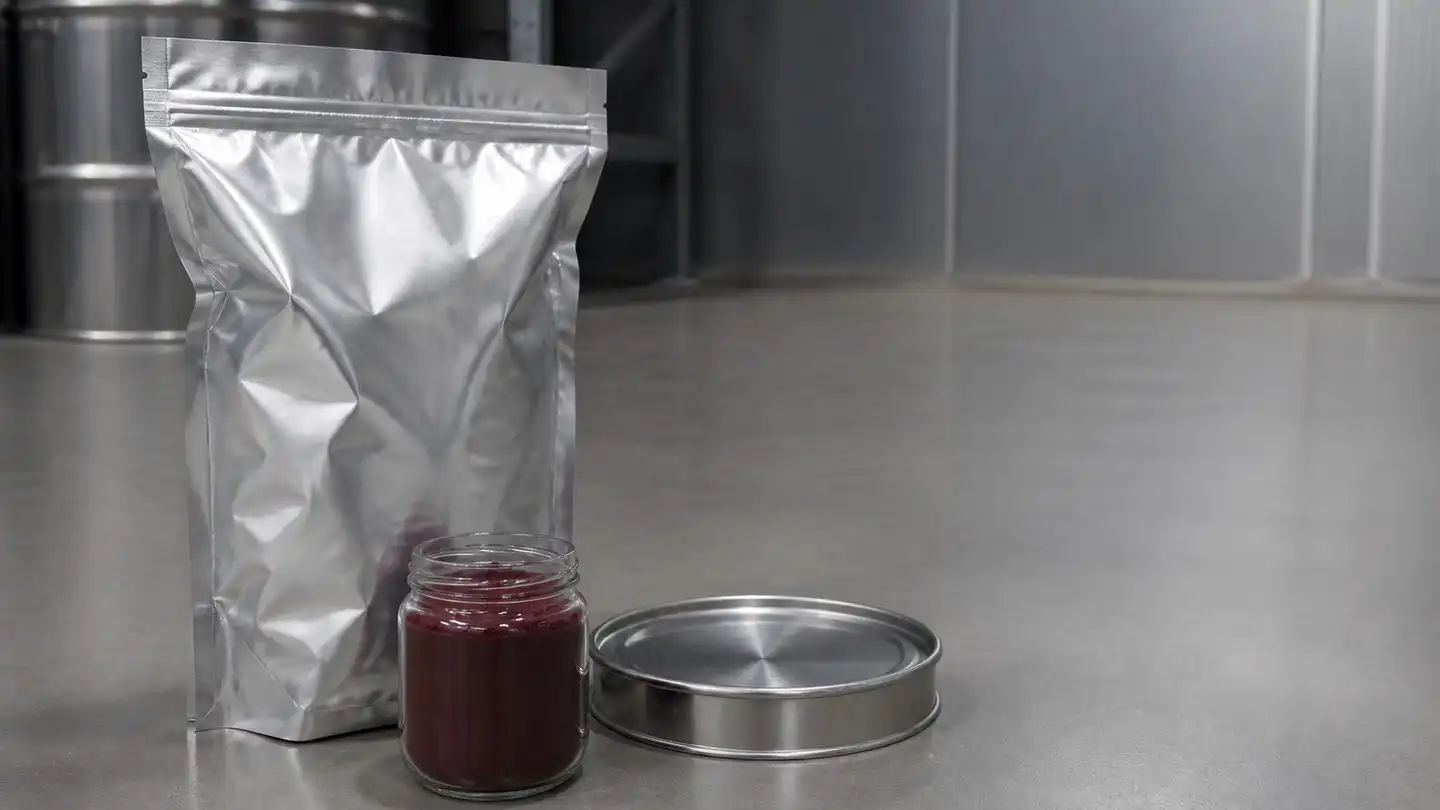
The delivered form decides the packaging, and the two product pages are explicit about how far the manufacturer's own instruction goes. The powder page lists packaging as 1–5 kg in an aluminium foil bag, 25 kg in a drum, or OEM, with storage in a cool, dry place away from strong light and heat and a two-year shelf life when properly stored. The oil page lists a two-year shelf life and a storage instruction of room temperature without sunlight, adding that freezing is better and reminding the buyer to use the product immediately after opening or repack it under vacuum. Those are manufacturer statements about their own listings, not generic advice.
The pigment is oxygen-sensitive, so the practical controls sit in three places. Headspace is the first: the less air left above the material, the less chance the delivered form has to change before it reaches your line. Nitrogen flushing and vacuum packing are the second. Light barrier is the third, and it is the one buyers most often leave to the supplier's default, even though a foil laminate bag and a fibre drum with a liner behave very differently under a warehouse skylight. Cold-chain expectations follow the form: the powder instruction is a cool, dry place, while the oil instruction is room temperature without sunlight with freezing preferred. Confirm in writing which of those applies to the lot you are buying, because the two are not interchangeable.
What to Ask a Manufacturer Who Claims to Serve Both
How the Two Specification Templates Are Managed
Ask to see both templates, the nutraceutical one and the cosmetic one, as documents rather than as an assurance. A manufacturer serving both segments should be able to show which line items are shared, which are segment-specific, and how a change to a shared line is reflected in both. If the answer is that "the specification is the same", that is the moment to compare the two certificates of analysis line by line.
Whether One Production Stream Serves Both
Ask directly whether a single production stream feeds both your programme and the other segment's, and if so how lots are allocated. The follow-up matters more than the first question: when two customers need different declared contents from the same stream, how is the material segregated, and how is residue from one specification prevented from appearing in the other? A manufacturer blending two specifications from one stream needs a clear answer about cleaning and changeover between them.
How Change Control Covers Two Customer Sets
A change that is invisible to one segment can be significant to the other. A revised analytical method, a new carrier, a different drum liner or a re-sourced algal input all touch both templates, but they will not touch both buyers equally. Ask how the change-control procedure identifies which customer sets are affected, how much notice each is given, and whether the two segments are notified through the same channel. Ask, too, which party owns the decision when a change would satisfy one segment and inconvenience the other.
How Complaints From Each Segment Are Handled
Complaint handling is where the two-segment claim is usually tested. A nutraceutical complaint tends to be analytical or documentary, such as a certificate line that does not match or a method that was not the one named. A cosmetics complaint tends to be sensory or visual, such as colour, odour or dispersion. Ask who receives each type, whether the two routes converge on the same root-cause investigation, and what the corrective-action record looks like when one root cause reaches both segments.
Table 3 collects the questions worth putting in writing before an order.
| Question | What a good answer sounds like |
|---|---|
| Which specification template applies to my programme? | A named document with the method, declared content and tolerance stated on the page |
| Which lines are shared with the other segment's template? | A side-by-side view, not an assurance that they match |
| Which analytical method sits behind the declared content? | UV/HPLC or HPLC named explicitly and stated on the certificate |
| Which supplied form and carrier will be delivered? | The form and carrier named, with trade or INCI naming for the cosmetic route |
| What are the heavy-metal and microbiological ceilings for my lot? | The same ceilings stated on the certificate, with the two differing yeast-and-mould figures explained |
| How is the material packaged and how is headspace controlled? | Bag or drum format, nitrogen or vacuum treatment, and the light barrier named |
| What storage and transport conditions apply to the delivered form? | The cooling instruction for that specific form, in writing |
| How is change control handled across two customer sets? | A named procedure, a notice period and an owner for the decision |
| How are complaints from each segment routed? | Two routes, one root-cause investigation, and a corrective-action record |
| Which certificates are current, and can I see the documents? | Current certificates as documents, not logos |
Getting Both Specifications Right With Wellgreen
Wellgreen supplies natural astaxanthin powder and astaxanthin oil from Haematococcus pluvialis, with the powder listed at a specification range of 1% to 10% and the oil at 10%, both tested by UV/HPLC and both carrying the certificates shown on their product pages: ISO9001:2015, ISO22000, Halal, Kosher and HACCP. If your programme sits on the boundary between a nutraceutical file and a cosmetic one, the powder page carries the specification, the certificate-of-analysis lines and the packaging formats you will be comparing.
Write to wgt@allwellcn.com with your specification template and the market you are selling into, and ask for the documentation that sits behind it.
This article is written for B2B ingredient procurement and formulation professionals and describes specification, documentation, packaging and supplier-qualification practice only; nothing here is a statement about any finished product or its use in any market.
References
- Wellgreen — Astaxanthin Powder (product page: specification, certificate of analysis, packaging and storage). https://www.wellgreenherb.com/pure-extracts/astaxanthin-powder
- Wellgreen — Astaxanthin Oil (product page: specification, certificate of analysis, storage). https://www.wellgreenherb.com/standardized-extract/astaxanthin-oil
- Wellgreen — Natural vs Synthetic Astaxanthin Powder: Which Should You Choose? https://www.wellgreenherb.com/knowledge/natural-vs-synthetic-astaxanthin-powder-which-should-you-choose
- Wellgreen — Best Sources of Natural Astaxanthin for Supplement Brands. https://www.wellgreenherb.com/knowledge/best-sources-of-natural-astaxanthin-for-supplement-brands
- Wellgreen — Is Astaxanthin Powder Safe for Use in Foods and Beverages. https://www.wellgreenherb.com/knowledge/is-astaxanthin-powder-safe-for-use-in-foods-and-beverages
- Wellgreen — Bulk MCT Oil Powder: Specifications, Carriers, and Quality Standards. https://www.wellgreenherb.com/knowledge/bulk-mct-oil-powder-specifications-carriers-and-quality-standards
- Ambati, R. R., Phang, S. M., Ravi, S., & Aswathanarayana, R. G. (2014). Astaxanthin: sources, extraction, stability, biological activities and its commercial applications — a review. Marine Drugs, 12(1), 128–152. (Cited in the source list of the Wellgreen knowledge page at reference 4.)
- Higuera-Ciapara, I., Félix-Valenzuela, L., & Goycoolea, F. M. (2006). Astaxanthin: a review of its chemistry and applications. Critical Reviews in Food Science and Nutrition, 46(2), 185–196. (Cited in the source list of the Wellgreen knowledge page at reference 3.)