
Oat Beta Glucan Powder Manufacturer for High-Fiber Food and Beverage Applications
2026-10-20 14:38:09
Choosing an oat beta glucan supplier is a specification exercise, not a catalogue exercise. Two manufacturers can quote the same headline assay figure and still ship powders that behave differently on a beverage line and in a bakery. The real question is whether a supplier can define the parameters that drive the customer's process, prove them batch after batch, and document them. The oat beta glucan powder range shows how one ingredient is offered in several grades, each aimed at a different production context.
This article is for ingredient buyers, procurement managers and product developers evaluating a manufacturer. It covers which parameters carry weight in a purchase specification, and how to write one that gives a beverage line and a bakery line different grades.
Why Supplier Capability, Not Just Purity, Decides the Purchase
What a Buying Team Is Actually Evaluating
A supplier that can state only a percentage is a price-taker. One that can state the percentage, name the assay method behind it, describe the molecular-weight profile, declare the solubility behaviour and produce documentation that survives an audit is a manufacturing partner. The difference shows not on the quotation sheet but eighteen months later, when a formulation must be locked or a label declaration defended.
Four capabilities separate the two profiles: analytical transparency (the certificate names the method, not only the result); process understanding (how the grade behaves at the customer's solids level and mixing regime); consistency (a fixed target rather than a range); and a complete, signable documentation trail.
Beta-Glucan Content and the Assay Behind the Certificate
Beta-glucan content is the first number a buyer sees and the least informative on its own. Oat beta glucan is a mixed-linkage polysaccharide built from glucose units joined by β-(1→3) and β-(1→4) bonds, which is what makes the fraction water-soluble and analytically distinct from cellulose-type fibre — and why the assay must measure the mixed-linkage fraction rather than total dietary fibre. A plain-language overview appears in this guide to what oat beta glucan is.
Reading the Number on the COA
An enzymatic procedure — the streamlined method published by McCleary and Codd, standardised as AOAC Official Method 995.16 — reports beta-glucan specifically and is the reference most quality teams expect to see named. Some suppliers report total dietary fibre instead; those numbers are not interchangeable across quotations, so the specification should fix the method and not only the target.
Reporting Basis: As-Is, Dry Weight and Moisture
A figure such as "70% beta-glucan" is ambiguous until the basis is fixed: a dry-weight value rises if the powder picks up moisture, while the same material expressed as-is falls. Moisture content and water activity therefore belong in the specification. Wellgreen's standard grade is listed at 80%–90% oat beta glucan on a customised basis, so basis and method should be confirmed for the grade quoted.
The table below lists the parameters that belong in a written specification and how each should be expressed.
| Parameter | Why it matters to the buyer | How it should be expressed |
|---|---|---|
| Beta-glucan content | Sets how much powder the formulation needs to reach its fibre-content labelling target | Percentage, with the basis (as-is or dry weight) and the assay method named |
| Assay method | Determines whether values are comparable between suppliers and lots | Named reference method (for example AOAC 995.16) shown on the certificate |
| Moisture and water activity | Alters the content figure and drives caking and flow problems | Percentage and water activity, each with a stated maximum |
| Molecular-weight profile | Governs how quickly the powder hydrates and how viscous the solution becomes | Declared distribution with the measurement method named |
| Viscosity | Sets pumpability and achievable solids loading on a beverage line | Value at a defined concentration, temperature and shear rate |
| Solubility and dispersibility | Decides whether the process needs warm water, high shear or neither | Stated grade class plus an agreed in-house dispersion test |
| Particle size and flow | Affects dosing accuracy, dusting and blend uniformity | Distribution or mesh range, with bulk and tapped density |
| Microbiological limits | Release criterion for food use in the intended category | Named organisms, each with its own limit |
| Heavy metals | Regulatory release criterion for the destination market | Arsenic, lead, cadmium and mercury, each with its own limit |
| Residue limits | Crop carry-over risk is real for any botanical powder | Agreed pesticide and mycotoxin panel with per-batch reporting |
Viscosity and Molecular-Weight Profile as Process Parameters
Content tells you how much of the polysaccharide is present; it says nothing about how the powder behaves when it meets water. That behaviour is governed by molecular weight and the viscosity it produces — the parameter most often missing from a specification, and the usual cause of a line failure after scale-up.
Why Two Batches With the Same Assay Behave Differently
Two powders at the same content can differ several-fold in solution viscosity if one has retained a higher molecular weight and the other was partially depolymerised during extraction or drying. A native, high-molecular-weight grade hydrates into a markedly viscous solution and needs adequate water, temperature and shear; a partially hydrolysed grade hydrates quickly and stays thin, which suits a high-solids ready-to-mix powder where a heavy liquid would be a nuisance in the mix tank.
Viscosity must therefore be specified as a value at a defined concentration, temperature and shear rate, because a figure without those conditions cannot be reproduced. Where viscosity is reported, an approach such as AACCI Approved Method 32-24.01, which uses a Rapid Visco Analyzer, gives a comparable basis. Molecular weight is best handled as a declared distribution with the method named. Lighter, faster-hydrating grades sit in the broader oat extract range.
Standardization and Batch-to-Batch Consistency
Consistency is where a manufacturer separates from a trader. A trader quotes a range and ships whatever the mill produced; a manufacturer blends to a target and releases against a fixed specification. The practical difference is whether the customer's blending sheet must be rewritten when a new lot arrives.
Blending, Ranges and the Cost of a Wide Specification
A wide specification is cheaper to supply and more expensive to use: if content is quoted as a broad range, the formulator must either over-dose to guarantee the label declaration or re-check each incoming lot, while a narrow blended specification costs more per kilogram but removes that revalidation step. Before accepting a range, ask what the guaranteed limit is, how the value is restored if a lot falls below target, and what recent lot-to-lot data show. The same discipline applies to any standardised botanical ingredient, as this discussion of COA, extraction ratio and purity standards sets out.
The matrix below describes grade archetypes rather than a catalogue; exact content levels are grade-specific and must be confirmed for the grade quoted.
| Grade profile | Content profile | Hydration behaviour | Typical fit | What to specify first |
|---|---|---|---|---|
| Standard powder grade | Mid-range concentrate, moderate limits | Moderate; usually needs warm water or shear | Bakery, extruded snacks, dry blends | Content and basis, moisture, particle size, viscosity at defined conditions |
| High-content concentrate | Higher concentrate, narrow limits | Very viscous; high dilution water demand | Dry blends and capsules where fill weight is tight | Assay method, narrow range, heavy metals, micro limits |
| Fast-hydrating grade | Similar content, lighter molecular weight | Disperses in cold water with low clump risk | Ready-to-mix powders and instant formats | Dispersion test, viscosity ceiling, particle size |
| Low-viscosity beverage grade | Tuned for low-viscosity liquid systems | Dissolves cleanly at line temperature | Beverages and liquid formats | Solubility, viscosity at line temperature, micro limits, allergen statement |
Choosing the Grade: Beverage, Bakery and Powdered Systems
Solubility and Dispersibility by Application
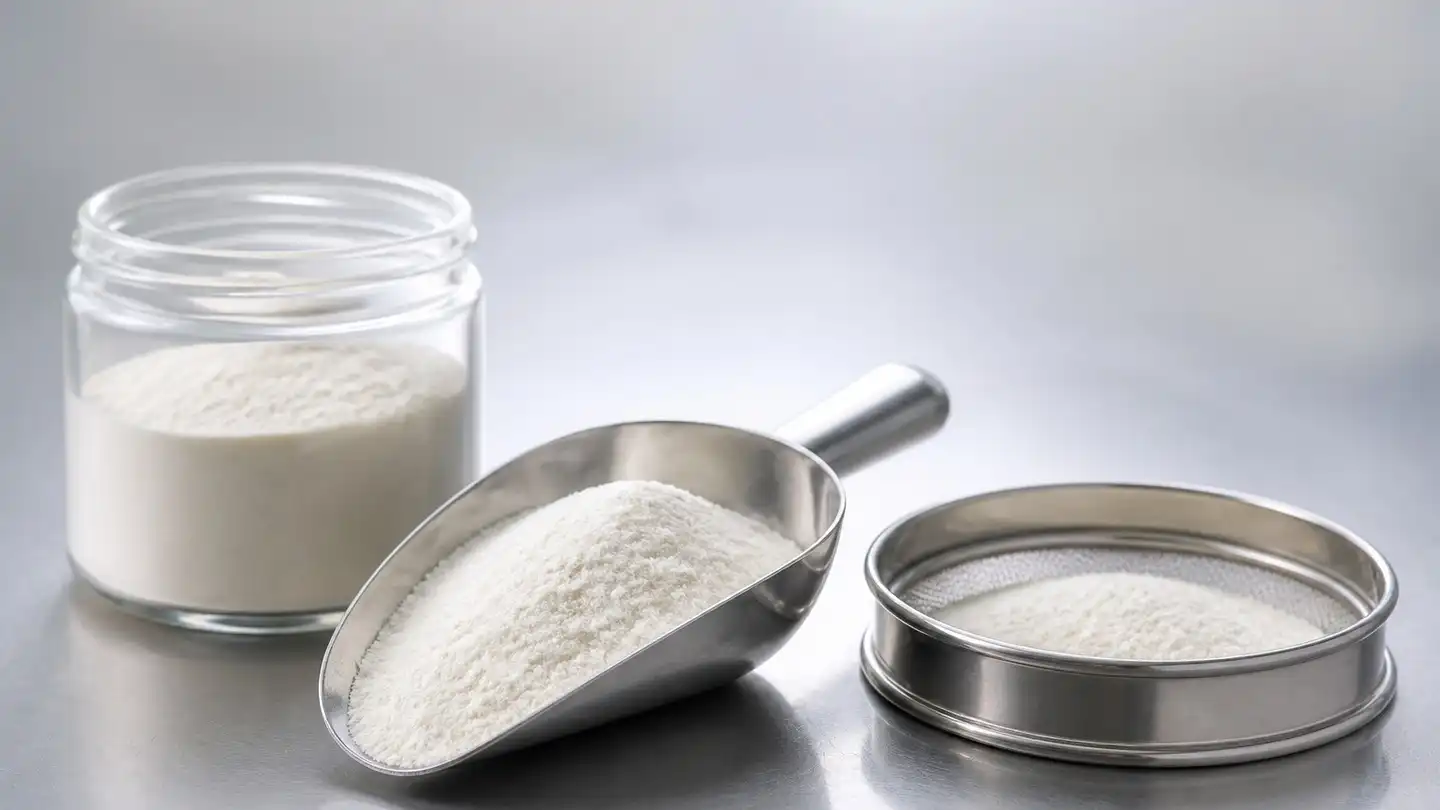
Grade selection follows the process, not the marketing story. A beverage line cares whether the powder disperses without lumping at tank temperature, whether the resulting viscosity stays inside what the pump and filler can handle, and whether the material stays in solution through the hold time. A bakery or extrusion line cares less about instantaneous dispersion and more about how the powder blends into a dry premix and how much molecular weight survives the process temperature.
Dispersion behaviour is the most useful thing to test early: an in-house trial that adds a fixed weight of powder to water at line temperature with the line's own agitation, then records dispersion time and lump formation, costs an afternoon and prevents a scale-up failure. Suppliers with real powder-in-liquid experience, such as those behind this guide to bulk powder specifications, carriers and quality standards, can supply dispersion data before the trial starts.
Microbiological, Heavy-Metal and Residue Limits
Oats are an agricultural crop, and a botanical powder carries the residue profile of the field it came from. Microbiological criteria cover total plate count, yeast and mould and the specified organisms relevant to the food category; the limits depend on the customer's market and on whether the finished product is wet or dry, so they belong in the specification as agreed numbers, not assumptions. Heavy metals — arsenic, lead, cadmium and mercury — are tested individually against their own limits, and a single "heavy metals" line with no breakdown is not sufficient for a food filing. Pesticide residues and mycotoxins should be covered by an agreed panel reported per batch, and every parameter should appear on the certificate with both a result and a limit.
Allergen and Gluten Declaration for Oat Ingredients
Oat allergen handling is a declaration issue that routinely surprises buyers. In the European Union, Annex II of Regulation (EU) No 1169/2011 lists "cereals containing gluten" — a category including oats — among the substances that must be declared on a food label. An oat ingredient therefore needs a clear allergen statement, and the supplier should be able to confirm the cross-contact controls applied to wheat, rye and barley on the same site.
Gluten-free positioning is a separate and stricter regime. Under Commission Implementing Regulation (EU) No 828/2014, oats used in food presented as gluten-free must be specially produced, prepared or processed to avoid contamination, and their gluten content may not exceed 20 mg/kg — a statement the supplier must support with batch testing and a defined protocol. Specifications should include the allergen text the supplier will sign, the gluten method and its reporting limit, the cross-contact statement, and a declaration of origin and species.
Packaging, Shelf Life and Storage Conditions
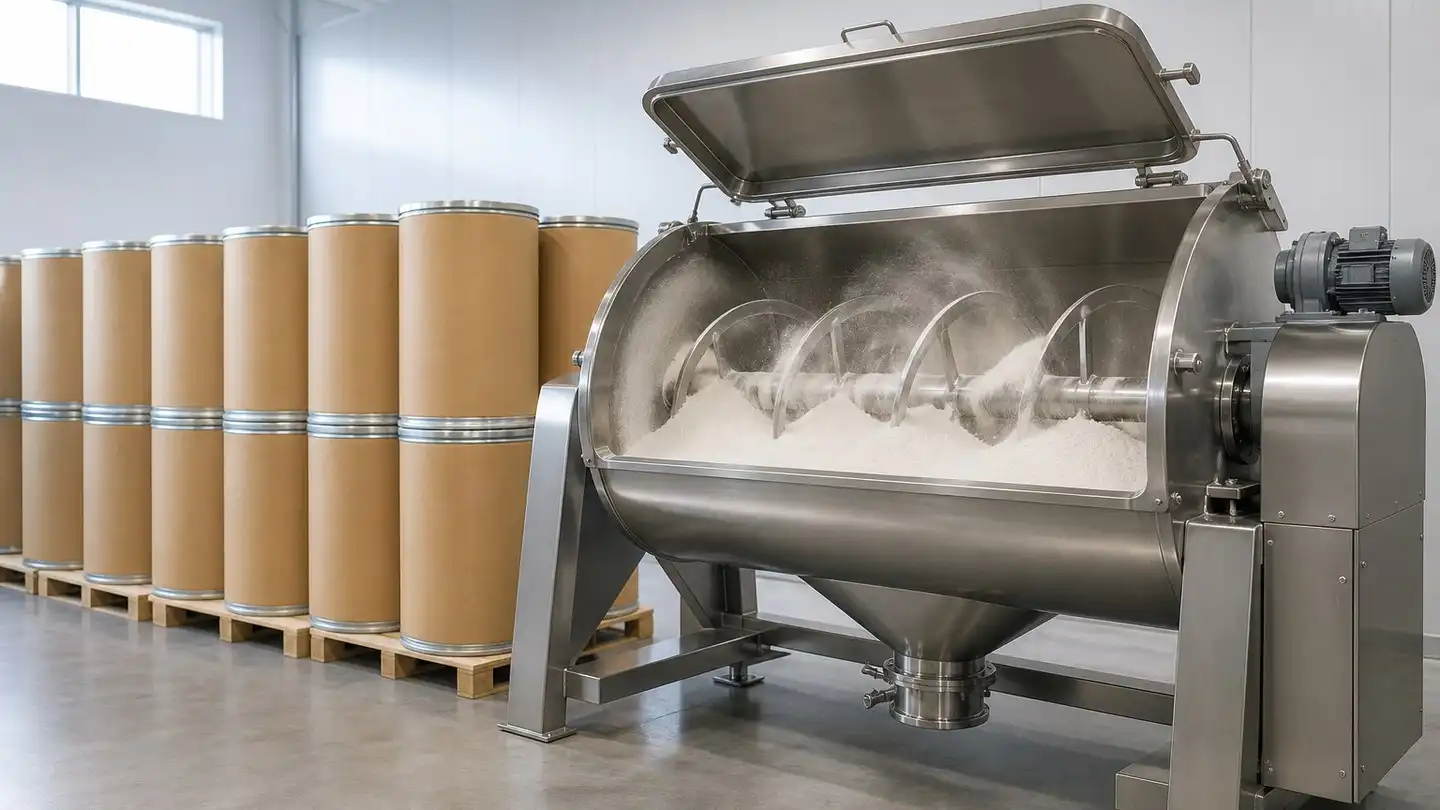
Packaging is where a technically sound ingredient can still fail on arrival. Standard packing — for example 1–5 kg aluminium foil bags and 25 kg fibre drums, with OEM options — should be matched to the customer's receiving, sampling and dispensing practice: a plant that dispenses by scoop from an open drum needs different packaging from one that charges a sealed bag into a blender.
Shelf life and storage conditions must be declared, not assumed: a declared period applies only under the stated conditions, so the specification should carry the expected temperature and relative humidity, the packing format and any liner or desiccant requirement. Because the powder is hygroscopic, moisture pick-up during storage is a real risk to the content figure and to powder flow, so ask how shelf life is validated and whether viscosity is re-tested at end of life. Wellgreen's standard grade is listed with a two-year shelf life and 1–5 kg aluminium foil bag or 25 kg drum packing including OEM options.
The Documentation Set a Serious Supplier Should Provide
Documentation turns a quotation into a supply relationship. The checklist below is the minimum set a buyer should be able to obtain, and when to request each item.
| Document | What it must contain | When to request it |
|---|---|---|
| Specification sheet | Every parameter above with target, limit, basis and method | Before the quotation is accepted |
| Certificate of analysis (COA) | Batch-specific results against every parameter, methods named | With each lot |
| Allergen statement | Declared allergens, cross-contact controls and gluten status | Before the first order |
| Gluten test report | Method, reporting limit and result for gluten-free grades | Per gluten-free lot |
| Heavy metal and micro reports | Individual results with limits, not a single blanket line | Per lot or at the agreed frequency |
| Flow and packing statement | Bulk and tapped density, flow behaviour, packing format and net weight | Before the first order |
| Shelf-life and stability statement | Declared period, storage conditions and parameters re-tested at end of life | Before the first order |
| Certification evidence | Current certificates showing scope and issuing body | Annually, or on request |
| Origin and species declaration | Botanical name, plant part and country of origin | Before the first order |
Certification is usually the first thing a buyer asks about and the last thing that should decide the purchase: certificates show that a quality system exists, not that a specific grade will behave as specified. Check scope and validity in the way this guide to common certifications for quality powders describes, then set them aside in favour of the batch data.
Writing the Purchase Specification: Beverage Line vs Bakery Line
The two lines want different documents, and the value of a manufacturer relationship is that both can be satisfied from one plant under two written specifications.
A Beverage-Line Specification
A beverage specification should fix beta-glucan content with basis and method; a viscosity ceiling at line temperature, concentration and shear rate; solubility and dispersion with an agreed test; a particle-size range that avoids dusting and lumping; microbiological and heavy-metal limits; a gluten status consistent with the intended label statement; and packing that fits the dispensing point. Viscosity and dispersion control the line's achievable rate.
A Bakery-Line Specification
A bakery or extrusion specification should fix beta-glucan content with basis and method; a molecular-weight retention requirement for the process temperature, or an agreed allowance for loss; moisture and water activity; particle size and flow for dry blending; microbiological and heavy-metal limits; the allergen statement; and packing suited to a premix operation. Here moisture, flow and molecular-weight retention control blend uniformity and how much beta-glucan survives the process.
Working With Wellgreen
Wellgreen manufactures standardised Oat Beta Glucan Powder in multiple grades for food and beverage applications, supporting each grade with a specification sheet, batch certificate of analysis, allergen statement and packing detail. Its own product pages list ISO 9001:2015, ISO 22000, HACCP, Halal and Kosher certification. To request a COA, a sample or a grade recommendation, review the Oat Beta Glucan Powder specification page and write to wgt@allwellcn.com with your application, target fibre content and line conditions.
Disclaimer: this article is for ingredient-industry professionals — buyers, formulators, quality and procurement teams — as technical sourcing information. It is not consumer, nutritional or medical advice and describes no health effect, permitted claim or intake recommendation. Confirm all specifications, limits and declarations against the supplier's current specification sheet, certificate of analysis and the labelling rules of the destination market.
A final practical note: teams that get the most from a supplier keep one living, version-controlled specification per grade, shared with the supplier, so any change in content, moisture, viscosity or packing is visible before it reaches a production run. A useful companion read on managing powder quality through wholesale supply is this wholesale quality and stability guide.
References
- McCleary, B. V. & Codd, R. (1991). Measurement of (1→3),(1→4)-β-D-glucan in barley and oats: a streamlined enzymic procedure. Journal of the Science of Food and Agriculture, 55(2), 303–312.
- AOAC International. Official Method 995.16 — β-D-Glucan in Barley and Oats: Streamlined Enzymatic Method. AOAC Official Methods of Analysis.
- AACCI Approved Method 32-24.01 — Measuring viscosity of β-glucan in cereal products using the Rapid Visco Analyzer. Cereal Foods World, 2015, 60(6), 279.
- Anttila, H., Sontag-Strohm, T. & Salovaara, H. (2004). Viscosity of beta-glucan in oat products. Agricultural and Food Science, 13, 80–87.
- Regulation (EU) No 1169/2011 of the European Parliament and of the Council on the provision of food information to consumers, Annex II (substances causing allergies or intolerances). Official Journal of the European Union, L 304, 18–63.
- Commission Implementing Regulation (EU) No 828/2014 on the requirements for the provision of information to consumers on the absence or reduced presence of gluten in food. Official Journal of the European Union, L 228, 5–8.