
Organic Barley Grass Powder vs. Juice Powder: Cost, Color and Label Differences
2026-10-30 14:00:01
Two buyers can request the same material and receive quotes that differ threefold, and the gap is rarely margin. What sits in the bag is different: dried whole grass, or pressed juice dried back into powder. Both come from young Hordeum vulgare and both can be certified organic, yet they carry different cost bases, colour behaviour and label wording. This comparison uses the organic barley grass powder specification as the whole-grass reference and works through three dimensions: cost, colour and label.
Two Products From One Plant
Route A: dried and milled whole grass
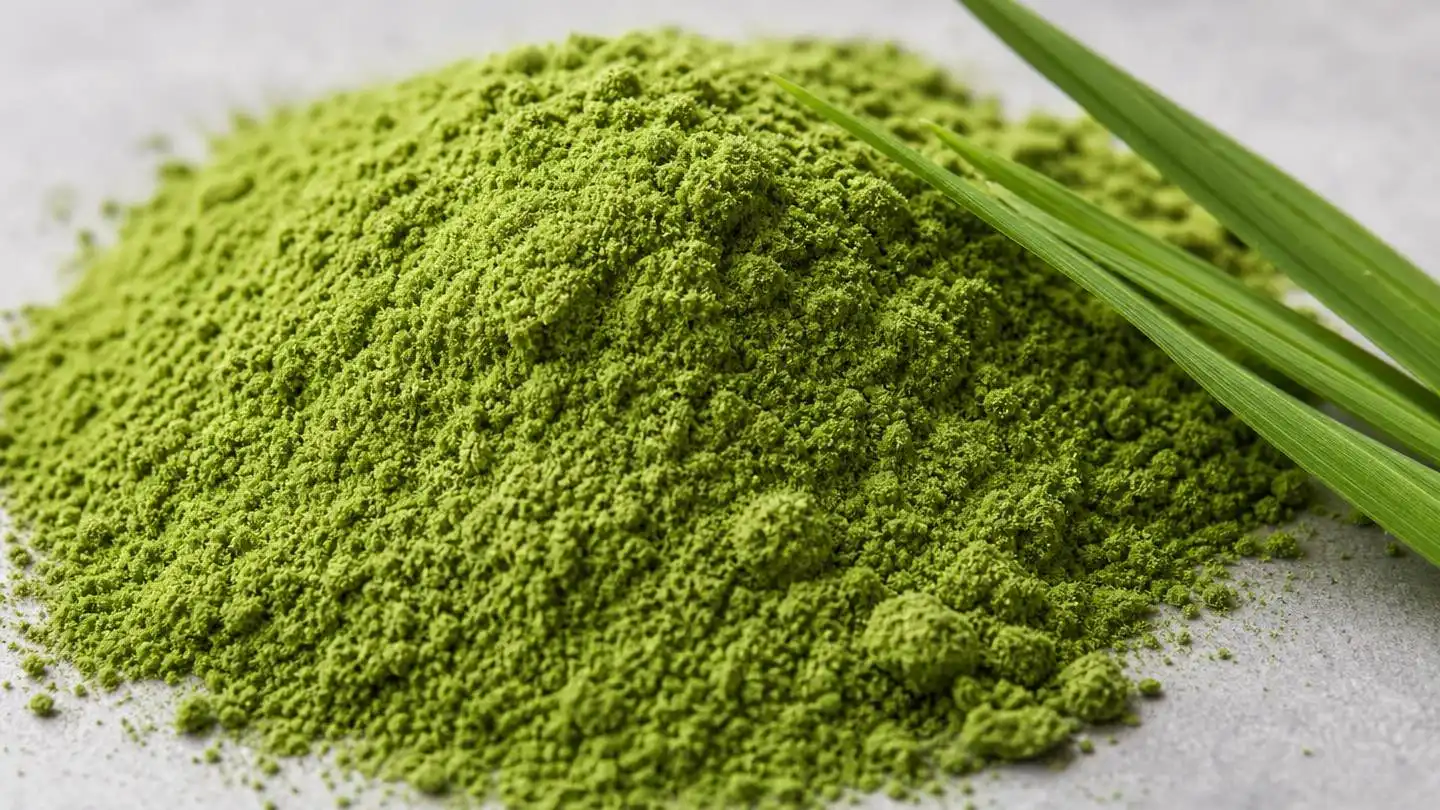
Leaf is cut, washed and dried — tunnel, belt or low-temperature air drying — until moisture is low enough to mill and store. Stem and fibre stay in, so yield depends on dry matter at harvest and on losses in drying and sieving, not on an extraction step.
A typical specification states a fine green powder, a sieve cut and a shelf life under cool, dry storage away from moisture, light and heat. This grade declares green fine powder, at least 95.00% passing 100 mesh, and 24 months.
Route B: pressed, clarified and dried juice
Fresh grass is pressed; the fibre leaves as press cake and becomes a by-product or a lower-value stream. The liquor is clarified, stabilised and dried, usually by spray drying, sometimes with a carrier. That single separation step explains most of the cost and colour gap: you pay for the fresh weight you press and discard the majority of it.
Juice powder is not a pure isolate either. Carriers dilute the juice solids, so ask for juice solids content and carrier identity in writing rather than inferring them from shade.
Why the cost structures diverge
Whole-grass cost is dominated by agricultural yield, drying energy per kilogram of water removed, and milling losses. The juice route adds a pressing yield that is a fraction of fresh weight, a larger water load to remove from a liquid, and often a purchased carrier — so energy per finished kilogram is higher, and the losses occur while the material is still wet and heavy.
Why Cost per Kilogram Cannot Settle It
Quotes arrive as currency per kilogram, and that is the wrong denominator. A kilogram of each powder delivers different colour intensity, different soluble solids and different bulk in a blend. Comparing them per kilogram is like comparing two juices per litre of single-strength liquid when one is a concentrate: normalise by the property the finished product is sold on, and state the weights when one number is needed.
A Workable Cost Model
Let C be landed cost per kilogram, C* the chroma from L*a*b*, and S the soluble solids fraction from hot-water extraction. Two single-metric views follow: cost per chroma unit is C ÷ C*, and cost per kilogram of soluble solids is C ÷ S.
Delivered-value cost index = C ÷ ( w1 × C*/C*ref + w2 × S/Sref ), with w1 + w2 = 1
| Metric (index units, illustrative arithmetic only) | Whole-grass powder | Juice powder | Ratio (juice ÷ grass) |
|---|---|---|---|
| Landed cost per kg | 100 | 300 | 3.00 |
| Chroma C* | 22 | 40 | 1.82 |
| Soluble solids fraction S | 0.18 | 0.62 | 3.44 |
| Cost per chroma unit (C ÷ C*) | 4.5 | 7.5 | 1.67 |
| Cost per kg soluble solids (C ÷ S) | 556 | 484 | 0.87 |
| Weighted index (w1 0.6, w2 0.4) | 224 | 300 | 1.34 |
The ranking moves with the metric, which is the argument. At three times the price per kilogram the juice powder looks expensive; per kilogram of soluble solids it is about 13% cheaper, and per unit of chroma about 67% more expensive. The weights are a commercial choice, and writing them down is the point: it forces the buyer to name the property being purchased. For ratio and carrier decisions in a blend, see using barley grass powder in green superfood blends.
The Five Variables That Move Unit Cost
- Raw material yield. Harvest moisture, cutting height and leaf-to-stem ratio set how much fresh weight becomes a kilogram of powder.
- Drying energy. Energy per kilogram of water removed dominates process cost and trades against colour retention.
- Sieving losses. Oversize is re-milled or rejected, so a tighter cut means a larger reject stream.
- Packing unit. A 25 kg drum and a 1 kg foil bag differ in filling, freight and barrier protection per kilogram.
- Batch scale. Cleaning, setup and testing are fixed per batch, so trial lots carry disproportionate overhead.
Colour Is a Quality Attribute, Not an Impression
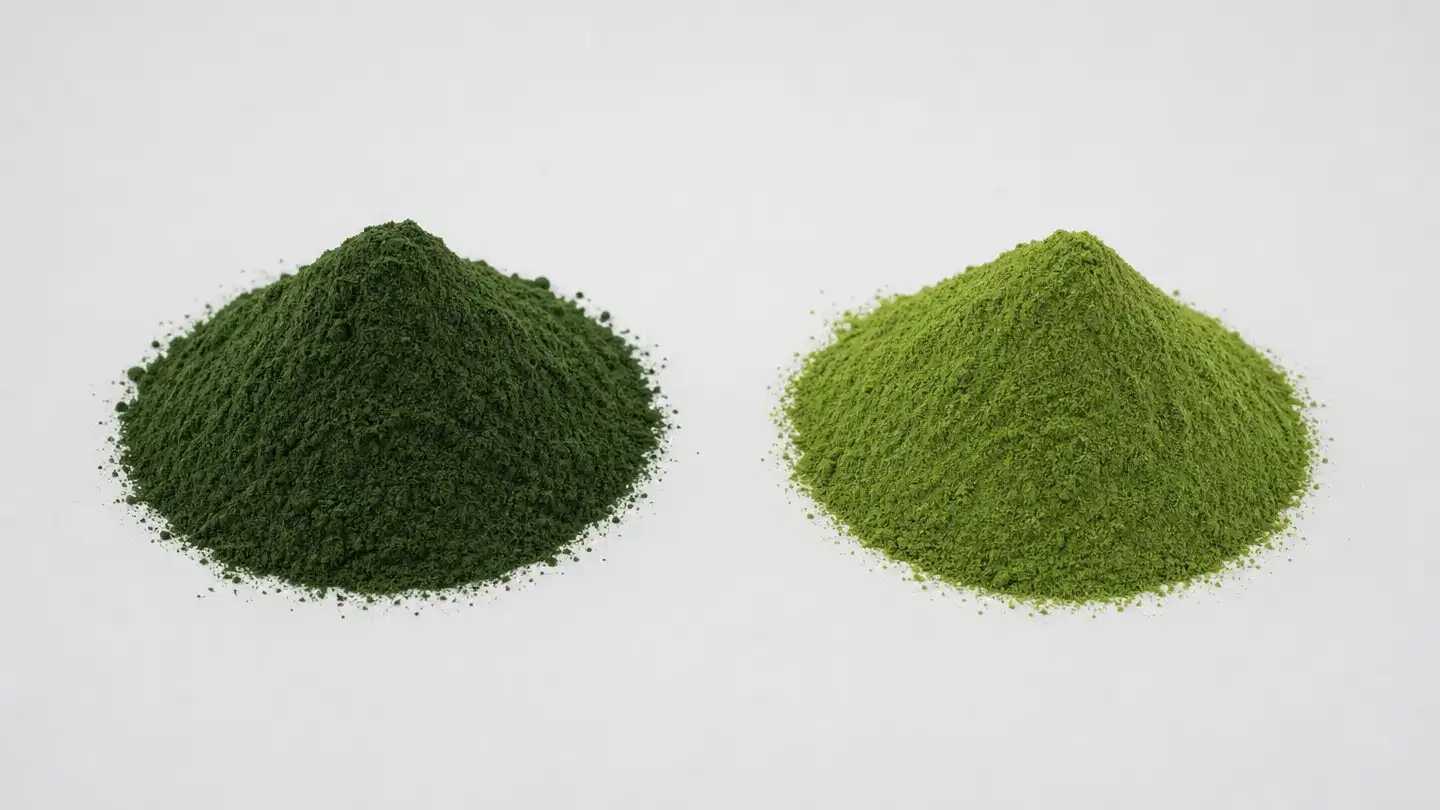
Colour is the first thing a buyer sees and the last thing a formulator can fix. In green botanicals it is also a process record: chlorophyll degrades to olive-brown products, so two lots both called green can sit several ΔE apart, and the eye adapts to ambient light too easily to catch it.
What destabilises chlorophyll
pH. Acid displaces the central magnesium and pheophytin forms, shifting bright green toward olive, so a powder stable in a neutral blend drifts in a low-pH beverage. Light. Photo-oxidation attacks the porphyrin ring and continues inside the pack. Temperature. Dryer inlet temperature and residence time are the main levers; once leaf temperature climbs, browning runs faster than water removal. Metal ions. Copper and iron traces catalyse degradation, and milling releases enzymes and organic acids that shift local pH.
Measuring Colour with L*a*b* and ΔE
L*a*b* expresses lightness (L*), a green-red axis (a*, more negative is greener) and a blue-yellow axis (b*). Chroma combines both axes into an intensity value, and ΔE*ab turns the difference from a reference into a number a specification can hold.
- Sample. Take a thief sample from three positions in the drum and quarter it down.
- Condition and prepare. Equilibrate to a fixed temperature and fill a fixed-depth cell at constant bulk density.
- Measure. Hold illuminant, observer and aperture constant; record L*, a*, b*, chroma and hue.
- Compare and retain. Apply limits to ΔE and to a* and b* separately, and keep a sealed reference of each approved lot.
An acceptable ΔE is a commercial decision, not a constant. What matters is a written limit, the same preparation every time, and application at goods-in rather than only at first approval.
Four Colour Defects and Their Usual Causes
| Defect | What the instrument shows | Likely process cause | Record to request |
|---|---|---|---|
| Browning | L* down, b* up, hue shifted toward olive | Dryer too hot or residence too long; delay between cutting and drying | Inlet and outlet temperature logs, hold time before drying |
| Fading | Chroma down, hue roughly unchanged | Light exposure in storage or clear packaging; high moisture | Packaging light barrier, warehouse records, water content |
| Scorched edges and specks | Bulk reading near normal, dark outliers in residue | Hot spots or uneven bed depth in the dryer; heat from the mill | Airflow and bed-depth records, sieve residue inspection |
| Colour mixing and streaking | High variance between sub-samples | Insufficient blending after sieving; carry-over between lots | Blender homogeneity check, line clearance records |
Browning moves lightness and yellowness, fading drops chroma, and scorching hides in the sieve residue rather than the bulk average. A single bulk reading is therefore incomplete: read the retained sample and the oversize fraction as well.
Particle Size, Dispersion and What 100 Mesh Means
Mesh is a screen count, not a solubility claim. In the US sieve series, 100 mesh is about 149 µm and 80 mesh about 177 µm; at least 95% passing 100 mesh means no more than 5% is retained, and says nothing about wetting, dispersion or sediment.
| Attribute | Whole-grass powder | Juice powder |
|---|---|---|
| Particle character | Irregular, fibre-rich platelets with elongated fragments | Rounded agglomerates of dried soluble solids and carrier |
| Declared fineness | At least 95.00% through 100 mesh for this grade | Supplier-specific; commonly 80 to 100 mesh |
| Wetting and dispersion | Wets slowly, tends to float, needs shear | Wets readily and dissolves with light agitation |
| Sedimentation | Settles as a visible fibrous layer | Low sediment, some haze possible |
| Mouthfeel | Detectable particle, more noticeable at higher use levels | Smooth, with slight chalkiness at high load |
| Dry blend behaviour | Bulky and light, can segregate from fine carriers | Higher bulk density, flows better, less segregation |
On the whole-grass route the retained fraction is vascular fibre, which holds water and adds body. Juice-route particles are agglomerates of dried solids and carrier, mostly soluble, so the same nominal fineness behaves differently in a glass.
Reading a high pass rate as proof of instant dispersion is a common specification error. Whole-grass powder can be 95% under 149 µm and still settle visibly, while a coarser juice powder disappears faster because most of its mass is soluble. Test dispersion in your own matrix, at your own use level and pH, before "instant" appears in a brief.
Labelling: What Goes in the Ingredient Statement
A juice powder and a whole-grass powder cannot share one ingredient name, because the name has to describe what is in the bag. The difference changes the cost basis, the fibre content and, in some markets, the allergen conversation.
| Label element | Whole-grass powder | Juice powder | What to verify |
|---|---|---|---|
| Ingredient name | Organic barley grass powder | Organic barley grass juice powder, plus any carrier | Name matches the process description in the specification |
| Meaning of "grass" | Leaf and stem; fibre retained | Expressed juice only; fibre removed | Whether fibre removal and juice solids are stated |
| Organic claim | Permitted only for certified material | Same, and the carrier must also be organic | Organic status of every component, carrier included |
| Origin and processing | Country of origin of the raw material; processing location if declared | Same | Whether "made in" means processing rather than farming |
| Non-GMO statement | Only with a supported declaration from the certified operation | Same | The declaration on file, not a logo on a website |
| Allergens | Barley is a gluten-containing cereal; cross-contact controls needed | Also derived from a gluten-containing cereal | Allergen statement plus segregation and cleaning records |
| Nutrition data | Calculated from a database or analysed as a composite | Same, with the carrier contributing solids and sugars | Which method, and whether values are per 100 g as sold |
Two habits cause trouble: shortening a juice powder to "barley grass powder" on pack misdescribes both the ingredient and the cost basis, and reading an organic certificate as a gluten statement confuses two programmes with separate evidence. Nutrition panels deserve the same scrutiny, because database values drift with variety and process while a composite analysis reflects what ships. Certificate copies for this grade are listed on the quality accreditation page.
Organic Claims: What NOP and EOS Certification Covers
An organic certificate is a scope statement, not a brand attribute. Under NOP and the EU organic regime it names the operator, the products or categories, the activities — growing, processing, handling, trading — and the standard applied. Documentation available for this grade is EOS and NOP organic certification, consistent with the NOP requirements stated on the product page, alongside ISO 9001:2015, ISO 22000, Halal, Kosher and HACCP certificates.
Three gaps matter: the schedule may list the product under another name; the drying, milling or sieving may be done by an uncertified subcontractor; and a blend containing non-organic components limits the claim to its weakest ingredient.
Auditing the Certificate Chain in Four Checks
- Scope. The product or category on the schedule matches the material, including its form — powder and juice powder are not interchangeable entries.
- Operation and site. The processing activity is listed and the address is the site that actually dries and mills it; a certified farm does not certify a toll processor.
- Transaction certificate. Each shipment carries a transaction certificate issued against the seller's certificate, stating product, quantity and consignee.
- Lot linkage. Certificate quantity, COA lot code and drum label reconcile, and cumulative certified quantities stay within certified output.
If one of the four is missing, the organic claim on the finished pack is exposed even when the material is genuinely organic — and that trail is easier to collect at purchase than to rebuild a year later.
Matching the Form to the Application
Green blends. Appearance dominates, so colour carries the most weight, and whole-grass powder brings body a juice powder cannot match. The trade-off is viscosity and visible fibrous sediment once the blend is mixed into liquid.
Capsules and tablets. Flow and density decide. A 100 mesh whole-grass powder runs on a dosator but is light enough to bridge in the hopper, while juice powder flows more freely and occupies less volume per dose.
Beverages and stick packs. Sediment and dispersion rule out the whole-grass form for most ready-to-drink formats unless homogenisation is available, and low pH will shift the hue over shelf life. Juice powder is the natural fit, with the carrier checked against the target sugar declaration. Where a contract manufacturer is involved, the OEM solutions for organic barley grass powder products describe how mesh, colour limits and carrier declarations carry into a production brief.
Five Sourcing Misconceptions
- "Juice powder is just a finer grind of the same grass." It is a different process stream: fibre removed, pressing yield a fraction of fresh weight.
- "A higher mesh number means it dissolves." Mesh describes a screen opening; solubility and sediment are separate measurements.
- "Darker green means better material." Dark can mean freshly dried, or oxidised and dull. Only L*a*b* separates the two.
- "The organic certificate covers the powder." It covers a scope, a site and a product list. Check the schedule, processor and transaction certificate.
- "The per-kilogram price is the cost." It is a quote denominator; cost per unit of colour or per kilogram of soluble solids is the decision number.
Bringing the Three Dimensions Together
Cost, colour and label are one decision seen from three angles. A juice powder buys colour intensity and soluble solids at a higher cost per kilogram and demands tighter drying discipline; a whole-grass powder buys yield, fibre and a shorter ingredient list at the price of dispersion and lot-to-lot colour variance.
Build the specification around the metric your product is sold on, put a ΔE limit and a mesh cut in it, and require the certificate schedule and transaction certificate with every lot. That is what makes quotations comparable, and it is the only basis on which a buyer can defend the label on the finished pack.
Send your target specification — mesh, colour limits, carrier, application and market — to wgt@allwellcn.com and we will reply with the matching specification sheet and a representative COA, a sample for your own sieve and colorimeter checks, and a note on what the organic scope covers. For finished-product development rather than ingredient supply, see OEM and ODM services.
References
- European Union. Regulation (EU) 2018/848 on organic production and labelling of organic products. 2018.
- European Commission. Commission Regulation (EC) No 1235/2008 on imports of organic products. 2008.
- ISO. ISO/CIE 11664-4 — Colorimetry: CIE 1976 L*a*b* colour space. 2019.
- ISO. ISO 13320 — Particle size analysis: laser diffraction methods. 2020.
- ISO. ISO 4833-1 — Microbiology of the food chain: colony count at 30 °C. 2013.
This article is intended for business-to-business ingredient sourcing and formulation discussion. It does not provide medical, nutritional, or regulatory advice for any specific product or market.