
What Buyers Should Check Before Sourcing Organic Turmeric Powder
2026-11-02 14:00:01
A purchase order for organic turmeric powder is quick to place and expensive to get wrong. The material is sold by color, by mesh and by a certificate, and none of those three things proves what is inside the bag. Most quality failures we see at the receiving dock are not detection failures — they are specification failures, because nobody wrote down what "acceptable" meant before the first container shipped. This checklist is for purchasing, QA and R&D teams who must qualify a supplier and then inspect incoming lots, whether they buy milled rhizome or the standardised grades in our organic turmeric powder range.
Three Decisions to Lock Before You Request a Quote
Quotes are only comparable when the underlying request is identical. Fix these three items in writing and attach them to the RFQ. A supplier that cannot answer them precisely is telling you about its documentation depth.
1. Material Identity: Root Powder, Extract, or Blend
Turmeric moves through several commercial forms that behave differently on the line: milled rhizome, standardised extract, and blends of powder with extract or with carriers. The extract sold on our product page is a fine orange-yellow powder, listed at 95% and 98% specification and tested by HPLC or UV. Milled root has no such declaration and must be specified by origin, drying method, mesh and color. State the form, the assay basis — HPLC and UV do not return the same number on the same sample — and whether carriers are permitted at all. If your label must read "turmeric powder", an extract blend will fail label review no matter how good the paperwork looks.
2. Scope of the Organic Claim
An organic certificate is issued to a scope, not to a product name. It names the operator, the standard, the product categories and the activities covered: growing, handling, processing, storage, export. A certificate covering primary production of raw agricultural commodities does not cover milling and packing. Ask for the scope page and match it against the operation that physically performs each step for your lot, which may be three different companies. What the claim is meant to certify in the material itself is set out in organic vs conventional turmeric powder.
3. Test Methods and Decision Rules
Two competent laboratories can test one lot and disagree without either being wrong, because methods differ in solvent, wavelength, reference standard and sample preparation. Specify the method alongside the parameter, not instead of it. Then agree the decision rule before results arrive: the retest window, the tolerance around each limit, and who pays for a referee laboratory. Without a rule agreed in advance, an out-of-specification result becomes a negotiation instead of a rejection.
The Organic Verification Chain: Five Pieces That Must Agree
The organic attribute is a chain of evidence, and it usually breaks at one link: the transaction certificate. A supplier can hold a valid certificate and still ship a lot whose organic status cannot be demonstrated, because the certificate proves capability while the transaction certificate proves this shipment. Review the five pieces as a set; no single document is sufficient. The sequence in how to choose trusted suppliers of organic turmeric powder is a useful starting framework; the table narrows it to the evidence that matters here.
| Evidence | What to request | How to verify | Common gap |
|---|---|---|---|
| Organic certificate | Current certificate plus scope annex: operator, standard, product categories, activities | Match the operator name to the actual producer and packer, not the trading company; confirm certificate number and status with the issuing body; check validity dates | Certificate is valid but the scope excludes processing or milling, or names a trader who never touches the goods |
| Transaction certificate (TC) | TC for the specific lot: product, quantity, seller, buyer, invoice reference, lot code | Match quantity to the shipping documents and lot code to the bag marks, packing list and COA; confirm the TC was issued against this sale | TC covers an earlier lot or a different quantity; the lot code on the TC does not appear on any bag |
| Input records | Field or plot records, rhizome or seed source, input list, harvest window | Cross-check the harvest window against drying and milling dates on the batch record | Only a one-page summary is offered, with no farm, plot or collection point identified |
| Segregation and cleaning validation | Changeover procedure for organic and conventional runs, cleaning records, storage segregation, pest control log | Pull the changeover record for the actual production date, not a blank template; confirm whether lines are dedicated or sequenced | Procedure exists on paper with no completed record for the date in question |
| Conversion status declaration | Written statement of conversion status, with the conversion start date where relevant | Compare with the certificate annex and check that the label claim matches the status permitted in your destination market | Material still in conversion is presented as fully organic, or status is left ambiguous in the specification |
Turmeric-Specific Contaminants and Adulteration
Turmeric is among the more frequently adulterated spices, and unusually, the adulteration targets appearance rather than weight alone. Buyers have long judged quality by color intensity, so the incentive to brighten a dull lot is strong. Limits differ by market; set every acceptance limit against your destination regulation and your customer's specification, not a figure copied from another buyer's contract. The commercial pressure behind that is covered in the growing demand for organic turmeric powder in nutraceuticals.
Lead Chromate and Lead Salts
The classic turmeric adulterant is lead chromate, a pigment that produces a bright yellow which survives milling. It has been used to brighten dull root and to add weight. In a laboratory result it appears as elevated lead, often with chromium alongside, and that pairing is the useful signal: both rising together in a yellow powder says more than lead alone. Screen by ICP-MS on a digested sample, and handle any elevated lead result as a possible colorant issue rather than an environmental one until the chromium picture is clear.
Sudan Dyes and Other Non-Permitted Colorants
Sudan I to IV and related azo dyes have been detected in spices, including turmeric, and are not permitted food colors in major markets. The practical check is a dye panel by LC-MS/MS on the powder itself. Visual inspection will not find them at the levels that matter, because the dye is designed to look like the product. Ask whether the panel runs on every lot or on a composite, since compositing can push a single adulterated bag below detection and hide the failure you are looking for.
Irradiation, Substitution and Fillers
Irradiation is used to lower microbial load, is restricted or requires labeling in many markets, and is incompatible with organic handling rules in most standards. Screen for it by photostimulated luminescence or thermoluminescence on the mineral fraction, supported by a written irradiation declaration and dosimeter records. Conventional material slipped into an organic lot is caught by the chain above plus a sanity check on price against the organic market. Starch and flour fillers show up in microscopy, in ash and in the starch-related indices; iodine staining helps separate turmeric's own starch grains from added cereal starch, but a blue-black reaction alone proves nothing, since the root contains starch of its own.
Incoming Inspection: What Every Lot Should Be Tested For
The plan below is a template, not a finished specification. Name a method for each parameter, and decide the disposition route before the first result lands. Release tests should block warehousing until the result is recorded against the lot.
| Parameter | Method | Acceptance basis | Action on failure |
|---|---|---|---|
| Color value or L*a*b* | Spectrophotometer on a fixed preparation, or color value by solvent extraction | Agreed range for the grade, measured on the defined preparation | Reject or re-grade; investigate storage and origin before accepting any deviation |
| Curcumin content | HPLC, or UV where a screening basis is declared | Declared assay for the grade, with the method stated on the COA | Retest from a second sample; reject if the result is confirmed |
| Moisture | Loss on drying or Karl Fischer | Limit set in your specification | Reject, or accept only with a documented deviation and re-test |
| Total ash and acid-insoluble ash | Gravimetric, per the method named in your specification | Limit set in your specification | Signals soil or mineral filler; reject pending investigation |
| Volatile oil | ISO 6571 | Minimum set in your specification | Indicates stale or exhausted material; review against origin and sensory |
| Particle size | Sieve analysis or laser diffraction | Mesh or distribution band agreed in the specification | Re-mill or reject, depending on the application |
| Heavy metals | ICP-MS for Pb, As, Cd, Hg | Market regulation and customer specification | Reject on lead; hold the lot for chromium correlation |
| Microbiology | ISO 4833-1, ISO 6579-1, ISO 21527-1 | Limits per market and customer specification | Reject; rework only where the process is validated and permitted |
| Pesticide residues | Multi-residue GC-MS/MS and LC-MS/MS panel | No prohibited inputs for organic status; limits per market | Reject and open an organic integrity review, not just a quality deviation |
| Residual solvents | Headspace GC | Only where extraction or carrier use is declared | Reject if an undeclared solvent appears; question the declared form |
Making Color Acceptance Reproducible
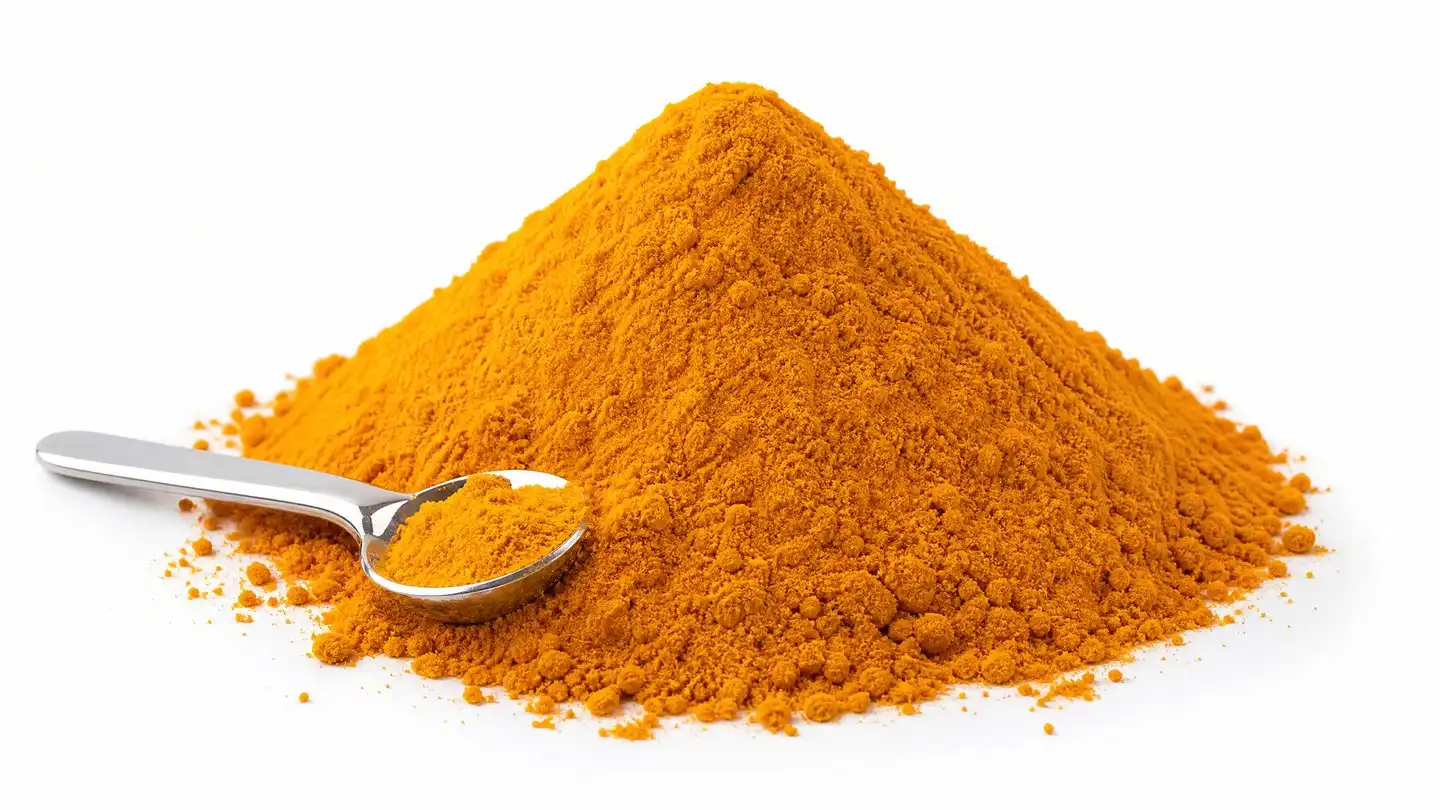
Color is the parameter most often argued about and least often defined. "Visually yellow" is not an acceptance criterion: it depends on the light source, the observer, the depth of powder, the particle size and the background. Two experienced people can look at the same sample under a window and under a warehouse lamp and reach opposite conclusions.
Fix five things. Sampling first: draw from several positions in the lot, composite to a defined mass, then reduce by quartering or riffle to the test portion so no single bag drives the reading. Preparation second: define whether the powder is measured loose in a dish or pressed into a pellet, because the two do not read the same. Instrument third: L*a*b* on a spectrophotometer under a stated illuminant and observer angle, calibrated against a white tile at the start of each session. Reference fourth: keep a physical retained sample from an approved lot and measure it beside every new lot, so instrument or method drift becomes visible. Viewing conditions fifth: if a visual check survives at all, standardise the lamp color temperature and the background, and compare against the retained sample rather than against memory.
Sampling Plans, Retained Samples, and COA Disputes
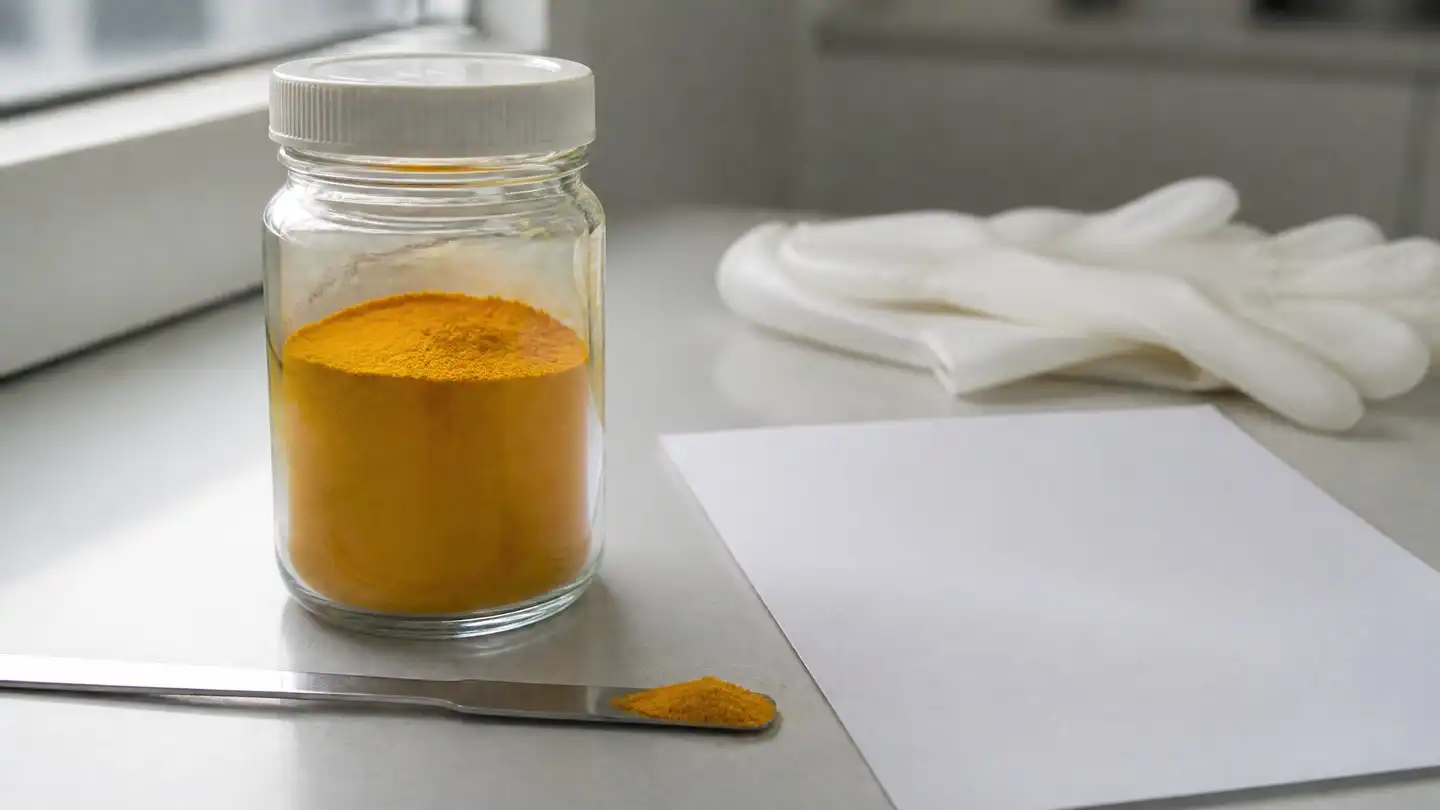
Define the lot before you define the sample. A workable definition is one production batch, one milling run or one homogeneous consignment, whichever is smallest, because a sample can only represent what was blended.
Sample count should scale with package count under a documented plan agreed with the supplier, such as a square-root scheme or one based on ISO 2859. Draw from top, middle and bottom; bulk bags need a probe long enough to reach the centre, not a scoop from the neck. Split each sample into three: in-house test, supplier or third party, and one sealed as the retained sample.
Retention periods come from your own quality system and your customer contracts; twelve to twenty-four months from receipt covers most dispute windows. Store retained samples under the conditions you claim for the material, sealed and labelled with lot, date, sampler and mass.
Use the third-party result as a referee, not a substitute for your own testing. When in-house and external results diverge beyond the agreed tolerance, the first question is method and sample preparation, not who is right. A formal escalation runs in four steps: internal retest on the retained sample, joint retest with the supplier on the sealed sample, referee laboratory, then disposition. Write that sequence into the contract.
Six Capability Checks Before You Approve a Supplier
- Line ownership. Ask which facility mills the powder and whether it appears on the organic certificate. A trader with a good certificate and three toll millers has three supply chains, not one.
- Scope, not certificate count. A wall of certificates is not evidence. One certificate whose scope matches your product and process beats five that do not.
- Batch records and deviations. Request the full batch record for a named past lot, including any deviation and how it was closed out. A supplier that only sends COAs is not showing you a system.
- Change notification. Ask in writing what triggers a notification: origin, mill, carrier, assay method, packaging. If the answer is "nothing", you will learn about a change in your finished product.
- Traceability test. Pick one lot code and ask them to reconstruct it back to a farm or collection point and forward to a shipping document, within a stated time. Time the exercise.
- Export documentation experience. Phytosanitary and origin certificates, health certificate where required, irradiation and fumigation declarations, allergen and GMO statements. Errors here delay containers more often than quality failures do.
Contract Terms That Decide Whether the Specification Holds
Specifications fail at the contract stage more often than at the laboratory stage. Six clauses carry most of the weight.
- Specification lock. The specification sheet is a version-controlled annex, with a method named for every parameter, so an "equivalent method" cannot be substituted later.
- Change notification period. A defined notice period before shipment for any change in origin, milling site, carrier, process or packaging, with your written acceptance required.
- Non-conformance handling. Rejection, replacement, cost allocation and who pays for the referee laboratory, all stated before the first dispute.
- MOQ and lead time. Stated per grade and per packaging format; a 25 kg bag and a 500 kg bulk bag rarely share a schedule.
- Packaging and transport protection. Food-grade liner, heat-sealed, moisture barrier, container condition, desiccant, and no co-loading with odorous cargo.
- Documentation set. Which documents travel with each shipment, in which format, and how quickly they are issued after loading.
Five Sourcing Mistakes That Recur
- Approving the trading company instead of the site that mills the powder.
- Accepting a COA with no lot code, which cannot be tied to anything you received.
- Using the organic certificate as a substitute for the transaction certificate.
- Setting color by eye, then arguing about a shipment nobody can objectively reject.
- Comparing price per kilogram without normalising for assay, moisture and mesh.
Each is cheap to fix before the order and expensive afterwards. In every case a document was accepted as proof when it was only an indicator.
Send the Specification Before You Ask for the Price
Wellgreen supplies organic turmeric root powder and standardised turmeric extract listed at 95% and 98% and tested by HPLC or UV, with specification sheets, COAs and samples available for review. Copies of our ISO 9001:2015, ISO 22000, HACCP, Halal and Kosher documentation are available, and the organic attribute of any offer is confirmed against the certificate and transaction certificate for the lot. Our quality documentation is summarised on the quality accreditation page.
Send your specification, destination market and annual volume to wgt@allwellcn.com and we will reply with the documentation set and a sample plan for a trial lot. If your specification is still open, we can review the parameters above with your QA team before anything is quoted.
References
- ISO. ISO 6571 — Spices, condiments and herbs: determination of volatile oil content. 2008.
- ISO. ISO 4833-1 — Microbiology of the food chain: horizontal method for the enumeration of microorganisms. 2013.
- ISO. ISO 6579-1 — Microbiology of the food chain: detection, enumeration and serotyping of Salmonella. 2017.
- ISO. ISO 21527-1 — Microbiology of food and animal feeding stuffs: enumeration of yeasts and moulds. 2008.
- U.S. Food and Drug Administration. 21 CFR Part 182 — Substances Generally Recognized as Safe.
- European Pharmacopoeia. Monograph: Curcumae longae rhizoma (Turmeric rhizome).
This article is intended for business-to-business ingredient sourcing and formulation discussion. It does not provide medical, nutritional, or regulatory advice for any specific product or market.