
Tongkat Ali Extract Powder for Capsules, Sachets, and Ready-to-Mix Functional Products
2026-09-24 14:18:09
Specifying Tongkat Ali Extract Powder for a capsule line, a stick-pack blend, or a ready-to-mix drink is three different specification exercises built on one raw material. Wellgreen's Eurycoma longifolia root extract is supplied as 10:1, 20:1 and 200:1 grades, identity-tested by UV and TLC, and that starting point behaves very differently depending on whether it is filled into a two-piece shell, tumbled with a carrier and a flavour system, or expected to wet out in a glass of water. The problems that surface on a production line are rarely about the marker compound alone; they are about particle size, moisture, density and flow, and about how the powder shares a blend with everything else in the formula.
This article treats the ingredient strictly as a formulation input: what each specification field tells a developer, where the three formats diverge, and which tests belong in the programme before scale-up.
Reading the Extract Specification Before You Lock a Format
The first fork in the road is not the application but the type of extract being purchased, because the type dictates which properties can be guaranteed batch to batch.
Ratio extracts such as 10:1, 20:1 or 200:1 describe how much dried root went into the extraction, not how much of any single compound survived into the powder. They are stable and cost-efficient at higher inclusion rates, but the profile still moves with harvest season, root age, solvent and drying route. A ratio figure is a statement about starting material, never a content guarantee.
Standardised extracts declare a named marker compound at a stated concentration and analytical basis, quantified against a reference standard by a validated chromatographic method. Eurycomanone is the marker most often chosen for this species; quassinoids account for a major portion of Eurycoma longifolia root phytochemistry, which is why the analytical literature on the plant concentrates on their identification and determination (Rehman et al., 2016). When a specification says standardised, ask which marker, on what basis, by which method, and within what acceptance range.
Water-dispersible grades trade part of the analytical result for physical performance. They are built by co-drying or agglomerating the extract with a carrier so that the powder wets and disperses instead of forming floating aggregates, and they carry a different particle-size, density and taste profile. That trade-off is a formulation decision, not a quality hierarchy.
Process route matters downstream as well: solvent system, concentration and drying determine residual moisture, particle morphology, hygroscopicity and the bitterness load a beverage formulator has to manage.
Assay and Specification Fields That Decide Formulation
Every field below changes either the equipment settings or the labelling story. Treat them as a package rather than a checklist, because a powder can pass on marker content and still fail in the filler.
| Specification field | What it controls in practice | What to request from the supplier |
|---|---|---|
| Marker compound and declared basis | Whether the declared percentage is reproducible between lots and comparable between suppliers | Marker name, method, reference standard, acceptance range, and whether the value is stated on an as-is or dried basis |
| Extraction ratio vs standardisation | Whether the purchase is a sourcing claim or an analytical guarantee | Clear statement of extract type plus the ratio or marker value actually certified |
| Identity test | Authenticity of the species and freedom from substitution | UV/TLC or chromatographic fingerprint, with representative figures |
| Particle-size distribution | Flow, dusting, segregation risk, wetting behaviour and mouthfeel of the finished powder | Mesh or micron specification with the percentage passing, not a single average |
| Moisture | Caking, sticking and long-term stability in the pack | Limit plus the measured value on the actual lot certificate |
| Bulk and tapped density | Fill volume on volumetric dosators and sachet augers | Both figures, with the test method and conditioning used |
| Flow behaviour | Feeder consistency, bridging and weight variation | Carr compressibility index or Hausner ratio, or angle of repose |
| Dispersibility in water | Behaviour in ready-to-mix formats | Wetting or dispersion test description relevant to the intended beverage system |
| Heavy metals and microbiology | Market access and release testing | Panel of results per lot, with the limits used for each element |
| Packaging and shelf life | Moisture and light protection across transport and storage | Pack format, barrier description and the shelf life the supplier supports |
Wellgreen's published certificate of analysis for the 10:1 grade, for example, lists appearance as a yellow-brown fine powder, particle size of at least 95% passing 80 mesh, moisture below 4.0% (3.08% measured), total ash below 5.0% (3.55% measured), heavy metals within arsenic <1.0, lead <1.0, mercury <0.1 and cadmium <1.0 mg/kg, and negative results for coliforms, E. coli, Salmonella and Staphylococcus. Shelf life is stated as two years, with storage and shipping in a cool, dry place away from moisture, light and heat. These are the figures to compare between quotations; broader purity and sourcing criteria cover the documentation side of the same evaluation.
Capsules and Tablets: Fill Weight, Blend Uniformity, and Powder Behaviour
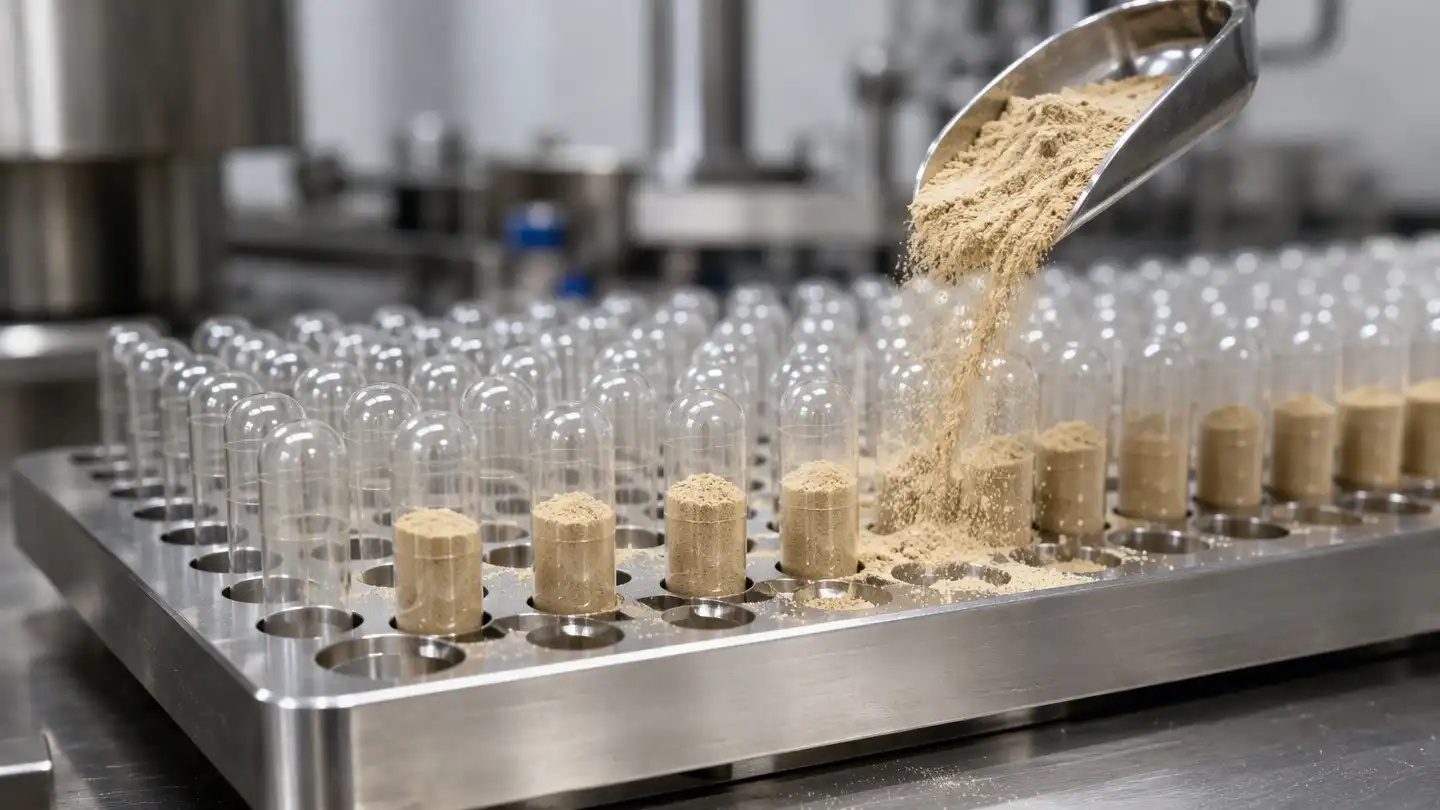
Fill weight and fill-volume variance
Capsule and tablet machines fill by volume. A powder whose bulk density drifts between lots produces a fill-weight drift even when the dosator setting never moves, which is why bulk and tapped density belong in the incoming specification alongside the marker value. Lock a target fill volume rather than a fill weight alone, qualify a density window, and confirm that the achieved weight still lands inside label tolerance at both ends of that window. Where extract inclusion is high and the powder is light and airy, a glidant or a denser co-ingredient may be needed to make the volume stable enough to control.
Blend uniformity at low inclusion rates
Once the extract becomes a minor component of a premix, segregation is the dominant risk. Differences in particle size and density let ingredients separate under vibration, transfer and hopper flow, and the segregation literature links that behaviour directly to content-uniformity failures in finished units (Jakubowska & Ciepluch, 2021). The countermeasures are unglamorous but effective: match particle-size bands across co-ingredients, blend by geometric dilution, cap mixing time so that over-blending does not undo the distribution just achieved, and sample the blend at the start, middle and end of the run.
Flow, dusting, lubricant and disintegrant interaction
Fine fractions cause dusting, weight variation and carry-over, and they form the cohesive bridges that make a feeder surge and stall. Powder flow is multifaceted enough that no single test characterises it, which is why standard practice combines angle of repose, compressibility index or Hausner ratio, flow through an orifice, and, where available, a shear cell (USP, 2024). Food-grade powder flow is further governed by particle size and shape, surface properties, moisture content and storage conditions, with moisture forming liquid bridges that progressively hinder movement (Suhag et al., 2024).
Lubricants and disintegrants deserve their own attention in botanical tablets. A hydrophobic lubricant such as magnesium stearate works at very low addition, and over-blending coats particle surfaces, slowing wetting and disintegration; a moisture-sensitive disintegrant can swell in a humid filling room, causing sticking on punch faces and weight variation. For two-piece shells the constraint moves to shell mechanics: powder held at the dry end of the moisture window can make shells brittle in a low-humidity encapsulation room, while material conditioned too wet can soften them. The capsule format carries its own engineering trade-offs, as explored in this overview of capsule-format engineering for botanical powders.
| Control point | Capsules / tablets | Stick packs and sachets | Ready-to-mix powders |
|---|---|---|---|
| Critical particle size | Narrow band for consistent fill volume and minimal dusting | Matched across all co-ingredients to resist segregation | Coarser, agglomerated or carrier-built particles for fast wetting |
| Moisture target | Controlled tightly: low enough to avoid sticking, high enough to avoid brittleness | Low, and protected by the laminate barrier | Low, with water activity monitored through shelf life |
| Density | Bulk and tapped density define the achievable fill-weight range | Density contrast with co-ingredients drives segregation | Density drives sedimentation once dispersed |
| Dominant risk | Weight variation, sticking, blend segregation | Dusting, segregation, caking in the pack | Floating clumps, sedimentation, bitterness |
| Primary release tests | Fill weight, blend and content uniformity | Fill accuracy, sieve-verified uniformity, pack integrity | Wettability, dispersion time, sensory panel |
Stick Packs and Sachets: Dry-Blend Engineering
A sachet is a small, agitated blend packed into a flexible barrier, which makes it the least forgiving of the three formats. Particle-size matching across the extract, carrier, acidulants, sweeteners and flavours is the most effective anti-segregation measure, because particles of similar size and density are far less likely to separate as the blend travels from blender to hopper to auger.
Segregation also decides the analytical reality: an assay taken from the blender can look perfect while filled sticks drift across a run, so sampling should follow the fill sequence rather than the batch. Dusting is the second issue, because a high fines fraction puts powder into the air around the filler, costing yield, fouling the sealing zone and risking cross-contamination. Where fines are unavoidable, granulating or agglomerating the extract before blending usually stabilises both fill and seal.
Carrier and diluent choice settles much of the design. Maltodextrin, dextrose and gum arabic systems dilute the extract, modify its flow and wetting behaviour, and change the total weight that must fit into a small pack. Hygroscopicity matters most: a powder that picks up moisture will cake in the stick, bridge in the feed tube and lose fill accuracy, and the anticaking literature shows the combined effect of moisture ingress on flowability, degree of caking and hygroscopicity over storage (Bashir et al., 2023). Validate fill accuracy on the actual filler type, because volumetric and auger systems respond differently to the same powder.
Ready-to-Mix Powders and Beverages: Wetting, Dispersion, and the Taste Load

Rehydration is not one event. It proceeds through wetting, sinking, dispersion and dissolution, and problems in the first stage propagate through the rest; the recent review literature treats wetting as the gateway step, with dispersion breaking down agglomerates and dissolution releasing the soluble fraction afterwards (Jiang et al., 2025). Fine botanical powders with hydrophobic surfaces are the classic case: particles sit on the surface tension of the water, form rafts and lumps, and dissolve unevenly even after vigorous stirring. Coarse particles solve the wetting problem and create a sedimentation one.
The toolkit is well established. Agglomeration builds porous, larger particles that sink and wet quickly; lecithination reduces surface hydrophobicity; carrier co-drying produces a dispersible grade in the first place; and control of the particle-size distribution keeps the fine tail small enough to avoid rafting. Crystal form and wetting behaviour matter in adjacent systems too, as work on particle form and solubility in powder blends shows, where a hydrated crystal structure improves wetting and dispersion relative to an anhydrous equivalent.
Bitterness and astringency are the second half of the beverage problem, and they are inherent to the material rather than a defect. The available approaches are normally combined: complexation of the bitter fraction with cyclodextrins, which the pharmaceutical literature reviews as an effective and inexpensive masking route whose outcome depends on the right cyclodextrin and guest ratio (Adamkiewicz & Szeleszczuk, 2023); encapsulation or coating of the extract particle; a carrier or bulking agent that dilutes the taste load; and a flavour system built around compatible bases. Sweetness suppresses bitterness more effectively than acidity, which is one reason cocoa, coffee and malt bases appear so often in this format.
Storage, Light and Moisture Protection
Extract powders are hygroscopic to a degree that depends on carrier and drying route, and moisture changes everything else: flow, caking, fill accuracy, microbial status and taste. Water activity is the practical indicator, because it tracks the moisture available to drive those changes rather than total moisture alone.
The barrier does the work in the pack. Aluminium-laminate structures and sealed foil packs limit moisture, oxygen and light ingress, and the spray-dried powder literature shows how much more slowly quality attributes drift when the laminate is combined with an appropriate anticaking agent (Bashir et al., 2023). Bulk handling follows the same logic: Wellgreen ships this extract in 1–5 kg aluminium foil bags or 25 kg drums with OEM options, and states a two-year shelf life when material is stored and shipped in a cool, dry place away from moisture, light and heat. Light protection is not a formality for a pale tan, finely milled extract, nor is headspace control in a repacked drum.
Stability Work to Complete Before Scale-Up
The programme should mirror the format, not the catalogue. A capsule product needs content uniformity and shell integrity data; a sachet needs fill accuracy and caking data; a beverage needs wetting and sensory data over time. Two or three lots under accelerated and long-term conditions is the normal starting point (FDA, 2002).
| Test or study | Why it is run | Practical note |
|---|---|---|
| Accelerated and long-term storage | Supports the declared shelf life and flags early change | Run in the final pack, not in a laboratory jar |
| Moisture, water activity and caking | Predicts loss of flow and dispersion during distribution | Include a degree-of-caking check with sieve retention |
| Flow re-testing over time | Confirms the powder still feeds after storage | Repeat Carr index or Hausner ratio at each pull point |
| Blend and content uniformity | Proves the extract is distributed and stays distributed | Sample across the fill run, not only the blender |
| Wettability and dispersion | Validates the ready-to-mix performance claim | Test in the real beverage base, hot and cold |
| Sensory panel for bitterness | Confirms the masking system still works at end of shelf life | Taste the masked powder, not just the neat extract |
| Microbiological monitoring | Protects release and market access | Re-check after any packaging or process change |
Where a supplier document states a two-year shelf life, treat it as the starting assumption rather than the result: the pack, the blend and the destination climate all shift the curve. Regulatory frameworks add a second constraint — Regulation (EC) No 1924/2006 shows how tightly commercial communication about foods is controlled in the European Union — so formulation choices that look purely technical cast a regulatory shadow, and that shadow is cheaper to accommodate early.
Working With Wellgreen
Wellgreen supplies bulk Eurycoma longifolia extract powder to supplement brands, contract manufacturers and OEM/ODM partners. The product page lists the certificates held for this material as ISO9001:2015, ISO22000, Halal, Kosher and HACCP. If your development team is choosing between the 10:1, 20:1 and 200:1 grades, or needs a grade aligned to a capsule, sachet or ready-to-mix brief, send your target format and specification fields to the technical team at wgt@allwellcn.com so that samples can be matched to the application. This article provides technical and commercial information for industry professionals; it is not medical advice, and use levels, regulatory status and label claims must be confirmed against the rules of the target market and your own product data.
References
- Rehman, S. U., Choe, K., & Yoo, H. H. (2016). Review on a Traditional Herbal Medicine, Eurycoma longifolia Jack (Tongkat Ali): Its Traditional Uses, Chemistry, Evidence-Based Pharmacology and Toxicology. Molecules, 21(3), 331. https://doi.org/10.3390/molecules21030331
- Adamkiewicz, L., & Szeleszczuk, Ł. (2023). Review of Applications of Cyclodextrins as Taste-Masking Excipients for Pharmaceutical Purposes. Molecules, 28(19), 6964. https://doi.org/10.3390/molecules28196964
- Jiang, H., et al. (2025). A Comprehensive Review of the Rehydration of Instant Powders: Mechanisms, Influencing Factors, and Improvement Strategies. Foods, 14(16), 2883. https://doi.org/10.3390/foods14162883
- Suhag, R., Kellil, A., & Razem, M. (2024). Factors Influencing Food Powder Flowability. Powders, 3(1), 65–76. https://doi.org/10.3390/powders3010006
- Bashir, O., Hussain, S. Z., Ameer, K., Amin, T., et al. (2023). Influence of Anticaking Agents and Storage Conditions on Quality Characteristics of Spray Dried Apricot Powder: Shelf Life Prediction Studies Using the Guggenheim-Anderson-de Boer (GAB) Model. Foods, 12(1), 171. https://doi.org/10.3390/foods12010171
- Jakubowska, E., & Ciepluch, N. (2021). Blend Segregation in Tablets Manufacturing and Its Effect on Drug Content Uniformity—A Review. Pharmaceutics, 13(11), 1909. https://doi.org/10.3390/pharmaceutics13111909
- United States Pharmacopeia. (2024). ⟨1174⟩ Powder Flow. USP. https://www.usp.org/sites/default/files/usp/document/harmonization/gen-chapter/20230428HSm99885.pdf
- U.S. Food and Drug Administration. (2002). Q1A(R2) Stability Testing of New Drug Substances and Products. FDA. https://www.fda.gov/regulatory-information/search-fda-guidance-documents/q1ar2-stability-testing-new-drug-substances-and-products
- Regulation (EC) No 1924/2006 of the European Parliament and of the Council of 20 December 2006 on nutrition and health claims made on foods. OJ L 404, 30.12.2006, pp. 9–25. https://eur-lex.europa.eu/legal-content/EN/TXT/?uri=CELEX:32006R1924