What Makes Cordyceps Militaris Powder a Popular Choice for Functional Food Manufacturers?
2026-09-20 14:29:17
Cordyceps Militaris Powder is no longer a novelty ingredient. The harder question is where it belongs first: a baked good, a spoonable dairy product, a gummy, or a snack bar. Each of those categories applies its own constraints — oven heat, available water, sugar solids, fat content, powder handling and label rules — and those constraints decide whether a specification survives scale-up. This article covers category-level processing compatibility: format selection, colour and flavour management, dry-blend behaviour, and the documentation a co-packer will ask for before a trial run.
Compatibility Is Decided by the Process, Not by the Ingredient
A development kitchen rarely asks whether a botanical powder is a good ingredient in the abstract. It asks how that powder behaves in a defined matrix. One lot can compress cleanly into a snack bar and still mottle a stirred white yoghurt. The same lot can disperse evenly through a dry sachet blend and leave a gritty mouthfeel in a chew. Those differences come from the process, not from the certificate of analysis.
Three variables explain most of the variation. Available water governs caking, sedimentation and colour development. Thermal load sets how much of the powder's colour and flavour survives the line — high dry heat in bakery, gentle pasteurisation or cold fill in dairy, cook-and-deposit in confectionery. Sensory budget decides how much savoury character the base can absorb before the finished product stops tasting like the product the consumer expects.
Format follows from those variables. Whole fruiting-body powder and a 10:1 extract sit at different points on the inclusion-versus-intensity curve, and the choice between them is usually a property of the category rather than a house preference — a decision that is far cheaper to make before the first bench trial than after the deposit stage.
Heat Exposure, Water Activity and Flavour Load
Thermal exposure by category
Baked goods subject the ingredient to dry heat at the dough surface. The practical questions are how much colour the powder develops during baking, whether its savoury note survives in the crumb, and whether the finished piece still matches the reference sample at the end of the shelf life. Chilled dairy is the opposite case: very little heat, but weeks of refrigerated storage inside a hydrated matrix, where dispersion and colour stability matter far more than thermal tolerance.
Confectionery sits between the two. Gummies and chews are cooked, deposited and then dried down to a low final moisture, so the ingredient spends time in a hot, concentrated sugar solution. That is the most aggressive environment discussed here, and it is the main reason gummy projects tend to begin with an extract.
The useful request is the same in every case: a sample in the real matrix, run through the real process, and assessed after the real shelf-life test.
Flavour load and sensory masking
Whole fruiting-body powder carries an unmistakable savoury, mushroom-forward note. In a savoury snack, a sesame cracker or a cocoa-heavy bar, that note reads as depth. In a vanilla confection or a fruit-flavoured dairy cup it reads as an off-note, and the project then needs either a masking flavour system or a lower inclusion rate.
An extract changes the arithmetic. Because the same measured marker content arrives in a smaller mass of powder, the flavour contribution per unit of marker falls, which buys room in the sensory budget. The trade-off appears on the label: whole powder supports a short, recognisable ingredient statement, while an extract has to be declared as an extract.
A Category-by-Category Compatibility Overview
The table below sets out where each format tends to fit and what normally needs testing before a formula is locked. Treat it as a starting point for bench work rather than a substitute for it.
| Product category | Process conditions to design around | Format that usually fits | What to validate on the bench |
|---|---|---|---|
| Baked goods, biscuits, crackers and soft-baked bars | Oven heat at the surface; competition with flour for water; low final moisture | Whole powder for wholemeal and cocoa recipes; extract for pale recipes | Crumb colour against the visual standard; flavour after bake rather than in raw dough |
| Yoghurt, drinkable dairy and chilled desserts | Cold chain; fully hydrated matrix; stirred addition after fermentation | Water-dispersible extract, or finely milled whole powder | Speck-free dispersion; uniform colour in a white base; mouthfeel after storage |
| Gummies, jellies and chews | Cook-and-deposit; high sugar solids; low final water activity | 10:1 extract at a low inclusion rate | Flavour masking; colour in translucent gels; grittiness at the deposit stage |
| Snack bars, clusters and coated cereals | Low moisture; compression or gentle extrusion; high fat | Whole powder | Flavour balance against sweet carriers; colour migration between layers |
| Dry mixes, sachets and instant powders | Dry blending; hygroscopic powder; long ambient shelf life | Powder milled to at least 95% passing 80 mesh | Segregation in low-dose blends; caking in opened packs; dust during weighing |
Two patterns recur. Pale, lightly flavoured matrices reward low inclusion rates and water-dispersible formats; dense, strongly flavoured matrices tolerate whole powder and often benefit from it.
Bakery and baked snacks
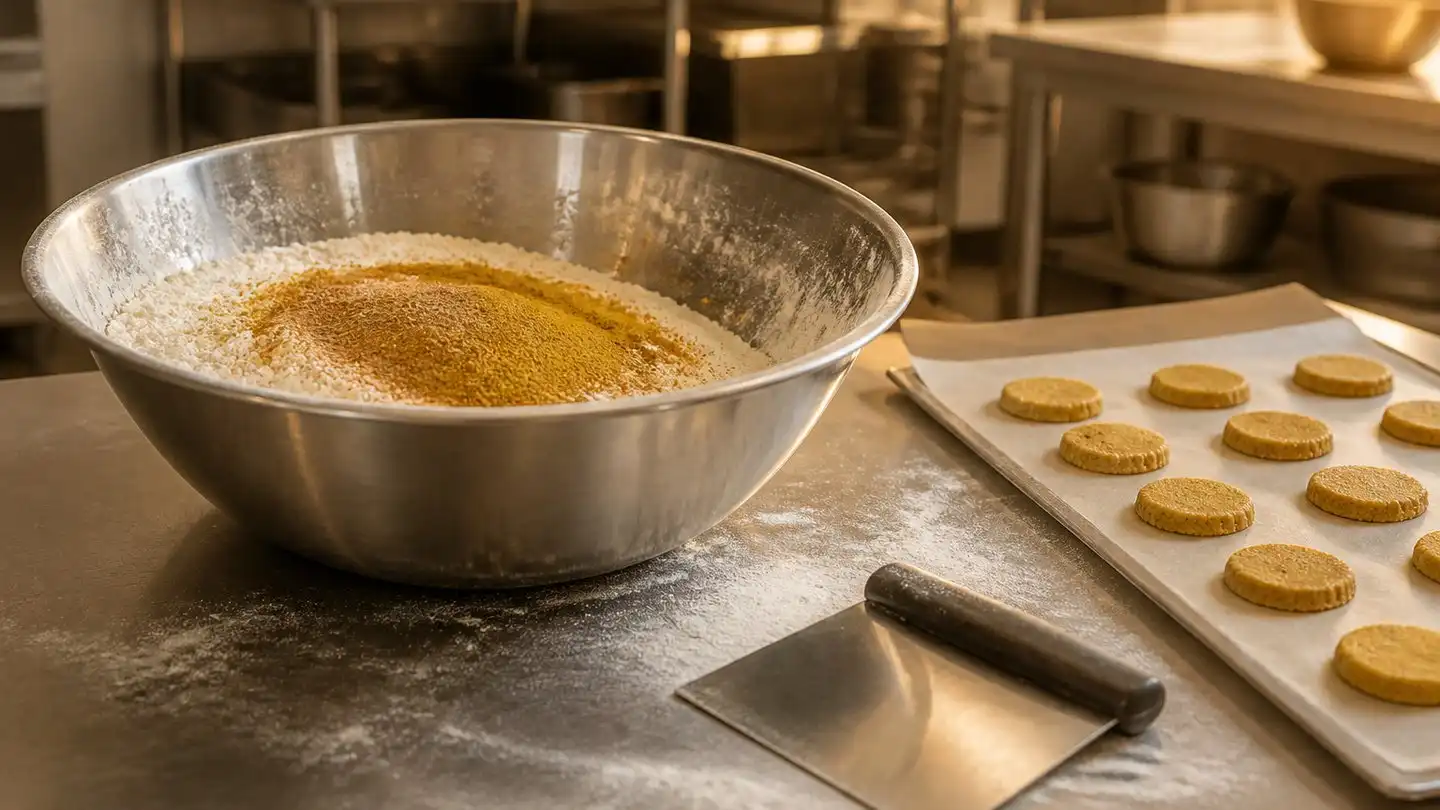
In breads, biscuits, crackers and soft-baked bars, the powder joins the dry blend and competes with flour for water. At a meaningful inclusion rate it darkens the crumb and pushes it toward a warm brown: acceptable in wholemeal and cocoa recipes, less so in pale sandwich applications. Published trials with mushroom powders in bread and cookies follow the same pattern, with technological quality holding up at moderate inclusion while colour and flavour are the variables most likely to need adjustment [5][6].
For the ingredient's own composition, cultivation and analytical background, our overview of Cordyceps militaris powder as a functional mushroom ingredient covers that ground; this article stays with the process side — how the powder behaves inside a bakery line.
Three practical starting points: blend the powder into the dry phase rather than into the fat or the egg wash, keep inclusion low enough that crumb colour stays inside the visual standard, and judge flavour on the baked piece.
Spoonable and drinkable dairy
Yoghurt, drinkable yoghurt, chilled desserts and processed cheese sauces are hydrated systems held under refrigeration. Whole powder continues to absorb water during the first days of storage: viscosity rises, colour deepens slightly, and in a white base any uneven dispersion becomes visible to the consumer. A water-dispersible extract reduces both effects, because less powder mass is needed and the colour distributes more evenly through the stirred product.
Three checks settle most dairy questions. Dispersion: does the powder hydrate without visible specks after the standard mixing cycle? Colour: does the batch read uniformly against a white control after 24 hours, and again at the end of shelf life? Mouthfeel: does the added powder contribute a texture the target consumer will accept? Reviews of ingredient additions to yoghurt show that sensory outcomes, not analytical ones, most often decide the final inclusion level [7].
Liquid formats raise a different set of questions, because ready-to-drink beverages, stick packs and sports blends are judged on solubility and dispersion rather than on spoonable texture. Our guide to Cordyceps Militaris Powder in functional beverage and sports nutrition formulations works through that side of the portfolio, while this article stays with bakery, dairy, confectionery and snack applications.
Gummies, jellies and chews
Confectionery is the most demanding of the categories covered here. The cook-and-deposit stage, the high sugar solids and the low final water activity concentrate flavour and intensify whatever colour the powder brings. Translucent pieces hide far less than opaque ones, and fine powder at a higher inclusion rate can register as grittiness against an otherwise smooth gel.
This is where a 10:1 extract usually earns its place. A lower inclusion rate means less flavour to mask and less colour to compensate, and the gel texture is easier to defend to a sensory panel. Whole powder remains workable in opaque chews, nougat-type pieces and coated centres, where the matrix can carry the powder rather than hide it.
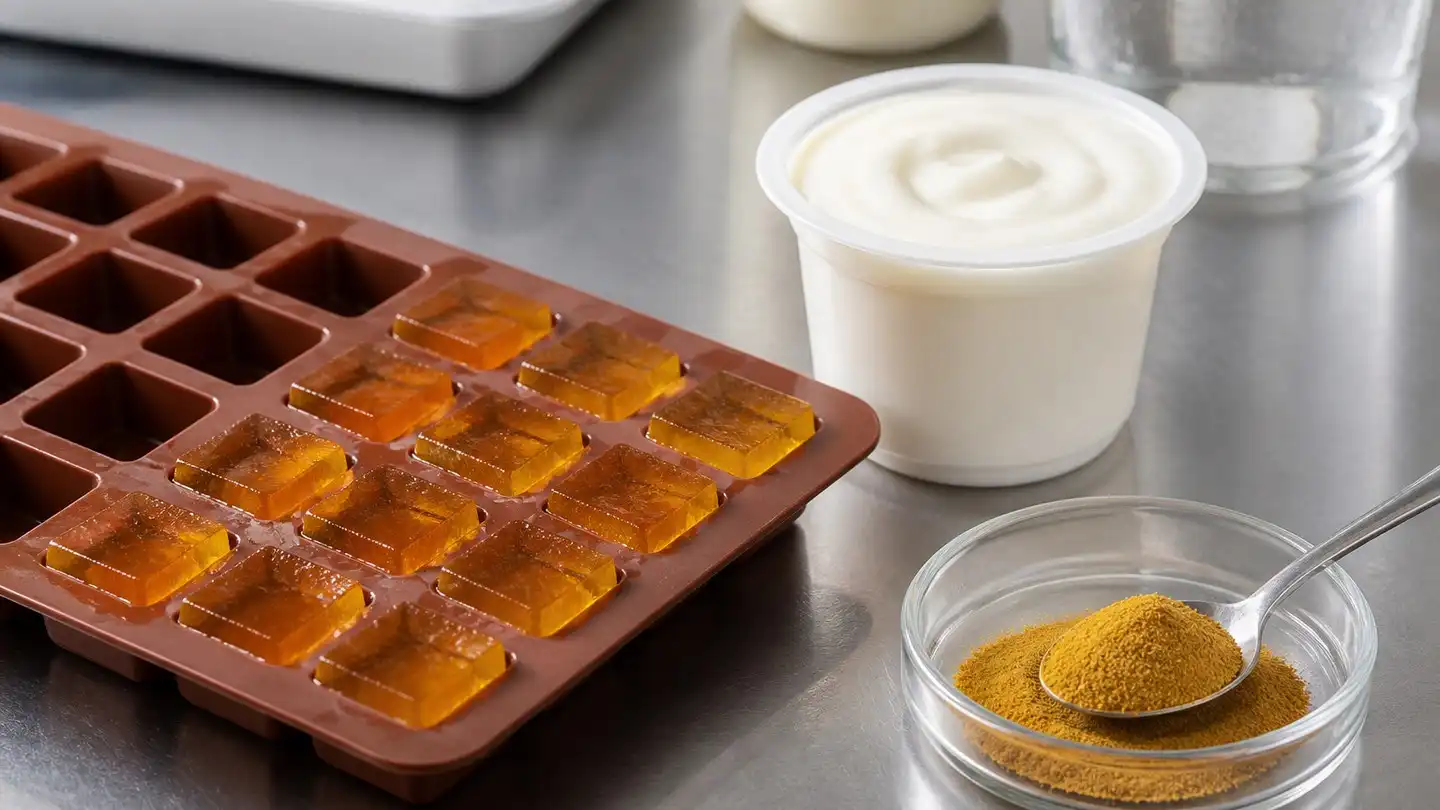
Two details are worth settling before the deposit stage rather than after it: the inclusion rate per piece and the colour reference the batch will be measured against.
Snack bars, cereals and coatings
Bars, clusters and coated cereals are low-moisture, often high-fat systems assembled by compression or gentle extrusion. Whole powder integrates well here. It contributes fibre that supports a short ingredient list, and its warm colour reads as intentional in a nut, oat or date-based recipe. The main design risk is flavour balance, because the powder's savoury note sits directly beside sweet carriers.
In multi-layer bars, the powder is best placed in the layer where the colour shift is least visible. In extruded products it is usually better added after the thermal step, wherever the process allows, so that colour development comes from the ingredient rather than from the line.
Colour Drift and Dry-Blend Behaviour
Colour is the parameter that most often triggers a complaint, because it is the easiest for a consumer to notice. The powder's natural palette runs from golden to orange-brown, and it darkens as the matrix hydrates and as heat is applied. In a white dairy base that reads as a deviation; in a cocoa or berry-based bar it disappears. Where a pale base genuinely needs the ingredient, formulators often pair it with a natural colour source that carries the visual load — a fruit or root vegetable powder, such as ube purple yam powder — so that the inclusion can stay low and the batch-to-batch colour stays consistent.
Powder handling is the quieter problem. A powder specified at 95% or finer through 80 mesh blends more predictably into dry mixes, but flow still depends on moisture uptake, particle shape and static charge. Segregation in low-dose blends, caking in opened bags and dust during weighing are routine production issues that a density and flow data sheet usually resolves before the trial run.
Matching the Specification to the Process
Once the category and the format are settled, the specification should be written against the process rather than taken from a catalogue page. The table below lists the parameters that decide whether a lot performs in production, with the values published for Wellgreen's Cordyceps Militaris Powder grades.
| Parameter | Value as published | Why the process cares |
|---|---|---|
| Assay and extract ratio | 10:1, tested by UV and TLC (extract grade); polysaccharide by HPLC (organic grade) | Sets the inclusion rate and how the ingredient can be declared |
| Particle size | Not less than 95% passing 80 mesh | Blend homogeneity, sachet fill weight, dust control |
| Moisture and physical limits | Loss on drying not more than 5.0%; residue on ignition not more than 5.0% | Caking and agglomeration in low-moisture systems |
| Heavy metals | Total not more than 20 ppm, with individual limits for lead, arsenic, mercury and cadmium | Export documentation and market clearance |
| Microbiology | Total plate count not more than 1,000 cfu/g; yeast and mould not more than 100 cfu/g; E. coli, Salmonella and Staphylococcus not detected | Release testing for ambient-stable formats |
| Appearance and sensory | Yellow-brown to brown fine powder with characteristic odour and taste (extract grade); brown-yellow fine powder (organic grade) | Batch-to-batch consistency in pale matrices |
| Certificates | ISO 9001:2015, ISO 22000, HACCP, Halal and Kosher; EOS and NOP organic additionally listed on the organic grade | Buyer qualification and retailer documentation |
| Packaging and shelf life | 1–5 kg aluminium foil bag or 25 kg drum, with OEM options; two-year shelf life | Moisture protection through transit and storage |
Values above are those published on Wellgreen's Cordyceps Militaris Powder product page and its organic cordyceps mushroom powder product page, including their Certificate of Analysis summaries. Bulk density, tapped density and water activity are not published; request them from the supplier for the intended application.
Parameters that are available on request rather than published are the ones that separate a production-ready supplier from a trading intermediary; bulk density in particular is rarely quoted yet frequently decisive. The assay convention is not interchangeable either: the extract grade is documented at 10:1 by UV and TLC, while the organic grade is documented by HPLC against a polysaccharide specification. Knowing which convention applies is essential before two quotations are compared.
Labels, Documentation and Market Checks
Ingredient declaration usually forces the final format decision. Under United States labelling rules, food ingredients are declared by common or usual name in descending order of predominance by weight, while a dietary supplement's ingredients are declared in the Supplement Facts panel, where the declared weight of an extract is the weight of the dried extract rather than of the raw material it was derived from [9][10]. A 10:1 extract therefore does not allow a brand to report ten times the ingredient weight on the panel.
Documentation should travel with the first sample rather than the first order: a batch certificate of analysis covering assay, moisture, particle size, heavy metals and microbiological limits; confirmation of the fungal species and the cultivation substrate; and the certificates the supplier actually holds. Wellgreen lists ISO 9001:2015, ISO 22000, HACCP, Halal and Kosher for its Cordyceps Militaris Powder grade, with EOS and NOP organic certification added on the organic grade, as stated on the respective product pages.
Finally, the market check. Confirm the ingredient's regulatory status and permitted labelling in each destination market before pack artwork is signed off, and keep usage levels and claim wording tied to the finished product's own data.
Building a Category-Specific Brief with Wellgreen
Wellgreen supplies Cordyceps Militaris Powder as a 10:1 extract grade and as an organic whole powder, with samples and batch documentation for category trials. Certificates as listed on the product pages are ISO 9001:2015, ISO 22000, HACCP, Halal and Kosher, with EOS and NOP organic certification on the organic grade. Bulk packaging is a 1–5 kg aluminium foil bag or a 25 kg drum, with OEM options for particle size and packing.
Send your matrix, target inclusion rate and process conditions to wgt@allwellcn.com, or review the Cordyceps Militaris Powder product page for the current specification list.
This article provides technical and commercial information for ingredient sourcing and product development teams. It is not medical or nutritional advice and makes no health claim of any kind. Usage levels, ingredient declarations and label statements must be confirmed against the regulations of each target market and against the manufacturer's own finished-product data.
References
- Influence of Culture Conditions on Bioactive Compounds in Cordyceps militaris: A Comprehensive Review. Foods, 2025, 14(19), 3408. https://doi.org/10.3390/foods14193408
- Strain Evaluation and Multi-Generational Stability of Cordyceps militaris for Functional Bioactive Compound Production. Current Drug Metabolism, 2026. https://doi.org/10.2174/0113892002410536251027102107
- Simultaneous Quantification of Adenosine and Deoxyadenosine Isomers in Foods with High Sensitivity. Analytical Methods, 2019, 11. https://doi.org/10.1039/C9AY01735F
- Determination of nucleosides in Cordyceps sinensis and Ganoderma lucidum by high performance liquid chromatography method. Journal of Pharmacy & Bioallied Sciences, 2015, 7(4). https://doi.org/10.4103/0975-7406.168022
- Wheat Bread Supplemented with Agaricus bisporus Powder: Effect on Bioactive Substances Content and Technological Quality. Foods, 2022, 11(23), 3786. https://doi.org/10.3390/foods11233786
- Impact of mushroom (Pleurotus eryngii) flour upon quality attributes of wheat dough and functional cookies-baked products. Food Science & Nutrition, 2020, 8(1). https://doi.org/10.1002/fsn3.1315
- Physico-chemical, microbiological, and sensory characteristics of yogurt as affected by various ingredients. Journal of Dairy Science, 2023, 106(6). https://doi.org/10.3168/jds.2022-22622
- Anthocyanins and Functional Compounds Change in a Third-Generation Snacks Prepared Using Extruded Blue Maize, Black Bean, and Chard: An Optimization. Antioxidants, 2021, 10(9), 1368. https://doi.org/10.3390/antiox10091368
- U.S. Food and Drug Administration. 21 CFR 101.4 — Food; designation of ingredients. Electronic Code of Federal Regulations. https://www.ecfr.gov/current/title-21/section-101.4
- U.S. Food and Drug Administration. 21 CFR 101.36 — Nutrition labeling of dietary supplements. Electronic Code of Federal Regulations. https://www.ecfr.gov/current/title-21/section-101.36