What Should Buyers Consider When Sourcing Bitter Melon Extract Powder in Bulk?
2026-10-10 14:48:38
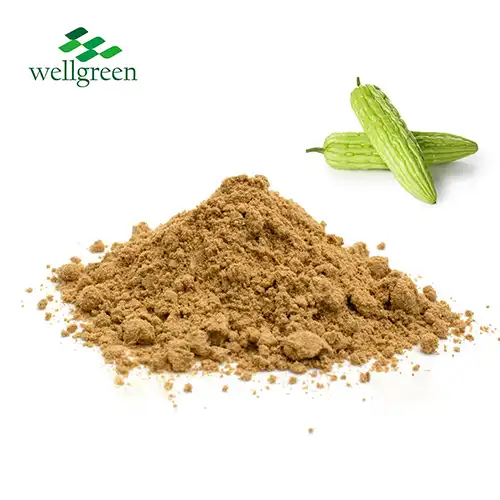
Sourcing Bitter Melon Extract Powder in bulk is a specification problem before it is a price problem. The ingredient arrives as a fine, yellow-brown powder milled from the fruit of Momordica charantia Linn., and the commercial documents that surround it — the specification sheet, the certificate of analysis (COA), the purchase order and the inbound release record — decide whether two shipments behave like the same material. Wellgreen publishes the specification and COA line items for its Bitter Melon Extract Powder, and that published sheet is a practical model for the questions below.
This article is written for procurement and quality-assurance teams. It sets out what a bulk specification has to pin down, the contaminant panel and paperwork a food-grade botanical requires, the questions that actually separate one supplier from another, the commercial terms worth fixing in the purchase order, and an incoming-lot release workflow that runs again on every delivery. How the powder is combined into a finished capsule, sachet or blend is deliberately out of scope; the focus here is the buy.
What the Specification Has to Pin Down
The first screen on any quote is the specification sheet. A sheet that names a product and a price but no marker, no method and no physical parameters cannot be compared with anything else. Six areas do the real work, and each of them should be evidenced on paper rather than assumed at the quotation stage.
The marker — and the method behind it
A specification only means something when it names both a characterisation basis and the analytical method used to measure it. Assay figures are commonly quoted by HPLC or UV, with identity confirmed by TLC or HPTLC fingerprinting. Wellgreen's published sheet for Bitter Melon Extract Powder, for instance, lists saponins at 10% with the method stated as “UV/TLC/HPLC”, alongside an extract specification of 10–20% bitter gourd extract. Buyers should establish whether the headline figure is a single marker compound or a class total such as total saponins, because the two are not interchangeable and a quote built on one cannot be compared to a quote built on the other. It is equally important to ask for the chromatographic conditions and the reference standard behind the number, not just the number itself.
Extract ratio and standardisation are different commercial claims
Two phrases dominate bulk botanical pricing, and they answer different questions. A ratio such as 10:1 or 20:1 states how much raw herb was processed per unit of extract; it is a statement about the process, not a guaranteed content. A standardised claim such as “10% saponins” states a measured amount of a defined marker per unit of the finished powder. Both are legitimate commercial propositions, but they are not substitutes. A ratio product can drift in marker content from lot to lot while the ratio itself stays the same. When two quotes use different bases, convert both to a common footing — content of the declared marker per kilogram, stated on a defined moisture basis — before any price comparison is meaningful.
Plant part, particle size, moisture and density
The used plant part must be declared; for this material it is the fruit. Physical parameters then drive how the powder behaves in handling and blending. Particle size is usually stated as a mesh or sieve pass, and the published COA for Wellgreen's material records 95% passing 80 mesh. Moisture matters because free water accelerates caking and chemical change, so loss on drying and, where available, water activity should both be specified; the same sheet caps loss on drying at ≤5.0% and ash at ≤8.0%. Bulk and tapped density should be reported with the method used to measure them, because they determine how a powder fills a scoop, a filling line or a drum. Colour and odour are also worth writing down as an agreed organoleptic reference, since a shift in appearance is often the first visible sign that a process has changed.
Carriers and anti-caking declarations
If the powder is a standardised extract carried on a diluent, or contains a free-flow or anti-caking aid, both must be declared by identity and level rather than left implicit in the word “extract”. Buyers should also ask whether the declared assay is expressed on an “as-is” basis or corrected to a dried, carrier-free basis. The difference can move the effective marker content appreciably, and it is one of the most common reasons two COAs that look alike do not describe equivalent material. Where a carrier is a declared component in its own right, request its specification and allergen status as a separate document, because the finished powder's declaration is only as reliable as the components behind it.
| Parameter | What to require on the specification | Why it matters |
|---|---|---|
| Characterisation basis | Named marker or class total (e.g. saponins), plus the assay basis (as-is vs dried/carrier-free) | Makes otherwise unequal quotes comparable |
| Analytical method | HPLC or UV for assay; TLC or HPTLC for identity | Confirms the figure is measured, not estimated |
| Extract ratio | Any ratio used as a selling basis (e.g. 10:1) | Describes the process, not potency |
| Used plant part | Fruit (Momordica charantia Linn.) | Identity and batch consistency |
| Particle size | Mesh or sieve pass (e.g. 95% through 80 mesh) | Flow, blending and behaviour in the buyer's own process |
| Moisture | Loss on drying (e.g. ≤5.0%) and water activity where reported | Caking, microbial risk and shelf life |
| Ash | Total ash limit (e.g. ≤8.0%) | Mineral and foreign-matter load |
| Density | Bulk and tapped density, with the method named | Fill volumes, packaging and transport |
| Carrier / flow aid | Identity and level of any carrier or anti-caking additive | Label declaration and effective marker content |
The Contaminant Panel and Documentation for a Food-Grade Botanical
A food-grade botanical is only as sound as the panel behind it. For a US or EU buyer the irreducible minimum is heavy metals, microbiology, pesticide residues and — for extracts — residual solvents, with allergen, gluten and other declarations completing the dossier. Every line should name its method of analysis and its limit basis, and it should be traceable to the lot being bought.
- Heavy metals. Lead, arsenic, cadmium and mercury should each carry an individual limit, measured by a method such as ICP-MS. The published COA for this material records total heavy metals <10 ppm, with Pb, As, Hg and Cd each <1 ppm.
- Microbiology. Total plate count, total yeast and mould, and the absence of specified pathogens. The same sheet lists total microbial count ≤1000 cfu/g, yeast and mould ≤100 cfu/g, and E. coli, Salmonella and Staphylococcus negative.
- Pesticide residues. A multi-residue screen by GC-MS/MS and LC-MS/MS, judged against the maximum residue limits of the destination market.
- Residual solvents. For solvent-extracted material, the solvents used and their limits should be declared, never assumed.
- Allergen, gluten and related statements. Allergen and gluten declarations, plus non-GMO or BSE/TSE statements where the buyer's market requires them.
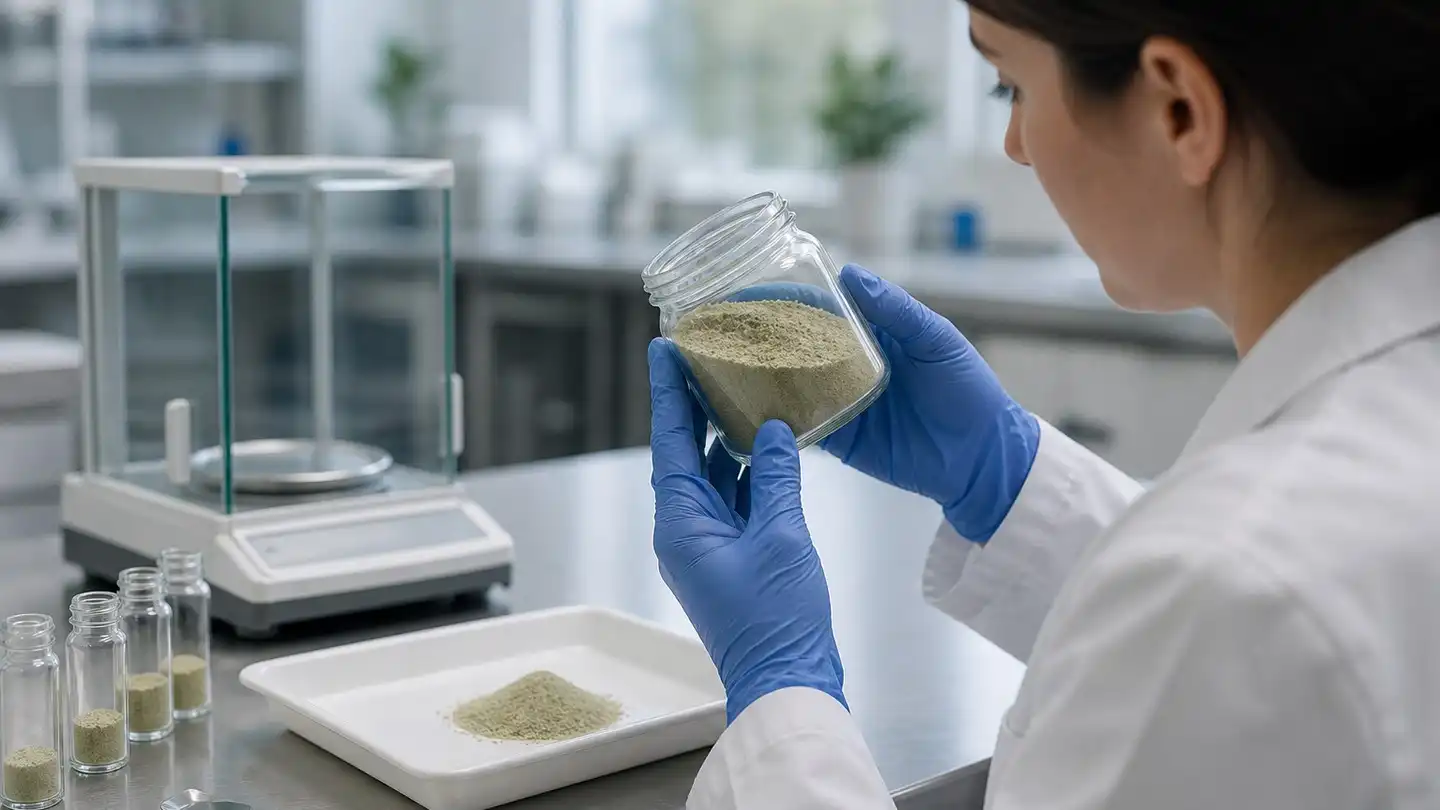
- COA discipline. A COA should carry the product name, lot number, item, specification, result and method line by line, with a conclusion and a date of manufacture; a retained or reserve sample from the same lot should be held for the agreed period.
| Document | Must contain | Applies when |
|---|---|---|
| Specification sheet | Marker, limits, methods and physical parameters | Always |
| Certificate of analysis | Item, specification, result and method per line, plus lot number | Always |
| Method-of-analysis statement | Instrument, conditions and reference standard used | Always for assay and identity |
| Heavy-metals report | Individual Pb, As, Cd and Hg results | Always |
| Microbiological report | Counts and pathogen absence | Always |
| Pesticide-residue report | Multi-residue screen against market MRLs | Always |
| Residual-solvent report | Solvents used and measured levels | Solvent-extracted material |
| Allergen / gluten statement | Declared presence or absence | Always |
| Retained-sample record | Lot number, quantity and retention period | Always |
Supplier Evaluation That Actually Discriminates
Price and a headline assay narrow the field, but they rarely separate a reliable supplier from an unreliable one. Three questions do more work than the rest.
Comparing two quotes that use different assay bases
The most common false comparison is a ratio quote set against a standardised quote. Normalise both to marker content per kilogram on a stated moisture basis, then add the cost of any testing the buyer will repeat on arrival. A quote that is cheap per kilogram but carries a lower and less well-defined marker content is not cheap. It also pays to ask what the supplier's internal release limits are, not just the customer-facing specification: a producer who tests to a tighter internal window has more room to absorb normal process variation before it ships material outside the agreed specification. The same discipline that governs how buyers select reliable bulk Boswellia serrata extract suppliers applies to this ingredient.
Sample-to-production consistency and change control
A sample is only evidence if it comes from the process that will make the production lot. Ask how the sample was drawn, from which batch, and whether it reflects routine production rather than a hand-made pilot batch. Then ask, in writing, how the supplier handles change: what triggers a change-control notification, how much notice the buyer receives, and whether a change in raw-material origin, extraction conditions or analytical method is disclosed before shipment. A supplier who cannot answer this in a document is a supplier who will surprise the buyer later.
Traceability from raw-material lot to finished lot
Traceability is what makes a future investigation possible. The buyer should be able to follow a finished lot number backwards to the raw-material lot, the harvest or sourcing region and the date of extraction, and forwards to the shipment documents. Ask for a worked example: take one finished lot number and request the record that links it to its raw material. A supplier who can produce that record on request is materially different from one who can only confirm that traceability “exists”. Documented traceability also underpins the recall-scope decisions a buyer may one day have to make.
Commercial Terms Worth Fixing in the Purchase Order
The specification is an intention until the purchase order turns it into an obligation, and a clear PO also removes the ambiguity that turns a routine delivery into a commercial dispute. The PO should restate the specification and its methods, the basis of the assay and the documents that must accompany each shipment, and it should say what happens when a lot does not conform. The parameters below are worth writing down explicitly rather than leaving to a supplier's marketing sheet. Carrier and packaging choices are themselves specification issues, and the reasoning that shapes bulk MCT oil powder specifications, carriers and quality standards applies equally when a carrier or flow aid is present in a botanical powder.
| PO parameter | What to fix in writing |
|---|---|
| Specification and method | Exact marker, limits and analytical method per line item |
| Assay basis | As-is, dried or carrier-free, stated on the COA |
| Lot identification | A unique lot or batch number on every document and container |
| Pre-shipment sample | Approval of a production-representative sample before dispatch |
| Change control | A written notification period for any change to process, origin or method |
| Packaging | Food-grade inner liner and drum, with agreed net weight and labelling |
| Shelf life | Minimum remaining shelf life at delivery, and date of manufacture |
| Certificates at shipment | COA, method statements, allergen and residue reports |
| Sampling and retention | The buyer's sampling rights and a retained sample held by the supplier |
| Non-conformance | Rejection, replacement or credit remedy, and the time limit for claims |
Incoming-Lot Release: A Workflow and a Decision Table
Quality is confirmed at receipt, not at order. A repeatable release workflow turns the specification into a gate that every lot passes before it reaches production. The same habit of verifying identity, marker content and physical parameters before accepting a lot is what buyers apply when choosing a standardised Polygonum multiflorum extract, and it transfers directly to this material.
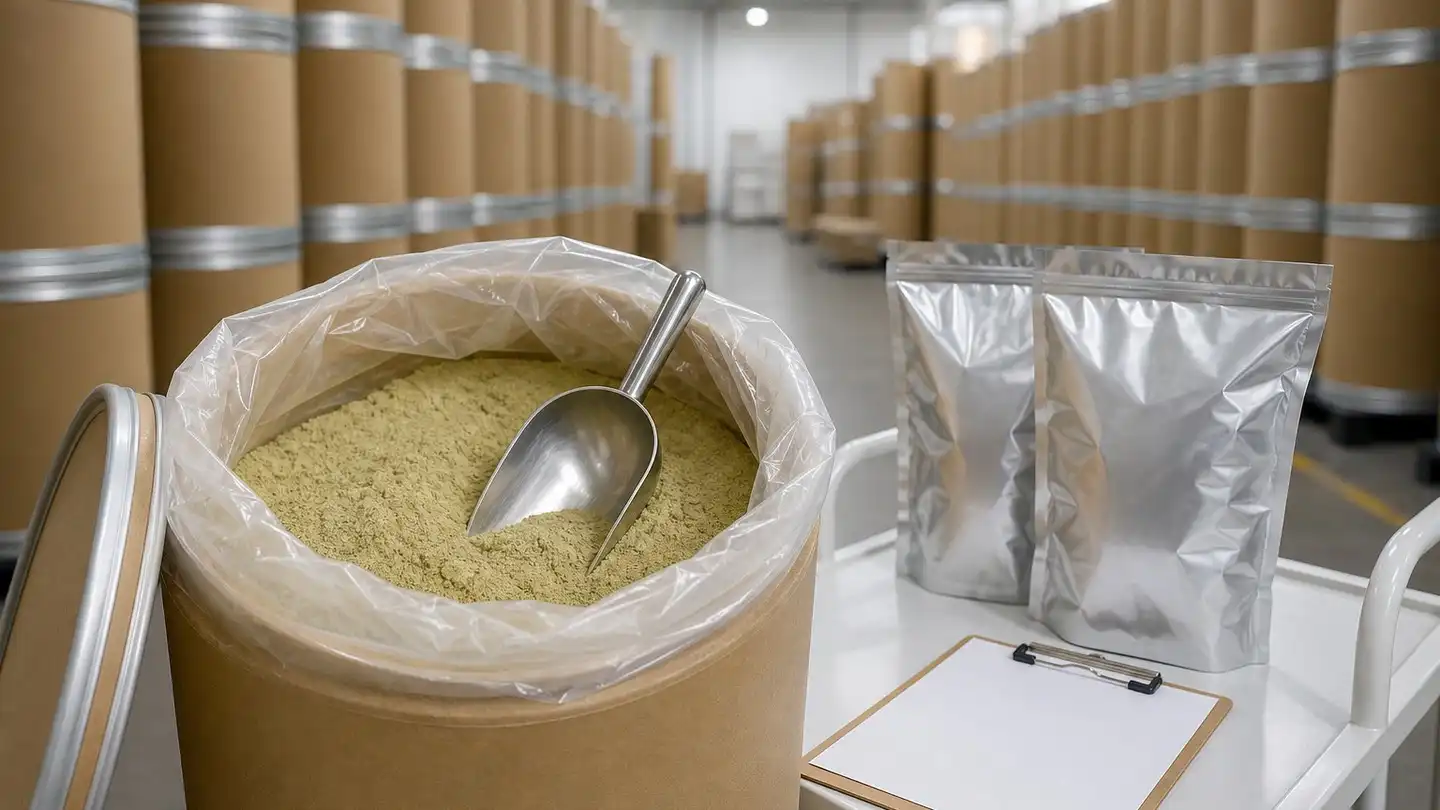
- Receiving check. Confirm drum count, seals, labelling and lot numbers against the shipping documents; inspect for damage or moisture ingress; move the lot to quarantine and record its condition.
- Document review. Compare the COA line by line with the PO specification, confirm that the methods match the contract, and check that every required certificate is present before releasing anything from quarantine.
- Sampling. Draw a representative sample against a written sampling plan, and set aside a reserve sample for the life of the lot plus the agreed retention period.
- Testing and inspection. Verify identity, marker content, particle size, moisture and density, and run or commission the contaminant panel. Identity and marker content can often be screened in-house and confirmed by a third-party laboratory.
- Disposition. Release, hold for deviation review or reject, using the decision table below. Every outcome, including a hold, is recorded against the lot number.
| Condition on arrival | Evidence | Disposition |
|---|---|---|
| Documents complete; all parameters within specification | COA matches PO; panel within limits | Release to stock |
| Minor document gap; material within specification | A certificate or report still outstanding | Hold pending document |
| Assay, particle size or moisture outside specification but within an agreed deviation | Deviation request and technical justification | Deviation review before any use |
| Heavy metals, microbiology or residues outside limits | Outside-limit result on the panel | Reject; quarantine; notify supplier |
| Identity test fails or a different material is indicated | Failed or non-matching identity result | Reject; escalate; review supplier |
| No production-representative pre-shipment sample, or an unexplained change | Missing sample record; no change-control notice | Hold and require the change-control record |
Turning the Checklist into a Purchase
For buyers ready to move from a checklist to a quote, Wellgreen supplies Bitter Melon Extract Powder to a published specification and supports sample requests and document review before a bulk order is placed. The published sheet for this ingredient lists certifications of ISO9001:2015, ISO22000, Halal, Kosher and HACCP, and the COA line items quoted above; reach the team at wgt@allwellcn.com.
This article provides technical and commercial information for industry professionals; it is not medical advice, and use levels, regulatory status and label claims must be confirmed against the target market's rules and the buyer's own product data.
References
- U.S. Food and Drug Administration. “Dietary Supplements.” https://www.fda.gov/food/dietary-supplements
- U.S. National Archives and Records Administration. 21 CFR Part 111 — Current Good Manufacturing Practice in Manufacturing, Packaging, Labeling, or Holding Operations for Dietary Supplements. Electronic Code of Federal Regulations. https://www.ecfr.gov/current/title-21/chapter-I/subchapter-B/part-111
- Lin, Y.-S., Huang, W.-Y., Ho, P.-Y., Hu, S.-Y., Lin, Y.-Y., Chen, C.-Y., Chang, M.-Y., & Huang, S.-L. (2020). Effects of Storage Time and Temperature on Antioxidants in Juice from Momordica charantia L. and Momordica charantia L. var. abbreviata Ser. Molecules, 25(16), 3614. https://doi.org/10.3390/molecules25163614
- Telomere-to-telomere genome assembly of bitter melon (Momordica charantia L. var. abbreviata Ser.). Horticulture Research (2023). https://doi.org/10.1093/hr/uhac228
- Wellgreen. Bitter Melon Extract Powder — product specification and certificate of analysis. https://www.wellgreenherb.com/standardized-extract/bitter-melon-extract-powder
- Wellgreen. How Do Manufacturers Select Reliable Bulk Boswellia Serrata Extract Suppliers? https://www.wellgreenherb.com/knowledge/how-do-manufacturers-select-reliable-bulk-boswellia-serrata-extract-suppliers
- Wellgreen. Choosing Standardized Polygonum Multiflorum Extract. https://www.wellgreenherb.com/knowledge/choosing-standardized-polygonum-multiflorum-extract
- Wellgreen. Bulk MCT Oil Powder: Specifications, Carriers, and Quality Standards. https://www.wellgreenherb.com/knowledge/bulk-mct-oil-powder-specifications-carriers-and-quality-standards