Natural Astaxanthin Powder in Aquaculture Feed: A Sourcing Guide for Bulk Buyers
2026-10-09 14:43:29
For feed mills and aquafeed formulators, Natural Astaxanthin Powder occupies an unusual place in the ingredient file: it is bought as a pigment, yet it behaves like an unstable active that has to survive everything the feed line throws at it. Sourcing it well is less about chasing the highest number on a specification sheet and more about matching a source, a delivered form and a protective package to your premix, your extrusion or pelleting regime and your storage conditions. Our own Natural Astaxanthin Powder is offered across a range of declared contents and delivery forms, and the questions below are the ones serious buyers raise before a first order. This guide is written for procurement, QA and formulation teams who must justify a lot on documents rather than marketing.
The commercial function here is pigmentation: carotenoid deposition into the flesh, epidermis and external colouration of farmed aquatic species, together with the handling properties that let a mill run a carotenoid through a premix without generating claims it cannot support.
The Source and Form Decision: Natural Versus Synthetic
Two questions dominate the first conversation with any supplier of this pigment. Where does the molecule come from, and which physical form of it are you actually buying? Both answers change the specification, the price and the processing risk.
Why Haematococcus pluvialis Is the Reference Natural Source
Natural astaxanthin for feed is produced by the green microalga Haematococcus pluvialis, which accumulates the pigment under stress conditions; a widely cited review reports accumulation of up to roughly 3.8% on a dry-weight basis (Ambati et al., 2014). The same review notes that natural sources of the molecule span algae, yeast, krill and crustacean material, while commercial supply is dominated by Haematococcus, Phaffia yeast and chemical synthesis. For a bulk buyer, "natural" is therefore a supply-chain statement rather than a synonym for a specific product.
Synthetic astaxanthin is produced by chemical synthesis and is authorised in that form for feed use. Under European Union rules the chemically synthesised substance is characterised as a solid with a minimum assay of 96% expressed as astaxanthin and a ceiling on carotenoids other than astaxanthin (Commission Implementing Regulation (EU) 2015/1415). The current EU authorisation sets a maximum content of 100 mg/kg of complete feedingstuff with 12% moisture for fish, crustaceans and ornamental fish, and caps the combined level of astaxanthin with other carotenoids and xanthophylls at the same figure. In the United States, astaxanthin is listed as a colour additive for salmonid fish feed, permitted only as a component of a stabilised colour additive mixture, with a maximum of 80 milligrams per kilogram (72 grams per ton) of finished feed (21 CFR 73.35). Those are regulatory provisions, not recommendations, and they differ by market — which is precisely why the destination market should be fixed before a specification is agreed.
Esterified Versus Free-Form, and the Stereochemistry Question
Astaxanthin exists as stereoisomers and as free and esterified forms, and the profile differs by source (Ambati et al., 2014). Haematococcus biosynthesises the (3S,3′S) isomer, whereas synthetic material comprises a mixture of (3S,3′S), (3R,3′S) and (3R,3′R). Buyers ask about esterification and stereochemistry because a declared assay can be reached by more than one route, and the form in which the pigment is presented changes both how it behaves in a premix and how it is measured. The practical consequence is that "astaxanthin, X%" is not a complete specification on its own. The isomer profile, the esterified-to-free ratio and the assay method have to be captured before one lot can be compared honestly with another.
Delivered Forms for Feed: Oleoresin, Stabilised Powder and Beadlet Grades
Suppliers deliver the same pigment in several physical forms, and the right choice follows the premix and the feed line more than it follows the label on the drum.
| Delivered form | What it is | Where it fits in the feed line | What to verify |
|---|---|---|---|
| Oleoresin / oil | Concentrated liquid pigment dispersed in a carrier oil | Oil-phase addition, fat coating, liquid premix | Declared content by HPLC, carrier oil, antioxidant, stability data |
| Stabilised powder | Pigment spread on a solid, feed-legal carrier | Dry premix blending and direct inclusion | Declared content, carrier, particle size, moisture, contaminant panel |
| Beadlet / microencapsulated | Pigment encased in a protective matrix | High-thermal-load extrusion and pelleting | Active loading, particle size, retention data at process temperature |
| Synthetic (comparison) | Chemically synthesised solid | Where the market authorisation and labelling permit | Authorisation reference, assay, non-astaxanthin carotenoids |
How Form Choice Follows the Premix and the Feed Line
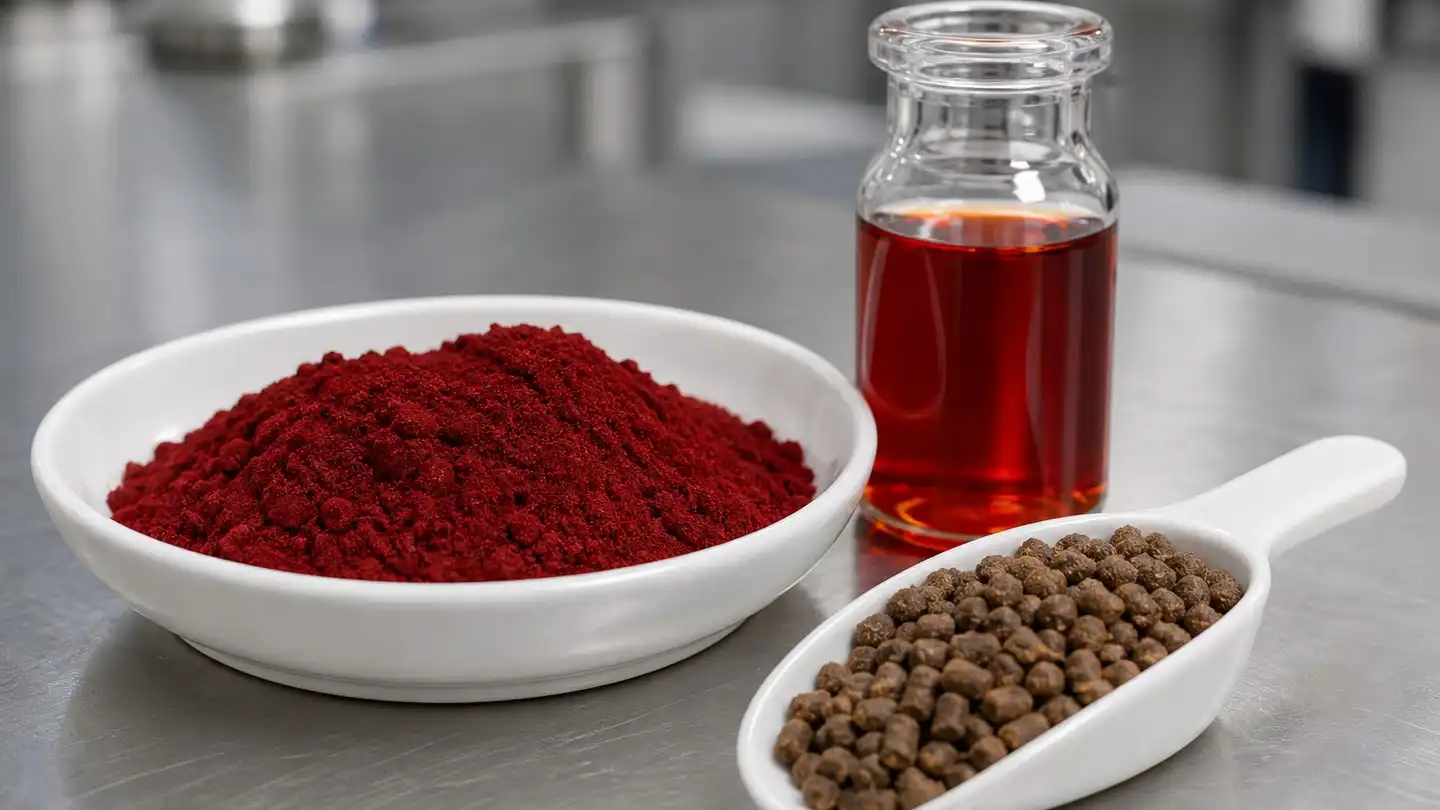
Pure astaxanthin is a crystalline, fat-soluble solid that is sensitive to oxygen, heat and light, so it is almost always supplied within a carrier or a protective matrix rather than neat. An oleoresin, typified by our astaxanthin oil grade, is a concentrated liquid that disperses readily into the oil phase of a mash or a fat coating. A stabilised powder spreads the pigment on a solid carrier and is easier to weigh and blend into a dry premix. A beadlet or microencapsulated grade encases the pigment in a protective shell intended to limit loss during thermal processing. Research on encapsulation for fish-feed applications reports encapsulation efficiencies in the 73–89% range for spray-dried and liposome-based carriers, with protection that maintained astaxanthin stability at 80 °C for up to two hours and at 100 °C for 30 minutes (Marine Drugs, 2025).
Aquafeed formulation rarely involves a single additive in isolation, so it also pays to understand how a carotenoid premix sits alongside other functional ingredients. A useful parallel is set out in our overview of the dietary applications of garlic extract in aquaculture, where the same premix, particle-size and pelleting logic is applied to a different plant-derived additive.
What Happens Down the Feed Line
The single largest technical risk with any carotenoid is cumulative exposure: thermal load during extrusion or pelleting, oxidative load at every stage, and time in storage.
Inclusion Into the Premix, Particle Size and Blending
At the inclusion rates typical of a premix, the pigment is a very small fraction of the blend, so uniformity depends on particle-size match and on a carrier that does not segregate. A powder declared as 100% passing 80 mesh blends predictably with other fine premix components, whereas a coarser or agglomerated grade can settle out and leave a heterogeneous premix. Where a liquid oleoresin is used instead, the practical questions shift to the carrier oil, its compatibility with the mash, and the uniformity of the coating step.
Thermal and Oxidative Exposure Through Extrusion, Pelleting and Storage
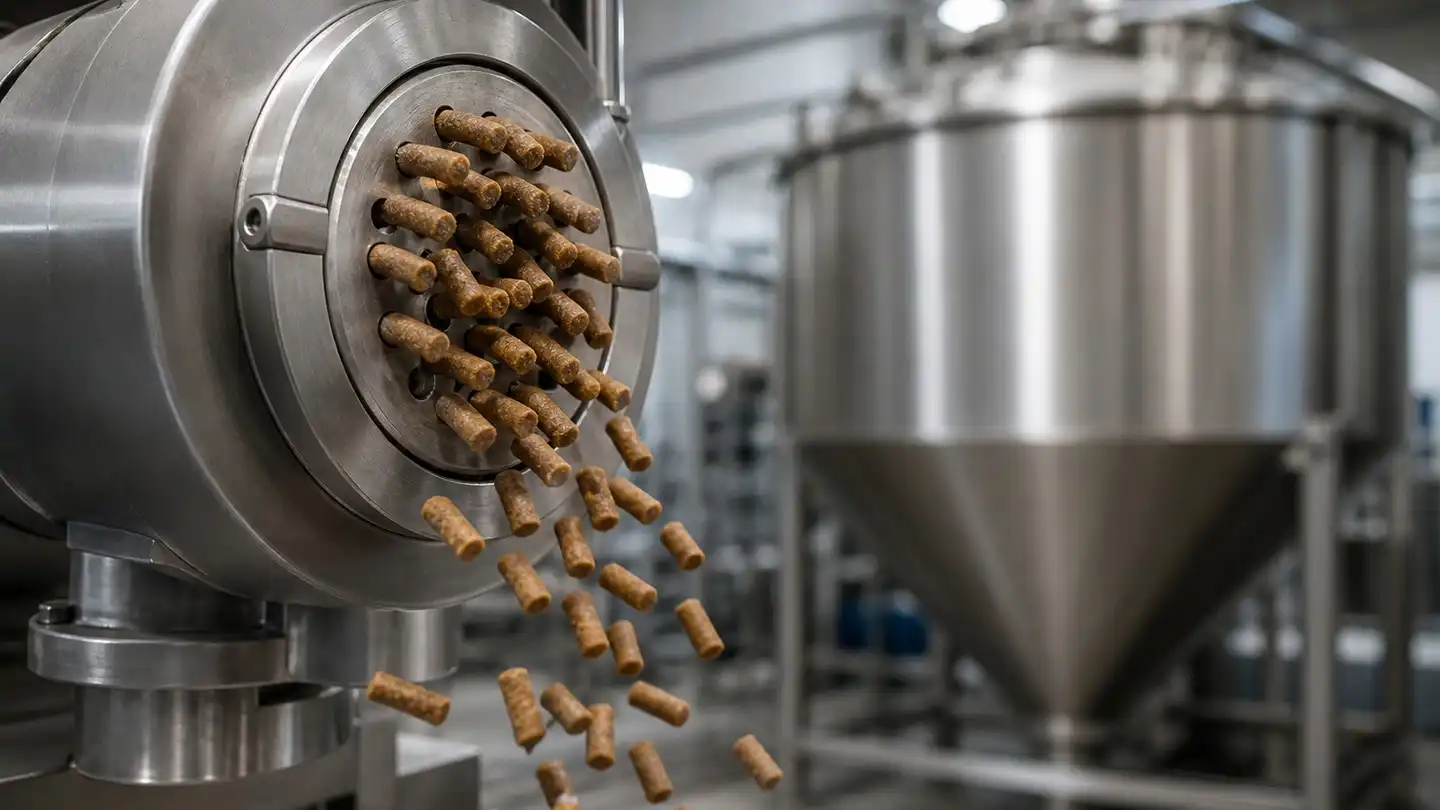
Extrusion and pelleting subject a carotenoid to heat, moisture and shear, and storage then adds light and oxygen over months. A thermal-stability study on astaxanthin in oils used as solvents in fish-food technology measured remaining pigment across a 25–180 °C range and found degradation rates that depended on both the oil and the presence of an antioxidant; soy oil retained the pigment better than sunflower oil, and butylhydroxytoluene had a statistically significant effect on the percentage of astaxanthin remaining (Calvo et al., 2020). The lesson for a mill is not one magic number but the shape of the exposure: the more thermal steps and the longer the storage, the more the delivered form and the antioxidant package matter.
| Feed-line stage | Dominant exposure | Control point to specify |
|---|---|---|
| Premix blending | Segregation, dust, non-uniform distribution | Particle-size match to the premix; carrier compatibility |
| Conditioning / extrusion | Heat, moisture, shear, oxygen | Form (beadlet / microencapsulated); retention data at process temperature |
| Pelleting | Short, high-temperature load | Antioxidant package; validated retention |
| Fat coating / oil addition | Oxidation at the pellet surface | Order of addition; antioxidant carried in the oil phase |
| Storage of additive and premix | Light, heat, oxygen, moisture | Light-blocking barrier packaging; storage instruction; shelf life |
| Storage of finished feed | Continued oxidative loss | Expiration dating; stock rotation |
Specification and COA Fields That Decide Whether a Lot Will Perform
A certificate of analysis is the buyer's only durable record of what was shipped. The fields below are the ones that most often separate a lot that performs from one that does not.
Declared Content, Assay Method, Carrier and Particle Size
The declared astaxanthin content is meaningless without the assay method. In EU feed-additive practice the substance is quantified by spectrophotometry at 431 nm in the additive preparation and by normal-phase HPLC with visible detection at 470 nm in premixtures and feedingstuffs (Commission Implementing Regulation (EU) 2015/1415). Feed-grade products are also commonly declared across the 1% to 10% range and tested by UV or HPLC, so a COA that states a method for the raw material but nothing about the premix method leaves a gap. Require the carrier and encapsulant, the particle-size distribution and the moisture content in the same document.
Oxidative-Stability Indicators and a Contaminant Panel Fit for Feed
Because the molecule degrades, stability data matter as much as the release assay. Ask for the antioxidant or stabiliser used, the packaging format it was validated in, and any accelerated-stability or retention data. For contaminants, a feed-appropriate panel covers heavy metals (lead, arsenic, mercury and cadmium), a microbiological screen and, where relevant, solvent or process residues; if the grade is sold as a premix-ready blend, confirm that the diluent itself is feed-legal.
Documentation to Request Before a First Order
Before the first purchase order, a buyer should be able to assemble a complete document set without chasing the supplier for pieces of it. That set typically includes a lot-specific COA for the actual batch, the specification sheet, the safety data sheet, the feed-additive authorisation or registration reference for the destination market, the analytical method behind each declared figure, statements on allergens and GMO status, and the batch traceability that lets you match a delivered drum back to a tested lot. On the commercial side, request the shelf-life statement and the storage conditions the supplier expects you to meet. A supplier that treats this list as routine is a different counterparty from one that treats it as an interrogation, and the same discipline is applied to other feed-grade botanicals in our guide to choosing feed-grade yucca extract powder for livestock, where it transfers directly to a carotenoid.
Packaging, Antioxidant Protection and Light or Cold-Chain Expectations
How a supplier protects the pigment in transit is part of the product, not an afterthought. Carotenoids are sensitive to light, heat and oxygen, so expect light-blocking, moisture-barrier packaging, an antioxidant package that is declared rather than implied, and a storage instruction specific about temperature and reclosure. The authorised EU entries require the stability and storage conditions to be indicated in the directions for use of the additive and premixtures, and require expiration dates for sealed and open containers to be established by recognised stability testing and carried on the label under the US colour-additive provisions (Commission Implementing Regulation (EU) 2015/1415; 21 CFR 73.35).
How Protection Choices Change the Landed-Cost Comparison
Two offers at the same price per kilogram are not the same offer. A grade that needs cold storage, carries a shorter validated shelf life, or arrives in a larger protective package brings costs that never appear on the quotation: the cold room, the shorter usable window, the higher freight per active kilogram, and the risk of a failed blend. The honest comparison is cost per kilogram of delivered, still-in-specification active pigment at the point of use, not cost per kilogram at the factory gate.
First-Order Checklist
Bring these points to the first negotiation and most of the sourcing risk is retired before a single drum ships.
- Fix the destination market first, then cite the applicable feed-additive authorisation or colour-additive listing.
- Declare the source organism and confirm natural versus synthetic in writing.
- Capture the assay method, the isomer profile and the esterified-versus-free form.
- Name the delivered form and confirm that it fits your premix and your feed line.
- Request a lot-specific COA, the specification sheet, the SDS and stability data.
- Confirm packaging, antioxidant protection and storage or reclosure instructions.
- Ask for retention or accelerated-stability data measured under your process conditions.
- Compare offers on cost per unit of delivered active, not on factory-gate price.
Source Natural Astaxanthin Powder for Feed With Wellgreen
Wellgreen supplies Natural Astaxanthin Powder derived from Haematococcus pluvialis across declared contents and delivery forms, with the documentation set described above available on request and OEM options for buyers working to their own formulation. If you are specifying a carotenoid for an aquafeed premix, speak to our team about the delivered form, the specification fields and the certificate of analysis you need — visit the Astaxanthin Powder product page or email wgt@allwellcn.com with your target market and process conditions.
This article provides technical and commercial sourcing information for feed-industry professionals and is not medical or veterinary advice; use levels, regulatory status and label claims must be confirmed against the rules of the target market and your own product data.
References
- Ambati, R. R., Phang, S. M., Ravi, S., & Aswathanarayana, R. G. (2014). Astaxanthin: Sources, Extraction, Stability, Biological Activities and Its Commercial Applications—A Review. Marine Drugs, 12(1), 128–152. https://doi.org/10.3390/md12010128 (open access: PMC3917265)
- Commission Implementing Regulation (EU) 2015/1415 of 20 August 2015 concerning the authorisation of astaxanthin as a feed additive for fish, crustaceans and ornamental fish. OJ L 220, 21.8.2015, pp. 7–10. https://eur-lex.europa.eu/eli/reg_impl/2015/1415/oj
- Commission Implementing Regulation (EU) 2020/998 of 9 July 2020 concerning the renewal of the authorisation of astaxanthin-dimethyldisuccinate as a feed additive for fish and crustaceans. OJ L 221, 10.7.2020, pp. 96–98. https://eur-lex.europa.eu/eli/reg_impl/2020/998/oj
- U.S. Food and Drug Administration. 21 CFR 73.35 — Astaxanthin (colour additive exempt from certification). Electronic Code of Federal Regulations, Title 21. https://www.ecfr.gov/current/title-21/chapter-I/subchapter-A/part-73/subpart-A/section-73.35
- EFSA Panel on Additives and Products or Substances used in Animal Feed (FEEDAP). (2014). Scientific Opinion on the safety and efficacy of synthetic astaxanthin as feed additive for salmonids, crustaceans and other fish. EFSA Journal, 12(6), 3724. https://doi.org/10.2903/j.efsa.2014.3724
- Lim, K. C., Yusoff, F. M., Shariff, M., & Kamarudin, M. S. (2018). Astaxanthin as feed supplement in aquatic animals. Reviews in Aquaculture, 10(3), 738–773. https://doi.org/10.1111/raq.12200
- Calvo, N. S., Reynoso, C. M., Resnik, S. L., Cortés-Jacinto, E., & Collins, P. A. (2020). Thermal stability of astaxanthin in oils for its use in fish food technology. Animal Feed Science and Technology, 270, 114668. https://doi.org/10.1016/j.anifeedsci.2020.114668
- Vitale, M., Gomez-Estaca, J., Chung, J., Chua, S.-C., & Pampanin, D. M. (2025). Encapsulation Techniques to Enhance Astaxanthin Utilization as Functional Feed Ingredient. Marine Drugs, 23(4), 143. https://doi.org/10.3390/md23040143 (open access: MDPI)