
What to Check Before Buying Organic Ginger Extract Powder in Bulk - Wellgreen
2026-11-25 14:00:00
Bulk buying of a standardized botanical is a different discipline from buying a commodity powder. The unit price is negotiated against a number that may be an extract ratio, a marker content or a specification band, and the material that arrives has to be checked against the basis on which the price was agreed. For organic ginger extract powder, the whole purchasing decision turns on getting that basis explicit before the order, then verifying it cheaply on receipt.
Ordering the First Bulk Quantity
A first bulk order is a test of the supply chain as much as of the material. Three decisions make it informative: take one production lot rather than several blended together, ask for the production record of that lot, and buy enough to run a full incoming inspection plus a formulation trial without exhausting the consignment. A quantity that only covers the trial means the second order is placed before the first has been fully evaluated.
It also helps to state the acceptance criteria with the enquiry rather than after the quotation. Suppliers who can meet a marker range and a documentation list will quote against it; suppliers who cannot will either decline or reveal the gap early, which is useful information at no cost.
Two Numbers Set the Price Basis
Ginger extracts are sold either on extract ratio or on marker content, and occasionally on both. A ratio describes how much rhizome went into the extraction; a marker content describes what the resulting powder contains, usually expressed against gingerols or total pungent compounds.
Only the second number tells a buyer what a kilogram will do in a formulation. The first is a processing descriptor, and it is compatible with a wide range of actual strengths. When a quotation leads with a ratio and has no marker figure, the conversation has not yet reached the point where prices can be compared.
Extract Ratio Is Not a Strength
Why ratios vary between suppliers
Extraction solvent, temperature, time and the starting rhizome all change the yield, so two suppliers can both describe 10:1 while producing materially different marker contents. Some apply the ratio to dried rhizome, others to fresh; some calculate it on the extract before carrier addition, others after.
What to ask for instead
Ask for the marker content with the analytical method, the basis (as-is or dry), and the carrier proportion. A supplier who can answer all three is describing a product; one who cannot is describing a process. The chemistry involved in the extraction and in the marker assay is set out in this note on extracting gingerol from ginger.
What "Bulk" Changes
Bulk does not only mean a larger quantity. It changes the sampling problem, the packaging problem and the homogeneity problem at the same time.
| Change | Consequence | What to agree in advance |
|---|---|---|
| Larger lot | A small sample no longer represents the delivery | Sampling plan with incremental samples per unit |
| Longer storage | Moisture ingress and caking over months | Packaging specification and rotation rule |
| Blending across runs | Marker content averages out, but a single drum may not | Statement of blend proportions per lot |
| Freight handling | Bag damage, pallet compression | Packaging grade and pallet configuration |
| Payment size | Errors cost more to unwind | Inspection and acceptance clause before balance payment |
Receipt Screening: Three Cheap Tests
Marker content by assay
The primary check is the marker assay, either in-house or at a contract laboratory. Compare the result with the agreed figure, and record the difference rather than a pass or fail. A consistent shortfall of a few percent is a commercial issue; a single large shortfall is a supply issue.
Microscopy and simple staining
Ginger extract is sometimes extended with starch, maltodextrin or a cheaper root powder. A microscope with an iodine stain shows starch granules immediately, and it takes minutes. It is not a quantitative method, but it is a fast screen that tells the analyst whether a full investigation is warranted.
Solubility and colour in a standard dispersion
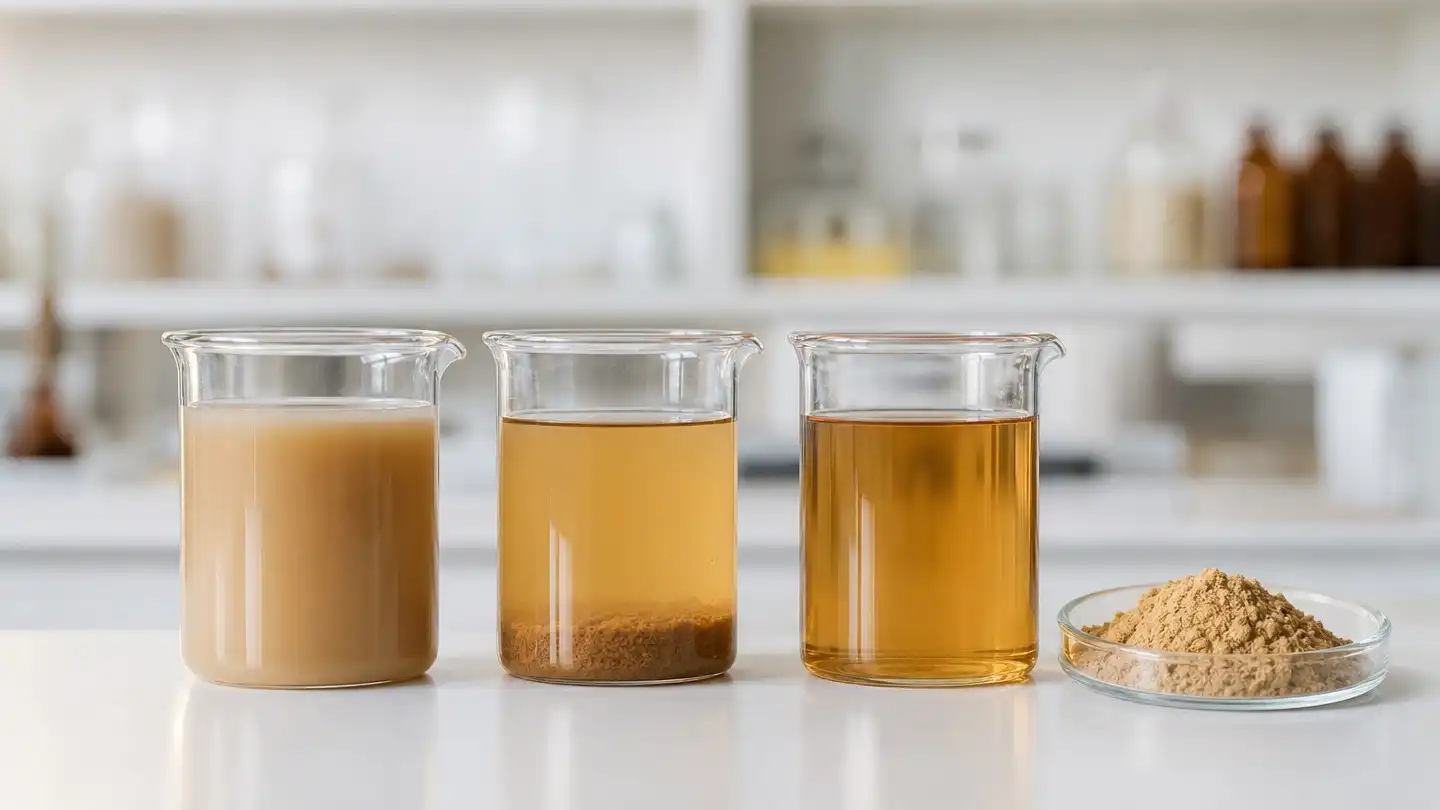
Disperse the powder at a fixed concentration in water and compare the colour, the sediment and the clarity with a retained standard. A material extended with a carrier usually looks paler and settles differently, and the comparison is more sensitive than a visual check of dry powder.
What a small shortfall is worth
A marker result a few percent below the declared figure is common and usually inside method repeatability. The correct response is not a rejection but a calculation: multiply the shortfall by the dose and by the annual volume to see what it costs. Where the number is material, renegotiate the basis or ask for the marker range to be narrowed; where it is not, record it and keep the relationship. Buyers who reject on a rounding difference spend their credibility on the wrong argument.
Documents Before the Deposit
The dossier for a bulk order is short but specific: specification with markers and methods, lot certificate for the material on offer, organic certificate with processing scope, transaction certificate on shipment, heavy metal and residue reports, microbiological results, allergen and carrier declaration, and the packaging specification.
Where the material is offered as an organic extract, the same three-document logic applies as for any organic input: certificate scope, transaction certificate, and evidence of separation from conventional material. The frameworks a supplier operates inside are listed on the quality and accreditation page.
One further commercial point is worth settling before the order: whether the price holds for a second consignment produced from the same raw material campaign. Extracts made from a different harvest can move inside the specification band, so a buyer who validates a formulation against one campaign and then receives the next at the other edge of the band will see a sensory difference without an analytical failure. Agreeing a narrower internal target, distinct from the published specification range, is a practical way to keep a formulation stable across campaigns.
Packaging That Survives the Warehouse
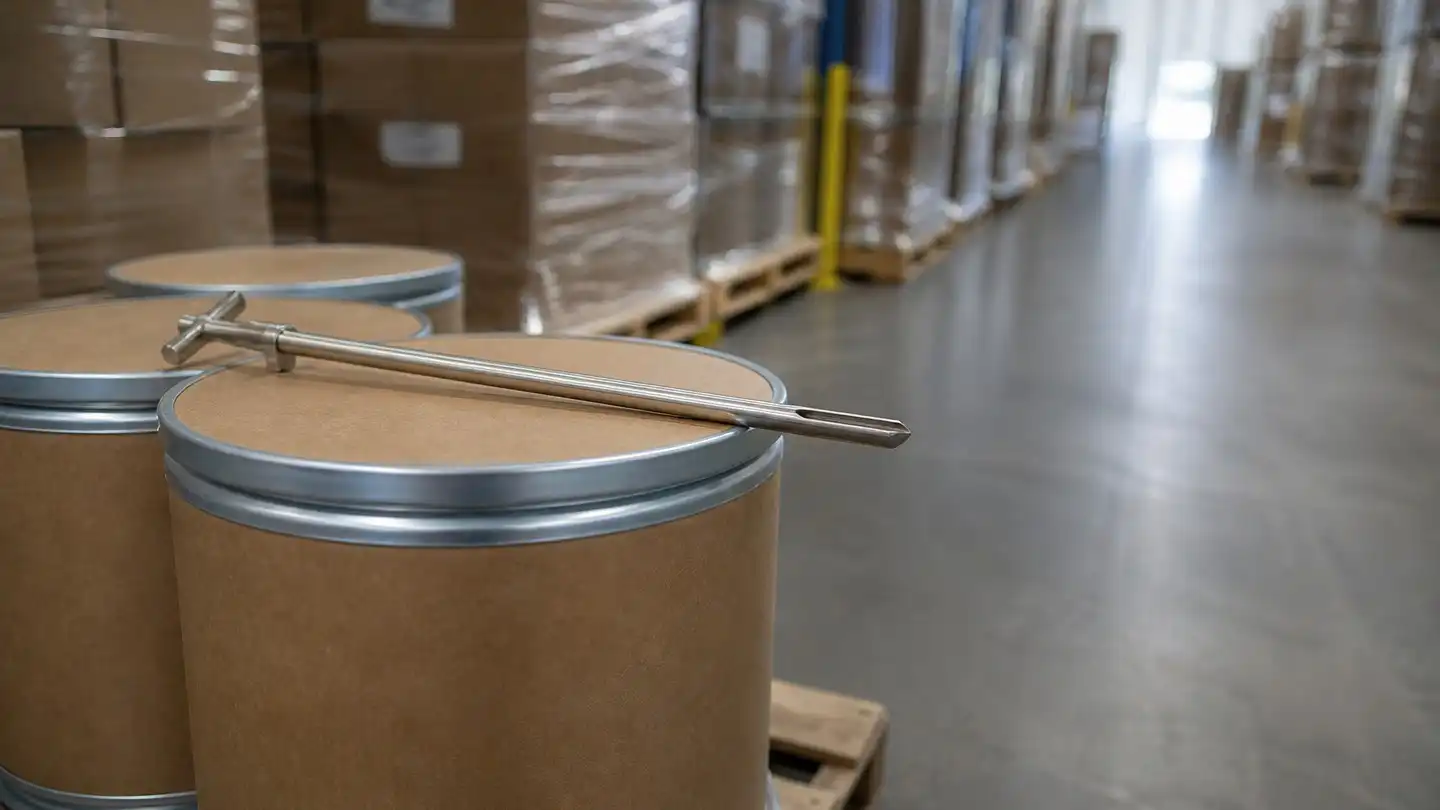
Extract powders are hygroscopic and prone to caking under pressure. A fibre drum with a double polyethylene liner is standard for good reason; a bag-in-box is not equivalent for a six-month storage period.
Ask for the liner thickness and the closure method, and for the net weight tolerance. Where the product will be decanted into smaller units, ask whether the supplier can pack to the intermediate size, because every decanting step is an opportunity for moisture ingress and cross-contamination.
Another failure worth designing out is the one caused by decanting. A drum opened three times in a humid room will pick up moisture at the surface, and the material at the top of the drum will behave differently from the material at the bottom when the next production run starts. Using the full drum in one campaign, or transferring to a sealed intermediate container under controlled conditions, avoids a variability that has nothing to do with the supplier.
Contract Clauses Worth Insisting On
- The specification as an annex, with methods and release criteria
- Marker content expressed on a stated basis, with the carrier proportion declared
- Sampling plan and the consequence of a failed incoming result
- Notice period for change of raw material origin, carrier or extraction route
- Organic documentation list per shipment
- Packaging specification and net weight tolerance
- Shelf life at delivery, and the storage conditions that support it
Two of these clauses do most of the work. A change-notification clause removes the situation where a formulation validated on one grade quietly stops working, and an acceptance clause gives an incoming failure a defined outcome rather than a negotiation.
When the Sample and the Lot Differ
It happens more often than suppliers admit: a pre-shipment sample is drawn from a small, carefully prepared batch, and the production lot is blended to hit the specification. The difference is usually inside tolerance and occasionally outside it.
The control is to compare the incoming lot with the retained pre-shipment sample using the same method on the same day. Where the two differ beyond the method's repeatability, ask for the production record of the lot and the blend proportions. Where the answer is unsatisfactory, the acceptance clause decides what happens next, which is why it belongs in the agreement rather than in an email.
Specification Items and What They Predict
| Item | What it predicts | Verification |
|---|---|---|
| Marker content (gingerols) | Dose required in the finished product | HPLC against a stated method, as-is or dry basis |
| Extract ratio | Processing descriptor only | Present, never the sole figure |
| Carrier identity and proportion | Label declaration and dose arithmetic | Declared per lot |
| Moisture and water activity | Caking and marker stability in storage | Loss on drying per lot |
| Particle size | Blend uniformity and dispersion | Sieve cut or distribution |
| Microbiological limits | Release for the intended application | Plate count, yeast and mould, pathogen screen |
| Heavy metals and residues | Market eligibility | Accredited laboratory report per lot |
For buyers working towards a beverage or a powder blend, the dispersion behaviour described in this note on bulk extracts for beverage formulation is the relevant complement to the chemical specification, and the grade definitions in this product overview of ginger extract powder show how marker levels are presented commercially.
Finally, keep the retained sample of every accepted lot for as long as the finished product made from it can remain on the market. When a customer question arrives eighteen months later, the retained sample is the only object that can answer it, and a retention policy written before the first order is much cheaper than reconstructing one afterwards.
Conclusion
Buying organic ginger extract in bulk comes down to agreeing a marker basis, verifying it cheaply on receipt, and writing the consequences into the contract before the deposit. A supplier who can state the marker content, the method, the basis and the carrier proportion is a supplier whose price means something; the rest is a ratio and a hope.
If you are placing a first bulk order and want the marker basis fixed in writing, send the target marker level, the dosage form and the destination market to wgt@allwellcn.com. The technical team can provide the specification with methods, a lot certificate on the agreed basis and samples from consecutive production runs for a retention comparison.
References
- International Organization for Standardization. ISO 6571 — Spices, condiments and herbs: determination of volatile oil content. 2008.
- International Organization for Standardization. ISO 3310-1 — Test sieves: technical requirements and testing. 2016.
- International Organization for Standardization. ISO 4833-1 — Microbiology of the food chain: colony count at 30 °C. 2013.
- Codex Alimentarius Commission. General Standard for Contaminants and Toxins in Food and Feed (CXS 193-1995, as amended). FAO/WHO.
- United States Department of Agriculture. National Organic Program, 7 CFR Part 205. Current edition.
- U.S. Food and Drug Administration. 21 CFR Part 101 — Food Labeling; ingredient declaration. Current edition.
This article is intended for business-to-business ingredient sourcing and formulation discussion. It does not provide medical, nutritional, or regulatory advice for any specific product or market.