
What Buyers Should Check Before Sourcing Barley Grass Powder - Wellgreen
2026-11-24 14:00:00
A quotation for barley grass powder is a statement about a material and, in practice, a statement about a supply chain. The two are not the same, and the gap between them is where most sourcing problems live: the powder is what the certificate says it is, and the organic claim behind it cannot be reconstructed six months later. The checklist below is written for the buyer who is about to place a first or second order for organic barley grass powder and needs to know which documents to demand before the deposit, not after the shipment.
A Supplier Check Is Not a Product Check
Most buyers begin with a sample. That is the right instinct for flavour and colour, and the wrong one for compliance, because a sample proves a material exists while a dossier proves a supply chain can reproduce it. The two questions are separate: what is this powder, and who can certify that the next twenty tonnes will be the same powder from the same certified operation.
This note covers the second question. The technical selection work — particle cut, colour after a heat challenge, dispersion in a beverage base — sits on top of it and is a different exercise.
What the First Conversation Should Establish
Before samples are shipped, four facts should be settled: who the certified operator is, which processing steps that operator covers, how much certified material the supplier can commit to in the next two quarters, and what happens if a lot fails your incoming test. Each answer is short, and each one removes a category of risk that would otherwise be discovered after the money has moved.
A supplier who answers all four without hesitation is usually a producer. A supplier who deflects two of them is usually a trader, which is not disqualifying — but it changes what the buyer has to verify independently, and it changes the price a buyer should be willing to pay for certainty.
Harvest Stage: Turning a Claim Into a Record
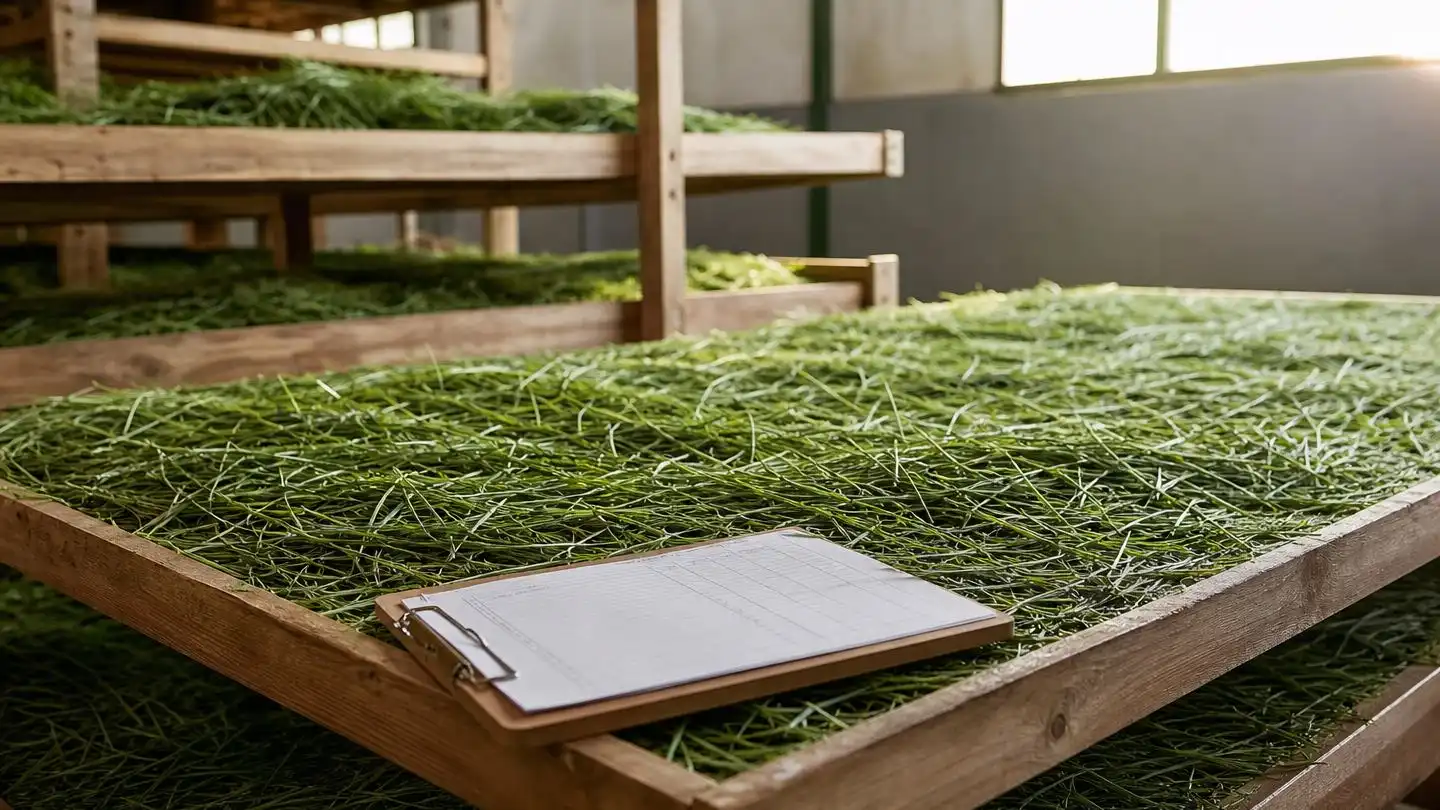
Barley grass is cut at a stage that determines its colour, its fibre and its flavour. Suppliers describe this as young shoots, first cut, or pre-jointing. Those phrases are marketing unless they are tied to a record: a cutting date, a field identifier, and a documented interval from sowing.
Ask for the harvest window in writing and compare it with the sowing date on the farm record. A supplier who can name the field and the week is describing a real product; one who answers with an adjective is describing a category.
Organic Status: Three Documents, Not One
The certificate and its scope
An organic certificate names an operator and a scope. Read the scope line by line: it should cover the crop, and it should cover the drying and milling steps, or name the certified subcontractor that performs them. A certificate covering cultivation only leaves the processing steps outside the certified chain.
The transaction certificate
A transaction certificate, issued against a specific consignment, links the goods to the certified operator. This is the document that turns a general claim into a statement about the material in the container. Without it, a buyer is relying on the supplier's assertion that the certified material is the material that shipped.
Mass balance and separation
Where a supplier handles both organic and conventional barley grass, ask how the two are kept apart: dedicated lines, dedicated storage, or a documented clean-down with records. The answer determines whether a mixed campaign can contaminate an organic lot, and it is a question an auditor will also ask.
Processing Temperature: Ask for the Record
Drying temperature affects colour and aroma more than any other processing variable, and it is routinely described rather than documented. A low-temperature claim without a batch record is a sales statement.
What to request: the drying method, the inlet and outlet temperature range recorded during the run, and the batch number the record belongs to. A supplier who can produce that for a recent lot is operating a controlled process. One who cannot may still be producing good material, but the buyer has no way to know whether the next lot will match.
Heavy Metals and Residues: Reading the Report
A laboratory report is only useful when the buyer can tell what was tested, on what sample, by what method. The common failure is a certificate quoting lead and arsenic with no method, no limit basis and no lot number.
| Document element | What a buyer should see | Red flag |
|---|---|---|
| Sample identity | Lot or batch number matching the offered material | No lot reference, or a reference that does not match the COA |
| Laboratory | Named laboratory with accreditation for the method | Unnamed "third-party lab" |
| Methods | Technique stated for each analyte (for example ICP-MS for metals) | Analytes listed with no method |
| Limits | Limits stated against a named standard or the buyer's own specification | Results with no limit to compare against |
| Pesticide scope | Multi-residue panel with the number of compounds stated | "Pesticide free" with no panel |
| Date | Test date inside the period agreed for the lot | Report dated to a different campaign |
Residue testing matters even for certified organic material, because the test verifies the claim rather than repeating it. A panel that covers the compounds used on neighbouring crops is more informative than one that covers a generic list.
Why the test date matters as much as the result
A residue report describes the sample that was drawn on the day it was drawn. Where material is stored for a season, a report from the previous campaign describes a different batch of leaf. Ask for the test date and compare it with the production date of the lot; a gap of more than a few weeks deserves a question, and a report dated before the harvest that produced the lot deserves a rejection.
Batch Records and Lot Coding
Traceability depends on a code that appears in three places: on the bag, on the certificate of analysis, and in the supplier's production record. Ask to see one complete example before ordering, and check that the three references line up.
Where a lot is blended from several production runs, the record should show the proportions. Blending is normal; invisible blending is not, because it makes a performance question impossible to investigate later.
Price, Origin and the Cost of Certainty
Two quotations for the same nominal grade usually differ for one of four reasons: the drying route, the harvest stage, the certification status of the processing step, or the amount of documentation the supplier is willing to produce. Only the first three are visible in the material. The fourth is invisible until a customer audit, which is why the cheapest offer is often the most expensive once the missing document has to be obtained from someone else.
A practical way to price the difference is to cost the work of replacing the missing evidence: an independent residue panel, a separate heavy metal test, a transaction certificate chase. Those costs are small per consignment and large per launch, because a launch does not wait for a document.
Allergen, Additive and Carrier Declarations
Pure dried leaf powder should carry a short declaration. Where a carrier, anti-caking agent or flow aid is present, it must be named and quantified, because it changes both the label and the dose arithmetic. Ask for the declaration per lot rather than once per year, since formulations change quietly.
The same applies to any processing aid used during milling. A statement that no additives are present is stronger than a statement that the product is natural, and only the first can be checked.
Packaging, Storage and Shelf Life Evidence
Shelf life is a claim with a basis. Ask what the shelf life is based on — real-time data, accelerated data, or an assumption carried over from a similar product — and in which packaging the study was run. A drum study does not cover a sachet.
Storage instructions should be specific enough to be actionable: a temperature range, a humidity limit and a statement about light. Where the product is hygroscopic in practice, the packaging specification matters as much as the storage instruction, and the moisture vapour transmission rate of the liner belongs in the agreement.
Two smaller documents are worth requesting as well. The first is a specification sheet signed and dated, since versions of the same sheet circulate with different limits. The second is a statement of the manufacturing site, because a certificate issued to a head office address tells the buyer nothing about where the material was milled.
Red Flags in a Quotation
| What the quotation says | Why it is a warning sign | What to ask instead |
|---|---|---|
| A price well below the market range | Usually a different grade, a different harvest, or a different drying route | Which lot, which drying method, which certificate |
| "Certified organic" with no certificate attached | The claim cannot be verified before payment | Certificate with scope, plus transaction certificate on shipment |
| Specification written as adjectives | Nothing in it can be tested or enforced | Values with methods and release criteria |
| Lead time shorter than the drying cycle | Suggests stock of unknown age or origin | Production date of the lot offered |
| No answer on change notification | Future changes will arrive without warning | A written clause covering origin, cut and processing |
An Order-Ready Checklist
- Organic certificate with the processing scope named
- Transaction certificate for the specific consignment
- Harvest window and field reference
- Drying method with recorded temperature range for the lot
- Lot certificate of analysis with methods
- Heavy metal and multi-residue reports from an accredited laboratory
- Microbiological results with sampling plan
- Allergen, additive and carrier declaration
- Packaging specification and shelf-life basis
- Change-notification clause in the supply agreement
The application side of this material — how it behaves in blends and finished products — is covered in this note on barley grass in green superfood blends, and the private-label route in this overview of OEM solutions for barley grass products. Where the material is destined for a beverage, the dispersion questions in this note on powder suitability for beverage applications apply directly.
Conclusion
Buying barley grass powder safely is mostly a documentation exercise carried out before the first payment. Harvest records, certification with processing scope, transaction certificates, drying records and lot-linked laboratory reports are what turn a supplier's description into something a buyer can rely on — and what make the technical selection work meaningful once it starts.
Barley is also used in other forms in the same category, such as barley malt extract powder for body and colour, and the document discipline is identical whichever form is specified. The management systems and certification scope behind a supplier are listed on the quality and accreditation page.
If you are preparing a first order and want the dossier before the deposit, send the target market, the organic scheme required and the application to wgt@allwellcn.com. The technical team can provide the certificate with scope, a specimen transaction certificate, lot-linked residue and heavy metal reports and the drying record for the lot on offer.
References
- United States Department of Agriculture. National Organic Program, 7 CFR Part 205. Current edition.
- Codex Alimentarius Commission. General Standard for Contaminants and Toxins in Food and Feed (CXS 193-1995, as amended). FAO/WHO.
- International Organization for Standardization. ISO 4833-1 — Microbiology of the food chain: colony count at 30 °C. 2013.
- International Organization for Standardization. ISO 21527-1 — Microbiology of food and animal feeding stuffs: enumeration of yeasts and moulds. 2008.
- U.S. Food and Drug Administration. 21 CFR Part 101 — Food Labeling; ingredient and allergen declaration. Current edition.
- Codex Alimentarius Commission. Guidelines for the Production, Processing, Labelling and Marketing of Organically Produced Foods (CXG 32-1999). FAO/WHO.
This article is intended for business-to-business ingredient sourcing and formulation discussion. It does not provide medical, nutritional, or regulatory advice for any specific product or market.