
How Extraction Methods Affect Broccoli Seed Extract Quality
2026-11-04 09:34:13
Two broccoli seed powders can carry the same declared assay and still behave like different raw materials on your line. The gap usually sits upstream of the certificate of analysis, in the extraction method: solvent, thermal history, the moment myrosinase is switched off, drying route and carrier decide how much glucoraphanin survives, how much has already converted to sulforaphane, and what else travels into the drum. This article maps that chain for R&D, QA and procurement teams qualifying a standardized broccoli seed extract.
Why the Method Outranks the Label
A specification sheet is an output, not a cause. Several routes can land on the same headline percentage in one lot and still not deliver the same material: one holds the glucosinolate intact, another converts part and declares the residue, a third concentrates a dilute stream and dilutes it back with carrier.
A comparison built only on that figure is not a comparison: before price, ask what is measured, how, and what the process did before sampling.
Glucoraphanin and Sulforaphane Are Two Different Numbers
Glucoraphanin is the intact glucosinolate stored in the seed: a glucose and a sulfate attached to a methylsulfinylbutyl chain. It is polar, water-soluble and reasonably stable in a dry matrix, which is why it anchors most seed extract specifications.
Sulforaphane is the isothiocyanate released when myrosinase removes the sugar and the sulfate from that same molecule. It is smaller, more lipophilic, volatile and reactive. The relationship is stoichiometric, not proportional by mass: one molecule of glucoraphanin gives at most one molecule of sulforaphane, but the product weighs far less. A powder declared at 13.5% glucoraphanin cannot be read as a 13.5% sulforaphane powder.
The Myrosinase Trigger
In intact seed, myrosinase sits in separate cellular compartments from the glucosinolates; grinding, crushing and wetting break that separation. Once cells are ruptured and water is present, hydrolysis runs until substrate or enzyme is exhausted, the enzyme is denatured, or the water is removed. The same seed yields a glucoraphanin-rich or a sulforaphane-rich powder depending on where the process stops.
For formulation work, "myrosinase active" and "myrosinase inactive" are two products, not two grades of one. An active powder keeps changing composition once it meets water in your matrix; an inactive powder is stable but supplies no endogenous conversion capacity. Neither is superior as such; the certificate should state which you are buying.
What an HPLC Result Actually Represents
Glucoraphanin is normally quantified by HPLC after enzymatic desulfation of the extract, against an external reference standard. Sulforaphane is quantified by HPLC with UV detection, or by LC-MS/MS where lower levels or confirmation are needed.
Two results both described as "sulforaphane 1%" can mean free sulforaphane in the powder, or total sulforaphane released after a controlled in-vitro conversion. The first is a composition figure, the second a potential figure, and a specification that does not name the protocol is not enforceable.
Basis matters as much as method: as-is or dry basis, and whether the laboratory stopped myrosinase at sampling or let a wet sample stand. A slow handling step can move glucoraphanin down and sulforaphane up in the same vial. For a comparison of grades built around the converted marker, see this note on broccoli seed extract with high sulforaphane content.
| Declaration on the COA | What the assay physically counts | Main process drivers | Question for the supplier |
|---|---|---|---|
| Glucoraphanin 13.5% (HPLC) | Intact glucosinolate remaining in the powder | Inactivation timing, water contact during extraction, drying heat load, storage moisture | As-is or dry basis, and was the enzyme stopped at sampling? |
| Sulforaphane 1% (HPLC) | Free isothiocyanate present at the time of analysis | Deliberate conversion step, residual myrosinase, losses during drying | Free or total potential, and by which conversion protocol? |
| Myrosinase status | Hydrolytic capacity remaining in the finished powder | Crushing and wetting, solvent strength, thermal history | Active, inactive, or uncharacterised? |
| Appearance: light yellow to brown | Co-extractives, oxidation state, carrier and particle size | Solvent polarity, purification, drying route | Is a retained reference sample or instrument colour value supplied per lot? |
How Solvent Choice and Process Conditions Shift the Result
The solvent does two jobs at once: it dissolves the target and it sets the environment in which myrosinase operates. Water is the most selective solvent for these polar glucosinolates, but water also activates the enzyme, so an aqueous route must control the enzyme through temperature or contact time. Aqueous ethanol slows the enzyme while keeping glucosinolates in solution, at the cost of a residual solvent specification. Higher ethanol fractions pull more lipophilic material (pigments, seed oil, sterols), which changes colour and flow more than the assay.
Thermal history is the second lever, and it is usually described too loosely. A short heat step on the slurry before solids separation inactivates myrosinase and freezes the marker ratio. The same total heat delivered slowly, or delivered again at drying, keeps working on the glucosinolates. Ask where in the sequence heat is applied, not simply whether the process is "low temperature".
pH is the third. Enzyme activity and the rearrangement of the unstable aglycone are both pH dependent, and acidic conditions favour nitrile formation over the isothiocyanate. pH also drives non-enzymatic browning, so an uncontrolled pH shows in colour before any assay.
| Process route | Key parameters | Effect on glucoraphanin | Effect on sulforaphane | Procurement implication |
|---|---|---|---|---|
| Cold aqueous extraction | Low temperature, short water contact, enzyme active or partly inhibited | High retention where contact is short; risk of decline after extraction if the powder stays moist | Little formed during extraction; may increase during storage | Ask for both markers at release and on stability; confirm enzyme status in writing |
| Hot aqueous with early inactivation | Thermal step at crushing or slurry stage, before solids separation | Retention set by total heat load; over-heating reduces it | Largely suppressed; conversion stopped | Preferred where glucoraphanin is the declared marker and the customer matrix is aqueous |
| Aqueous ethanol | Ethanol-to-water ratio, contact time, solvent recovery | Good solubility; enzyme slowed but not always stopped | Low to moderate | Residual solvent panel required; colour often cleaner than a water-only route |
| High-ethanol or lipophilic fraction | High ethanol share, longer extraction | Lower glucosinolate recovery, more oil and pigment co-extracted | Low | Expect a lower assay per kilogram, higher carrier load, different colour and mouthfeel |
| Deliberate conversion step | Controlled hydration, temperature and hold time before drying | Falls by design as substrate is consumed | Rises by design and becomes the declared marker | COA must state the conversion protocol, not only the final figure |
| pH-adjusted extraction | Acid or buffer control at extraction and before drying | Acidic conditions increase loss and nitrile formation | Yield sensitive to pH; can fall sharply | Ask whether pH is controlled in-process or merely measured on the batch record |
Drying Route: Spray, Freeze-Dry and Vacuum Belt
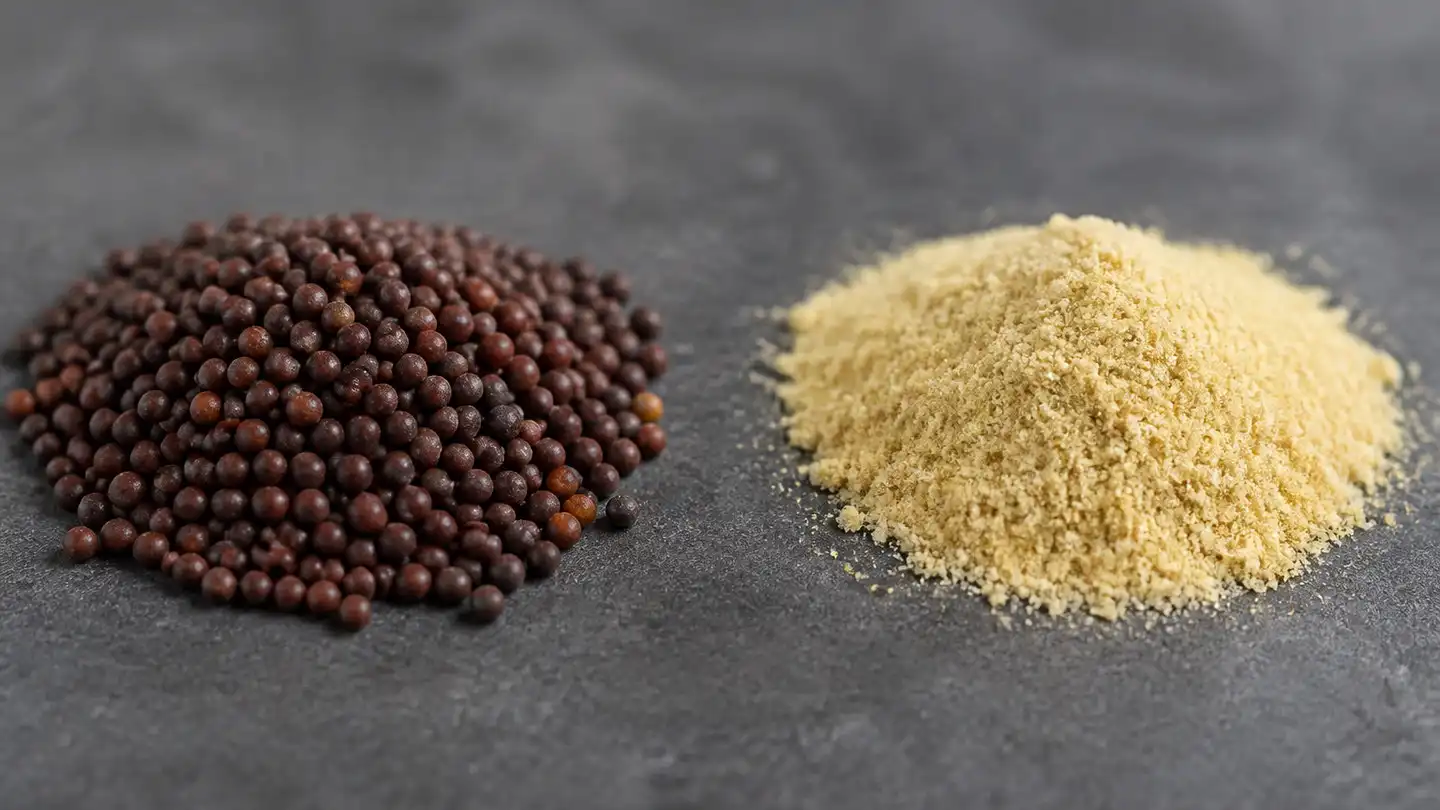
Drying is where much of the price gap between identical nominal specifications appears. A separated aqueous extract is often only a few percent solids, so it is concentrated and then dried with a carrier or as a liquid. Spray drying gives a short residence time and a free-flowing, soluble powder, but the feed needs enough solids to atomise, which usually means adding maltodextrin before the tower. That carrier is mass you pay for and do not assay.
Freeze drying removes water by sublimation at low thermal load. It preserves thermolabile markers and colour most faithfully, and leaves a light, fluffy powder that can be slow to wet out and expensive per kilogram. Vacuum belt drying sits between: low oxygen, moderate temperature, continuous output, and a denser sheet that mills to a controlled particle size.
A very light freeze-dried powder can bridge in a hopper and stall a capsule filler; a dense spray-dried powder flows well but may need more water to dissolve. Ask for bulk and tapped density plus a solubility observation in a stated medium.
| Drying route | Thermal load | Marker retention | Colour | Bulk density and flow | Solubility | Cost driver |
|---|---|---|---|---|---|---|
| Spray drying | High inlet, short residence | Moderate; surface heat and carrier dilution both act | Can darken through browning where a sugar-based carrier is used | Low to medium density, good flow | Good, fast wetting | Carrier ratio, evaporation energy, fines loss |
| Freeze drying | Low, sublimation-driven | Highest retention of thermolabile markers | Pale, close to the extract colour | Very low density, cohesive, slower flow | Slow to wet, needs a dispersion aid | Cycle time, refrigeration, throughput |
| Vacuum belt drying | Moderate, low oxygen | Good; oxidation-limited rather than heat-limited | Consistent, limited oxidation browning | Medium to high density, mills predictably | Moderate, improves with particle size control | Vacuum duty, continuous line utilisation |
Purification, Carriers and the "Same Percentage" Trap
Resin adsorption separates glucosinolates from sugars, salts and proteins and lets the eluate be concentrated before drying; column chromatography gives finer selectivity but adds steps. Both can lose yield, both can leave solvent residue, and both change the ratio of co-extractives that determine colour and taste. Two suppliers can honestly describe "resin purification" and still ship powders that behave differently in your blend.
The carrier question is arithmetic. A 13.5% glucoraphanin declaration on a 1 kg pack means 135 g of glucoraphanin; the rest is carrier, moisture and co-extractives. If a concentrate is diluted further to reach a target assay, the percentage can stay identical while the grams per kilogram fall. Compare cost per kilogram of glucoraphanin, not per kilogram of powder.
Reading a Price Against Delivered Active
Build a comparison sheet for each quotation: declared assay, basis, moisture, carrier identity and ratio, pack size, price. Divide price by grams of glucoraphanin per pack. The ranking usually changes, because a cheaper powder at higher moisture and a higher carrier load often costs more per gram of active.
Carrier identity matters technically. Maltodextrin adds reducing sugars that brown and can shorten colour stability; silicon dioxide improves flow but adds an insoluble fraction; cyclodextrin hosts the lipophilic fraction but changes dissolution. None of it appears in a percentage. For grades positioned around the intact glucosinolate, the same arithmetic applies to glucoraphanin-standardized broccoli seed extract for nutraceutical use.
Impurities and Residues: What the Process Leaves Behind
Residues follow the solvent and the hardware. An aqueous ethanol route needs a residual solvent panel against the applicable class limits; a water-only route does not, but may carry a carrier with its own specification. Cleaning validation for shared equipment belongs in that review.
Pesticide residues arrive with the seed as an agricultural commodity. Lipophilic fractions concentrate them along with the oil, so a multi-residue screen by GC-MS/MS and LC-MS/MS is the relevant control, not a single-compound check. Ask for the panel, the quantification limits and the date of the last full scan.
Heavy metals enter through soil and contact materials; per-lot ICP-MS data is the baseline. Filtration aids such as clay or diatomaceous earth can reduce or introduce metals depending on grade and regeneration, which is one reason an unchanged specification can still produce a failing lot.
Microbiology is set by water quality, water activity after drying and packaging hygiene. Spray drying is a dehydration step, not a sterilisation step, and late pasteurisation adds thermal load that competes with marker retention. Confirm plant part and extract ratio too: seed, sprout and blended extracts have different marker and impurity baselines.
A Specification That Can Actually Be Verified
A specification becomes enforceable when four things are written for every line: the nominal value, the method, the decision rule and the batch-to-batch expectation. Most purchase specifications carry only the first. Without the method, two laboratories can disagree by more than the tolerance and neither is wrong; without a decision rule, a result slightly below a minimum becomes a negotiation.
State sampling and retest provisions, and whether limits are as-is or dry basis. For a powder standardised at glucoraphanin 13.5% with sulforaphane 1%, also fix the appearance range rather than the word "yellow", define myrosinase status, and align pack size with the commercial minimum order.
| Parameter | Method | Limit or target | Decision rule |
|---|---|---|---|
| Glucoraphanin | HPLC, desulfated glucosinolate, external standard | 13.5% on the declared basis | Release within the agreed tolerance; retest on a second prepared sample before rejection |
| Sulforaphane | HPLC-UV or LC-MS/MS, free or total as stated | 1%, protocol named in the method section | Protocol change requires a specification revision |
| Appearance | Visual against a retained reference, or instrument colour value | Light yellow to brown, within an agreed reference range | Deviation beyond the reference triggers a batch review |
| Loss on drying | Vacuum oven or halogen moisture balance, method stated | Agreed maximum, basis-consistent with the assay | Assay corrected to dry basis for comparison across lots |
| Heavy metals | ICP-MS | Set by the destination market limit | Supplier states panel and LOQ; failing element blocks release |
| Pesticide residues | GC-MS/MS and LC-MS/MS multi-residue panel | Set by the destination market limit | Full panel report per lot, not a summary statement |
| Residual solvents | Headspace GC against the applicable class limits | Class-appropriate limits for the solvents declared | Any new solvent in the route requires re-qualification |
| Microbiology | ISO colony count, Salmonella detection, yeast and mould enumeration | Agreed limits per destination market | Trend review across lots, not only pass or fail |
| Particle size and bulk density | Sieving or laser diffraction; tapped density | Agreed mesh range and density window | Change beyond window triggers a line trial before acceptance |
| Myrosinase status | Declared as active, inactive or uncharacterised | Must match the grade description | Unstated status is regarded as uncharacterised and rejected for aqueous applications |
| Packaging and minimum order | Declared pack format | 1 kg minimum, food-grade liner | Pack change requires written notice |
Scale-Up: Where Batch Consistency Is Won or Lost
Pilot and commercial lots are rarely made on the same equipment, and the differences surface in the markers. Seed is the first variable: cultivar, growing region and harvest window change the glucosinolate load before any process step. Extraction ratio and resin cycle count come second; drying inlet temperature drift comes third, and it usually shows in colour before it shows in the assay.
Colour is an early warning indicator: the light yellow to brown range is wide enough to hide a process shift, so retain a reference sample or an instrument reading per lot.
Residual myrosinase is a shelf-life variable, not only a labelling variable. In a powder held above its critical moisture, glucoraphanin declines while free sulforaphane rises, so the two markers move in opposite directions. Stability protocols should assay both at every pull point, under accelerated and long-term conditions, in the packaging you will receive. Where the converted marker is the specification, as in sulforaphane powder grades, this drift is the dominant risk.
Change control closes the loop. Any change in solvent system, resin, drying route, carrier, seed origin or sterilisation step is a re-qualification trigger. The supply agreement should require written notice in advance of commercial shipment, with comparative data on both markers, colour and microbiology. That clause is easier to negotiate before the first order than after the third.
What a Supplier Should Hand Over Before the First Order
A process-capable supplier answers these without a project plan; a confidential answer is itself a data point.
- Process route description: solvent system, extraction stage, inactivation or conversion step, purification, drying route and carrier.
- Critical control points and how they are monitored: temperature, hold time, moisture, resin cycle count, metal detection.
- The analytical procedure behind each certificate line, including sample preparation and whether glucoraphanin is reported on a desulfated basis.
- Three consecutive commercial lots with both markers side by side, plus colour and moisture.
- Stability data under accelerated and long-term conditions in the proposed packaging.
- Impurity panels with limits of quantification: residual solvents, pesticides, heavy metals, microbiology.
- Allergen, GMO, irradiation and TSE statements, plus the country of origin of the seed.
- A change notification history and a written commitment to future notification.
- Specification sheet, per-lot COA, and a sample at the commercial minimum order quantity.
Talk to Wellgreen About Your Specification
Wellgreen supplies a broccoli seed extract powder standardized to glucoraphanin 13.5% and sulforaphane 1%, light yellow to brown, with a 1 kg minimum order. We can share the specification sheet, per-lot COAs, the analytical methods behind each line and available stability data, and discuss how the grade behaves in your matrix before you commit to a purchase order.
Write to wgt@allwellcn.com with your target specification and application, and include the quality documentation you need for supplier approval. Our quality accreditation and documentation page lists the certificates and audit records we can provide during qualification.
References
1. ISO. ISO 4833-1:2013 — Microbiology of the food chain — Horizontal method for the enumeration of microorganisms — Part 1: Colony count at 30 °C by the pour plate technique. 2013.
2. ISO. ISO 6579-1:2017 — Microbiology of the food chain — Horizontal method for the detection, enumeration and serotyping of Salmonella — Part 1: Detection of Salmonella spp. 2017.
3. ISO. ISO 21527-1:2008 — Microbiology of food and animal feeding stuffs — Horizontal method for the enumeration of yeasts and moulds — Part 1: Colony count technique in products with water activity greater than 0,95. 2008.
4. U.S. Food and Drug Administration. 21 CFR Part 182 — Substances Generally Recognized as Safe. Current edition.
5. U.S. Pharmacopeia. USP–NF General Chapter <467> Residual Solvents. Current edition.
This article is intended for business-to-business ingredient sourcing and formulation discussion. It does not provide medical, nutritional, or regulatory advice for any specific product or market.