Can Ube Purple Yam Powder Bring Natural Color and Flavor to Bakery Products?
2026-10-09 14:43:24
Yes — Ube Purple Yam Powder can deliver both natural colour and flavour to bakery products, but only when the formula is designed for both jobs at once. In a baked good the ingredient must act as a pigment and as a flavour source within the same short oven window, and the two functions fail for different reasons. Colour depends on pigment chemistry, pH and the bake’s thermal budget; flavour depends on how much tuber solid the crumb can carry before it reads earthy and turns gummy. Treating “colour plus ube taste” as one line item is the commonest reason a first bakery trial disappoints. What follows separates the two functions, then covers the process decisions that decide whether either survives production.
Colour: What Ube’s Anthocyanins Do Inside a Dough
Ube (Dioscorea alata) takes its violet hue from anthocyanins, the water-soluble pigment family behind the red, purple and blue tones of berries and coloured grains. It is intensely coloured and heat-sensitive, and manageable provided the formulator tracks pH, temperature and time together.
Hue Is pH-Dependent, and a Batter Spans a Range
Anthocyanins sit in an equilibrium between coloured and colourless forms that pH determines. At strongly acidic pH the pigment is predominantly the red flavylium cation; as pH rises the equilibrium shifts toward purple and then blue species, and the pigment becomes progressively less stable. Bakery systems never sit at one value: dough starts at one pH, leavening shifts it during mixing and proofing, and the crumb settles at another. The range matters, not a single reading, and it must suit the target hue.
The Bake Is the Main Threat
Heat is the dominant loss mechanism. A study of crackers and bread made with purple and blue wheat wholemeals (Francavilla & Joye, 2022) found that mixing and baking caused the largest anthocyanin losses, while resting and fermentation were comparatively harmless; overall losses across the process ran from roughly 69% to 81% depending on variety. The same study found that dough systems with reduced pH protected the pigment better during intermediate processing, and that high-temperature, short-time baking retained more than a long, gentle bake. Those are conditions for coloured wheat rather than ube powder, but the mechanisms — thermal degradation and oxidative loss during aeration — are the same.
Crumb, Crust and Surface Do Not Behave Alike
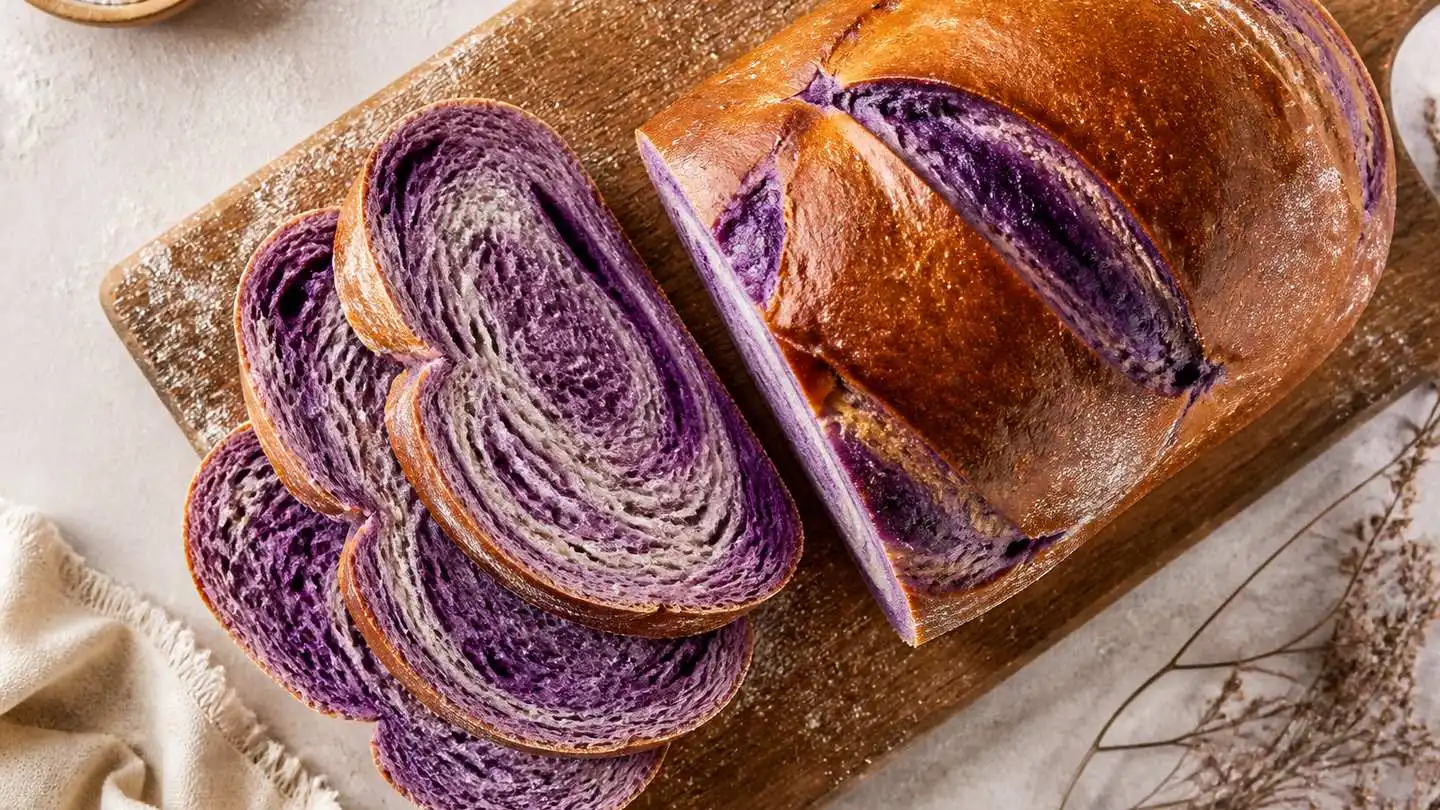
Loss is not uniform through a baked piece. The crumb is moist, comparatively protected and lower in temperature, so it usually holds the violet tone a formulator wants. The crust and exposed surface reach much higher temperatures and lose water; there, pigment degradation and non-enzymatic browning proceed together and the surface browns. The result is a purple crumb under a browned crust, and that combination changes how the product reads. On a sliced cake roll or cut loaf the contrast is an asset: the crumb carries the colour story. On an unglazed bun or cookie the consumer mainly sees browned surface, so judge colour on the outside of the piece.
Egg, Dairy and Alkaline Leavening
Ingredients interact with the pigment in ways that are easy to overlook. Anthocyanins behave differently in real food matrices than in simple solutions because they interact with proteins and polysaccharides (Oancea, 2021). In bakery terms, egg and dairy proteins — including the milk solids of an enriched dough — can associate with the pigment and change both its apparent intensity and its thermal behaviour. Alkaline leavening is the more direct risk: sodium bicarbonate raises batter pH, pushing the hue toward blue and grey and accelerating degradation, while acidic components such as buttermilk, sourdough, fruit purées or cream of tartar hold pH down and preserve hue and intensity. Measure both batter and crumb pH.
Colour Has to Be Measured, Not Assumed
Because loss is progressive, a single “does it look purple?” check on day one proves little. Track colour instrumentally — for example as CIE L*a*b* values under fixed lighting against a physical standard — at unbaked batter, straight after baking, after a freeze–thaw for frozen lines, and across the start, middle and end of shelf life. What matters is whether the hue holds and how far it drifts toward grey. For related reading on colour behaviour in baked and snack formats, see our notes on purple sweet potato powder in baking and snacks.
Flavour: What Actually Survives the Oven
Flavour behaves nothing like colour. Colour asks how much pigment remains; flavour asks how one aroma profile reads inside a crumb, at a concentration the crumb can physically carry. Answer both before fixing an inclusion level.
The Characteristic Note
Wellgreen’s product page describes the flavour profile of its Ube Purple Yam Powder as “sweet, creamy, and nutty”, and its FAQ calls the authentic ube note sweeter and more vanilla-like than taro. That combination — soft sweetness, a vanilla-like aromatic and a faint nutty base — makes ube recognisable, and also easy to over- or under-deliver.
The Crumb Is Not a Cooked Paste
Ube flavour is most familiar from cooked, sugar-rich pastes and fillings, where the tuber is fully hydrated, sweetened and often enriched with dairy. A baked crumb is a different delivery system. Much of the more volatile aromatic escapes in the oven, the crumb is drier and more aerated, and the starch matrix dilutes what remains, so the powder contributes its solid, faintly earthy base as much as its top notes. A formula copied from a cooked application therefore usually tastes flatter after baking; the fix is to rebuild flavour from the crumb outward, not to keep adding tuber solid. For the same logic applied to a fruit powder, see our guide to using strawberry powder in baking.
Interacting With the Flavour System Already in the Recipe
Ube rarely arrives into an empty flavour system; its success depends on what surrounds it.
- Vanilla. Because ube already carries a vanilla-like note, added vanilla or vanillin reinforces the perceived ube character — useful to a point, then cloying. Treat vanilla as a multiplier that is easy to double-count.
- Dairy solids. Milk powder, cream and butterfat round the note but also mute it. A high-dairy ube crumb reads less distinctly ube than a leaner one — often desirable in buttercream, not in bread.
- Brown sugar and caramel. Molasses-rich sugars sit naturally beside the nutty note and deepen the crumb colour, but they also push it toward brown and compete with the violet.
- Cocoa and coffee. Both are acidic and intensely coloured. They can tilt batter pH and, in a marbled or layered product, muddy the ube zone into an indefinite brown unless the phases stay separate until assembly.
The Load Ceiling, and How to Find It
Every starch-bearing tuber powder has an inclusion level above which the flavour turns earthy or beany and the crumb turns dense and gummy. The mechanism is straightforward: the powder brings its own starch and absorbs water, so a high load dilutes gluten or batter structure and competes for free water. Flavour and texture fail together, which is why the ceiling belongs to sensory testing.
Design it as a blind, randomised, monadic test across a ladder of inclusion levels bracketing the expected optimum, with the rest of the formula constant. Around sixty screened category users rate overall liking on a 9-point hedonic scale and rate colour intensity, ube flavour, sweetness and gumminess on just-about-right scales; a trained panel adds descriptors such as earthy, beany and raw-starch. The ceiling is where liking stops rising while gumminess and off-note intensity keep climbing. Test the baked, cooled product, and again after a freeze–thaw, since ranking can change.
Process and Formulation Levers
Once colour and flavour targets are defined, a few process decisions determine whether they survive scale-up.
Hydration
The powder is a starch-bearing tuber solid, not an inert colourant, and it takes up water. Added without adjustment it reduces free water, tightens dough or thickens batter, and leaves the crumb drier than expected. Set the water correction by targeting consistency, and verify with crumb moisture — not by assuming a fixed offset per unit of powder.
Viscosity, Spread and Crumb
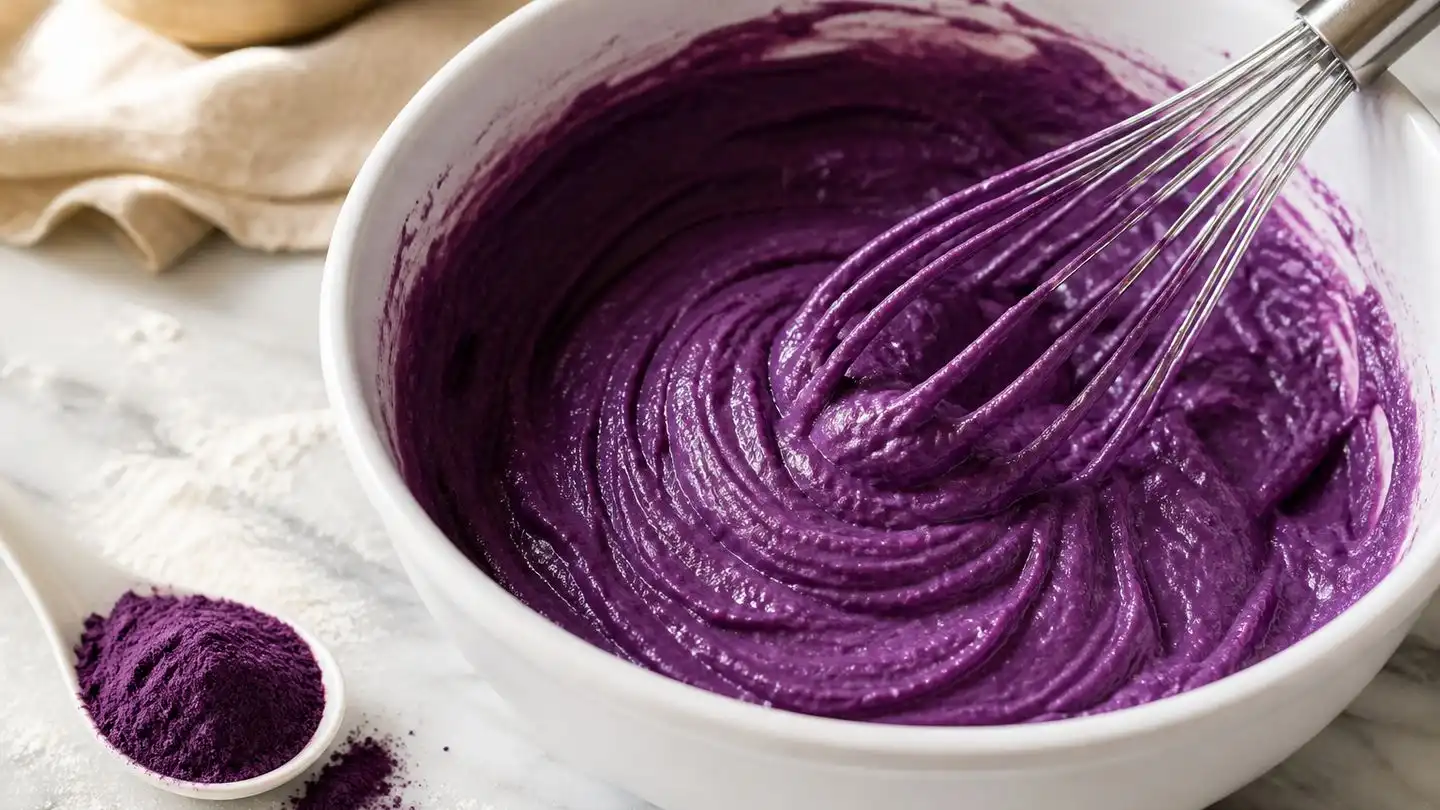
Thickening changes rheology. A thicker cookie dough spreads less, so the biscuit is smaller and thicker; a stiffer cake batter traps air differently and gives a denser crumb. Viscosity also governs colour uniformity: a stiff batter disperses the powder unevenly and bakes out with faint streaks.
Fat and Emulsifiers
Fat coats starch particles and slows hydration, moderating thickening and carrying fat-soluble flavour notes. Emulsifiers — lecithin, mono- and diglycerides — stabilise the batter and influence crumb softness and staling. Both matter to the dual function: adequate fat supports flavour release and tenderness, while excess fat or emulsifier can mute the ube note and over-soften the crumb. Fat also drives oxidative flavour change, so re-taste the note at the end of shelf life.
Bake Temperature, Time and Freeze–Thaw
The bake schedule is a real trade-off. The wheat study cited above found high-temperature, short-time baking more protective of anthocyanins than long, gentle baking, but a short bake must still set the crumb, and an aggressive schedule browns the surface faster and widens the crust-to-crumb colour gap. Freezing adds a second stress: ice-crystal growth in unbaked or part-baked dough is the dominant concern, and freeze–thaw cycling of finished product can cause moisture migration and syneresis that carry pigment unevenly and dull the surface. Re-measure colour and flavour after one cycle. For a plant powder with a comparable colour-and-flavour remit, see our article on how organic goji berry powder enhances natural colour and flavour.
Bakery Application Checklist
The tables below summarise how the two functions behave across bakery formats, and which variables keep both on target. For a comparable vegetable powder, see our overview of pumpkin powder in functional foods and beverages.
| Bakery format | Where colour is judged | How the ube note reads | Main process tension |
|---|---|---|---|
| Sandwich loaf and pan bread | Cut crumb; the crust browns and hides colour | Soft background note against a neutral crumb | Long bake and a large water load both work against pigment retention |
| Soft rolls and buns | Glazed or dusted surface, plus the cut face | Slightly sweet note that reads well in enriched dough | Surface browning competes with violet on the outside |
| Layer cake, chiffon and Swiss roll | Cut crumb, against cream or filling | Clear note when the crumb is tender and lean | Crumb must stay open enough to carry the load |
| Cookies and shortbread | Top surface of the baked piece | Concentrated and forward in a low-moisture matrix | Lowest moisture and the longest surface heat exposure |
| Muffins and quick breads | Cut crumb and domed top | Reads as a soft, cakelike note | Chemical leavening drives the pH shift |
| Mochi and chewy confections | Whole piece, translucent | Strongest expression of the note | Highest starch load; texture turns gummy first |
| Laminated and enriched pastry | Cut layers and glazed surface | Note competes with butter and lamination fat | Fat and steam layers interrupt colour uniformity |
| Buttercream, fillings and glazes | Bulk colour of the cream | Directly expressed, undiluted by baking | No heat stress, but dairy can mute the note |
| Variable to control | What it governs | How to verify | Failure if unmanaged |
|---|---|---|---|
| Batter and crumb pH | Hue direction and pigment stability | pH meter on the batter and on the cooled crumb | Hue drifts blue-grey and fades faster |
| Leavening system | Size of the pH shift during mixing and proof | pH before and after mixing | Alkaline soda pushes the crumb off target |
| Thermal budget (time × temperature) | Proportion of pigment surviving the bake | Instrumental colour before and after baking | Large, invisible colour loss |
| Hydration | Crumb openness, gumminess and colour dispersion | Consistency, plus finished crumb moisture | Dry crumb or streaks of uneven colour |
| Fat and emulsifier level | Flavour release and crumb softness | Sensory panel plus texture measurement | Muted note or an over-soft crumb |
| Oxygen and mixing intensity | Oxidative pigment loss during aeration | Colour of the batter at start and end of mixing | Loss occurring before the oven |
| Freeze–thaw | Moisture migration and pigment distribution | Colour after one full cycle | Dull surface and uneven colour |
| Storage and packaging | Shelf-life colour and flavour drift | Colour and taste at start, middle and end of shelf life | Late-life fade and stale-fat notes |
- Define the colour target as instrument values against a physical standard under fixed lighting, and state whether crumb, crust or both is the reference.
- Record pH before baking and in the cooled crumb, and confirm the leavening system does not shift the hue away from target.
- Fix the thermal budget, then measure colour retention across that bake rather than after an arbitrary one.
- Rebalance water against the powder’s uptake, and verify by consistency and crumb moisture.
- Screen fat and emulsifier levels for crumb softness, flavour release and shelf-life flavour drift.
- Run a preference panel to locate the inclusion ceiling, with a trained panel for earthy and beany off-notes.
- Measure colour and flavour at the start, middle and end of shelf life, and after at least one freeze–thaw cycle.
- Confirm the specification points that protect batch-to-batch consistency — colour value, particle size and moisture — with the supplier.
Designing the Pilot Trial
A pilot should isolate the variables that colour measurement and the panel flagged as decisive.
| Trial variable | Levels to test | Held constant | Output measured |
|---|---|---|---|
| Inclusion load | A ladder of levels bracketing the panel ceiling | Base formula and bake schedule | Colour values, liking, gumminess, off-notes |
| pH and leavening | Current system versus acidic variants | Inclusion load and bake schedule | Hue retention and crumb pH |
| Bake schedule | Longer-and-lower versus shorter-and-hotter | Inclusion load and pH | Colour retention, crumb set and surface colour |
| Hydration | Powder added with and without a water correction | All other factors | Consistency, crumb moisture, crumb openness |
| Freeze–thaw | Fresh versus one freeze–thaw cycle | All other factors | Colour and texture after thaw |
| Storage | Start, middle and end of declared shelf life | Pack format and inclusion load | Colour drift and flavour drift |
Specifying and Sourcing for Bakery Work
Bakery work rewards batch-to-batch consistency, because drift between powders is visible and tasteable in the finished product. The specification points that matter most control both functions: a defined colour value, a particle size that disperses cleanly in dough or batter, and a moisture limit that keeps the powder free-flowing in storage. Wellgreen lists its Ube Purple Yam Powder with ISO 22000, HALAL, KOSHER and Non-GMO certification, an 80–100 mesh target, a moisture limit of ≤ 7.0% and a flavour profile described as sweet, creamy and nutty, all as stated on the product page. Buyers should confirm the specification, documentation and regulatory status for their own market.
For bakery development work, samples and full technical documentation, contact us at wgt@allwellcn.com or request specifications through the Ube Purple Yam Powder product page. Tell us your format and your colour and flavour targets, and we will match the specification.
This article is technical and commercial information for food-industry professionals, not medical or nutritional advice; colour performance, use levels, regulatory status and label claims must be confirmed against target-market rules and your own product data.
References
- Francavilla, A., & Joye, I. J. (2022). Anthocyanin Content of Crackers and Bread Made with Purple and Blue Wheat Varieties. Molecules, 27(21), 7180. https://doi.org/10.3390/molecules27217180 — https://pmc.ncbi.nlm.nih.gov/articles/PMC9656245/
- Oancea, S. (2021). A Review of the Current Knowledge of Thermal Stability of Anthocyanins and Approaches to Their Stabilization to Heat. Antioxidants, 10(9), 1337. https://doi.org/10.3390/antiox10091337 — https://pmc.ncbi.nlm.nih.gov/articles/PMC8468304/
- Enaru, B., Drețcanu, G., Pop, T. D., Stănilă, A., & Diaconeasa, Z. (2021). Anthocyanins: Factors Affecting Their Stability and Degradation. Antioxidants, 10(12), 1967. https://doi.org/10.3390/antiox10121967 — https://pmc.ncbi.nlm.nih.gov/articles/PMC8750456/
- Khoo, H. E., Azlan, A., Tang, S. T., & Lim, S. M. (2017). Anthocyanidins and anthocyanins: colored pigments as food, pharmaceutical ingredients, and the potential health benefits. Food & Nutrition Research, 61(1), 1361779. https://doi.org/10.1080/16546628.2017.1361779 — https://pmc.ncbi.nlm.nih.gov/articles/PMC5613902/
- Thermal and pH degradation kinetics of anthocyanins in natural food colorant prepared from black rice bran. (2015). Journal of Food Science and Technology, 53(1), 461–470. https://doi.org/10.1007/s13197-015-2002-1 — https://pmc.ncbi.nlm.nih.gov/articles/PMC4711436/
- Tamaroh, S., Sari, Y. P., & Wariyah, C. Formulation and characterization of nanoemulsion containing anthocyanin extract from purple yam (Dioscorea alata L.). PMID 39974873. https://europepmc.org/article/med/39974873