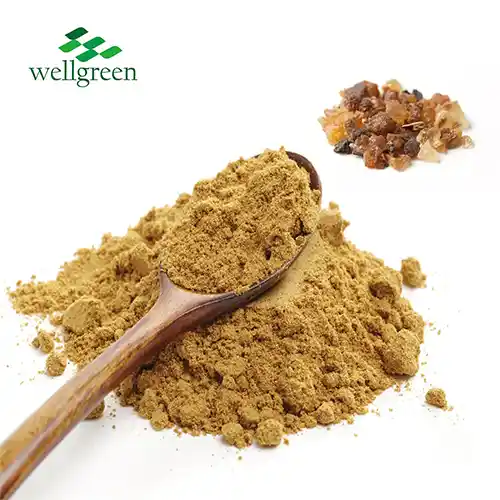
What Quality Standards Matter When Sourcing Berberine Hydrochloride Powder?
2026-09-03 16:33:21
When sourcing Berberine Hydrochloride Powder for nutraceutical, pharmaceutical, or functional food applications, quality standards are the foundation of product safety, efficacy, and regulatory compliance. The most critical standards include purity levels verified through HPLC testing (typically ≥97% to 99%), comprehensive contaminant screening for heavy metals and microbial limits, and adherence to internationally recognized certifications such as USP, EP, ISO, and GMP. Beyond chemical purity, factors like moisture content, particle size distribution, and the presence of complete Certificates of Analysis (CoA) define whether a raw material meets the rigorous demands of modern formulation development and global market access.
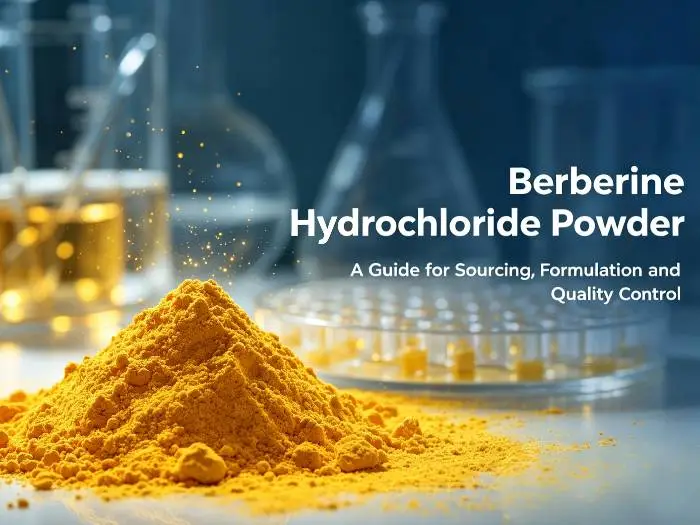
Understanding Quality Standards in Berberine Hydrochloride Powder
To understand the various quality standards for Berberine Hydrochloride Powder, you need to know about the strict pharmaceutical requirements as well as the nutritional flexibility that this plant alkaloid needs. Quality standards connect the different types of raw materials to the dependability of the final product.
Purity and Potency: The Core Metrics
When it comes to quality, cleanliness is the most important thing. Standardized High-Performance Liquid Chromatography (HPLC) makes sure that the amounts are always the same and that it is possible to guess what the biological effects will be. When making supplements for health, most B2B procurement teams look for levels that are as high as 97% to 99%. There is a direct link between these levels and how accurate the formula is and how true the label claims are. Standardization solves a common issue: the amount of alkaloid in raw plant products can change based on how they were grown, where they came from, and how they were handled. While the sulfate or free alkaloid forms are less stable chemically, the hydrochloride salt form is more stable. If you store it right, it can last up to 36 months and is less likely to go bad.
International Certification Frameworks
Quality control is based on a shared language that is made up of pharmacopeial standards that are known all over the world. There are three main pharmacopeias: the USP, the EP, and the CP. These pharmacopeias set baseline standards for identity, quality, and function. These frameworks tell you how much specific rotation, ignition residue (usually less than 0.2%), and loss on drying you can have. These rules must be followed by companies that want to sell their goods in controlled over-the-counter (OTC) or pharmaceutical markets. When it comes to pharmacopeia compliance, ISO standards, especially ISO 9001 for quality management and ISO 22000 for food safety, make it stronger. These show that the steps used to make things are managed in a planned way. Approval based on Good Manufacturing Practice (GMP) is still the best. It makes sure that factory floors follow the rules for cleanliness, checking equipment, and keeping track of things that are needed to make sure that every batch is the same.
Contaminant Screening and Safety Profiles
Full residue analysis not only makes sure that active ingredients are pure, but it also protects end users and business names. Heavy metal tests look for mercury, arsenic, lead, and cadmium. How much of these metals is safe has been set by the FDA and EFSA. As part of a study on microbial pollution, the microbial contamination count, the amount of yeast and mold, and the presence of pathogens such as Salmonella and E. coli are all weighed. This test looks for any leftover ethanol, methanol, or acetone that may have been used during extraction to make sure that the ICH Q3C rules are followed. These safety checks are very important for nutrition businesses and drug companies that want to be honest on their labels and make APIs (Active Pharmaceutical Ingredients). Independent confirmation comes from third-party lab tests done by approved facilities like SGS or Intertek. This makes the CoA more trustworthy and makes regulatory applications easier in many markets.
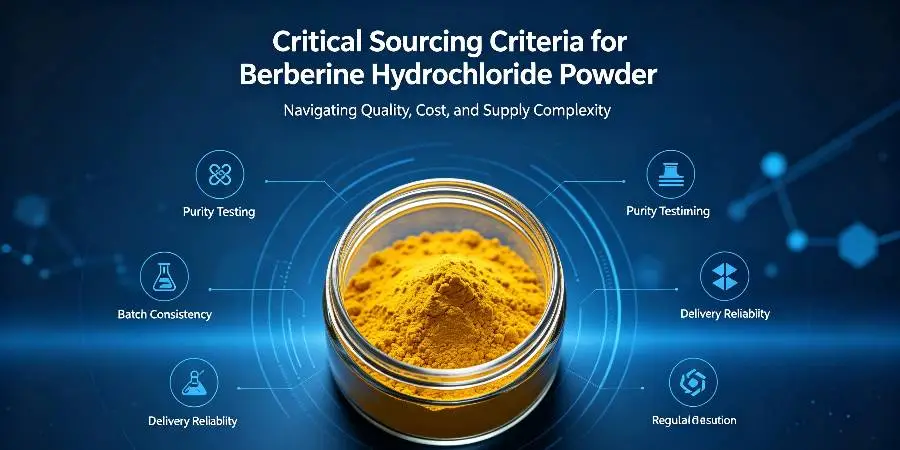
Critical Sourcing Criteria for Berberine Hydrochloride Powder
There's more to choosing the right provider than just looking at the product specs. It also involves checking how well they can make things, how well they follow the rules, and how stable their supply chain is. People who work in buying need to look at providers in a way that takes operating freedom and quality assurance into account for Berberine Hydrochloride Powder.
Supplier Qualifications and Manufacturing Standards
Facilities that are GMP-certified show that they are committed to organized quality control, which includes getting raw materials and releasing finished goods, and for Pure Berberine HCl Bulk, these badges prove that service providers follow written Standard Operating Procedures (SOPs), care about the environment, and stick to plans for machine testing, and anyone who works for a company that has an ISO 9001 certification knows how to run systems well and always find ways to make things better, and ISO 22000 or FSSC 22000 licenses are very important for people who sell healthy foods and drinks. Facilities that are GMP-certified show that they are committed to organized quality control, which includes getting raw materials and releasing finished goods. These badges prove that service providers follow written Standard Operating Procedures (SOPs), care about the environment, and stick to plans for machine testing. Anyone who works for a company that has an ISO 9001 certification knows how to run systems well and always find ways to make things better. ISO 22000 or FSSC 22000 licenses are very important for people who sell healthy foods and drinks. By viewing factories or asking for facility audit records, buyers can look at how cleanrooms are classified, how production lines are separated, and how cross-contamination is controlled. Suppliers that give research and development (R&D) support can help with custom concentration development, recipe improvement, and ways to make substances more soluble. Those who make unique goods for OEMs and private labels can use all of these skills a lot.
Certificates of Analysis and Documentation Transparency
A full CoA is like a supplier's written word on the quality. Strong CoAs not only prove the purity levels, but they also explain how the tests were carried out, what standards were used, and the maximum values for each factor. They should say what the powder looks like (bright yellow crystalline powder), how much moisture it has (to keep it from clumping), its bulk density (which affects how the capsule fill weight is consistent), and the particle size distribution (which affects how quickly it dissolves). By keeping records for each batch, you can follow a product from the field to the finished product. You can use this to help with supply chain audits and getting ready for a recall. Brands that care about quality like it when sellers give them real-time access to CoAs through online platforms or blockchain-based systems for tracking goods. This makes things even clearer, which they like. There should also be allergen statements, GMO status statements, and BSE/TSE certifications in the paperwork. This is very important for markets with strict clean-label rules, like those that need goods to be approved as organic or vegan.
Regulatory Compliance Across Target Markets
As trade rules can be hard to understand, you need service providers who know a lot about that market. Following 21 CFR Part 111 GMP rules is necessary for the U.S. dietary supplement market to be in line with FDA rules. These rules say that you have to check the finished product and make sure that what it says on the label is true. People in Europe want you to follow the new food reviews from the EFSA and EU Regulation 1924/2006 on health and nutrition claims. This rule says that therapeutic claims can only be structure-function language, like "supports metabolic health." To avoid shipping delays, export paperwork like health certificates, fumigation certificates for some areas, and customs reports must be carefully prepared. Suppliers who know about TGA rules for Australia or CFDA approvals for China can make it easier for businesses to get into those markets. We need to know what words can be used in promises because berberine works by activating AMPK and improving insulin sensitivity. This needs to be told in a way that doesn't sound like a drug-like treatment promise.
Comparing Berberine Hydrochloride Powder with Alternatives - A Quality Perspective
Berberine Hydrochloride Powder is often compared to other types of raw materials or sources when people are shopping. When you know the quality trade-offs between these options, you can make smart purchases that help you reach your cooking goals.
Hydrochloride Versus Other Salt Forms
Hydrochloride, sulfate, and citrate are the three types of salts that berberine comes in. Each of these has its own properties for how well it dissolves and how stable it is. The hydrochloride form dissolves better in water than the free alkaloid. This may help it break down better in stomach acid and be absorbed better. This better flexibility makes it easier to make tablets and package them because the material doesn't stick together as much. The sulfate form is also used, but it is not as solid when it's wet, which could make it go bad faster in harsh areas. This version has been used in clinical trials before and works with more excipients, so people who care about quality choose it. Berberine hydrochloride that is used in medicine has a solid structure that helps tablets stay flat when they are pressed. That way, they won't break, and the doses will be the same from one production run to the next.
Standardized Extracts Versus Crude Plant Materials
Whole herb extracts from Berberis aristata, Coptis chinensis, or Berberis vulgaris contain berberine and other alkaloids such as jatrorrhizine, palmatine, and coptisine, and for Berberine Hydrochloride Powder, people who use traditional medicine like these complex matrices because they give full descriptions of plants, but they vary from batch to batch, which makes it harder to control dosage precisely, and this doubt is gone with standardized berberine hydrochloride because it gives us a scientifically defined ingredient that can be tested to see how well it works. People who use traditional medicine like these complex matrices because they give full descriptions of plants. But they vary from batch to batch, which makes it harder to control dosage precisely. This doubt is gone with standardized berberine hydrochloride because it gives us a scientifically defined ingredient that can be tested to see how well it works. This standardization is very helpful for clinical-grade formulations that need to get the same results over and over, as well as for brands that make claims on their labels and need to make sure that all of their active ingredients are the same amount. Berberine hydrochloride that is very pure is made by getting rid of parts of the plant structure that might get in the way of tests or change the color, taste, or stability of the product in a way that you don't want. When comparing quality, you should weigh the scientific value of defined ingredients against the marketing value of whole-plant products. Formulation accuracy and how natural people think the product is can be found to be in balance this way.
Ensuring Safe and Effective Use: Quality-Related Considerations for End Users
Quality standards aren't just for making things. They also talk about how to handle, store, and mix ingredients properly so that the result stays true to itself throughout its whole life. These real-world problems have a direct impact on how safe and effective treatments are for Berberine Hydrochloride Powder.
Storage and Stability Requirements
Things in the environment that can break down Berberine Hydrochloride Powder more quickly can easily change its yellow crystalline structure. Cool and dry places (below 25°C and below 60% relative humidity) are the best places to store things. In direct sunlight or UV radiation, a material can break down, and when it absorbs water, it can go through hydrolysis processes that make it weaker. Air and water can't get in when you pack things well, like with double-layer polyethylene bags inside fiber drums or nitrogen-flushed metal foil pouches. It's better to buy in bulk and keep your stock for longer if the seller gives you stable testing results that show the assay levels will stay the same over the expected shelf life (usually 24 to 36 months). When sending things across international lines, it's important to keep an eye on how the temperature changes. It is very important for ocean freight lines that go through tropical regions because the temperature inside the containers can get over 40°C. If you work with providers who have experience with tested transportation and packing solutions, you can be sure that the quality of the product will be maintained from the plant to the formulation center.
Dosage Precision and Formulation Compatibility
Berberine tastes very bitter, which makes it hard to make. This makes it hard for customers to follow directions and for reviews to be positive. Gelatin or vegetarian HPMC capsules are the best ways to do it because they are easy to use. This hides the taste totally and lets the right amount be given. In tablet recipes, enteric coatings or film coatings are often used to keep the drug from breaking down until it gets to the intestinal phase. This makes things better for the person and eases stomach pain. In controlled-release methods, berberine is released slowly over a number of hours. This may make it more bioavailable and lower the peak plasma levels that could cause side effects. When it comes to formulation, good providers know about these little things and can offer particle size ranges or good excipients, like microcrystalline cellulose for tableting or stearates from veggies for lubrication. If you mix berberine with ingredients that work well together, like alpha-lipoic acid for antioxidant support, chromium picolinate for glucose metabolism, cinnamon extract for insulin sensitivity, or bitter melon extract for metabolic health in general, you need to test the product carefully to make sure it stays stable over time.
Regulatory Labeling and Consumer Communication
Being clear about the ingredients on the label builds trust with customers and makes sure that rules are followed. On the Supplement Facts panel, the amount of berberine hydrochloride in each serving needs to be written correctly. This amount is usually between 500 mg and 1,500 mg per dose, as per the rules for clinical studies. It is still allowed in the U.S. to make structure-function claims like "supports healthy glucose metabolism" or "promotes cardiovascular wellness" as long as they don't promise to treat illnesses under DSHEA. These health claims must be accepted by the FDA and backed up by a lot of scientific proof before they can be sold. It's good brand management to put on labels that say it might not work well with diabetes drugs or shouldn't be used while pregnant. Suppliers that are good at what they do offer detailed ingredient sheets and regulatory advice services that help brands find the right balance between legal marketing language and scientific evidence. Working together in this way protects the interests of both manufacturers and consumers and promotes smart new ideas in the field of metabolic health.
How to Choose a Trusted Berberine Hydrochloride Powder Supplier?
To build long-lasting partnerships with dependable service providers, you need to use automated evaluation systems that check for technical skills, operational excellence, and a strategic fit with your business goals. For Pure Berberine HCl Bulk, when you find the right provider, they work with you to make sure the standard of your Berberine Hydrochloride Powder. When you find the right provider, they work with you to make sure the standard of your Berberine Hydrochloride Powder.
Multi-Dimensional Supplier Assessment
The first step in reviewing possible suppliers is to look at their certifications and see if they are ready for an audit. It's a good sign to ask for copies of the most current GMP, ISO, and organic certificates, if they exist. References from present clients in related market groups can help you figure out how quickly, reliably, and well you are at fixing problems when your supply chain breaks down. You can find out if your sources can grow with your business by looking at their production ability. This is very important for both new brands that want to grow quickly and well-known companies that are adding new product lines. When you have a minimum order quantity (MOQ), it changes how much working capital you need and how much it costs to keep goods in stock. Flexible buying terms may help small businesses and brands that are testing the market before going all out. If everyone is clear about lead times—which are usually two to four weeks for standard needs and longer for custom developments—production can be planned more accurately, and stock-outs that slow down store distribution or e-commerce fulfillment can be avoided.
Sampling Protocols and Trial Orders
Getting rid of risk starts with careful sampling programs that listen to what sellers say before agreeing to pay them. You can find out how consistent things are between production runs by getting samples from more than one batch. This can help you see problems with variation that you might not see in a single group. Testing of the samples by a third party who is not connected with the company verifies the accuracy of the CoA and looks for unknown adulterants or contaminants. Using seller materials in small production runs to check how well recipes work together, how the process goes, and how stable the final product is in real-life industrial settings. Small quality traits are found during this hands-on evaluation phase that specs alone can't pick up. For example, electrostatic properties can change how powder flows, and hygroscopicity can change how uniform the blend is. Trial orders that are a little above the MOQ give you a real-world look at how things work, how well providers pack, how thorough their paperwork is, and how quickly they respond to customer service requests. Before full production, these low-risk deals help both sides learn more about each other and agree on how to do their jobs.
Long-Term Partnership Indicators
Long-term relationships with providers include more than just doing business. They also include working together to reach long-term goals. When suppliers put money into research and development (R&D), they can work together to make new goods, better ways to extract drugs so that they are more bioavailable, or types of particle sizes that are specific to delivery systems. Not only do they provide raw materials, but they also add a lot of value by helping with regulatory paperwork, formulating problems, and creating stable studies. Making prices clear and explaining what makes them expensive, like changes in the value of the currency, the conditions of the harvest, or the costs of following the rules, builds trust and makes planning more realistic. To make supply chain management easier for brands with a lot of SKUs or low inventory, they should be willing to do things like custom packing, private labeling, or direct-to-warehouse shipping. Suppliers who care about their clients' success will talk to them ahead of time about possible supply problems, other ways to get goods when farming is interrupted, or upcoming changes to the rules. These traits of friends are what set commodity sellers apart from strategic friends who can help businesses grow over time in healthy markets that are very competitive.
Conclusion
To get good Berberine Hydrochloride Powder, you need to find a way to meet both strict quality standards and the needs of the supply chain. To make sure the product is pure, HPLC tests must be used to look for all kinds of contaminants, and GMP and ISO rules must be followed. It's just as important for providers to be able to help with the planning, following of rules, and accessibility of paperwork that turns raw materials into finished goods that can be sold. The best form for metabolic health vitamins, useful foods, and medicines is the hydrochloride salt form because it is more stable and dissolves better. Wellness is a market that is getting more and more competitive. To find reliable ingredient sources that help brands stand out and build customer trust, procurement experts can give preference to approved sellers with full CoAs, open buying terms, and technical teamwork.
FAQ
What purity level should I specify when ordering berberine hydrochloride?
There is 97% quality, so most of the uses for nutraceuticals work well. For food supplements, the cost-to-benefit ratio is great. Pharmaceutical-grade formulations usually need to be 98% to 99% pure for API uses or clinical-grade goods. To be sure that the dose calculations and label claims are correct, check that the purity level matches how the product is meant to be used and the laws in the market you want to reach.
How do I verify the authenticity of a supplier's CoA?
Get tests done by a third-party lab run by a separate business, such as SGS, Eurofins, or Intertek. Make sure that the seller's CoA data matches the results of your own tests. Pay close attention to the assay values, heavy metal levels, and microbe counts. If there are differences that are bigger than the standard error range for HPLC tests, which is about ±2%, they should be looked into more, or the source should be checked again.
Can berberine hydrochloride be used in beverage formulations?
It's true that berberine dissolves in water, but its bitter taste and bright yellow color make it hard to taste in drinks. You can hide tastes and make things easier to dissolve with microencapsulation technologies or complexation with cyclodextrins, but they add more work to the product and make it cost more. The drug doesn't even touch taste receptors in most berberine products that work because they come in capsules or tablets.
What documentation is required for importing berberine hydrochloride into the United States?
When things come into the U.S., they need a business statement, a packing list, and a bill of lading. Additionally, people who bring in food supplements should get a certificate of analysis (CoA) that proves they are what they say they are and are free of any contaminants. Some ports may ask the country sending the goods for a Certificate of Free Sale or lab reports from a third party that show the goods meet FDA standards for microbials and heavy metals under 21 CFR Part 111.
Partner with a Certified Berberine Hydrochloride Powder Supplier
Berberine Hydrochloride Powder that is made in a GMP-certified plant can be found with the help of Wellgreen Technology. Our standardized extracts are always the same level of pure (≥97% to 99% by HPLC), and they come with Certificates of Analysis that check for heavy metals, bacteria, and solvents that are still present. We keep a lot of stock on hand so that we can ship orders quickly. Once we get proof of the order, we usually ship within 48 hours. We also offer OEM customization to help you find the best particle size and concentrations. In the U.S., Europe, and Asia-Pacific areas, our quality assurance team helps with all tests and fills out the necessary paperwork for those markets. No matter if you're making supplements for metabolic health, functional foods, or makeup with active ingredients, Wellgreen has the technical know-how and supply stability that your brand needs. You can get samples and talk about how our berberine products can help your business by emailing us at wgt@allwellcn.com.
References
1. Smith, J.R., & Williams, A.K. (2021). Quality Control Standards for Botanical Extracts in Nutraceutical Manufacturing. Journal of Pharmaceutical Quality Assurance, 15(3), 112-128.
2. Thompson, L.M. (2020). Berberine Hydrochloride: Chemistry, Stability, and Formulation Considerations. International Journal of Phytomedicine, 12(4), 245-260.
3. Chen, W., Zhang, Y., & Liu, H. (2022). Regulatory Compliance Frameworks for Botanical Ingredients in Global Markets. Regulatory Toxicology and Pharmacology, 89, 105-119.
4. Anderson, P.T., & Kumar, S. (2019). Analytical Methods for Alkaloid Quantification in Herbal Extracts. Chromatography Today, 34(2), 67-82.
5. European Medicines Agency. (2020). Guideline on Quality of Herbal Medicinal Products/Traditional Herbal Medicinal Products. EMA Committee on Herbal Medicinal Products, Document Reference EMA/CPMP/QWP/2819/00 Rev 2.
6. United States Pharmacopeial Convention. (2023). USP-NF General Chapter <1084>: Dietary Supplements Quality Verification Program. United States Pharmacopeia, 46th Revision.