
What Buyers Should Check Before Sourcing Shiitake Mushroom Powder
2026-11-03 09:55:24
Most shiitake sourcing problems are not discovered in the warehouse. They surface eighteen months later, when a customer asks why lot four looks darker than lot one, or when a certifier requests a transaction certificate nobody can produce. The material itself is not exotic: organic shiitake powder is a straightforward agricultural powder. What makes it hard to buy well is that the same three words describe at least three materials, made differently, tested differently, and priced accordingly. This guide is for the procurement leads, QA managers, and regulatory staff who sign the purchase order.
Start With Material Identity, Not With Price
Before comparing quotations, make every supplier describe the same material in the same vocabulary. A wide gap between two offers for "shiitake mushroom powder" is usually not a negotiation gap; it is two different products.
Fruiting Body, Mycelium, and Extract Are Three Different Materials
Fruiting body powder is dried mushroom tissue ground to a defined particle size. Mycelium powder is grown on a grain or liquid substrate and dried with that substrate, so it can contain a substantial share of grain solids that were never part of the mushroom. An extract is a concentrate produced by hot water or solvent extraction, standardised to a declared component, and it behaves differently in a formula because much of the fibrous matrix is gone.
All three can be called shiitake powder somewhere, and all three can carry an organic certificate. If your specification says "powder" and the supplier ships an extract, your label declaration, use level, and cost per unit of active material are wrong at once, so a buyer who needs a concentrate should work from a dedicated shiitake extract specification.
Species, Plant Part, and Stem Content
The species should be stated as Lentinula edodes. Older trade documents still use Lentinus edodes; both names refer to one organism, so the synonym is acceptable when identity is unambiguous. What matters more is the part used and whether the stem is included.
Stems are harder, denser, and cheaper than caps, and they carry more mineral ash and less of the soluble material that gives the powder its value. A specification silent on cap-only, cap-and-stem, or stem percentage lets the supplier adjust the ratio every lot, so get the answer and its tolerance in writing.
What "Organic" Actually Covers
An organic claim can attach to the raw mushroom, to the drying and milling operation, to both, or to neither. A supplier may buy certified organic dried mushrooms and mill them in an uncertified facility, in which case the powder cannot carry the claim in most markets.
Ask in two parts: which certificate covers agricultural production of the raw material, and which covers handling, drying, milling, and packing of the powder. If the second answer is vague, organic status is unproven regardless of the logo on the quotation.
The Identity Confirmation Checklist
The table below is the minimum set of written answers to collect before a sample is requested. Each row has a correct answer shape and a pattern that should stop the conversation.
| Item to confirm | What a complete answer contains | Common warning pattern |
|---|---|---|
| Material type | Fruiting body powder, mycelium powder, or extract, stated explicitly | "Mushroom powder" with no process description |
| Species | Lentinula edodes, with synonym noted if used | Genus only, or a loosely translated common name |
| Plant part | Cap only, or cap and stem with a stated stem proportion | Silence on stems |
| Growing substrate | Hardwood log or a named substrate mix such as oak sawdust with bran | "Natural substrate" with no composition |
| Drying method | Hot air, freeze drying, or spray drying, with a temperature range | "Sun dried" on an industrial volume |
| Organic scope | Certificate number covering both farming and processing, or a clear split | A certificate for a different product line |
| Assay basis | Polysaccharide content by HPLC, with the calculation basis named | A percentage with no method and no basis |
Verifying the Organic Chain of Custody
An organic certificate proves that a certified operation exists. It does not prove that the drum in front of you came from that operation. The principles are covered in our overview of what organic shiitake powder is; the practice below applies them to a purchase decision, including the input, separation, and conversion-period questions that raw-material declarations usually hide.
| Evidence | What to request | How to verify it | Common gap |
|---|---|---|---|
| EOS or NOP certificate | Current certificate whose scope lists the product category and the processing activity | Check certifier and certificate number in the public database, and expiry against shipment date | Certificate covers raw mushrooms only, or has expired |
| Transaction certificate | TC issued for the specific lot quantity and product form | Match TC reference and net quantity to the invoice and the lot code on the drum | TC covers a different quantity or form |
| Input and separation records | Organic input list, cleaning log between organic and conventional runs, storage separation plan | Ask for the record covering your lot's production dates, not a generic procedure | Procedure supplied instead of records |
| Conversion period | Date the growing area or substrate entered conversion, and the first harvest claimed as organic | Cross-check against the certificate's first certified harvest | Conversion-period material sold as fully organic |
| Subcontracting | Declaration of any third-party drying, milling, or sterilization step | Confirm each subcontractor appears under the certificate scope | Uncertified toll milling outside the chain |
Key Analytical Indicators and What They Tell You
| Parameter | Method | Why the buyer should check it |
|---|---|---|
| Polysaccharide content | HPLC, with the calculation basis stated | Defines the value of the material and the use level in your formula |
| Moisture | Loss on drying or Karl Fischer | Drives shelf life, caking, and microbial risk in storage |
| Total ash | Gravimetric, muffle furnace | Rises with soil, substrate, or stem content; a lot-to-lot stability indicator |
| Particle size | Sieve analysis against a stated mesh | Controls dispersion, mouthfeel, and suspension behaviour |
| Solubility | Dispersion test in water at a stated temperature | Determines behaviour in beverage and liquid applications |
| Heavy metals | ICP-MS or AAS, element by element | Mushrooms accumulate metals from substrate; total and individual limits both matter |
| Microbiology | Total plate count, yeast and mould, E. coli, Salmonella | Confirms hygiene of drying and post-milling handling |
Polysaccharide Assay: the Calculation Basis Is the Argument
Most disputes about polysaccharide content are arithmetic, not analytical error. A result expressed as glucose equivalent is converted through a standard curve, while a result expressed as extract describes the share of the extracted fraction in the powder; neither is comparable to a gravimetric crude figure. Ask for the basis on the COA and the formula in the specification, and compare quotations only on the same basis.
Moisture, Ash, Particle Size, and Solubility
Moisture is the quiet variable: a powder arriving at the top of its range will cake in a warm warehouse and lose flowability before the end of its stated shelf life. Ash is the cheapest proxy for dilution, since substrate residue, soil, and stem all push it up, which makes an ash trend across lots one of the earliest downgrade signals.
Particle size and solubility belong together. A 95 percent pass through 80 mesh describes the grind; solubility of 95 percent or above describes how that grind behaves in water. For beverage and instant applications both numbers belong on the specification, because a fine powder that disperses poorly still sediments in the cup. Our note on how organic shiitake powder is used in food manufacturing covers the application side.
Heavy Metals and Microbiology
Request elemental results individually rather than a single total: lead at or below 1 ppm, arsenic at or below 2 ppm, mercury at or below 1 ppm, and cadmium at or below 0.1 ppm, against a total limit of 10 ppm. Cadmium is the element most often elevated in mushroom material, so a total-only report withholds the number you need.
For microbiology, a typical food-grade specification sets total plate count at or below 1,000 cfu/g and yeast and mould at or below 100 cfu/g, with E. coli and Salmonella absent. Use these as incoming-gate limits, and confirm the methods are ones your customer's auditor recognises.
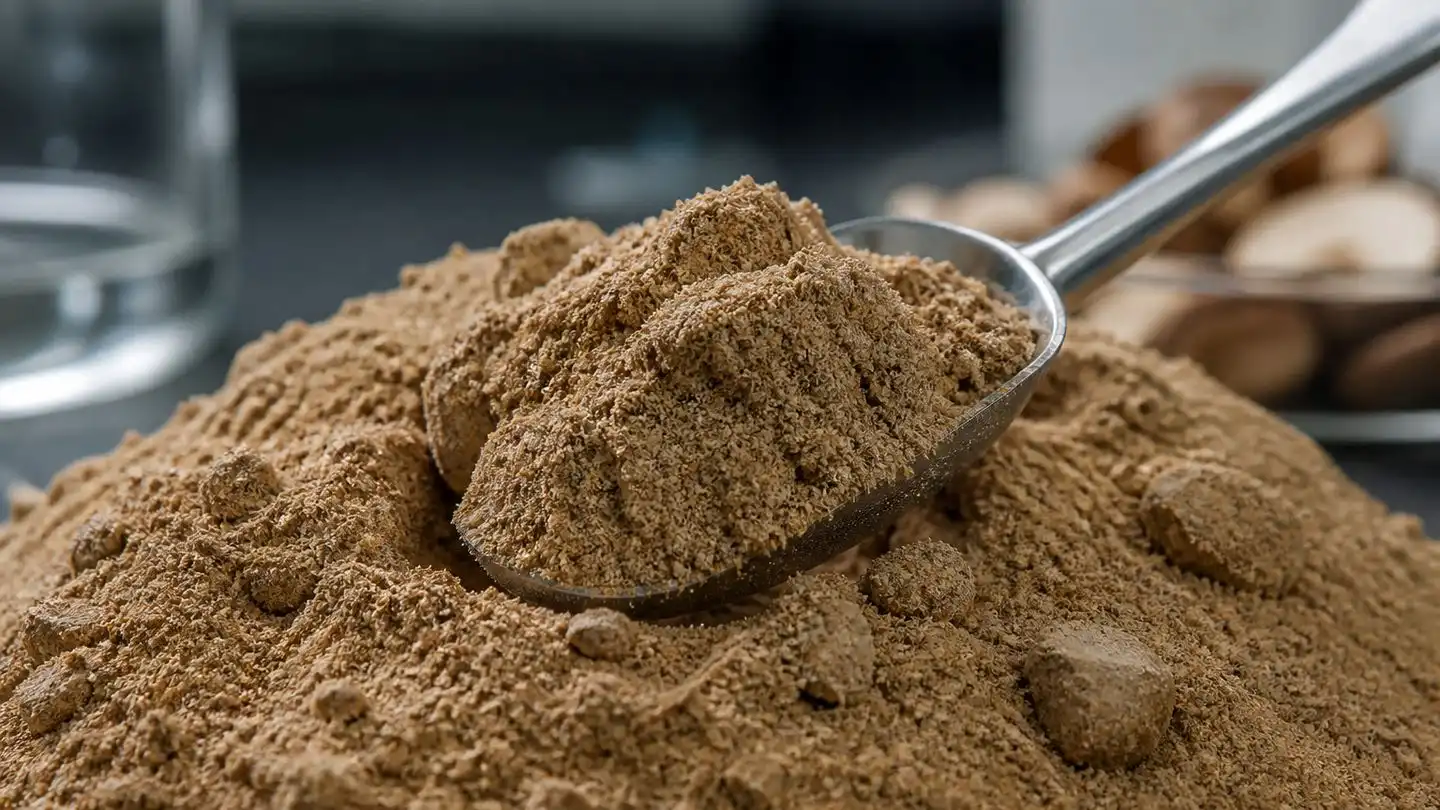
Ask Directly How the Powder Was Sterilized
Sterilization is the step buyers forget to ask about and the step that most often changes the material.
Steam, Ethylene Oxide, and Irradiation
Steam applies heat and moisture under pressure. It leaves no chemical residue and usually no labeling obligation, but the thermal load darkens the powder, pushes the aroma toward a cooked note, and can raise moisture unless the material is re-dried. Ethylene oxide works at low temperature and preserves colour well, but it is a fumigant with tightly regulated residual limits, restricted or prohibited in some jurisdictions. Irradiation reduces microbial load without heat, but it triggers labeling requirements in several markets and is not accepted by some organic standards or retail customers.
None of these routes is automatically wrong: the choice depends on destination-market rules, your customer's specification, and whether the organic certificate permits the step. What is not acceptable is not knowing which one was used.
What to Request in Writing
Ask for the method by name, the process parameters (temperature and time, dose, or gas concentration and exposure), and a statement that the step is permitted under the organic certification you rely on. For chemical or irradiation routes, request residual or dose data for the actual lot. Put the declaration into your specification so a process change requires a written deviation.
Adulteration and Downgrade Risks
- Stem and substrate inclusion. Milled stems and spent substrate raise yield cheaply. Ash rises, polysaccharide falls, and microscopy shows organised fibre rather than the looser cellular debris of cap tissue.
- Ageing stock. Old powder darkens, loses aroma, and gains moisture; colour drift against a retained reference often appears before any result moves.
- Conventional material in an organic lot. Caught only through the documentation chain, plus targeted residue screening on arrival where the risk justifies it.
- Spent extract residue. Material left after water extraction can be dried and sold as powder. It looks similar, but HPLC polysaccharide sits well below the declared figure while ash and fibre rise.
- Cross-origin blending. Two origins blended to hit a price pass assay but fail sensory and colour consistency.
The defence is a combination rather than a single test: microscopy for tissue structure, ash as a dilution proxy, an independent assay on arrival, and a colour comparison against a retained standard under fixed lighting.
Sampling and Incoming Acceptance
No specification survives a weak sampling plan. If the sample is not representative, the result describes a spoonful rather than a lot.
Define the Batch Before You Define the Test
Agree in the contract what a lot is: one production run from one raw material receipt, with one lot code, one production date, and one COA. Suppliers who aggregate several runs into one shipment code make later investigation impossible, so state the maximum lot size you accept under one COA.
Sampling, Retention, and Third-Party Cross-Check
Use a written plan: containers sampled, sample size per container, and whether the sample is composited or kept per container. Retain a sealed reference of every lot for the full shelf life plus a margin. For the first two or three lots from a new supplier, split a sample to a third-party laboratory and compare it with the supplier's COA; a consistent match builds confidence, while a consistent offset tells you which laboratory to trust later.
When the COA Does Not Match
Put an escalation path in the quality agreement before the first shipment: quarantine the lot, re-test the retained sample, request the supplier's raw data and method reference, then agree a joint third-party laboratory. Define in advance what happens to a rejected lot, who pays for confirmatory testing, and what justifies a replacement shipment rather than a credit note.
Commercial Terms, Packaging, and Documentation
Commercial terms are part of quality: packaging that does not protect the powder undermines a correct specification. Quote minimum order quantities separately for standard and custom specifications, including the volume needed for a custom mesh or assay, and agree lead time in writing for both cases.
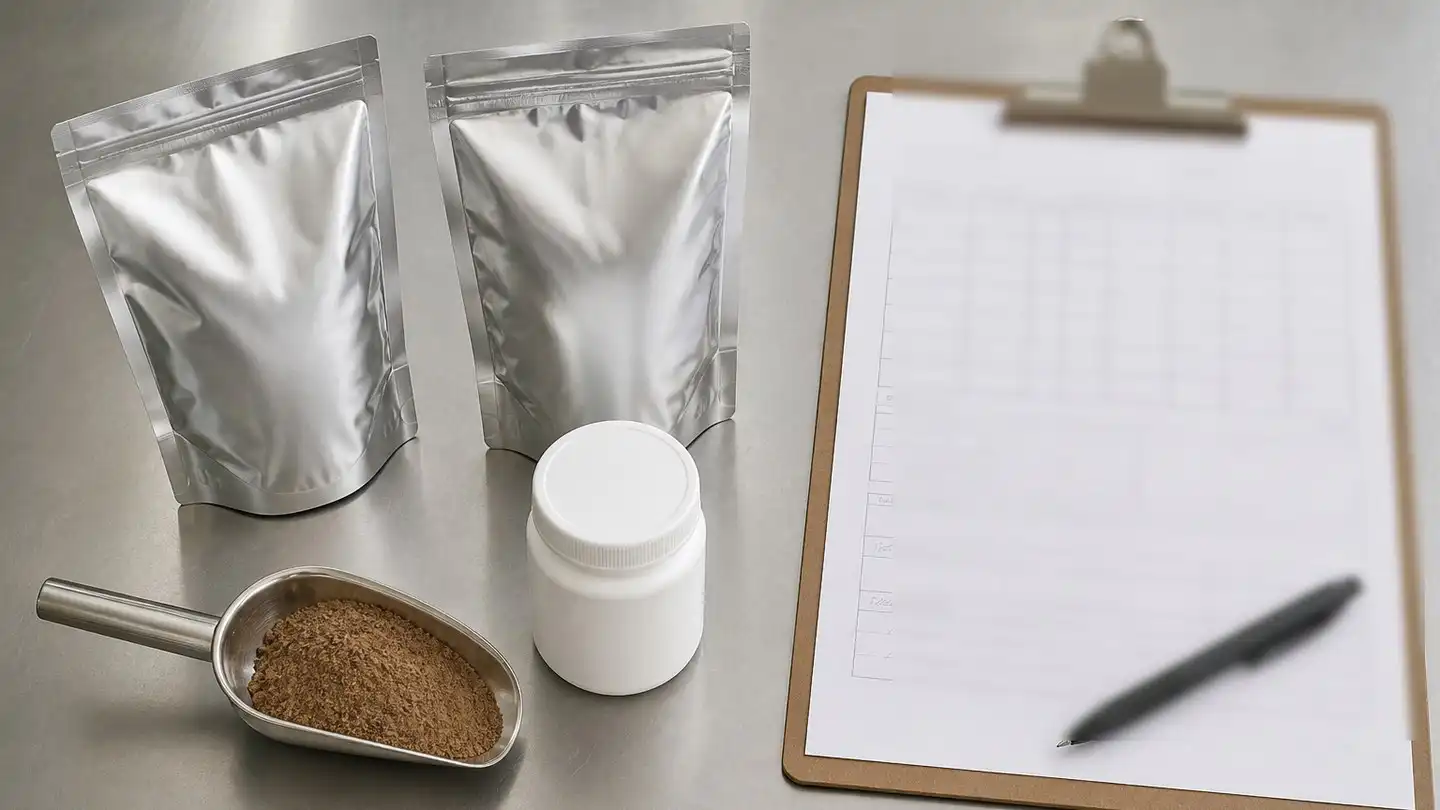
Packaging is normally offered as 1 to 5 kg aluminium foil bags for sampling and small runs, 25 kg fibre drums with an inner liner for bulk, and OEM or private-label formats where the buyer supplies artwork. Confirm the liner material and that the drum is food-grade.
Storage and transport belong in the contract, not only on the label: cool, dry, away from strong light and heat, container closed between uses. The stated shelf life for this material is two years under those conditions, which holds only if custody respects them. Ask for the production date on every drum and reject shipments whose residual shelf life at arrival is below your policy.
The document set per shipment should include the lot COA, the organic certificate and transaction certificate where an organic claim is made, the specification in force at production, a sterilization certificate, allergen and GMO statements, a country-of-origin declaration, and a packing list matching the drum codes. Missing documents are a delivery defect.
Six Capability Checks Before You Approve a Supplier
- Ownership of processing. Does the supplier run the drying and milling lines, or broker from an unidentified plant? Ask for the address and a site audit report.
- Certificate currency and scope. Are the EOS and NOP certificates current, and does the scope include the activity at the site that ships your order?
- Lot-specific documentation. Can a COA and transaction certificate tied to a specific lot code be produced within one working day?
- Analytical capability. Is HPLC assay run in-house or at a named contract laboratory, and can raw data be shared on request?
- Change control. Is there written notice before a change in origin, drying method, sterilization route, or mesh size?
- Traceability exercise. Ask them to trace one lot back from a drum code to raw material receipt and forward to customer shipments. The speed of that answer predicts how the next quality event will be handled.
Next Step: Request the Specification and a Sample
Wellgreen supplies organic shiitake mushroom powder as a brown fine powder with polysaccharide content confirmed by HPLC on each certificate of analysis, 95 percent passing 80 mesh, and solubility of 95 percent or above. We can send the specification sheet, a lot-specific COA, a sealed sample pouch, and a written sterilization declaration, and we are glad to discuss mesh, packaging, and matrix compatibility against your formulation. Write to wgt@allwellcn.com with your target specification and destination market; the certification set a supplier should evidence is summarised on our quality accreditation page.
References
U.S. Food and Drug Administration. 21 CFR Part 182 — Substances Generally Recognized as Safe. 2024.
U.S. Food and Drug Administration. 21 CFR Part 184 — Direct Food Substances Affirmed as Generally Recognized as Safe. 2024.
U.S. Department of Agriculture, Agricultural Marketing Service. National Organic Program, 7 CFR Part 205. 2024.
International Organization for Standardization. ISO 4833-1 — Microbiology of the food chain: colony count at 30 °C. 2013.
International Organization for Standardization. ISO 6579-1 — Microbiology of the food chain: detection of Salmonella spp. 2017.
International Organization for Standardization. ISO 21527-1 — Enumeration of yeasts and moulds in products with water activity greater than 0.95. 2008.
This article is intended for business-to-business ingredient sourcing and formulation discussion. It does not provide medical, nutritional, or regulatory advice for any specific product or market.